Predictive History Audit / Systematic Content Analysis
Civilization
Episode 2 · Posted 2024-09-03

Religion and the Dawn of Society

This lecture argues that religion is the fundamental characteristic that makes humans human, using Ice Age cave paintings as primary evidence. The speaker reviews three prehistoric sites from the previous lecture (Göbekli Tepe, Jericho, Çatalhöyük) and builds the case that the religious impulse -- the need to understand existence -- drove the transition to agriculture. Through analysis of cave paintings found in acoustically optimal cave locations, the lecture reconstructs a speculative animist theology involving a mother goddess, spirit worlds accessed through portals (caves, wombs, mountaintops, rivers), and shamans who mediated between worlds. Drawing on Émile Durkheim's sociology of religion and Immanuel Kant's epistemology, the speaker concludes that religion is humanity's collective consciousness, the foundation of society, and the precondition for philosophy and science.

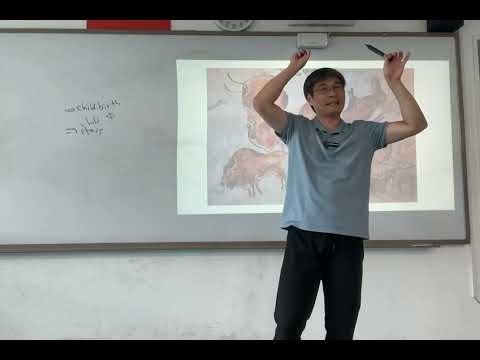
Video thumbnail
youtube.com/watch?v=x1E5rRmCiT4 ↗ Analyzed 2026-03-14 by claude-opus-4-6

Viewer Advisory

  • The lecture's interpretive framework for cave art (shamanism, portals, mother goddess) represents one scholarly tradition among several competing approaches -- it is not the consensus view despite being presented with increasing confidence.
  • The claim that prehistoric societies were egalitarian and matriarchal is heavily debated among archaeologists and anthropologists.
  • Key scholars whose ideas are being presented (Lewis-Williams, Gimbutas) are not named, making it difficult to follow up on the sources.
  • The Durkheim quotations are legitimate and well-deployed, but Durkheim's view of religion is itself one among many sociological approaches (compare Max Weber, who emphasized religion's role in meaning-making and legitimating power structures).
  • The equation of science with religion obscures the fundamental methodological differences between them.
  • The brief treatment of Marx and Darwin creates oversimplified caricatures of these thinkers' actual arguments.
  • This is one of the more epistemically honest lectures in the series, with explicit acknowledgment of uncertainty, but the caveats are front-loaded and then gradually forgotten.
Central Thesis

Religion is the fundamental defining characteristic of humanity -- it has existed since the dawn of human consciousness, it is what enabled the formation of society through shared collective imagination, and it precedes and makes possible both philosophy and science.

  • Ice Age cave paintings (30,000-40,000 years old) are expressions of religious belief, not merely artistic endeavors, evidenced by their placement in caves with optimal acoustics and the presence of musical instruments.
  • Animism -- the belief that all living things possess souls and are interconnected -- was likely the first religion, and is still found among indigenous peoples worldwide and in Buddhism.
  • Caves served as symbolic portals between the physical world and the spirit world, analogous to the womb as a portal through which souls enter our world.
  • Shamans were likely physically different or disabled individuals whom the community regarded as specially chosen by the mother goddess to communicate with the spirit world, and they may have created the cave paintings.
  • Geometric symbols found in cave paintings worldwide represent either proto-writing, the language of the spirit world accessed through psychedelics, or abstract concepts (like balance, cycle, harmony) that cannot be drawn representationally.
  • Immanuel Kant's insight that reality is constructed by the mind rather than passively perceived has been confirmed by modern neuroscience, and prehistoric use of psychedelics may have been an early exploration of this principle.
  • Émile Durkheim established that religion is fundamentally a social phenomenon -- a system of ideas by which humans imagine the society of which they are members, creating collective consciousness.
  • Humans are primarily 'religious animals' rather than merely economic animals (Marx) or biological animals (Darwin), though all three drives interact to shape human history.
  • Prehistoric societies were likely egalitarian or matriarchal, since the mother goddess was female and childbirth was considered sacred and mysterious, granting women special status.
Qualitative Scorecard 3.0 / 5.0 average across 7 axes
Historical Accuracy ▸ Expand
Basic factual claims are mostly correct: cave paintings in Chauvet, Lascaux, and Altamira exist at roughly the stated dates; Homo sapiens originated in Africa roughly 300,000 years ago; the Ice Age ended about 12,000 years ago; humans interbred with Neanderthals; world population was very small 20,000 years ago; mycorrhizal networks do facilitate tree communication. However, several claims are inaccurate or misleading: the statement that Kant wrote 'maybe over 20 years ago' (likely a transcription error for 200 years, but Kant actually wrote over 240 years ago); the claim about Altamira dating to 34,000 BCE is at the upper end of disputed dating; the characterization of Marx as arguing humans are motivated by 'the need to have money' misrepresents historical materialism; and the claim that there is 'no oxygen' in caves is incorrect (caves have oxygen, though air quality can be poor in deep passages). The archaeological evidence regarding the dwarf burial from Graeber/Wengrow appears accurately cited.
3
Argumentative Rigor ▸ Expand
The lecture builds a coherent narrative from cave paintings to animism to Durkheim's sociology of religion, and the overall argument that religion played a foundational role in human social development is well-supported in the anthropological literature. The speaker commendably acknowledges uncertainty multiple times ('there's absolutely no agreement,' 'no one knows,' 'this is my own personal interpretation'). However, the argument proceeds through speculative reconstruction presented as increasingly confident: the cave-as-womb-as-portal chain is presented as plausible, then treated as established for subsequent arguments; the leap from disabled individuals receiving elaborate burials to 'they were shamans' involves several unstated assumptions; and the claim that animism was 'probably the first religion' is treated as near-certain despite the impossibility of knowing prehistoric beliefs. The argument against humans being primarily economic or biological animals is gestured at rather than rigorously developed.
3
Framing & Selectivity ▸ Expand
The lecture is selective but less egregiously so than the Geo-Strategy series. The speaker explicitly notes that his interpretation is personal and that 'there are many different interpretations and the evidence is extremely unclear.' However, having made this caveat, the lecture proceeds to present one interpretive framework (animism, mother goddess, shamanic cave art) without seriously engaging alternatives. The strongest evidence (Graeber/Wengrow on dwarf burials, von Petzinger on symbols) is well-deployed, but counterevidence -- such as cave paintings that clearly depict hunting scenes, or evidence of violence in prehistoric societies that would complicate the egalitarian/compassionate framing -- is not discussed. The lecture selectively presents prehistoric society as harmonious and egalitarian, which aligns with a particular ideological reading of prehistory.
3
Perspective Diversity ▸ Expand
Despite the initial caveat about multiple interpretations, the lecture presents essentially one perspective throughout: a Durkheimian view of religion as collective consciousness combined with a romantic reading of prehistoric animism. Alternative scholarly interpretations of cave art (hunting magic, structuralism, information storage, social signaling) are not discussed. The Marxist and Darwinian frameworks are mentioned only to be set aside in favor of the 'religious animal' thesis. No critical perspectives on the mother goddess hypothesis are presented. The classroom format features Socratic questioning, but students' answers are steered toward the speaker's predetermined conclusions. The lecture would benefit enormously from presenting at least one serious competing interpretation of cave art.
2
Normative Loading ▸ Expand
Compared to the Geo-Strategy lectures, the normative loading here is more moderate and appropriate to the subject matter. The lecture does carry implicit normative messages -- prehistoric people were 'extremely compassionate,' animism represents ecological harmony and gender equality, modern emphasis on economics is reductive -- but these are presented with some nuance. The speaker frames religion positively as fundamental to humanity rather than as superstition, which is a normative choice but one that serves the educational goal. The framing of prehistoric egalitarianism and care for disabled individuals carries an implicit critique of modern society's treatment of the same, but this is not belabored.
3
Determinism vs. Contingency ▸ Expand
The lecture presents a somewhat deterministic narrative -- religious impulse drove agriculture, which drove civilization -- but the determinism is more structural than predictive. The speaker acknowledges uncertainty about specific interpretations while maintaining the broad thesis that religion was inevitable given human cognitive architecture. The Durkheim framework implies that religion necessarily arises from social life, which is a form of sociological determinism, but the lecture allows for the possibility that religions change when they fail to meet economic and biological needs. The brief acknowledgment that 'you might have a religion but this religion is not meeting your economic and biological needs, then you have to either abandon the religion or change the religion' introduces some contingency. However, the overall framing of prehistoric religion as harmonious animism that was later corrupted implies a fall-from-grace narrative with deterministic overtones.
3
Civilizational Framing ▸ Expand
This lecture is notably less civilizationally charged than the Geo-Strategy series. It deals with universal human prehistory rather than competing civilizations. The framing is largely universalist -- cave paintings are found 'all around the world,' animism is present in indigenous cultures worldwide, and all humans share the religious impulse. There is no ranking of civilizations or cultures. The only culturally specific reference is to Chinese medicine as an example of body-soul alignment, which is used descriptively rather than evaluatively.
4
Overall Average
3.0
Civilizational Treatment
CHINA

China is mentioned only briefly through Chinese medicine as an example of the body-soul alignment concept found in animism, presented neutrally as a surviving expression of an ancient universal belief system.

THE WEST

Western intellectual tradition is represented through Kant, Durkheim, Marx, and Darwin -- all presented respectfully as important thinkers. No civilizational critique of 'the West' is present in this lecture.

Named Sources

book
David Graeber and David Wengrow, 'The Dawn of Everything'
A passage is directly quoted/displayed on screen describing the burial of a dwarf from 10,000 years ago who received the same quality of food as others and an elaborate burial, used to argue that prehistoric peoples cared for disabled individuals and may have considered them special or shamanic.
✓ Accurate
scholar
Genevieve von Petzinger
Identified as a Canadian anthropologist who documented recurring geometric symbols in Ice Age cave paintings worldwide (hands, spirals, quadrangles, circles, asterisks), used to support the argument that cave paintings contain symbolic/linguistic elements beyond mere pictorial representation.
✓ Accurate
scholar
Immanuel Kant
Described as 'the greatest philosopher who ever lived,' his epistemological framework (reality is something the mind constructs rather than passively observes, using time and space as examples of mental categories imposed on experience) is used to support the argument that prehistoric cave painters were exploring the constructed nature of reality.
? Unverified
scholar
Émile Durkheim
Described as the founder of sociology. Multiple passages from his work on religion are quoted: 'Religion is above all a system of ideas by which men imagine the Society of which they are members'; religion creates collective thought and consciousness; religion made philosophy and science possible. Used as the theoretical backbone for the lecture's central thesis.
✓ Accurate
other
Pablo Picasso
Anecdote that Picasso visited a cave (likely Lascaux) and remarked 'we learned nothing in 10,000 years,' used to argue that prehistoric humans were artistically equal to modern humans.
? Unverified
scholar
Karl Marx
Briefly referenced as the originator of the idea that humans are 'economic animals' driven by the need for money, presented as one of three competing frameworks for understanding human nature.
? Unverified
scholar
Charles Darwin
Referenced as the inspiration for evolutionary biologists who view humans as 'biological animals' driven by the desire to spread their genes, presented as a competing framework to the lecture's religious-animal thesis.
? Unverified
other
Chauvet Cave
Referenced as containing cave paintings dating to about 30,000 years ago, showing animals (bison, lions, rhinos, horses) as part of an interconnected natural world.
✓ Accurate
other
Lascaux Cave
Referenced as containing cave paintings from about 20,000 years ago, including famous depictions of lions.
✓ Accurate
other
Altamira Cave (Spain)
Referenced as containing cave paintings dating to 34,000 BCE showing horses with non-realistic stylistic interpretation.
? Unverified

Vague Appeals to Authority

  • 'The general scholarly consensus is that what drove the transition to agriculture was the religious beliefs of the people at that time' -- no specific scholars named for this claim, which is actually highly contested.
  • 'We're fairly convinced that these paintings were part of a ritual which included music because we found musical instruments as well' -- presented as scholarly consensus without citing specific archaeologists or studies.
  • 'We believe that these two beings represent the mother goddess' -- uses collective 'we' to imply scholarly agreement on a speculative interpretation of cave art figures.
  • 'We believe that this is the first religion' -- animism described as the first religion without attribution to specific anthropological work beyond Graeber/Wengrow.
  • 'A recent discovery that we made is that trees talk to each other' -- references mycorrhizal network research without citing Suzanne Simard or other researchers who actually conducted this work.
  • 'We now know that the brain imagines reality, it projects reality' -- presented as settled neuroscience without citing specific researchers or studies.

Notable Omissions

  • No engagement with alternative theories of cave art, such as 'art for art's sake,' hunting magic (Henri Breuil), or structuralist interpretations (André Leroi-Gourhan), despite acknowledging multiple interpretations exist.
  • No mention of David Lewis-Williams' 'The Mind in the Cave,' the most influential scholarly work connecting cave art to shamanism and altered states of consciousness, despite the lecture advancing essentially the same thesis.
  • No discussion of Marija Gimbutas, whose 'goddess civilization' hypothesis is effectively being deployed without attribution, nor of critiques of the mother goddess theory.
  • No engagement with critiques of the animism-as-first-religion model, including problems with projecting modern indigenous beliefs onto prehistoric peoples.
  • No mention of the debate around whether cave paintings were created by specialists or by many community members, despite the lecture's claim they were painted by shamans.
  • No discussion of the significant scholarly debate about whether prehistoric societies were actually egalitarian or matriarchal, nor of evidence that contradicts this view.
  • The characterization of Marx as arguing humans are driven by 'the need to have money' is a significant oversimplification of historical materialism, which centers on modes of production and class relations, not individual desire for money.
Socratic leading questions 00:16:31
The speaker asks 'what in nature most resembles a womb?' and guides students to answer 'a cave,' then uses this to build the cave-as-portal-to-spirit-world interpretation.
Creates the appearance of student-driven discovery while directing the class toward a specific interpretive framework. Students feel they arrived at the conclusion independently, increasing buy-in for what is actually a speculative scholarly interpretation.
Speculative reconstruction presented as narrative 00:15:01
The speaker constructs an elaborate theology -- souls come through wombs from a spirit world, the dead return through burial, caves are portals, a mother goddess governs balance -- from fragmentary archaeological evidence of cave paintings and burials.
The narrative coherence of the reconstructed belief system makes it feel more plausible and complete than the underlying evidence warrants. Each speculative step becomes the foundation for the next, creating an internally consistent worldview that is difficult to challenge on any single point.
Appeal to empathy/imagination 00:09:30
'Let's imagine that we go back in time to this time. It's very cold and our memories have been wiped out, meaning like we've lost the knowledge of today, we've lost science.' The speaker invites students to imaginatively inhabit prehistoric consciousness.
Bypasses critical analysis by asking the audience to adopt a pre-scientific mindset, making the speculative animist theology feel intuitive and obvious rather than one of many possible interpretations of the evidence.
Authority citation 00:37:34
Kant is introduced as 'the greatest philosopher who ever lived' and Durkheim as 'the founder of sociology,' with multiple passages quoted from Durkheim's work on religion.
Leverages the authority of major intellectual figures to lend weight to the lecture's thesis. By quoting Durkheim extensively, the speaker positions his own interpretation as aligned with foundational sociological thought, making it harder for students to push back.
False dichotomy resolution 00:55:36
The speaker presents three competing views of human nature (economic/Marx, biological/Darwin, religious) and argues for the primacy of the religious view while acknowledging the others 'play together.'
Positions the lecture's thesis as a synthesis that transcends reductive alternatives, making it appear more sophisticated and complete. The competing frameworks are briefly sketched and set aside rather than seriously engaged.
Repeated comprehension checks 00:18:56
The phrase 'does that make sense' or 'does that make sense guys' appears dozens of times throughout the lecture, after nearly every major claim.
Functions as both a pedagogical tool and a rhetorical device. Each 'does that make sense' implicitly codes the preceding claim as straightforward and obvious, discouraging critical pushback. The implicit message is: if you don't agree, you didn't understand.
Evidence escalation 00:30:04
The speaker moves from cave paintings to burial practices to Durkheim to Kant, each layer presented as confirming and strengthening the previous claims, creating a cumulative sense of certainty.
The progressive layering of different types of evidence (archaeological, anthropological, philosophical, neuroscientific) creates an impression of interdisciplinary convergence on the thesis, even though each piece of evidence is individually debatable.
Personal anecdote as evidence 00:11:01
'I'm a father, I have three kids, and I can tell you when I first saw my child being born I was amazed because you have this life come out of nothing.'
Grounds the abstract claim about childbirth as a source of religious awe in personal experience, making it emotionally relatable and harder to dispute. Blurs the line between the speaker's subjective experience and what prehistoric humans would have felt.
Modern science validates ancient wisdom 00:22:03
The speaker presents mycorrhizal networks ('trees talk to each other') and neuroscience (confirming Kant) as modern validation of animist and philosophical intuitions, implying prehistoric people were right all along.
Creates a flattering narrative where ancient religious intuitions are vindicated by modern science, lending retroactive credibility to the animist worldview being presented. This elides the significant differences between animist beliefs about tree souls and scientific findings about chemical signaling through fungal networks.
Conspicuous epistemic humility 00:02:19
'There's absolutely no agreement on any of these questions... the evidence is extremely unclear... this is my own personal interpretation based on my research.'
By frontloading strong epistemic caveats, the speaker establishes credibility as a careful thinker, which makes the subsequent presentation of speculative claims with increasing confidence more persuasive. The caveat functions as a rhetorical inoculation against criticism.
⏵ 00:02:22
There's absolutely no agreement on any of these questions. Cave paintings is something that we have a lot of around the world, but there's very little evidence as to what they are, what they represent, and how they were painted.
A commendable acknowledgment of scholarly uncertainty that is rare in this lecture series. However, it functions partly as rhetorical inoculation -- having disclaimed certainty, the speaker then proceeds to present his interpretation with increasing confidence throughout the lecture.
⏵ 00:43:07
Religion is above all, first and foremost, a system of ideas by which men imagine the Society of which they are members.
Direct quotation from Émile Durkheim that serves as the theoretical foundation of the lecture. This Durkheimian framework -- religion as collective imagination of society -- is the intellectual core from which the speaker derives his central thesis.
⏵ 00:41:07
Art is basically religion. There's no difference.
Reveals the speaker's tendency toward totalizing claims. The equation of art and religion is a strong interpretive position that many art historians and anthropologists would dispute, but it is presented as a self-evident conclusion.
⏵ 00:45:57
You can say that science today is our religion. There's really no difference. It's just an understanding of the world based on our imagination and some evidence.
A provocative epistemological claim that equates scientific methodology with religious belief, differing only in having 'some evidence.' This relativization of science and religion is philosophically contentious and reflects a particular postmodern sensibility.
⏵ 00:42:19
Without religion we could not be human. We could not think. We could not communicate. We could not imagine.
The lecture's thesis statement in its strongest form. This is a Durkheimian claim about the social foundations of cognition, but stated more absolutely than Durkheim himself would have, collapsing the distinction between religion specifically and symbolic culture generally.
⏵ 00:55:38
We are first and foremost a religious animal. We have the fundamental need to understand why we are here.
The lecture's concluding thesis, positioning the religious drive as more fundamental than economic (Marx) or biological (Darwin) motivations. This framing choice shapes the entire Civilization series by placing religion rather than material conditions at the center of historical development.
⏵ 00:28:54
If you're different it doesn't mean you're less special, it means you're more special. It means that the mother goddess has given you a special power.
Reveals the lecture's idealized portrait of prehistoric society as fundamentally compassionate and inclusive, where physical difference conferred spiritual status rather than marginalization. While supported by some archaeological evidence, this romanticized framing projects modern values of inclusion onto prehistoric peoples.
⏵ 00:40:11
Back then there was no separation of sexes. If anything, women were considered superior to men.
A strong claim about prehistoric gender relations that reflects the 'goddess civilization' hypothesis associated with Marija Gimbutas, presented here without attribution and without engagement with the significant scholarly debate around this claim.
⏵ 00:39:01
What drugs do is they change the structure of your brain so that you see a different reality.
Introduces the psychedelic theory of religious origins (associated with scholars like David Lewis-Williams) without attribution. The claim that psychedelics reveal 'a different reality' rather than producing hallucinations reflects a particular philosophical stance on the nature of perception.
⏵ 00:54:58
We are motivated by our desire to spread our genes. So if I'm a man I want to sleep with as many women as possible.
A crude oversimplification of evolutionary psychology presented as a foil for the speaker's preferred 'religious animal' thesis. By presenting the biological perspective in its most reductive form, the speaker makes his own thesis appear more nuanced by comparison.
claim Future classes will show how men came to have more power than women, reversing the prehistoric egalitarian/matriarchal order.
00:40:03 · Not falsifiable
unfalsifiable
This is a pedagogical forward reference to future lecture content, not a testable prediction about world events.
prediction Neuroscience has confirmed Immanuel Kant's thesis that the brain imagines/projects reality rather than passively perceiving it.
00:38:43 · Falsifiable
partially confirmed
Neuroscience research on predictive processing (e.g., Karl Friston's free energy principle, Andy Clark's work) does support the idea that the brain actively constructs perception rather than passively receiving it. However, characterizing this as a straightforward 'confirmation' of Kant oversimplifies both Kant's philosophy and the neuroscience. Kant's noumena/phenomena distinction involves metaphysical claims that neuroscience cannot directly test.
Verdict

Strengths

The lecture is well-structured as an educational presentation on prehistoric religion and the origins of human society. It draws on legitimate scholarly sources (Durkheim, Graeber/Wengrow, von Petzinger) and presents a coherent interpretive framework. The speaker commendably acknowledges uncertainty about cave art interpretation early in the lecture. The Durkheimian framework for understanding religion as collective consciousness is academically sound and pedagogically valuable. The discussion of cave art symbols and their possible functions (proto-writing, abstract concept representation, psychedelic visions) reflects genuine scholarly debates. The lecture successfully connects archaeological evidence to broader philosophical questions about the nature of reality and human cognition.

Weaknesses

The lecture suffers from a progressive abandonment of its initial epistemic humility, as speculative interpretations are treated as increasingly certain throughout. The cave-as-womb-as-portal chain of reasoning, while creative, involves multiple unverifiable leaps. The characterization of prehistoric society as uniformly egalitarian, compassionate, and matriarchal reflects a romanticized view that ignores archaeological evidence of prehistoric violence, hierarchy, and patriarchy. Key scholars whose work the lecture effectively deploys (David Lewis-Williams on shamanism and cave art, Marija Gimbutas on goddess civilization) are not credited. The simplistic characterization of Marx as arguing humans want money, and Darwin as arguing men want to sleep with many women, creates weak strawmen for the 'religious animal' thesis to triumph over. The claim that 'there is no oxygen' in caves is factually incorrect. The equation of science with religion ('there's really no difference') is philosophically careless.

Cross-References

BUILDS ON

  • Civilization #1 (directly referenced as 'last class') -- reviewed the three prehistoric sites Göbekli Tepe, Jericho, and Çatalhöyük, and the argument that religious impulse drove the transition to agriculture.
  • References future classes in the Civilization series on monotheism, the shift from matriarchal/egalitarian to patriarchal society, neuroscience, and ritual.
This lecture represents the Civilization series at its most academically grounded -- it cites named scholars (Durkheim, Kant, Graeber/Wengrow, von Petzinger), acknowledges uncertainty, and makes no geopolitical predictions. The contrast with the Geo-Strategy series is stark: where those lectures present speculative geopolitical scenarios with high confidence, this lecture presents speculative prehistorical reconstructions with explicit caveats. The idealized portrait of prehistoric society (egalitarian, compassionate, ecologically harmonious) may serve as an implicit contrast to the cynical realpolitik of the Geo-Strategy lectures, suggesting a fall-from-grace narrative running through the broader curriculum. The speaker's pedagogical method (Socratic questioning, leading students to predetermined conclusions) is consistent across both series.