Predictive History Audit / Systematic Content Analysis
Civilization
Episode 33 · Posted 2025-02-25

The Rise and Fall of the Byzantine Empire

This lecture examines the Byzantine Empire through three questions: why Constantine moved the capital from Rome to Byzantium, how the empire endured for over a thousand years, and why it ultimately fell. The speaker first presents the scholarly consensus (strategic defensibility, geographic centrality, proximity to Persian threat) then offers his own theory: that Constantine's move was primarily a cultural revolution, enabling a shift from pagan/Roman/republican culture to Christian/multicultural/imperial bureaucratic culture. The lecture develops extended comparisons between pagan and Christian worldviews (covering truth, evil, individualism) and between republican and imperial political systems, arguing that bureaucracies inevitably ossify into corruption, stagnation, and conformity. The speaker concludes that multicultural bureaucratic empires are inherently less creative than tribal societies.

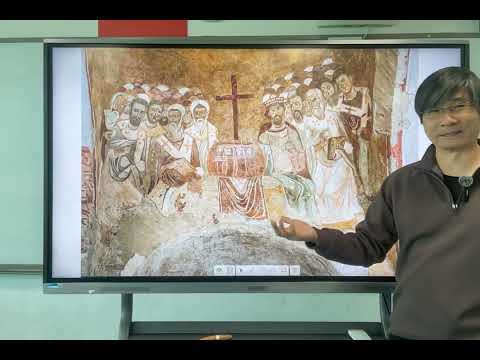
Video thumbnail
youtube.com/watch?v=abs6z7VPEMc ↗ Analyzed 2026-03-14 by claude-opus-4-6

Viewer Advisory

  • The claim that the Byzantine Empire was 'not very creative' contradicts extensive scholarly evidence and even the speaker's own praise of Byzantine achievements like the Hagia Sophia.
  • The argument that multicultural societies are inherently less creative than tribal ones is a sweeping generalization contradicted by many historical and contemporary examples.
  • The speaker's description of bureaucratic pathologies — controlling schools, media, history, and thought — applies most precisely to modern China, where he teaches, creating an unacknowledged irony.
  • The reinterpretation of the Holy Trinity as a 'bureaucratic invention' is presented without historical evidence and would not be accepted by theologians or church historians.
  • The speaker dismisses the scholarly consensus as 'superficial' without engaging with the actual arguments of professional Byzantine historians.
  • The binary framework (pagan/Christian, tribal/multicultural, republic/empire) oversimplifies complex historical realities that existed on spectrums with many hybrid forms.
Central Thesis

Constantine's move from Rome to Byzantium was fundamentally a cultural revolution — not merely a strategic relocation — that enabled a shift from pagan, Roman, republican culture to Christian, multicultural, imperial bureaucratic culture, which gave the empire longevity but at the cost of creativity and dynamism.

  • The scholarly consensus that Constantine moved the capital for purely strategic reasons (defensibility, centrality, proximity to Persia) is superficial; the deeper motivation was to escape Roman cultural traditions that resisted imperial centralization.
  • The Byzantine Empire was culturally a radical departure from the Roman Republic/Empire: it was Christian rather than pagan, Greek-speaking and multicultural rather than Roman, and bureaucratic-imperial rather than republican.
  • The pagan worldview centered on gods as metaphors for nature, fate/fortune as higher forces, and community/action as supreme values, while Christianity introduced truth, evil, and the individual — fundamentally different organizing principles.
  • Republics are inherently more innovative and creative than empires because they are egalitarian and open, while imperial bureaucracies produce centralization (leading to corruption), systematization (leading to stagnation), and standardization (leading to conformity).
  • Multicultural/cosmopolitan societies like the Byzantine Empire, modern Singapore, and Canada are less creative than tribal societies like the ancient Greeks, Vikings, and Europeans, because tribalism produces energy and passion while multiculturalism requires conformist self-censorship.
  • The Holy Trinity (Godhead) doctrine was essentially a bureaucratic invention designed to create mystery, distance, and secrecy — hallmarks of bureaucratic control.
  • Imperial bureaucracies triumph over competing institutions (court, nobility, military, church) by monopolizing status/mobility, information/censorship, and narrative/literacy.
Qualitative Scorecard 2.3 / 5.0 average across 7 axes
Historical Accuracy ▸ Expand
The broad chronological framework is correct: Constantine founded Constantinople in 330, the Council of Nicaea in 325, Theodosius made Christianity the state religion, the Theodosian Walls made the city nearly impregnable, Justinian and Belisarius reconquered much of the Western Mediterranean, the Justinianic Plague devastated the population, and the Ottomans conquered the city in 1453 using cannons. However, several claims are inaccurate or misleading: the inventor of Greek Fire is traditionally identified as Callinicus, a Syrian Greek refugee, not a 'Hellenized Jew who converted to Christianity'; the speaker conflates the Theodosian Walls (built by Theodosius II in the 5th century) with Theodosius I (who made Christianity official); the claim that Marcus Brutus was Caesar's 'biological son' is ancient gossip, not established fact; the description of Greek Fire as 'basically kerosene' significantly understates the sophistication of this weapon; and the claim that the Byzantines were 'not very creative' is contradicted by their own Hagia Sophia, which the speaker praises, and by extensive scholarship on Byzantine intellectual and artistic achievements.
3
Argumentative Rigor ▸ Expand
The central argument — that Constantine's move was primarily cultural rather than strategic — is presented assertively but supported only by analogy (a school consultant who would be 'fired within a week' for challenging institutional culture). No primary source evidence is offered for Constantine's cultural motivations. The argument that multicultural societies are less creative than tribal ones relies on cherry-picked examples (Singapore, Canada as 'bland'; Greeks, Vikings as 'creative') while ignoring counterexamples (cosmopolitan Renaissance cities, the Abbasid Caliphate, Tang Dynasty). The claim that the Holy Trinity is a 'bureaucratic invention' is presented without theological or historical evidence — it ignores centuries of genuine theological debate. The dichotomy between republic-as-creative and empire-as-stagnant oversimplifies vastly: the Roman Republic was highly hierarchical and conservative, while several empires produced extraordinary cultural achievements.
2
Framing & Selectivity ▸ Expand
The lecture is highly selective in its evidence. The speaker positions the scholarly consensus as 'superficial and shallow' before presenting his own theory, but does not engage seriously with the evidence supporting the consensus. The Byzantine Empire's extensive achievements in law, theology, art, architecture, and diplomacy are dismissed with the sweeping claim that Byzantines were 'not very creative.' Examples supporting the multicultural-societies-are-bland thesis are cherry-picked (Singapore, Canada) while counterexamples (New York, London, Renaissance Venice, Abbasid Baghdad) are omitted. The comparison of pagan and Christian worldviews selectively highlights aspects that support the narrative (pagans = action/community, Christians = passivity/individualism) while ignoring the Crusades, Christian monasticism's preservation of learning, and the considerable violence within Christian civilization.
2
Perspective Diversity ▸ Expand
The lecture presents essentially one perspective — the speaker's own contrarian interpretation — positioned against a briefly summarized 'scholarly consensus' that serves as a straw man. No alternative scholarly viewpoints are seriously engaged. The pagan vs. Christian comparison is presented as a binary with no acknowledgment of the many intermediate positions, syncretic traditions, or internal diversity within each tradition. The student question from 'Duck' about Greek cultural pull is the only moment where an alternative perspective surfaces, and it is quickly absorbed into the speaker's framework. No Byzantine, Turkish, or Orthodox Christian perspectives on the empire's legacy are considered.
2
Normative Loading ▸ Expand
The lecture maintains a relatively academic tone for most of its duration, with the speaker explicitly cautioning against cultural arrogance ('it's easy for us to be culturally arrogant and say we are so better than these ancients'). However, normative judgments are embedded throughout: bureaucracies 'suck,' 'they dehumanize you'; multicultural societies are 'bland,' 'conformist,' 'bureaucratic'; tribal societies are 'energetic,' 'passionate.' The characterization of the Godhead as a 'bureaucratic invention' carries significant normative weight. The food comparison (American hamburgers vs. Chinese malatang) attempts even-handedness but is somewhat condescending. The overall normative loading is moderate — less than the Geo-Strategy lectures but still present.
3
Determinism vs. Contingency ▸ Expand
The lecture presents a strongly deterministic framework. Bureaucracies inevitably ossify: centralization leads to corruption, systematization leads to stagnation, standardization leads to conformity. This is presented as an iron law applicable across all empires. The Byzantine Empire's fate is presented as structurally predetermined by its cultural choices (Christian, multicultural, bureaucratic). No room is given for contingent events — the Fourth Crusade, specific emperors' decisions, technological changes, or geopolitical shifts — that might have altered the trajectory. The brief mention that the Ottomans' siege cannons enabled the conquest of Constantinople is the only nod to contingent factors.
2
Civilizational Framing ▸ Expand
The lecture employs broad civilizational categories (pagan vs. Christian, tribal vs. multicultural, republican vs. imperial) that flatten enormous internal diversity. The characterization of entire civilizations as 'creative' or 'bland' based on their political structure is reductive. The claim that multicultural societies produce conformity while tribal societies produce genius is a form of civilizational essentialism that mirrors problematic frameworks like Huntington's 'Clash of Civilizations.'
2
Overall Average
2.3
Civilizational Treatment
CHINA

China is mentioned twice: first, positively, as having 'natural boundaries' that the Roman Empire lacked (implying geographic advantage); second, as a paradigmatic example of a bureaucratic empire where 'everyone wants to be a bureaucrat' because that is the mechanism for social mobility. The latter reference is used to illustrate the pathology of bureaucratic societies — China as cautionary example of how bureaucracy monopolizes status. The speaker does not explicitly critique China but his framework (bureaucracy = corruption, stagnation, conformity) implicitly characterizes Chinese civilization as stagnant.

UNITED STATES

The United States is mentioned only in passing through the example of the US Census categorizing all Asians together as 'Asian-American,' used as an illustration of bureaucratic indifference to cultural diversity. America's food culture (hamburgers, Coca-Cola, french fries) is described as something 'we'd be disgusted by.' No broader characterization of American civilization.

RUSSIA

Russia is mentioned briefly and neutrally as deriving from the Rus (Vikings) and as geographically connected to Constantinople via the Black Sea. No characterization of Russian civilization beyond this etymological note.

THE WEST

Western civilization is implicitly characterized as the product of the tension between pagan/tribal/republican culture (creative, dynamic) and Christian/multicultural/bureaucratic culture (stable but stagnant). The lecture frames Western history as a dialectic between these forces, with the Byzantine shift to Christianity and bureaucracy as a pivotal moment that traded creativity for longevity.

Named Sources

primary_document
Homer / The Iliad
Referenced extensively to illustrate the pagan worldview: Achilles choosing a short glorious life over a long obscure one, and Hector refusing to retreat behind Troy's walls out of shame. Used to demonstrate that action and community were supreme pagan values.
✓ Accurate
primary_document
Virgil / The Aeneid
Mentioned as sponsored by Augustus Caesar in response to Greek cultural hegemony, and as part of the classical canon the Byzantines had access to but failed to build upon creatively.
✓ Accurate
primary_document
Augustine / City of God
Referenced for Augustine's condemnation of Lucretia's suicide as a sin against God, used to illustrate the Christian shift from community-based shame culture to individual-based sin culture.
✓ Accurate
scholar
Friedrich Nietzsche
Briefly referenced as a thinker who believed the shift from paganism to Christianity was 'a major setback' for civilization. Promised for later treatment in the semester.
✓ Accurate
primary_document
Council of Nicaea (325 AD)
Presented as establishing the Holy Trinity doctrine, which the speaker reinterprets as a bureaucratic invention designed to create mystery and secrecy rather than a genuine theological resolution.
? Unverified
other
Mucius Scaevola legend
Retold as an illustration of the Roman/pagan ethic of action: Mucius attempts to assassinate the Etruscan king despite 50/50 odds, then burns his own hand to demonstrate Roman fearlessness.
✓ Accurate

Vague Appeals to Authority

  • 'Modern historians believe it came from the steppes' — regarding the origin of the Justinianic Plague, no specific historians named.
  • 'Even today scholars debate where this plague came from' — vague appeal to ongoing scholarly debate without citing participants.
  • 'Historians refer to the Eastern Roman Empire as the Byzantines' — accurate but presented without nuance about the historiographic debate over this naming convention.
  • 'We believe Marcus Brutus was actually his biological son' — presented as scholarly consensus when it is actually a debated ancient rumor.
  • 'This is all pretty basic stuff, this is stuff you can find on the internet, on Wikipedia' — used to dismiss the scholarly consensus before presenting the speaker's own contrarian interpretation.

Notable Omissions

  • No engagement with major Byzantine historians such as Procopius, Anna Comnena, or Michael Psellus, despite the lecture being about Byzantium.
  • No mention of Justinian's legal code (Corpus Juris Civilis), one of the Byzantine Empire's most consequential and creative contributions to civilization.
  • No discussion of Byzantine art, iconography, or the Iconoclast controversy, which directly bears on the lecture's themes of bureaucratic control of culture.
  • No engagement with Edward Gibbon's 'Decline and Fall of the Roman Empire,' the foundational Western treatment of this topic.
  • No mention of the Crusades, particularly the Fourth Crusade (1204) which sacked Constantinople — a major factor in Byzantine decline.
  • No discussion of the theme system (military-administrative reorganization) that was key to Byzantine survival.
  • The claim that Byzantine civilization was 'not very creative' ignores Byzantine contributions in architecture (Hagia Sophia, which the speaker himself praises), mosaic art, manuscript preservation, theological philosophy, diplomatic innovation, and legal codification.
  • No discussion of Peter Brown, Averil Cameron, or other leading scholars of late antiquity who have fundamentally reshaped understanding of the Roman-to-Byzantine transition.
  • The multicultural-societies-lack-creativity claim ignores obvious counterexamples: Renaissance Florence/Venice (highly cosmopolitan), Golden Age Baghdad (the Abbasid Caliphate the speaker himself mentions), Tang Dynasty China, and modern-day United States.
Thought experiment / analogy 00:27:32
The speaker uses an extended analogy comparing Constantine's cultural challenge to a school consultant trying to change an institution's culture: 'If I tried that I'd be fired within a week... the only thing I can really do is switch schools and build my own school.'
Makes the abstract question of imperial cultural reform feel immediately relatable to students, but also vastly oversimplifies the comparison between managing a school and restructuring a world empire, making the conclusion seem more self-evident than it is.
Dismissal of scholarly consensus 00:31:08
The speaker characterizes the scholarly view that the Byzantine Empire was a continuation of Rome as 'only a superficial and shallow understanding,' then says the standard explanations for Constantinople's founding are 'all pretty basic stuff you can find on Wikipedia.'
Positions the speaker's own interpretation as deeper and more sophisticated than mainstream scholarship without actually engaging with the arguments of professional historians. The Wikipedia dismissal implies that centuries of historiographic debate can be reduced to basic encyclopedia content.
False dichotomy 00:29:41
The entire lecture is structured around binary oppositions: pagan vs. Christian, republic vs. empire, tribal vs. multicultural, creative vs. bland. No intermediate positions, hybrid forms, or exceptions are considered.
Creates a tidy analytical framework that appears explanatory but forces complex historical realities into oversimplified categories. The student is left with a clean model that doesn't reflect the messy reality of historical change.
Cherry-picked examples 00:59:57
To support the claim that multicultural societies lack creativity, the speaker cites Singapore and Canada as 'bland' and 'conformist,' while citing Greeks and Vikings as creative tribal societies.
The examples are carefully selected to support the thesis while ignoring obvious counterexamples: cosmopolitan Renaissance Florence, multicultural Tang Dynasty China, modern multicultural New York/London as creative powerhouses, or tribal societies that produced little notable cultural output.
Provocative reinterpretation 00:57:14
The speaker reinterprets the Holy Trinity as a 'bureaucratic invention' designed to create 'mystery, distance, and secrecy' rather than a genuine theological doctrine.
This striking claim captures student attention and positions the speaker as an iconoclastic thinker willing to challenge sacred ideas, but it is presented without any supporting evidence from theology, church history, or primary sources on the Council of Nicaea.
Vivid historical storytelling 00:37:13
Extended retelling of the Mucius Scaevola legend — swimming the Tiber, the 50/50 gamble, killing the secretary, burning his hand before the king — to illustrate the pagan ethic of action.
The vivid narrative makes the abstract concept of 'pagan worldview' concrete and memorable, but the legend is presented as representative of an entire civilizational worldview rather than as a specific mythological story that served particular ideological functions in Roman culture.
Cultural relativism as rhetorical tool 00:45:17
The speaker argues that ancient pagans would view modern people as 'slaves' — 'Achilles is out winning glory on the beaches of Troy while we are in school memorizing useless facts so that we can get useless pieces of paper so that we can make useless pieces of money.'
Uses cultural relativism to challenge students' assumptions about progress, making the pagan worldview seem attractive and the modern world seem degraded, which serves the broader argument that the shift to Christianity was not unambiguously positive.
Institutional critique by analogy 00:58:58
The US Census categorizing all Asians together as 'Asian-American' is used to illustrate how bureaucracies categorize people 'almost randomly or indifferently,' dehumanizing individuals.
Makes the abstract critique of imperial bureaucracy feel immediate and personal to Asian students in the classroom, building emotional buy-in for the anti-bureaucracy thesis through lived experience.
Socratic leading 01:02:47
The speaker asks questions whose answers he has already determined: 'Does that make sense to you guys?' 'Was this clear?' 'Any questions?' — always before moving to his next predetermined point.
Creates the appearance of collaborative inquiry while maintaining unidirectional information flow. Students are positioned as passive recipients who should confirm understanding rather than challenge the framework.
Scope hedging with overreach 00:31:45
The speaker repeatedly acknowledges he is making 'generalizations' and presenting a 'simplified version,' but then makes sweeping civilizational claims (multicultural societies are bland, tribal societies are creative) without qualification.
The hedging language provides rhetorical cover ('I said it was a generalization') while the actual claims are presented with full conviction, leaving students with the strong claims rather than the qualifications.
⏵ 00:31:02
Historians today argue the Byzantine Empire is continuation of the Roman Empire but that's only a superficial and shallow understanding. Culturally the Byzantine Empire was a radical departure from the Roman Empire.
Reveals the speaker's characteristic pattern of dismissing scholarly consensus as superficial before presenting his own interpretation as deeper. This framing recurs across the Predictive History series.
⏵ 00:56:43
They control the schools, they control the media, they control history writing, they control how you think.
The speaker describes how imperial bureaucracies monopolize narrative and suppress alternative viewpoints, presented as a critique of Byzantine-style governance.
This description of bureaucratic control over schools, media, history, and thought is an almost perfect description of contemporary China's Communist Party apparatus. The speaker, who teaches in China and generally treats Chinese civilization favorably, does not note this parallel. China's censorship regime, state-controlled media, patriotic education campaigns, and restrictions on historical discussion (Tiananmen, Cultural Revolution, Tibet) match this description far more precisely than the Byzantine bureaucracy he is nominally critiquing.
⏵ 00:59:44
Multicultural societies are not as creative as tribal societies... Singapore is a multicultural society, Canada is a multicultural society. They're not very creative guys, they're very bland, they're very conformist, they're very bureaucratic.
This is the lecture's most sweeping and controversial claim — that multiculturalism inherently suppresses creativity. It reveals a preference for cultural homogeneity that sits uneasily with the speaker's own cosmopolitan position as a Chinese-Canadian educator.
The speaker criticizes multicultural societies as 'bland' and 'conformist' while praising tribal societies as creative, yet China — which he generally treats favorably — is one of the most ethnically homogeneous major countries (92% Han Chinese) and is simultaneously one of the most bureaucratically conformist societies on earth. If multiculturalism produces blandness, China's relative homogeneity should produce creativity by his logic, but China's modern cultural output is heavily constrained by the very bureaucratic apparatus he describes.
⏵ 01:01:35
If you had a genius like Homer or Dante living in the Byzantine Empire, well he would just become a bureaucrat. We would never know the genius of Homer and Dante.
Encapsulates the speaker's thesis that bureaucratic empires absorb and neutralize creative talent. A striking claim that ignores the many creative figures who emerged from bureaucratic systems throughout history.
This claim that bureaucratic empires absorb geniuses into the bureaucracy applies powerfully to modern China, where the gaokao system channels the most talented individuals into state-approved career paths, and where writers, artists, and filmmakers face censorship that constrains creative expression. The speaker does not note this parallel despite its direct relevance to his Chinese students' lived experience.
⏵ 00:03:56
The only thing they can really agree on is to be corrupt together.
A pithy characterization of aristocratic committee governance in Rome, revealing the speaker's cynical view of elite consensus politics that recurs throughout his analysis of political systems.
⏵ 00:57:17
The idea of the Godhead, it's really a bureaucratic invention... to create a sense of mystery and distance and secrecy, and that my friends is a definition of a bureaucracy.
The most iconoclastic claim in the lecture — reinterpreting a central Christian doctrine as a tool of bureaucratic control. Reveals the speaker's materialist/functionalist approach to religion, where theological ideas are explained by political utility rather than genuine belief.
⏵ 00:45:17
Achilles is out winning glory on the beaches of Troy while we are in school memorizing useless facts so that we can get useless pieces of paper so that we can make useless pieces of money.
A rhetorically powerful moment where the speaker uses the pagan worldview to critique modern education and capitalism. Notable for being delivered to students who are literally 'in school memorizing facts' — the speaker includes himself in the critique, creating complicity with the audience.
⏵ 00:37:55
Fortune favors the bold. So he's like 50 is great, it's great odds, I'm never getting better odds.
Used to illustrate the pagan ethic of action through Mucius Scaevola. The speaker's enthusiasm for this worldview reveals his own values: preference for boldness and action over caution and deliberation.
⏵ 01:01:16
Even though they had access to every culture in the world, even though they had access to the classics like Plato, Homer, Herodotus as well as Virgil, they were not that creative.
A sweeping dismissal of Byzantine cultural achievement that ignores the empire's own extraordinary artistic, architectural, legal, and theological contributions — some of which (Hagia Sophia) the speaker himself praised minutes earlier.
The claim that having access to the world's knowledge doesn't guarantee creativity could be applied to modern China, which now has extensive access to global culture and technology but whose creative output in film, literature, and art is constrained by state censorship and bureaucratic conformity — precisely the dynamic the speaker describes for Byzantium.
⏵ 00:44:41
It's easy for us to be culturally arrogant and say like we are so better than these ancients, but it's all a matter of perspective.
One of the lecture's more genuinely thoughtful moments — the speaker advocates cultural humility and warns against presentist bias. This sits in tension with his own sweeping judgments about which civilizational types are 'bland' vs. 'creative.'
Verdict

Strengths

The lecture provides a genuinely engaging and accessible introduction to Byzantine history for what appears to be a high school or university audience. The comparison of pagan and Christian worldviews, while oversimplified, gives students a useful framework for understanding a fundamental cultural transition. The use of vivid historical narratives (Mucius Scaevola, Hector, Lucretia) makes abstract concepts concrete and memorable. The analysis of bureaucratic dynamics (centralization → corruption, systematization → stagnation, standardization → conformity) contains real insight applicable across historical contexts. The speaker's willingness to advocate cultural relativism and challenge students to question modern assumptions about progress is pedagogically valuable.

Weaknesses

The lecture suffers from significant oversimplification and selective evidence. The central claim that multicultural societies are inherently less creative than tribal ones is contradicted by numerous counterexamples the speaker himself should know (Renaissance Florence, Abbasid Baghdad, Tang Dynasty). The dismissal of Byzantine creativity ignores the empire's extraordinary contributions to law, art, architecture, and intellectual preservation — including the Hagia Sophia the speaker himself praises. The reinterpretation of the Holy Trinity as a 'bureaucratic invention' is presented without any supporting evidence. The scholarly consensus is dismissed as 'superficial' without serious engagement. The pagan-vs-Christian binary flattens enormous internal diversity within both traditions. The speaker's own framework of bureaucratic control (monopolizing information, schools, media, history writing) applies most directly to modern China, an irony that is never acknowledged.

Cross-References

BUILDS ON

  • Previous Civilization lectures on the Roman Empire (referenced: 'as we discussed last class' regarding the contradiction between empire and republic)
  • Earlier lecture on the Iliad and Homer (referenced: 'you weren't here for my lecture on the Aeneid')
  • Previous semester's lectures on the Council of Nicaea (referenced: 'we talked about this last semester')
  • Earlier Civilization lectures on Greek civilization and the pagan worldview

CONTRADICTS

  • The speaker's praise of Constantinople as multicultural and tolerant ('Jews, Christians, Muslims were all treated with extreme tolerance') contradicts his later claim that multicultural societies are 'bland' and 'conformist' — Constantinople was arguably the most creative city in the medieval world precisely because of its multiculturalism.
This lecture continues a pattern observed across the series where the speaker positions himself against scholarly consensus ('superficial and shallow') to present his own framework. The lecture's themes of bureaucratic ossification, empire vs. republic, and the costs of multiculturalism connect to recurring concerns in the Geo-Strategy series about American imperial decline and Chinese bureaucratic governance, though the connections are left implicit rather than explicit. The anti-bureaucratic framework presented here is notable because it could be read as a veiled critique of Chinese governance (monopoly on literacy, information control, narrative control), though the speaker never makes this connection explicit. The lecture also sets up future topics (Vikings, Holy Roman Empire, Mongols, Renaissance) suggesting this is part of a carefully structured curriculum.