Predictive History Audit / Systematic Content Analysis
Civilization
Episode 34 · Posted 2025-02-27

The Useful Fiction of the Holy Roman Empire

This lecture examines the creation of the Holy Roman Empire in 800 AD when Charlemagne was crowned by Pope Leo III, using Voltaire's famous observation that it was 'neither holy, nor Roman, nor an Empire' as an organizing framework. The speaker argues that Europe's geography — lacking the rivers, temperate climate, and natural boundaries that enabled other great civilizations — made military unification impossible, requiring instead legitimacy-based governance. The lecture presents an unorthodox history of the Catholic Church as a political instrument created by Paul of Tarsus to resolve Jewish-Roman conflict, which later became the primary mechanism for assimilating barbarian migrants into Roman civilization. Augustine's City of God is presented as the intellectual blueprint for the Holy Roman Empire, which the speaker characterizes as a 'useful fiction' that served the mutual interests of kings and popes in conferring legitimacy, unity, and differentiation across a divided Europe.

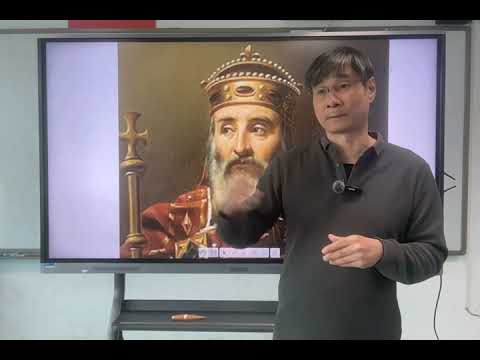
Video thumbnail
youtube.com/watch?v=1dwvgtc7XzY ↗ Analyzed 2026-03-14 by claude-opus-4-6

Viewer Advisory

  • The speaker's interpretation of early Christianity as a political project by Paul of Tarsus is one heterodox scholarly position, not established historical consensus — mainstream scholarship offers a far more complex picture.
  • The claim that Paul was 'backed by the Roman State' is unsupported by and contradicted by primary sources.
  • The geographic determinism framework, while containing genuine insights, oversimplifies civilizational development by ignoring cultural, technological, and contingent factors.
  • The lecture presents the speaker's interpretations with the same confidence as established facts, making it difficult for students to distinguish between scholarly consensus and speculative readings.
  • The rich scholarly literature on Christianization (Stark, Brown, MacMullen, Ehrman) is entirely absent, giving the impression that the speaker's materialist reading is the only serious alternative to the 'official' Church history.
Central Thesis

The Holy Roman Empire was a deliberately constructed 'useful fiction' — a legitimacy mechanism created through the alliance of Charlemagne and Pope Leo III to serve their mutual political interests in a Europe that could not be unified by military force alone.

  • Europe's geography — mountainous interior, high latitude, lack of major rivers, absence of natural external boundaries — made it fundamentally different from other cradle civilizations (Egypt, Mesopotamia, Indus Valley, China) and prevented military unification.
  • The Catholic Church originated not as a miraculous religious movement but as a political alliance between assimilationist Jews (led by Paul of Tarsus) and the Roman state, designed to pacify Jewish resistance by redirecting messianic expectations toward peace and forgiveness rather than military victory.
  • Christianity spread through the Roman Empire primarily because it served as an assimilation mechanism for barbarian migrants, analogous to how churches serve immigrant communities in modern America.
  • New religious converts are the most fanatical believers due to sunk cost fallacy — having given up their previous community and identity, they become fully committed to justify their investment.
  • Augustine's City of God provided the intellectual framework for the Holy Roman Empire approximately 400 years before it was established, demonstrating the 'power of ideas' in shaping history.
  • The Holy Roman Empire functioned as a confederation, not a true empire, because the emperor was elected by prince-electors and could not enforce his will without their cooperation.
  • The Catholic Church served as a 'freelance imperial bureaucracy' for Europe, providing cultural unity and administrative infrastructure (through local priests) in the absence of centralized political authority.
Qualitative Scorecard 2.7 / 5.0 average across 7 axes
Historical Accuracy ▸ Expand
The broad historical framework is generally correct: Charlemagne was crowned in 800 by Leo III, the HRE was elective rather than hereditary, the Great Schism occurred around 1054, and the geographic constraints on European unification are real. However, several claims are inaccurate or misleading. The claim that Charlemagne 'was the first to introduce the idea of armored knights' oversimplifies — heavy cavalry with stirrups predated Charlemagne, and the classical knight as understood in medieval culture developed over centuries after him. The claim that King David 'sponsored the writing of the Bible' is anachronistic and contested — most scholars date the Hebrew Bible's composition and compilation across centuries, with much of it postdating David. The characterization of Paul of Tarsus as 'backed by the Roman State' when founding Christianity lacks evidence; Paul was in fact imprisoned and executed by Rome. The claim that the Nicene Creed was imposed through 'military expeditions' by Constantinople conflates several distinct episodes of theological enforcement across centuries. The date of 212 AD for the Caracalla edict is correct.
3
Argumentative Rigor ▸ Expand
The lecture has a clear central argument — the HRE as 'useful fiction' — and supports it with a logical chain: Europe's geography prevented military unification → legitimacy was required instead → the Church provided legitimacy → Charlemagne and Leo III exploited this dynamic. This is a defensible and well-structured argument. However, the interpretation of early Christianity as a deliberate political project by Paul is presented as historical fact rather than one contested scholarly interpretation among many. The analogy between barbarian migrants converting to Christianity and Chinese students joining churches in modern America is creative but somewhat anachronistic. The sunk cost fallacy explanation for religious fanaticism among converts, while psychologically interesting, is presented without evidence and ignores alternative explanations (genuine spiritual experience, social selection effects). The lecture's strength is its structural analysis of legitimacy; its weakness is treating speculative interpretations as settled history.
3
Framing & Selectivity ▸ Expand
The lecture is moderately selective. The speaker explicitly distinguishes between 'the official history of the Catholic Church' and 'my understanding of the history,' which is commendable transparency. However, the alternative presented is treated as the definitive corrective rather than one interpretation among several. The materialist/political explanation for Christianity's spread is presented without acknowledging the genuine scholarly debate about the relative roles of spiritual appeal, social networks, demographic factors, and political patronage. The treatment of Paul of Tarsus as a cynical political operator ignores the extensive evidence of genuine theological conviction in his letters. The geographic determinism framework selectively emphasizes factors that support the thesis while omitting counter-evidence (e.g., the Rhine and Danube were major European rivers that served many of the functions described for other civilizations).
3
Perspective Diversity ▸ Expand
The lecture presents essentially two perspectives — the 'official' Catholic history (dismissed as miracle-based) and the speaker's materialist/political interpretation (presented as the correct one). No intermediate positions are explored. The rich scholarly debate about Christianization (Stark's sociological model, Brown's emphasis on elite conversion, MacMullen's focus on coercion) is entirely absent. The lecture does not consider perspectives from Eastern Orthodox Christianity on the Great Schism, nor does it engage with Jewish historiography on the Roman-Jewish wars and the relationship between Judaism and early Christianity. Student questions are used pedagogically but do not introduce genuinely alternative viewpoints.
2
Normative Loading ▸ Expand
The lecture is moderately normatively loaded but less so than the Geo-Strategy lectures. The description of the United States as 'humanity's greatest Empire' carries evaluative weight, though it's deployed in service of a geographic comparison rather than a political argument. The characterization of the Catholic Church as 'basically an elite social club for Jews and Romans' is reductive and normatively loaded. The description of barbarians as people who 'worship war' and 'worship violence' is a stereotype presented as fact. However, the overall tone is more pedagogical than polemical — the speaker is genuinely trying to explain historical dynamics rather than score political points. The framing of religion as primarily a tool of political control, while a legitimate analytical lens, carries implicit normative assumptions that are not acknowledged.
3
Determinism vs. Contingency ▸ Expand
The lecture is heavily deterministic, particularly in its geographic framework. The three-factor model (latitude, rivers, natural boundaries) is presented as explaining why civilizations rise and prosper, with little room for contingency, human agency, or cultural variation. The speaker explicitly instructs students to 'remember for the rest of the semester these three factors' as the key to understanding civilization. The spread of Christianity is presented as functionally inevitable given the political dynamics, with no acknowledgment that different historical actors' choices could have led to different outcomes. The one area where contingency is acknowledged is the role of ideas — Augustine's City of God is presented as a genuinely creative intellectual contribution that enabled the HRE — but even this is framed deterministically as ideas that were 'needed' given structural conditions.
2
Civilizational Framing ▸ Expand
The lecture uses civilizational categories as its primary analytical framework, comparing Egypt, Mesopotamia, the Indus Valley, China, and Europe through geographic determinism. Europe is characterized as fundamentally disadvantaged compared to other civilizations — 'divided, weak, and poor' — but with the ironic twist that these disadvantages later drove innovation. This is a more nuanced civilizational framing than crude hierarchy, acknowledging that disadvantage can produce dynamism. However, the treatment of 'barbarians' as a monolithic category of violent, pagan outsiders who need to be civilized through Christianity reproduces a Rome-centered civilizational hierarchy without critical examination.
3
Overall Average
2.7
Civilizational Treatment
CHINA

China is mentioned briefly as one of the four major 'civilization empires' with favorable geographic endowments (two major rivers, natural boundaries), presented as parallel to Egypt and Mesopotamia. Chinese students in America are mentioned as a modern analogy — Chinese Christians being the best-assimilated group. China receives neutral, almost incidental treatment in this lecture.

UNITED STATES

The United States is described as 'humanity's greatest Empire' — a strikingly positive characterization that is deployed in the context of geographic advantage (two oceans, Mississippi River, mountains) rather than as political commentary. The US is presented as the ultimate beneficiary of the same geographic factors that enabled ancient civilizations. The US southern border migration comparison to barbarian migrations into Rome is used as a neutral pedagogical analogy.

THE WEST

Western Europe is characterized as geographically disadvantaged — 'divided and poor and isolated from the rest of the world' for most of its history — but with the ironic foreshadowing that these disadvantages later drove the innovation that allowed Europe to 'conquer the world.' The Catholic Church is presented as the unifying institution that compensated for Europe's political fragmentation.

Named Sources

scholar
Voltaire
His famous quotation that the Holy Roman Empire was 'in no way holy, nor Roman, nor an Empire' is used as the organizing framework for the entire lecture. The speaker promises to demonstrate that Voltaire was correct on all three counts.
✓ Accurate
primary_document
Augustine / City of God
Presented as the intellectual blueprint for the Holy Roman Empire, providing the theological framework of two cities (Rome/temporal power vs. Jerusalem/spiritual faith) that Charlemagne and Leo III later implemented. The speaker claims Charlemagne had it read to him daily.
? Unverified
primary_document
Paul of Tarsus / Pauline epistles
Paul is presented as a Roman citizen and assimilationist Jew who strategically co-opted the Jesus movement to create a religion of peace that would resolve Jewish-Roman conflict. This is presented as the speaker's own interpretation rather than the 'official history' of the Church.
? Unverified
primary_document
The Nicene Creed
Referenced as the mechanism by which Constantinople imposed doctrinal orthodoxy (specifically the Holy Trinity) on other churches, with the speaker noting that most churches initially rejected it.
? Unverified

Vague Appeals to Authority

  • 'Historians have debated for a long time why Charlemagne would agree to such an arrangement' — no specific historians named.
  • 'Historians estimate that Jews accounted for about 10% of the population of the Roman Empire' — no specific demographic study cited, though this figure is within the range of scholarly estimates (7-10%).
  • 'A lot of historians thought it was a joke' regarding Voltaire's quotation — no specific historians identified.
  • 'There are lots and lots of issues with this story' regarding official Church history — issues asserted but scholarly debates not cited.
  • 'Apparently he was illiterate, I'm not completely sure' regarding Charlemagne — hedged claim without citation. Einhard's biography suggests Charlemagne could read but struggled with writing.

Notable Omissions

  • No engagement with Peter Brown, Ramsay MacMullen, or Rodney Stark — the major scholars on Christianization of the Roman Empire who have extensively debated exactly the question the speaker addresses.
  • No mention of Constantine's conversion (312 AD) and the Edict of Milan (313 AD) as pivotal moments in Christianity becoming the state religion — a major omission in any account of how Christianity conquered Rome.
  • The Donation of Constantine — a famous forged document claiming to grant the Pope temporal authority over western Rome — is not mentioned despite being directly relevant to the lecture's thesis about papal legitimacy claims.
  • No discussion of the Treaty of Verdun (843 AD) which formally divided Charlemagne's empire among his grandsons — mentioned only obliquely as 'the Empire splits into three.'
  • No mention of Einhard's Life of Charlemagne, the primary biographical source for Charlemagne's motivations and character.
  • The Investiture Controversy — the defining conflict between papal and imperial authority — is not named despite the speaker describing exactly this dynamic.
  • No engagement with the substantial scholarly debate about whether Paul actually 'invented' Christianity or represented one strand among many early Christian movements (Bart Ehrman, E.P. Sanders, etc.).
Framing through binary opposition 00:23:24
The speaker contrasts 'the official history of the Catholic Church' (miracle-based, faith-driven) with 'my understanding' (political, materialist), positioning the audience to accept the latter as the sophisticated, demystified truth.
Creates a false binary where the only alternatives are naive faith and the speaker's cynical-political reading, excluding the vast scholarly middle ground. Students are primed to reject any faith-based explanation as unsophisticated.
Contemporary analogy 00:31:59
Barbarian migrations into Rome are compared to Latin American immigration to the US and Chinese students converting to Christianity in America, making ancient dynamics feel immediately familiar.
Makes the argument more accessible and intuitive but risks anachronism — the social dynamics of modern immigration differ substantially from late-antique population movements. The analogy also subtly normalizes the speaker's interpretation by linking it to observable modern phenomena.
Geographic determinism as explanatory master key 00:11:47
The three-factor model (latitude, rivers, natural boundaries) is presented as the universal explanation for why civilizations rise, with students instructed to 'remember for the rest of the semester these three factors.'
Provides an elegantly simple framework that students can easily remember and apply, but oversimplifies the complex, multi-causal nature of civilizational development. By establishing this framework early, all subsequent analysis is channeled through geographic determinism.
Socratic questioning with predetermined answers 00:29:25
Throughout the lecture, the speaker asks 'does that make sense?' and 'okay?' after presenting each claim, creating the illusion of interactive learning while actually checking for compliance rather than genuine understanding or challenge.
The repeated 'does that make sense?' functions as a micro-commitment device — students who nod along at each step find it difficult to challenge the overall argument later, having incrementally accepted each building block.
Casual assertion of contested claims 00:29:13
Paul of Tarsus being 'backed by the Roman State' in creating Christianity is stated as historical fact without qualification, despite being a highly contested interpretation that contradicts the evidence of Paul's imprisonment and execution by Rome.
By embedding a controversial scholarly position within a confident narrative flow, the claim acquires the status of established fact in students' minds. The speed of the lecture prevents critical reflection.
Psychological framework as historical explanation 00:35:28
The sunk cost fallacy is invoked to explain why religious converts become more fanatical than those born into a faith, applied to explain the growth of Christianity among barbarian converts.
Lending a veneer of scientific credibility (behavioral economics terminology) to what is essentially an untested historical hypothesis. Makes the argument feel empirically grounded when it is actually speculative.
Strategic concession and foreshadowing 00:12:14
The speaker acknowledges Europe was 'divided and poor' but teases that 'despite its disadvantages Europe was still able to conquer the world... because of these disadvantages,' promising a future payoff.
Creates narrative anticipation and positions the speaker as having a coherent grand theory that explains apparent paradoxes. Students are kept intellectually engaged by the promise of future resolution.
Superlative characterization 00:07:29
The United States is described as 'humanity's greatest Empire' — a value-laden superlative presented within an apparently neutral geographic comparison.
Normalizes an evaluative claim (greatest) within a descriptive context (geographic features), making it seem like an objective assessment rather than a contestable judgment.
Reductio ad absurdum of opposing view 00:23:08
The Catholic Church's official explanation for Christianity's spread is reduced to 'it's a miracle guys, it's the power of Faith, that's the explanation, that's it' — making the official position sound intellectually vacuous.
Creates a straw man of the religious perspective by stripping it of any theological sophistication or scholarly support, making the speaker's materialist alternative seem like the only intellectually serious option.
Invasion vs. migration reframing 00:31:19
The speaker explicitly reframes 'barbarian invasions' as 'migrations,' arguing that migrants seek assimilation rather than conquest, and draws a parallel to modern immigration.
This reframing has legitimate historical support but also serves the speaker's broader argument that Christianity spread through political utility rather than military imposition, by characterizing the barbarians as willing participants in assimilation.
⏵ 00:00:54
The Holy Roman Empire was in no way holy, nor Roman, nor an Empire.
Voltaire's quotation serves as both the title and organizing thesis of the lecture. The speaker promises to demonstrate all three claims, structuring the entire lecture around this deconstruction.
⏵ 00:07:29
This is all especially true in humanity's greatest Empire called the United States.
A strikingly positive characterization of the US as 'humanity's greatest Empire,' used in the context of geographic advantage. Notable because the same speaker in geo-strategy lectures tends to characterize the US as an empire in decline driven by hubris. The inconsistency reveals how framing shifts across the series depending on the argument being made.
⏵ 00:30:04
In other words, the Catholic Church, the beginning of the Catholic Church, it was basically an elite social club for Jews and Romans to get together and to work together.
Encapsulates the speaker's reductive materialist reading of early Christianity, stripping it of spiritual content and reducing it to political networking. This is presented as historical fact rather than one contested interpretation among many.
The speaker criticizes the Catholic Church for constructing a 'useful fiction' to serve political power, but this characterization itself functions as a useful fiction — a simplified narrative that serves the speaker's pedagogical framework while ignoring the genuine complexity of early Christian history.
⏵ 00:29:13
Paul of Tarsus, backed by the Roman State, starts this religion as a way for Jews to practice their faith without incurring the wrath of the Roman Empire.
This claim directly contradicts the historical evidence: Paul was imprisoned multiple times by Roman authorities and tradition holds he was executed in Rome. The assertion that he was 'backed by the Roman State' transforms a persecuted minority figure into a state agent, which is a dramatic and unsupported reinterpretation.
⏵ 00:10:22
If you want to unify Europe you cannot do so through military conquest. You have to do so through the idea of legitimacy.
This is the lecture's key insight and its strongest analytical contribution. The argument that Europe's geography necessitated legitimacy-based rather than force-based governance is historically well-supported and provides a useful framework for understanding medieval European political development.
⏵ 00:47:27
Why did King David sponsor the writing of the Bible? For these three reasons. Why did Augustus Caesar sponsor the writing of the Aeneid? For these three reasons.
Reveals the speaker's tendency toward sweeping historical claims. The assertion that King David 'sponsored the writing of the Bible' is anachronistic — most biblical scholars date the bulk of the Hebrew Bible centuries after David's putative reign. The parallel with Augustus and the Aeneid is more defensible but still oversimplified.
⏵ 00:56:23
The entire Holy Roman Empire — it's a useful fiction.
The central thesis stated plainly. While the characterization of the HRE as more fiction than reality has scholarly support (it was indeed a decentralized confederation), calling it 'entirely' a fiction overstates the case — the HRE did function as a political entity with real institutions, courts, and legal frameworks for a millennium.
The concept of 'useful fictions' that serve political legitimacy could equally apply to modern China's official historical narratives — the 'Century of Humiliation' narrative, the claim of 5,000 years of continuous civilization, and the CCP's legitimacy story all function as 'useful fictions' that confer political authority, yet the speaker applies this critical lens only to Western institutions.
⏵ 00:50:58
It's ideas that move history.
A methodological statement that distinguishes this lecture series from materialist or great-man approaches to history. The speaker positions ideas (Augustine's City of God) as causally prior to political action (the HRE's creation), which is an interesting historiographic stance that sits in tension with the geographic determinism presented earlier in the same lecture.
⏵ 00:37:39
What the church does is, in exchange for joining the church, the church can make these leaders who are only temporary into a hereditary elite.
This is a genuinely insightful observation about the political economy of conversion. The Church's ability to confer hereditary legitimacy on barbarian chieftains who had only situational authority is a well-documented dynamic in late-antique and early medieval history.
⏵ 00:33:02
The group that has assimilated the best are Chinese Christians... because when they're Christians there's an immediate social community for them that welcomes them.
An unusually personal and contemporary aside that reveals the speaker's awareness of Chinese diaspora dynamics. Used as an analogy for barbarian conversion to Christianity in the late Roman Empire. The observation is sociologically plausible but used to support a reductive view of religious conversion as primarily strategic rather than spiritual.
Verdict

Strengths

The lecture provides a well-structured argument about why the Holy Roman Empire took the form it did, with the geographic analysis of Europe's fragmentation being genuinely insightful and well-supported. The central thesis — that Europe's geography necessitated legitimacy-based governance rather than military unification — is historically sound and pedagogically effective. The comparison of the Catholic Church to a 'freelance imperial bureaucracy' is a creative and useful conceptual frame. The discussion of how the Church conferred hereditary status on barbarian chieftains in exchange for conversion is historically well-grounded. Augustine's City of God as intellectual blueprint for the HRE, while somewhat oversimplified, highlights a genuine historical connection that students might otherwise miss.

Weaknesses

The lecture's treatment of early Christianity is its weakest element. The characterization of Paul of Tarsus as 'backed by the Roman State' directly contradicts historical evidence of his persecution and execution. The reduction of the Catholic Church to 'an elite social club' ignores the extensive scholarship on early Christianity's genuine appeal to the poor and marginalized. The claim that King David 'sponsored the writing of the Bible' is anachronistic. The geographic determinism, while useful as a starting point, is presented as more explanatory than it actually is — the Rhine and Danube rivers are never mentioned despite being major European waterways that facilitated trade and communication. There is a tension between the lecture's geographic determinism (structure determines outcomes) and its emphasis on the 'power of ideas' (Augustine's City of God enabling the HRE) that is never acknowledged or resolved.

Cross-References

BUILDS ON

  • Previous Civilization lectures on the Byzantine Empire ('last class we did the Byzantine Empire')
  • Earlier lectures on the Yamnaya migrations from the steppe to Europe
  • Previous semester's coverage of Augustine's City of God
  • Earlier lectures establishing the geographic determinism framework (rivers, latitude, natural boundaries)
  • Lectures on the fall of the Roman Empire and the culture death beginning in 212 AD (Edict of Caracalla)

CONTRADICTS

  • The characterization of the US as 'humanity's greatest Empire' sits in tension with Geo-Strategy lectures that characterize the US as a declining empire driven by hubris and addiction to easy money.
This lecture is more purely educational and less geopolitically polemical than the Geo-Strategy series, but it shares the same analytical tendencies: geographic determinism, materialist explanations for cultural/religious phenomena, and the framing of institutions as 'useful fictions' serving elite interests. The speaker's treatment of religion as primarily a political instrument is consistent across the series. The lecture introduces frameworks (legitimacy over force, useful fictions, sunk cost fallacy in belief systems) that likely recur in later lectures when analyzing modern institutions.