Predictive History Audit / Systematic Content Analysis
Civilization
Episode 35 · Posted 2025-03-04

The Viking Legacy

This lecture provides an overview of Viking history, culture, and legacy within a broader civilizational framework. The speaker argues that Vikings are an underappreciated 'fifth pillar' of Western civilization alongside the Greco-Roman and Judeo-Christian traditions, and that they founded or heavily influenced four dominant European civilizations: Britain, France, Germany, and Russia. The lecture introduces a theoretical framework contrasting 'Empire' advantages (mass, organization, strategic depth) with 'Borderland' advantages (energy, openness, opportunism), positioning the Vikings as an exemplary Borderland culture. The speaker also contrasts Greek, Roman, and Viking conceptions of community and individuality, arguing that Viking identity centered on storytelling, adventure, and exploration. A provocative aside compares the practical skills of a Viking teenager to the rote memorization of modern Chinese students.

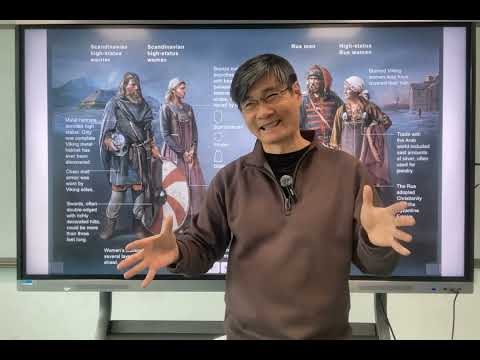
Video thumbnail
youtube.com/watch?v=7k5XoLzwmls ↗ Analyzed 2026-03-14 by claude-opus-4-6

Viewer Advisory

  • The lecture heavily romanticizes Viking culture while minimizing its violent and exploitative aspects — the slave trade is normalized rather than critically examined.
  • The Empire vs. Borderland framework is presented as comprehensive but is a significant oversimplification that doesn't account for many types of societies.
  • The comparison of Viking and Chinese education is anachronistic and designed to provoke rather than illuminate — it compares fundamentally different types of societies across a millennium.
  • Claims about pre-modern tolerance and the modernity of racism are significant oversimplifications that ignore substantial scholarly evidence to the contrary.
  • The identification of Magyars as Proto-Indo-Europeans is incorrect — they were Finno-Ugric peoples.
  • The central thesis that Vikings are a 'fifth pillar' of Western civilization is asserted but never substantiated in this lecture.
  • No Viking scholars are cited despite making ambitious historiographical claims.
Central Thesis

The Vikings represent an underappreciated fifth pillar of Western civilization whose Borderland culture — characterized by energy, openness, and opportunism — profoundly shaped the four dominant European civilizations (Britain, France, Germany, Russia) and offers a distinct model of individual-community relations centered on storytelling and adventure.

  • The Viking Age (793-1066) was driven by opportunistic exploitation of concentrated monastic wealth rather than purely by Carolingian expansion or population pressure.
  • Viking culture was primarily trade-oriented and egalitarian, with raiding representing only a minority of Viking activity, though it disproportionately shaped European perceptions.
  • Borderland cultures compensate for their lack of mass, organization, and strategic depth through superior energy, openness to innovation (open cooperative competition), and strategic opportunism.
  • European feudal hierarchies deliberately chose not to adapt to the Viking maritime threat because doing so would have required restructuring their political systems.
  • The Viking Age ended through successful assimilation: Vikings accumulated enough wealth to intermarry with European nobility and convert to Christianity, a top-down process.
  • Viking conceptions of community (as a collection of stories) and individuality (measured by adventurous contribution to those stories) were fundamentally different from Greek (polis/standing out) and Roman (tradition/piety) models.
  • Modern Chinese education teaches students only to 'memorize useless facts and do stupid tests,' representing the mass-society suppression of individual energy.
  • The premodern world was more tolerant than the modern world because concepts of race, fixed ethnicity, and rigid borders did not exist.
  • Racism is a modern invention of the past 200 years, created to justify imperialism.
Qualitative Scorecard 2.4 / 5.0 average across 7 axes
Historical Accuracy ▸ Expand
The broad outline of Viking history is correct: the periodization (793-1066), the Lindisfarne raid, the Normandy settlement, the Battle of Hastings, Vinland in Newfoundland, the founding of Kiev and Novgorod, and Dublin's Viking origins are all historically sound. However, several claims are oversimplified or inaccurate: the Althing is described as the 'world's first parliament,' which is debatable (other assemblies existed); the claim that the Magyars were 'Proto Indo-Europeans' conflates steppe nomadic culture with the original PIE migrations by thousands of years (Magyars were Finno-Ugric, not Indo-European); the assertion that racism is only '20 years' old is either a misspeak or a significant error; the claim that premodern cultures universally accepted homosexuality is an overgeneralization that ignores considerable variation; and calling feudalism simply knights becoming landowners who exploited farmers oversimplifies a complex set of social arrangements.
3
Argumentative Rigor ▸ Expand
The Empire vs. Borderland framework is an interesting analytical tool and is applied consistently, with relevant historical examples (Alexander vs. Persia, Hannibal vs. Rome, Japan vs. China in WWII). However, the argument that Vikings are a 'fifth pillar' of Western civilization is asserted rather than demonstrated — the lecture promises to prove this next class but presents it as established fact. The causal claim that European feudalism prevented adaptation to Viking raids is plausible but presented without evidence. The comparison of Viking teenagers to modern Chinese students is rhetorically effective but logically dubious — comparing survival skills across millennia is not a meaningful educational evaluation. The lecture also contains a logical tension: if Viking culture was primarily about trade and egalitarianism, the framework emphasizing their 'energy' and warrior culture is somewhat contradictory.
3
Framing & Selectivity ▸ Expand
The lecture is heavily selective in its presentation of Viking culture, emphasizing positive aspects (egalitarianism, innovation, openness, trade, tolerance) while minimizing negative ones (slave trading is mentioned but not dwelt upon; violence against monasteries is framed as economically rational rather than destructive; the human cost of raiding is not discussed). The monastic accounts of Vikings are dismissed as biased without acknowledging that they are primary sources with evidential value. The comparison with Chinese education is one-sided — Chinese students are reduced to rote memorizers while Viking teenagers are romanticized as Renaissance-man survivalists. The claim about premodern tolerance ignores well-documented forms of prejudice in pre-modern societies.
2
Perspective Diversity ▸ Expand
The lecture presents a single romanticized perspective on Viking culture. There is no engagement with the victims' perspective (enslaved peoples, monastery inhabitants beyond brief mention, conquered populations). Alternative scholarly interpretations of Viking expansion are mentioned only to be dismissed in favor of the speaker's 'opportunism' theory. The European feudal response to Vikings is presented as purely self-interested hierarchy preservation, without considering military, logistical, or economic constraints. Chinese civilization is used only as a negative foil for Viking energy. No counterarguments to the 'fifth pillar' thesis are considered.
2
Normative Loading ▸ Expand
The lecture is heavily normatively loaded despite its academic framing. Viking culture is consistently valorized with positive language: 'extremely egalitarian,' 'extremely worldly,' 'strong and resilient,' 'extremely efficient,' 'lean and mean,' 'open,' 'innovative.' Chinese education is described with contemptuous language: 'memorize useless facts,' 'do stupid tests.' The speaker explicitly states he would send his children to 'Viking school' over Yale. The claim that modern nation-states propagandize about tolerance being a modern achievement carries strong normative judgment. The framing of monasteries as 'banks' naturalizes their pillaging. The rhetorical question about Chinese students' abilities is designed to provoke shame, not analysis.
2
Determinism vs. Contingency ▸ Expand
The lecture presents a structural framework (Empire vs. Borderland) that could tend toward determinism, but partially mitigates this by acknowledging multiple theories for the Viking Age's start and noting that some Europeans did adapt to the Viking threat. The speaker acknowledges that 'history is a continuous process of cultural integration' and that cultural change is 'dynamic' and 'never really ends.' However, the framework implies that Borderland cultures inevitably follow certain patterns (energy → expansion → conflict → assimilation), and the claim that Viking influence 'cannot be overstated' verges on historical determinism about cultural causation.
3
Civilizational Framing ▸ Expand
Civilizations are characterized in essentializing terms. Vikings are presented as inherently energetic, open, innovative, and tolerant — an idealized Borderland archetype. Chinese civilization is reduced to 'mass' — a society that suppresses individual energy through rote education. The framework assigns fixed civilizational characteristics (Empires are hierarchical and stagnant; Borderlands are dynamic and free) that flatten enormous internal diversity. The lecture treats Viking culture as a coherent civilizational unit despite acknowledging significant internal diversity, and treats 'China' as a monolithic mass society.
2
Overall Average
2.4
Civilizational Treatment
CHINA

China is used as the negative exemplar of 'mass' civilization — one that suppresses individual energy through conformist education ('memorize useless facts, do stupid tests'). The speaker directly contrasts the competence and worldliness of a Viking 16-year-old with the narrow skill set of a modern Chinese student to illustrate the Empire-Borderland dichotomy. China is presented as the epitome of organizational control at the expense of individual vitality. The Guomindang's strategic depth against Japan is cited as an example of Empire advantage, but this is neutral rather than evaluative.

RUSSIA

Russia is mentioned briefly as one of four civilizations founded or influenced by Vikings, through the Rus settlements in Kiev and Novgorod. The etymology of 'Russia' from 'Rus' (Viking settlers) is noted. Russia is treated neutrally as a product of Viking-Byzantine cultural fusion.

THE WEST

Western civilization is presented as resting on four traditional pillars (Greek, Roman, Jewish, Christian) that have been 'over-studied and over-appreciated.' The speaker argues for a fifth Viking pillar. The broader West is not critically evaluated in this lecture; the critique is reserved for modern nation-states' claims about tolerance and for Chinese mass education.

Named Sources

primary_document
Icelandic Sagas
Referenced as the foundation of modern European literature, written down in Iceland to preserve Viking mythology and stories.
? Unverified
primary_document
Thucydides / Peloponnesian War (implied)
Referenced indirectly through the Athenian concept of ostracism and the polis framework discussed in prior lectures.
✓ Accurate
data
Archaeological ship burials in Scandinavia
Used to illustrate Viking burial practices, noting individual uniqueness of graves, ancestral layering, and care in burial arrangements.
? Unverified
other
L'Anse aux Meadows (Vinland settlement)
Cited as the first European settlement in North America, predating Columbus by at least 500 years.
✓ Accurate
other
Carolingian Renaissance / Holy Roman Empire
Discussed as the context for monastery construction, book production, and wealth concentration that made Viking raids profitable.
✓ Accurate

Vague Appeals to Authority

  • 'Scholars term the period from 793 to 1066' — no specific scholars cited for this periodization.
  • 'The most popular theory is that as Charlemagne and this Holy Roman Empire expanded it threatened Scandinavia' — no specific historians named for this theory.
  • 'Some historians use the word strategic depth' — unnamed historians cited for a key theoretical concept.
  • 'Scholars have debated for a long time' why the Viking Age started — no specific scholarly debate referenced.
  • 'In the Pagan culture there just isn't the idea of homosexuality, men had sex with each other all the time and no one cared' — sweeping claim presented without any scholarly source.
  • 'The premodern world was much more tolerant than the world we live in today' — broad generalization without citation.

Notable Omissions

  • No engagement with major Viking scholarship (e.g., Peter Sawyer, Judith Jesch, Neil Price, Anders Winroth) despite making ambitious claims about Viking cultural significance.
  • No discussion of the extensive debate about the Rus origins (Normanist vs. Anti-Normanist controversy), which is directly relevant to claims about Vikings founding Russia.
  • No mention of Viking violence against civilians, sexual violence, or the human cost of the slave trade beyond noting it existed — the lecture romanticizes Viking culture while criticizing the 'negative' monastic accounts.
  • No engagement with feminist scholarship on Viking women, which is far more nuanced than the claim that women 'had status' because they 'practiced magic.'
  • No acknowledgment that the Althing was not truly democratic — it was dominated by chieftains (goðar) and excluded women and slaves.
  • No discussion of the significant scholarly debate about whether the term 'Viking' even applies broadly to all Scandinavians or only to those who went raiding.
  • The claim that racism is only '20 years old' (likely meant 200) ignores pre-modern forms of ethnic and religious prejudice, which scholars like Benjamin Isaac and Geraldine Heng have documented extensively.
  • No mention of Chinese maritime exploration (Zheng He) when discussing maritime cultures, despite lecturing to Chinese students about the contrast between Viking energy and Chinese 'mass.'
Romanticization through idealization 00:40:02
The speaker describes a Viking 16-year-old as someone who can farm, navigate by stars, build boats, fight with axes, survive in the wilderness, and find their way home from anywhere — essentially a Renaissance survivalist.
Creates an idealized image of Viking youth that serves as a flattering contrast to modern Chinese students. The portrait is speculative and selective — it omits hardship, disease, infant mortality, and the brutal realities of subsistence life.
Provocative comparison to shame the audience 00:42:27
'What do you guys do? Two things: memorize useless facts, do stupid tests. I'm sorry to tell you the truth but this is the truth.'
Uses direct confrontation to shock students into accepting the speaker's framework. By framing Chinese education as producing only two meaningless skills, the speaker positions himself as a truth-teller against the system his students are products of, while elevating the Viking model he's presenting.
Personal authority appeal 00:43:37
'I received a very good education, I was at Yale College for my undergraduate... if I had a choice whether to send my child to Yale or to Viking school, I would send my kid to Viking school.'
Deploys personal credentials (Yale education) and parental conviction to validate the Viking educational model. The rhetorical move simultaneously establishes the speaker's authority to judge educational systems and makes his preference for Viking culture seem the conclusion of deep expertise rather than romantic idealization.
Reframing negative evidence as bias 00:17:25
The negative historical accounts of Vikings are attributed to the monks' trauma of seeing their books destroyed — 'it was the equivalent of having your child killed before you' — which explains why 'we have such a Negative understanding of the Vikings.'
Dismisses primary source evidence that contradicts the speaker's positive characterization by psychologizing the sources' authors. While source bias is a legitimate concern, this framing encourages the audience to discount all negative accounts of Viking activity.
False binary framework 00:34:06
Empire vs. Borderland is presented as a comprehensive dichotomy where cultures have exactly three complementary advantages each: mass/organization/depth vs. energy/openness/opportunism.
The neat symmetry makes the framework feel more rigorous than it is. Real civilizations don't divide cleanly into two types with three opposing advantages each. The framework excludes cultures that don't fit (city-states, nomadic empires, maritime trading networks that are neither Empire nor Borderland).
Socratic leading questions 00:12:44
Throughout the lecture, the speaker asks questions like 'what is the culture, what is the mentality of the worldview that drives this aggressive expansion?' and then immediately provides his answer.
Creates the appearance of intellectual discovery while guiding students to predetermined conclusions. The classroom setting reinforces the speaker's authority as the one who has already worked out the answers.
Universalizing from a specific case 00:27:56
'The slave trade... has been an integral part of human interaction, human trade for most of civilization' — used to normalize Viking participation in slavery.
By framing slavery as universal and timeless, the speaker minimizes the specific moral weight of Viking slave-trading. This normalizing move prevents the audience from incorporating slavery into their evaluation of Viking culture.
Anachronistic educational comparison 00:42:17
Directly comparing what a Viking teenager could do in 800 AD with what a Chinese teenager can do today, as if these are comparable skill sets.
The comparison is category-flawed — it compares survival skills in a subsistence society with academic skills in an industrial one — but is rhetorically powerful because it makes Chinese students feel inadequate and receptive to the speaker's critique of their educational system.
Sweeping generalization presented as insight 01:08:23
'The premodern world was much more tolerant than the world we live in today mainly because we did not categorize people back then.'
Presents a highly contestable historical claim as an established fact that the audience has just discovered through the lecture's reasoning. This flattens enormous variation across pre-modern cultures and ignores well-documented forms of pre-modern prejudice and persecution.
Promise of future revelation 00:52:50
Repeatedly promises that 'next class' will provide the deeper explanation — Viking worldview, cultural system, why four civilizations were influenced — deferring evidence for the central thesis.
Allows the speaker to make grand claims ('cannot be overstated,' 'extremely influential') without having to defend them in this lecture. The audience accepts the claims on credit, trusting that evidence will follow.
⏵ 00:00:16
I believe that they are one of the most underappreciated and misunderstood European cultures in the Western tradition.
Sets up the lecture's revisionist framing from the opening — the speaker positions himself as correcting a scholarly blind spot, establishing his authority to reinterpret Western civilization.
⏵ 00:11:04
The Vikings either founded or influenced four major European civilizations... Germany, France, Britain, and Russia. For the past 500 years these four nations were the dominant militaries in the world.
The core claim of the lecture — Viking influence explains European dominance. This is a strong causal claim that conflates temporal correlation (Vikings preceded these nations) with causation (Vikings caused their dominance). Many other factors contributed to these nations' rise.
⏵ 00:42:27
What do you guys do? Two things: memorize useless facts, do stupid tests. I'm sorry to tell you the truth but this is the truth.
Reveals the speaker's contempt for the Chinese educational system and his rhetorical strategy of using Viking culture as a mirror to critique modern China. This is a genuinely provocative moment in a university lecture.
The speaker criticizes Chinese education for producing conformity and suppressing individual energy, but China's imperial examination system — which he implicitly criticizes — was historically one of the most meritocratic institutions in the pre-modern world, far more socially mobile than Viking or medieval European systems where status was largely determined by birth.
⏵ 00:43:55
If I had a choice whether to send my child to Yale or to Viking school, I would send my kid to Viking school, because I want my child to be worldly, strong, and resilient.
The speaker's most personal and revealing statement — it encapsulates his romanticization of Viking culture and his critique of modern education. The hypothetical is unfalsifiable and rhetorically convenient.
⏵ 00:42:58
The reason why most mass societies are like this is they want to reduce your energy... they want to be able to control you, they want you to fit into larger society.
Applies the Empire/Borderland framework directly to critique Chinese society as an energy-suppressing mass civilization. This is a politically charged claim delivered to Chinese students in what appears to be a Chinese university.
The speaker frames Chinese mass society as uniquely controlling, but Viking society also enforced conformity — banishment (the worst punishment) was precisely about enforcing community norms. The 'openness' of Viking society coexisted with rigid gender roles, violent enforcement of honor codes, and a slave-owning economy.
⏵ 00:17:37
These monks are literate people so they had nothing nice to say about the Vikings. In fact they thought that the Vikings were basically the equivalent of Satan.
Dismisses the primary sources that document Viking violence as biased, without acknowledging that the monks' accounts may contain accurate information despite their perspective. This is a selective application of source criticism.
⏵ 00:20:35
History is a continuous process of cultural integration... it's a dynamic process, it never really ends.
One of the lecture's more nuanced claims, acknowledging cultural fluidity and change. However, it sits in tension with the lecture's essentializing characterizations of Viking culture as inherently energetic and Chinese culture as inherently mass-oriented.
⏵ 01:08:23
The premodern world was much more tolerant than the world we live in today, mainly because we did not categorize people back then.
A sweeping and highly contestable claim. While pre-modern societies often lacked modern racial categories, they had extensive systems of religious persecution, caste, and social hierarchy. The claim serves the lecture's broader argument that modern nation-states are uniquely oppressive.
The speaker praises premodern tolerance while lecturing in modern China, which maintains extensive censorship, political persecution of dissidents, and surveillance of minorities — forms of intolerance that are neither 'categorization' nor 'racism' but represent communal suppression of individual rights that the speaker elsewhere criticizes.
⏵ 00:27:56
The slave trade... has been an integral part of human interaction, human trade for most of civilization.
Normalizes Viking slave-trading by universalizing it. While historically accurate that slavery was widespread, this framing prevents moral evaluation of the specific Viking slave trade, which is at odds with the lecture's emphasis on Viking egalitarianism and tolerance.
⏵ 01:08:38
Racism... it's a new modern concept that didn't exist before. We only have this because of the idea of imperialism.
Attributes racism exclusively to modern imperialism, ignoring pre-modern forms of ethnic prejudice documented by scholars. The speaker may have misspoken when saying '20 years' (likely meaning 200), but even the corrected claim is an oversimplification.
claim Over the next few decades, scholars will slowly reveal to us the importance of Viking culture to the development of Western Civilization.
00:00:53 · Not falsifiable
unfalsifiable
Too vague and long-term to test. Viking scholarship has been growing for decades already.
Verdict

Strengths

The lecture provides a genuinely engaging overview of Viking history that challenges the popular image of Vikings as mere raiders. The Empire vs. Borderland framework, while oversimplified, is a useful analytical tool that helps students think about structural differences between types of societies. The historical examples of strategic depth (Alexander vs. Persia, Hannibal vs. Rome, Japan vs. China) are well-chosen and pedagogically effective. The comparison of Greek, Roman, and Viking concepts of community and individuality is intellectually stimulating and shows genuine comparative thinking. The speaker's willingness to discuss uncomfortable topics (slavery, the limits of modern tolerance claims) demonstrates intellectual courage.

Weaknesses

The lecture suffers from significant romanticization of Viking culture — positive attributes are emphasized while negative ones (slavery, violence, social stratification) are minimized or normalized. The comparison between Viking teenagers and Chinese students is anachronistic and unfair, comparing survival skills in a subsistence society with academic skills in an industrial one. Several factual errors undermine credibility: the Magyars were Finno-Ugric, not Proto-Indo-European; the Althing was not truly democratic; the claim that racism is only '20 years' old is either a misspeak or a major error. The 'fifth pillar' thesis is asserted but not demonstrated — evidence is deferred to the next lecture. Major Viking scholarship is entirely absent. The treatment of pre-modern tolerance is a significant oversimplification that ignores extensive scholarship on pre-modern prejudice.

Cross-References

BUILDS ON

  • Earlier Civilization lectures on the Proto-Indo-Europeans (Yamnaya), referenced as the common cultural origin of Greeks, Romans, and Vikings.
  • Civilization lectures on Greek culture — specifically the polis concept, Athenian democracy, and ostracism, used to compare Greek and Viking models of community.
  • Civilization lectures on Roman culture — the triumph, Roman tradition, and piety are contrasted with Viking storytelling.
  • Civilization lectures on the Byzantine Empire — referenced as a 'walled Empire' that used diplomacy and intermarriage rather than military force.
  • Civilization lectures on the Carolingian Renaissance and Holy Roman Empire — provides the context for monastery construction and wealth concentration.
  • Civilization lectures on Greek military organization — the link between military structure (navy/cavalry/hoplites) and political system (democracy/monarchy/oligarchy).
This lecture is part of a cumulative Civilization series that builds a framework comparing different cultural models across history. The Empire vs. Borderland framework introduced here appears to be a recurring analytical tool. The speaker consistently uses historical cultures as mirrors to critique modern China — here the Vikings are used to highlight what Chinese education lacks (practical skills, independence, energy), following a pattern seen in other lectures where historical examples serve as vehicles for contemporary social commentary. The lecture's romanticization of Viking culture follows the series' tendency to valorize decentralized, energetic cultures over centralized, hierarchical ones.