Predictive History Audit / Systematic Content Analysis
Civilization
Episode 39 · Posted 2025-03-18

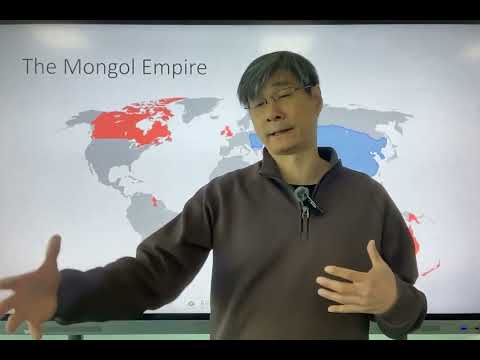
Genghis Khan, World Shatterer

This lecture examines Genghis Khan and the Mongol conquests, arguing that Mongol brutality was a logical optimal strategy given their constraints of low population, vast distances, and inability to govern conquered peoples. The speaker situates the Mongols within a broader history of steppe peoples (Yamnaya, Huns, Turks) and their conflicts with agricultural empires. A significant portion is devoted to comparative mythology, arguing that the Secret History of the Mongols follows the same Proto-Indo-European mythological structure as Roman founding myths and Christianity. The lecture introduces game theory as an analytical framework and uses it to explain Mongol tactics of escalation dominance, psychological warfare, and cultivating an aura of invincibility. The speaker also introduces the controversial claim that the Mongols adopted from Chinese warfare the concept of treating people as an 'infinite resource,' which he argues distinguished them from Vikings and ultimately contributed to their empire's collapse.

Video thumbnail
youtube.com/watch?v=mPQzAPnjYkM ↗ Analyzed 2026-03-14 by claude-opus-4-6

Viewer Advisory

  • The attribution of 'people as infinite resource' to Chinese civilization specifically is an unsourced civilizational claim that ignores comparable practices worldwide and contradicts China's own rich military-philosophical traditions.
  • The Vikings-vs-Mongols comparison selectively emphasizes positive Viking traits while omitting negative ones, and vice versa for the Mongols.
  • The game theory framework, while analytically useful, can rationalize any atrocity as 'optimal' — viewers should note that the speaker applies this sympathetic rationalization selectively to historical cases while treating contemporary Western military actions more critically in other lectures.
  • The comparative mythology framework, while drawing on real scholarship, can lead to unfalsifiable pattern-matching.
  • Several specific historical claims are inaccurate or oversimplified (Han as last Chinese dynasty, Black Death's differential impact attributed solely to sanitation, Mongols having 'no interest' in other cultures).
  • The lecture omits major scholarly works that would complicate its thesis, particularly Jack Weatherford's influential revisionist account of Mongol civilization.
Central Thesis

Mongol atrocities were not uniquely barbaric but represented the optimal strategy for a low-population steppe confederation fighting vast agricultural empires, driven by game-theoretic logic of escalation dominance, terror, and invincibility.

  • The Mongols are not unique among steppe peoples but represent the most successful iteration of a recurring pattern of steppe-agricultural empire conflict stretching back to the Yamnaya.
  • The Secret History of the Mongols follows the same Proto-Indo-European mythological structure as the Aeneid, the Romulus and Remus story, and the Gospel of Mark — featuring a divinely chosen hero who suffers hardship, kills his beloved, and shatters the old world.
  • Great conquerors (Sargon of Akkad, Philip of Macedon, Julius Caesar, Genghis Khan) share a common pattern: they win mentors, betray them, develop professional/meritocratic/innovative armies, and believe they have a divine mission.
  • The Mongols' three fundamental constraints — low population, vast distances requiring fast victories, and inability to govern — dictated their optimal strategy of escalation dominance, psychological warfare, and cultivating an aura of invincibility.
  • The Mongol concept of treating people as an 'infinite resource' was learned from Chinese warfare traditions, where peasant armies were expendable, and this concept was revolutionary and shocking to the Western world.
  • The Black Death spread along Mongol trade routes but devastated Europe far more than China or the Islamic world due to Europe's inferior sanitation and hygiene.
  • The Mongol Empire collapsed because the very cultural values (freedom, egalitarianism, self-reliance) that made them great warriors prevented them from governing hierarchical agricultural societies, and their contempt for conquered cultures made assimilation impossible.
  • Christianity's founding myth is a subversion of Proto-Indo-European mythology: instead of the hero killing his beloved, God kills himself, thereby ending the cycle of violence.
Qualitative Scorecard 2.7 / 5.0 average across 7 axes
Historical Accuracy ▸ Expand
The broad outlines are correct: the Mongol Empire was the largest contiguous land empire; steppe peoples had recurring conflicts with agricultural civilizations; the Mongols used terror strategically; the Yuan Dynasty imposed a racial hierarchy. However, several claims are oversimplified or inaccurate: the claim that the Han Dynasty was 'the last ethnically Chinese dynasty' is debatable (the Ming and many subsequent dynasties were ethnically Han Chinese); the assertion that the Black Death was 'not as devastating' for China due to sanitation oversimplifies complex epidemiological factors; the claim that 'people as infinite resource' was a concept that 'never existed before in human history' outside East Asia ignores Assyrian mass deportation policies and Roman decimation practices; the characterization of Mongols as having 'absolutely no interest in other cultures' contradicts well-documented Mongol religious tolerance and cultural exchange; Subotai is described merely as a 'talented subordinate' when he was arguably the greatest military commander in history in his own right.
3
Argumentative Rigor ▸ Expand
The game theory framework provides a coherent analytical structure for explaining Mongol brutality, and the argument that terror tactics were strategically rational given population constraints is well-constructed. The comparative mythology analysis linking the Secret History to Proto-Indo-European myth is intellectually interesting, though the speaker himself notes it makes the Secret History 'suspicious' as historical source while continuing to rely on it. The weakest link is the 'people as infinite resource' argument attributed to Chinese influence — this makes a sweeping civilizational claim without evidence, and the logical chain (China had large armies → therefore Chinese culture uniquely viewed people as expendable → Mongols learned this from China) involves significant leaps. The comparison of four conquerors (Sargon, Philip, Caesar, Genghis Khan) is illuminating but risks pattern-matching coincidences.
3
Framing & Selectivity ▸ Expand
The lecture's stated goal — to show Mongol brutality was 'logical and understandable' — is a legitimate revisionist framing that challenges simplistic moral condemnation. However, the evidence is selectively marshaled: Mongol cultural achievements (religious tolerance, legal code, postal system, patronage of arts and sciences) are omitted to support the thesis that they 'didn't leave a rich cultural legacy.' The Vikings-vs-Mongols comparison selectively emphasizes Viking cultural curiosity while ignoring Viking atrocities (the Blood Eagle, slave trading, monastery burnings). The attribution of the 'infinite resource' concept specifically to Chinese civilization, while ignoring similar practices in other cultures, represents selective framing that serves a particular civilizational narrative.
3
Perspective Diversity ▸ Expand
The lecture presents essentially one analytical perspective — the speaker's game theory/cultural values framework. No alternative scholarly interpretations are engaged: environmental/climatic explanations for Mongol expansion, economic analyses, or the significant body of revisionist scholarship that emphasizes Mongol contributions to global connectivity, commerce, and cultural exchange. The Mongolian perspective itself is paradoxically absent — no Mongolian scholars or the modern Mongolian view of Genghis Khan as a national hero and state-builder is discussed. The Chinese perspective is reduced to 'people as infinite resource,' ignoring the rich Chinese historiographic tradition on the Mongols.
2
Normative Loading ▸ Expand
The lecture maintains a more analytical tone than many in this series, with the game theory framework providing some distancing from purely normative judgments. The speaker explicitly acknowledges his own potential biases ('I could be wrong,' 'that could be my prejudice'). However, normative loading is present in the characterization of Chinese warfare as 'human wave attacks' and the assertion that in China 'people were treated like an infinite resource' — these carry strong evaluative weight. The phrase 'world shatterer' in the title, while drawn from mythology discussion, frames Genghis Khan in dramatic normative terms. The Viking-Mongol comparison reveals clear normative preferences dressed as cultural analysis.
3
Determinism vs. Contingency ▸ Expand
The lecture acknowledges some contingency — historians 'argue about the reasons' for the Mongol failure to conquer India, and multiple explanations are offered. The game theory framework inherently allows for different strategies and outcomes. However, the framing of cultural values as deeply embedded in the 'subconscious' and persistent across millennia tends toward cultural determinism — the idea that Proto-Indo-European peoples are fundamentally shaped by ancient cultural DNA regardless of environment. The claim that the Mongol Empire was 'doomed to fail' because of inherent cultural contradictions is deterministic. The presentation of the 'optimal strategy' as though there was only one rational course of action understates the role of contingent decisions.
3
Civilizational Framing ▸ Expand
The lecture employs strongly essentialist civilizational categories. The Proto-Indo-European framework treats cultural values as quasi-genetic traits persisting across millennia and geography. The contrast between steppe culture (freedom, egalitarianism, self-reliance) and agricultural empires (hierarchy, bureaucracy) is presented as a fundamental civilizational divide. Most problematically, the 'people as infinite resource' concept is attributed specifically to Chinese civilization, implying that Chinese culture uniquely devalued human life — a claim with orientalist undertones that ignores comparable practices in many civilizations.
2
Overall Average
2.7
Civilizational Treatment
CHINA

China is characterized in strikingly negative terms: Chinese warfare is described as based on 'human wave attacks' where peasant armies were expendable, and the concept of treating people as an 'infinite resource' is attributed to Chinese civilization specifically. The Yuan Dynasty class system (Mongols on top, Chinese at bottom) is mentioned, and the Chinese are described as having rebelled against Mongol contempt. The Mongols' contempt for Chinese culture is presented sympathetically as partially justified by Chinese social structure. Overall, China is cast as the origin of a dehumanizing concept in warfare.

RUSSIA

Russia is mentioned only in passing — the Russian Empire is described as eventually taking over Mongol territory, and the Golden Horde is noted as giving rise to the Russian Empire. No characterization of Russian civilization as such.

THE WEST

Europe/the West is characterized as relatively poor and unhygienic during the medieval period ('streets literally filled with manure'), which explains the Black Death's devastating impact. The Western world is presented as having found the 'people as infinite resource' concept 'unimaginable' and 'radically revolutionary,' implicitly positioning Western civilization as more humane. Christianity is presented favorably as a subversion of violent Proto-Indo-European mythology — God killing himself to end the cycle of violence.

Named Sources

primary_document
The Secret History of the Mongols
Presented as the primary source for Genghis Khan's biography, described as an oral history of his life and his son Ögedei's. The speaker notes it is 'suspicious' because it conforms to Proto-Indo-European mythological structure, but then treats its narrative details as historically informative.
? Unverified
primary_document
The Aeneid (Virgil)
Referenced as a comparative mythological text — the story of Aeneas escaping Troy, abandoning Dido, and founding the Roman lineage is presented as structurally parallel to the Secret History of the Mongols.
✓ Accurate
primary_document
The Gospel of Mark
The ending of Mark's Gospel (the tearing of the temple curtain, the centurion's recognition) is read as a subversion of Proto-Indo-European myth — God sacrificing himself rather than the hero killing his beloved.
✓ Accurate
primary_document
Thucydides / Homer (The Iliad)
The Achilles-Patroclus relationship is cited as an example of the 'best friend as lover' pattern in Proto-Indo-European culture, used to argue that Genghis Khan's killing of Jamukha was the sacrifice of his beloved.
? Unverified
paper
Genetic study on Genghis Khan's descendants
The claim that 1 in 200 males today (approximately 16 million) are direct descendants of Genghis Khan is cited without attribution to the original 2003 Zerjal et al. study in the American Journal of Human Genetics.
✓ Accurate

Vague Appeals to Authority

  • 'Previously historians believe they killed about 65 million people — today that figure is disputed' — no specific historians or revisionist scholarship named.
  • 'Historians argue about the reason why' the Mongols failed to conquer India — no specific historians or debates cited.
  • 'We know today' that Mongol cannibalism claims 'are not true' — no sources for this revisionism.
  • 'As we discussed' and 'as you know from last class' — frequent appeals to prior lectures as established knowledge without sourcing.
  • 'I believe' and 'based on my readings so far' — the speaker's personal assessment of Vikings vs. Mongols is presented as informed opinion without citing specific scholarship.

Notable Omissions

  • Jack Weatherford's 'Genghis Khan and the Making of the Modern World' — the most widely read modern revisionist account that argues for Mongol contributions to civilization, directly relevant to the lecture's thesis.
  • Timothy May's scholarship on Mongol military tactics and the decimal organization system, which would provide academic grounding for the game theory analysis.
  • Morris Rossabi's work on Khubilai Khan and Mongol governance in China, relevant to the discussion of Yuan Dynasty collapse.
  • No engagement with the substantial historiographic debate about Mongol death toll numbers — simply dismissed as 'disputed.'
  • The Mongol legal code (Yasa/Jasagh) is not mentioned despite being directly relevant to claims about Mongol governance capacity.
  • No discussion of the sophisticated Mongol postal system (Yam) or administrative innovations that complicate the claim they 'didn't know how to govern.'
  • The role of Mongol religious tolerance — they practiced notable religious pluralism — is omitted despite being relevant to the cultural characterization.
  • No reference to the significant Chinese, Persian, or Arabic historiographic traditions on the Mongols (Rashid al-Din, Juvaini, etc.).
Rationalization through game theory 00:52:12
The speaker applies game theory to argue that 'everything the Mongols did made complete sense' and was their 'optimal strategy,' framing mass atrocities as logical responses to constraints.
By casting genocide as a rational optimization problem, the analysis intellectualizes atrocity and implicitly suggests moral judgment is less relevant than strategic analysis. This framework could justify any atrocity as 'optimal' given sufficient constraints.
Comparative mythology as historical explanation 00:19:53
The Secret History of the Mongols is analyzed through Proto-Indo-European mythological structure — the speaker identifies parallels with the Aeneid, Romulus and Remus, and the Gospel of Mark to explain Genghis Khan's behavior.
Elevates Genghis Khan from historical conqueror to mythological archetype, lending his actions a sense of cosmic inevitability and divine purpose that obscures the contingent political and military realities.
Cultural essentialism 01:08:43
The speaker argues that Proto-Indo-European cultural values persist in the 'subconscious' across millennia — 'they might have changed clothes, they might have changed hair color, but their soul was still Proto-Indo-European.'
Presents culture as an immutable essence rather than a dynamic, evolving phenomenon, enabling sweeping generalizations about entire civilizations based on supposed ancestral values.
Orientalist attribution 01:04:49
The concept of 'people as infinite resource' is attributed specifically to Chinese civilization — 'where did the Mongols learn the idea that people are infinite resource? Well they learn it from China.'
Creates a civilizational hierarchy where Chinese culture is uniquely responsible for the dehumanization of populations, while implying that Western/European civilizations valued human life more. This ignores comparable practices (Assyrian deportations, Roman decimation, European colonial massacres).
Hedged assertion 01:03:08
The speaker says 'I could be wrong' and 'that could be my prejudice' when comparing Vikings and Mongols, but then proceeds with sweeping claims: 'the Mongols were not curious about the world, they were intent on conquest and enslaving other people — they were predators.'
The hedging creates an appearance of intellectual humility while the substantive claims remain unqualified and sweeping. The disclaimer inoculates against criticism without actually moderating the argument.
Socratic leading questions 00:45:13
Throughout the lecture: 'does that make sense?' 'okay?' — asked repeatedly after controversial claims, creating pressure for agreement rather than genuine inquiry.
The classroom setting turns rhetorical questions into implicit demands for assent, foreclosing critical engagement with controversial claims.
Selective comparison 01:02:41
Vikings are characterized as having 'genuine curiosity' and 'respect for other cultures' while Mongols had 'absolutely no interest in other cultures' — ignoring Viking slave trading and monastery destruction while ignoring Mongol religious tolerance.
Creates a flattering portrait of one warrior culture to serve as a foil for another, with evidence selectively marshaled to support predetermined characterizations.
Escalation framing 00:46:46
The concept of 'escalation dominance' is introduced through a relatable interpersonal example (argument → pushing → punching → knife → gun) before being applied to Mongol genocide.
Normalizes extreme violence by placing it on a continuum with everyday conflict, making Mongol mass killing seem like a natural extension of universal human behavior rather than an extraordinary historical phenomenon.
Appeal to divine mission 00:36:52
All four great conquerors are said to believe they had a 'divine mission' — 'their goal is not to conquer the world, their goal is to change the world for the better as demanded by the gods.'
Reframes conquest as messianic purpose, ennobling mass violence as divinely ordained world improvement. The speaker presents this not as the conquerors' self-justification but as the analytical explanation for their behavior.
Structural parallelism for implicit equivalence 00:31:56
The speaker draws structural parallels between four conquerors (Sargon, Philip, Caesar, Genghis Khan) — all had mentors they betrayed, talented subordinates, professional armies — implying they represent a universal type.
By showing that Genghis Khan fits a pattern shared with figures more accepted in Western culture (Caesar, Philip), the speaker implicitly normalizes Mongol violence as part of a universal pattern of greatness.
⏵ 00:05:34
What I want to show you today is the Mongols are not unique among the steps people... and the way they behaved, there was a strategy, there's a logic to the way they behaved given the circumstances and constraints they found themselves under.
States the lecture's core thesis explicitly — Mongol brutality was rational, not uniquely barbaric. This sets up the game theory framework that will rationalize atrocity.
⏵ 00:52:12
According to Game Theory everything the Mongols did made complete sense. In fact it's their optimal strategy... what they did was completely logical and reasonable even though it resulted in the deaths of tens of millions of people.
The most revealing statement in the lecture — mass killing of tens of millions is described as 'completely logical and reasonable.' The game theory framework allows moral detachment from atrocity by recasting it as optimization.
The speaker applies sympathetic strategic rationalization to Mongol mass killing but in other lectures characterizes American military operations through the lens of hubris and irrationality. The analytical charity extended to Mongol genocide ('optimal strategy given constraints') is notably not extended to Western military actions.
⏵ 00:55:37
The Mongols were based in East Asia, they were based in China basically, and in China because of the Empire, people were treated like an infinite resource. You could massacre them, you could send them off in human wave attacks, it didn't matter because they were an infinite resource.
This is the lecture's most problematic claim — attributing a uniquely dehumanizing concept to Chinese civilization. It characterizes Chinese culture as uniquely callous toward human life, a claim that carries orientalist undertones.
The speaker attributes the dehumanizing concept of 'people as infinite resource' to Chinese civilization, yet this precisely describes the characterization he makes of Chinese culture itself — treating an entire civilization as a monolithic entity defined by its worst practices, ignoring the rich philosophical traditions (Confucian humaneness, Mencian governance) that explicitly valued human welfare.
⏵ 01:05:00
Chinese warfare was also predicated on the belief that people were an infinite resource... the entire idea of warfare in China is I organize this peasant army, I throw them at my opponent, and if my entire army dies, guess what, I'll just go and raise another peasant army.
Reduces thousands of years of Chinese military history — including Sun Tzu's emphasis on winning without fighting — to 'human wave attacks,' a grossly reductive characterization.
Sun Tzu, perhaps the world's most famous military strategist, explicitly argued that 'the supreme art of war is to subdue the enemy without fighting' and that 'in war, the way is to avoid what is strong and to strike at what is weak.' The speaker's characterization of Chinese warfare as mindless human wave attacks contradicts the very civilization's most celebrated contribution to military thinking.
⏵ 01:00:18
The Vikings never really adopted a belief that people were an infinite resource... the Vikings regardless, even though they were brutal, they still had respect for their opponents... the Mongols were not curious about the world, they were intent on conquest and enslaving other people. They were predators.
Reveals the speaker's civilizational preferences through selective characterization — Vikings are cultural learners, Mongols are predators. This flatly contradicts documented Mongol religious tolerance, patronage of scholars, and cultural exchange along the Silk Road.
⏵ 00:27:07
When Genghis Khan killed Jamukha he was basically killing the man he loved the most in this world... that's a very important part of Proto-Indo-European myth, you have to show your commitment by making the ultimate sacrifice which means killing the person you love the most.
Illustrates the speaker's method of reading historical events through mythological structures, transforming a political assassination into a cosmic sacrifice narrative. The interpretation of the Genghis Khan-Jamukha relationship as sexual is presented as self-evident when it is actually debated among scholars.
⏵ 00:29:46
Christianity... believes violence is the worst thing... the founding myth of Christianity is no, I kill myself to show you that violence is terrible. Once God has sacrificed himself it means that all violence now must cease.
Presents Christianity as fundamentally anti-violence, which represents a selective reading of Christian history. The lecture's favorable treatment of Christianity contrasts sharply with its treatment of Chinese civilization.
The characterization of Christianity as inherently anti-violence ignores the Crusades (which the speaker plans to cover next class), the Inquisition, the Wars of Religion, and colonial violence carried out explicitly in Christianity's name. The religion described as ending 'the cycle of violence' produced some of history's most systematic violence.
⏵ 00:08:14
The Han Dynasty as we know from last class is really the last ethnically Chinese dynasty and they are intent on a policy of eradication against the step people.
Two notable claims: the Han as the 'last ethnically Chinese dynasty' (historically inaccurate — the Ming, among others, were ethnically Han Chinese), and the characterization of Han policy as 'eradication' of steppe peoples, which oversimplifies complex diplomatic, military, and trade relationships.
⏵ 00:13:56
In Europe their streets were literally filled with manure... they didn't have sanitation, people just threw [waste] onto the streets... in China and in the former Islamic empire their cities were pretty well organized, pretty wealthy, pretty civilized.
A rare moment where the speaker characterizes China and the Islamic world favorably relative to Europe, though the characterization of medieval Europe as uniformly squalid while China and the Islamic world were 'pretty civilized' is itself an oversimplification.
⏵ 00:37:02
Each in their own way believe they are the Messiah sent by the gods to shatter the world so that it can be built anew.
Encapsulates the speaker's framework for understanding great conquerors — they are messianic figures with divine missions. This frames mass conquest and killing as world-renewal rather than destruction, lending a romantic quality to conquest.
Verdict

Strengths

The lecture provides a genuinely interesting analytical framework for understanding Mongol military strategy through game theory concepts like escalation dominance and optimal strategy given constraints. The comparative mythology analysis linking the Secret History of the Mongols to Proto-Indo-European mythological structures is intellectually stimulating and draws on real scholarly traditions (Joseph Campbell, Georges Dumézil). The analysis of why the Mongol Empire collapsed — cultural values suited for conquest but not governance — is a legitimate historical argument. The speaker is engaging as a lecturer, uses accessible examples, and acknowledges his own potential biases. The broad historical narrative of steppe peoples from the Yamnaya through the Mongols is generally accurate.

Weaknesses

The lecture's most significant weakness is the attribution of the 'people as infinite resource' concept specifically to Chinese civilization. This claim is historically unsupported as a uniquely Chinese phenomenon, ignores comparable practices in Assyrian, Roman, and other empires, reduces thousands of years of Chinese military thought to 'human wave attacks' (contradicting Sun Tzu's entire philosophy), and carries orientalist undertones. The Vikings-vs-Mongols comparison is heavily selective — Viking cultural contributions are emphasized while their atrocities are minimized, and Mongol atrocities are emphasized while their cultural contributions (religious tolerance, legal code, postal system, Silk Road facilitation) are entirely omitted. The claim that the Han was 'the last ethnically Chinese dynasty' is factually wrong. The game theory framework, while interesting, risks intellectualizing atrocity — describing the killing of tens of millions as 'completely logical and reasonable' involves a moral detachment that the speaker does not apply equally to all civilizations.

Cross-References

BUILDS ON

  • Previous Civilization lectures on the Yamnaya/Proto-Indo-Europeans and their spread ('as we discussed')
  • A prior lecture on the Han Dynasty, referenced as 'last class'
  • A prior lecture on the Aeneid/Virgil ('remember last semester we discussed Virtues')
  • A prior lecture on Vikings and Viking culture ('a few lessons ago... you talked about if there was a Viking university')
  • Prior discussion of steppe vs agricultural civilization dynamics
  • Geo-Strategy series lectures that also apply game theory to strategic analysis

CONTRADICTS

  • The characterization of Chinese civilization as uniquely treating 'people as infinite resource' sits uneasily with the more nuanced treatment of Chinese civilization in other Civilization series lectures.
This lecture continues the series' pattern of using Proto-Indo-European cultural frameworks as a master key for understanding diverse civilizations. The game theory analytical model introduced here appears in the Geo-Strategy series as well, suggesting an integrated curriculum. The speaker's tendency to attribute negative civilizational characteristics to Chinese culture (here: 'people as infinite resource,' 'human wave attacks,' contempt-inducing hierarchy) while treating Western cultural traditions more sympathetically (Christianity ending violence, Vikings as curious) represents a recurring pattern worth tracking across the corpus. The lecture is notably less geopolitically focused than the Geo-Strategy series and contains no falsifiable predictions about contemporary events.