Predictive History Audit / Systematic Content Analysis
Civilization
Episode 40 · Posted 2025-03-20

Church and Empire

This lecture examines the medieval Catholic Church's accumulation of power and the Crusades. It begins by contrasting early Christianity's emphasis on humility and poverty with the Church's immense wealth and institutional power by the year 1000, tracing how the Church used its faith monopoly, control of Latin literacy, sacraments, and the threat of eternal damnation to dominate European society. The lecture then identifies five sources of legitimacy crisis for the Church — Muslim control of the Holy Land, the prosperity of Muslim Spain, the Great Schism of 1054, internal corruption, and popular religious dissent — and explains how the Church responded through scapegoating (targeting Jews), persecuting dissenters (Cathars, Waldensians), and launching the Crusades. The lecture concludes by tracing the decline of Church authority through the 14th-century crises (Little Ice Age, Great Famine, Black Death, Western Schism) and the proto-Reformation movements of Wycliffe and Hus leading to Martin Luther.

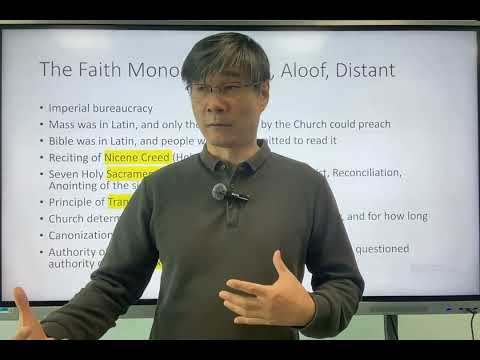
Video thumbnail
youtube.com/watch?v=3751ZjwmrBw ↗ Analyzed 2026-03-14 by claude-opus-4-6

Viewer Advisory

  • The lecture consistently frames Islam as tolerant and Christianity as violent, omitting significant counterevidence on both sides — consult Jonathan Riley-Smith, Thomas Madden, or Christopher Tyerman for more balanced Crusade historiography.
  • The claim that the Inquisition involved 'very little violence' is contradicted by substantial evidence of torture (authorized by Ad extirpanda, 1252) and execution by secular proxy.
  • The reduction of the Holocaust to medieval scapegoating patterns omits crucial modern causal factors.
  • The assertion that modern Middle Eastern wars continue the Crusades is a political claim, not a historical conclusion.
  • The speaker never engages with scholars who emphasize genuine piety as a Crusade motivation (Riley-Smith's position), presenting only the cynical-power-politics interpretation.
  • The Templar connection to the American Revolution is a fringe historical claim not supported by mainstream scholarship.
  • The lecture is delivered in a classroom setting to what appear to be Chinese students, and the framing consistently positions Western/Christian civilization as the aggressive, intolerant party — viewers should consider whether this framing serves pedagogical or ideological purposes.
Central Thesis

The Catholic Church's institutional power was built on controlling access to salvation through a faith monopoly, and the Crusades were primarily a political strategy to maintain orthodoxy and consolidate Church authority over Europe, not a genuine religious endeavor.

  • Early Christianity was a religion of humility and poverty, but the Catholic Church became the wealthiest and most powerful organization in European history — a fundamental contradiction.
  • The Church's power derived from its faith monopoly: it alone could determine salvation, purgatory, and damnation, giving it authority over even kings.
  • Church corruption (indulgences, simony, selling relics, worldliness, tithes, feudal landholding) was systematic and legally sanctioned, not incidental.
  • Five sources of conflict threatened the Church's orthodoxy: Muslim control of Jerusalem, the superior prosperity of Muslim Spain, the Great Schism of 1054, internal corruption, and popular religious dissent.
  • The Church responded with a three-prong strategy of scapegoating Jews, persecuting heretics, and launching crusades to channel religious energy and consolidate power.
  • Pope Urban II's speech launching the First Crusade was essentially a call for jihad, employing racist propaganda against Muslims and offering unconditional salvation to participants.
  • The Crusaders' violent conquest of Jerusalem in 1099 contrasts with Saladin's peaceful recapture in 1187, demonstrating that medieval Christianity was historically more violent than Islam.
  • The Knights Templar became freethinkers and proto-modern Europeans through exposure to religious diversity in Jerusalem, which threatened Church orthodoxy and led to their persecution.
  • The Cathar heresy and other dissent movements represented genuine spiritual needs the Church was failing to meet — community, intimacy with God, and truth.
  • The medieval Inquisition was more methodical than violent, using written interrogation rather than mass killing to identify and isolate heretics.
  • Modern wars in the Middle East are still part of the crusading mentality.
Qualitative Scorecard 2.6 / 5.0 average across 7 axes
Historical Accuracy ▸ Expand
The broad narrative is largely correct: the Church did accumulate enormous wealth and power, the Crusades were called in 1095, the Great Schism occurred in 1054, and the Cathars were violently suppressed. Many specific details are accurate: the camel/needle parable, the Eucharist and transubstantiation, the role of indulgences and simony, the Knights Templar as proto-bankers, the burning of Jacques de Molay in 1307, the Western Schism of 1378, Wycliffe's Bible translation, and Hus's execution. However, several claims are misleading or oversimplified: the claim that Muslims conquered Jerusalem 'peacefully' in 638 omits that it followed a military siege; the assertion that the Fatimids expelled Christians before the 1099 siege is not well-established in the sources; the claim that 'Muslims don't worship demons' is correct but the implication that Pope Urban II knew this oversimplifies medieval theological understanding of Islam; the Great Schism date is given as '1045' at one point rather than the correct 1054; the statement that the Inquisition involved 'very little violence' significantly understates the documented use of torture authorized by Pope Innocent IV in 1252. The Little Ice Age is conventionally dated to begin around 1300-1350, not 1303.
3
Argumentative Rigor ▸ Expand
The lecture presents a coherent and internally consistent argument about the Church's power dynamics and legitimacy crises. The framework of orthodoxy-as-power-source is well-constructed and does explain many of the phenomena discussed. The five-source conflict model and three-prong response strategy provide useful analytical structure. However, the argument sometimes relies on oversimplification: the reduction of the Crusades to a pure power play ignores substantial evidence of genuine religious motivation among participants (as documented by Riley-Smith and others); the scapegoating framework for anti-Jewish violence, while containing truth, is presented as more mechanistic and deliberate than the historical evidence supports; the leap from 'the Church was corrupt' to 'therefore the Crusades were cynical' doesn't follow necessarily; and the claim that modern Middle Eastern wars are 'still part of the crusading mentality' is asserted without argumentation.
3
Framing & Selectivity ▸ Expand
The lecture consistently selects evidence that portrays the Catholic Church negatively and Islam favorably. Muslim Spain is presented as uniformly 'open, inclusive and tolerant' without mentioning the Almohad persecutions or varying periods of intolerance. Saladin's peaceful capture of Jerusalem in 1187 is highlighted while Muslim violence in the Crusade era is minimized. The initial Muslim conquest of Jerusalem is described as peaceful despite involving military force. The Fatimid Caliph al-Hakim's destruction of the Church of the Holy Sepulchre in 1009 — a major precipitating factor for Crusade sentiment — is omitted entirely. The lecture presents the Inquisition as having 'very little violence' which contradicts substantial historical evidence of torture and execution. The selective framing creates a narrative of Christian aggression against Muslim/Jewish tolerance that, while containing elements of truth, omits counterevidence that would complicate the picture.
2
Perspective Diversity ▸ Expand
The lecture presents essentially one analytical perspective: the Church as a power-seeking institution using religion as a tool for social control. Alternative perspectives are not considered: the view that many Crusaders were genuinely motivated by piety (Riley-Smith's position); the perspective that the Church's institutional structure provided genuine social goods (education, poor relief, dispute resolution); the view that medieval orthodoxy enforcement, while harsh, served community cohesion functions; Muslim perspectives on the Crusades beyond the 'tolerant Islam' framing; the Byzantine perspective on the Crusades; or scholarly debates about whether the Inquisition was as systematic as often portrayed. The lecture assumes students should adopt its critical-materialist interpretation of Church power without exposure to alternative historiographical frameworks.
2
Normative Loading ▸ Expand
The lecture maintains a somewhat academic tone for most of its duration, presenting institutional analysis of Church power structures. However, normative judgments regularly surface: the Church's wealth is described as a 'contradiction' (implying it should have remained poor); corruption is called 'disgusting and wrong'; the crusaders' violence is described as horrifying while Saladin's restraint is celebrated; Pope Urban II is described as 'spreading racism'; the characterization of the Crusaders' response as 'righteous killing' carries clear ironic disapproval. The comparison of the Crusade call to 'jihad' is used pointedly. That said, the lecture avoids the most extreme normative loading found in other lectures in this series — it does not, for instance, make sustained polemical arguments about modern politics based on this historical material.
3
Determinism vs. Contingency ▸ Expand
The lecture presents a largely structural analysis where the Church's power dynamics and legitimacy crises make the Crusades seem somewhat inevitable. The five-source conflict model implies that the Church had no choice but to respond aggressively. However, the lecture does acknowledge some contingency: Pope Urban II is presented as making a strategic choice (he 'sees an opportunity'), suggesting the outcome was not predetermined; the success of the First Crusade is attributed partly to the contingent fact that 'Muslims don't really care about Jerusalem' at that time; the 14th-century crises (climate change, plague) are presented as exogenous shocks that altered the trajectory. The teleological claim that Crusade mentality 'is still going on today' implies a deterministic continuity over 900 years.
3
Civilizational Framing ▸ Expand
The lecture employs a consistent civilizational framework that contrasts a violent, intolerant, corrupt Christian West with a peaceful, tolerant, cosmopolitan Islamic world. Muslim Spain is 'more wealthy, more cosmopolitan and innovative' because it is 'much more open, inclusive and tolerant.' Muslim Jerusalem under Islamic rule is described as an 'open, inclusive and tolerant religious community.' Saladin recaptures Jerusalem 'without killing any Jews, Christians or Muslims.' Christianity is 'historically a very violent religion' while Muslims 'tend to be much more peaceful, open, and inclusive.' This binary framing omits the complexity on both sides: periods of Islamic intolerance (Almohad persecutions, al-Hakim's destructions) and periods of Christian tolerance and intellectual flourishing.
2
Overall Average
2.6
Civilizational Treatment
CHINA

China receives one brief, passing mention as a comparison for belief systems — the speaker compares medieval Christians' belief in salvation through the Church to Chinese students' belief that good grades lead to a good life, calling both 'religions.' This is a relatively neutral cultural observation used pedagogically, though it does reduce Chinese educational culture to a simplistic belief system.

THE WEST

The Western/Christian civilization is characterized throughout as violent, intolerant, corrupt, and driven by institutional power rather than genuine spirituality. The Church is presented as a cynical power structure that exploits fear of damnation. The Crusades are framed as racist aggression driven by propaganda. Western Christianity's scapegoating of Jews is presented as a deliberate political strategy. The brief mention of modern Middle Eastern wars as continuations of the Crusades extends this negative characterization to the present.

Named Sources

primary_document
The Bible (Gospel of Matthew / Mark — the rich young man parable)
Used to establish early Christianity's emphasis on humility and poverty as foundational principles, contrasting with the Church's later wealth accumulation.
✓ Accurate
book
Augustine — The City of God
Referenced briefly as providing the 'intellectual blueprint for the Catholic Church' — the vision of the Church as an eternal spiritual force representing God on earth.
? Unverified
primary_document
Pope Urban II — Speech at the Council of Clermont (1095)
Quoted extensively to demonstrate the Church's use of racist anti-Muslim propaganda and the promise of immediate remission of sins to recruit crusaders. The speaker reads directly from a version of the speech.
✓ Accurate
other
Peter Waldo / Waldensians
Cited as an example of dissenting movements that preached poverty and considered the Pope the devil, leading to their persecution.
✓ Accurate
other
Francis of Assisi / Franciscan Order
Presented as the Church's co-optive response to the Cathar movement — a brotherhood focused on humility and poverty but operating within Church hierarchy.
✓ Accurate
scholar
John Wycliffe
Cited as a proto-Reformation theologian who translated the Bible into English and was posthumously declared a heretic, with his body exhumed and burned.
✓ Accurate
scholar
Jan Hus
Cited as a Bohemian reformer burned at the stake whose martyrdom sparked the Hussite Wars, linking to the later Protestant Reformation.
✓ Accurate

Vague Appeals to Authority

  • 'Historically, Christianity has been a very violent religion. And Muslims, there's a lot of violence, but it tends to be much more peaceful, open, and inclusive than Christianity.' — sweeping comparative judgment without citing any specific scholarship on religious violence.
  • 'These are all rumors. They're all fake. They're not true.' — regarding reports of Muslim persecution of Christians in Jerusalem, stated without specific sources for debunking.
  • 'The Knights Templars really become one of the basis for modern Europe' — presented as established fact without citation.
  • 'A lot of their beliefs will start to spread throughout Europe and it will incubate the Protestant Reformation and they will actually even influence the American Revolution' — connecting Templars to the American Revolution without any scholarly support.
  • 'In its thousand years of history, the Catholic Church has amassed more money than God' — hyperbolic claim without any specific financial data.

Notable Omissions

  • No engagement with the substantial historiography debating the motivations for the Crusades (e.g., Jonathan Riley-Smith's emphasis on genuine piety, Thomas Madden's revisionist work, Christopher Tyerman's comprehensive analysis).
  • No mention of the complex internal Muslim politics that facilitated the First Crusade's success (Sunni-Shia divisions, Seljuk fragmentation, Fatimid-Abbasid rivalry).
  • No discussion of positive cultural exchanges during the Crusade period (transmission of Greek philosophy, mathematics, medical knowledge from Islamic world to Europe).
  • No acknowledgment that Muslim tolerance in Jerusalem varied significantly across different rulers and periods — the Fatimid Caliph al-Hakim's persecution of Christians and Jews (1009) is omitted.
  • No mention of Bernard of Clairvaux or the intellectual debates within the Church about the morality of crusading.
  • The portrayal of Muslim Spain as uniformly tolerant omits the Almohad dynasty's forced conversions and persecution of Jews and Christians in the 12th century.
  • No discussion of Byzantine Christianity's perspective on the Crusades (e.g., the sack of Constantinople in 1204 by the Fourth Crusade).
  • Peter Turchin's 'elite overproduction' concept is used without attribution — it is presented as though the speaker coined the term.
  • No engagement with R.I. Moore's 'The Formation of a Persecuting Society' or other scholarly frameworks for understanding medieval persecution.
Contrast framing 00:02:03
The lecture opens with Jesus's teaching on poverty ('easier for a camel to go through the eye of a needle') then immediately contrasts it with the Church's immense wealth: 'the Catholic Church has amassed more money than God.'
Establishes moral judgment from the outset by framing the entire history of the Catholic Church as a betrayal of its own founding principles, priming the audience to view everything that follows through a lens of hypocrisy.
Systematic comparative favoritism 00:37:17
Muslim Jerusalem is 'open, inclusive and tolerant'; Muslim Spain is 'more wealthy, more cosmopolitan and innovative'; Saladin takes Jerusalem 'without killing any Jews, Christians or Muslims.' Christianity is 'historically a very violent religion' while Islam 'tends to be much more peaceful, open, and inclusive.'
Creates a sustained binary between tolerant Islam and intolerant Christianity that shapes the audience's framework for understanding the Crusades and subsequent religious conflict, while omitting evidence that would complicate this binary.
Anachronistic reframing 00:27:42
The Pope's call for the Crusade is repeatedly described as 'a jihad' — 'This is a jihad. He's calling for jihad.' — and Pope Urban II's language about Muslims is called 'racism.'
Applying modern concepts (jihad, racism) to medieval events creates moral clarity for a modern audience but obscures the historical context in which these actions occurred. The jihad comparison implicitly argues that Western critiques of Islamic holy war apply equally to Christianity.
Structural teleology 00:59:05
The lecture draws a direct line from Crusade rhetoric through the Age of Exploration to 'the wars in the Middle East that you're seeing on the news — it's really still part of the crusading mentality.'
Implies an unbroken chain of Western aggression spanning 900 years, making modern conflicts appear as inevitable consequences of medieval Christian ideology rather than products of contemporary political dynamics.
Emotional moral narrative 00:48:32
The speaker describes how Catholic communities converted to Catharism during the Albigensian Crusade 'knowing that they will die because they are so disgusted by the crusades, so disgusted by the Catholic Church.'
Transforms a complex historical process into a moral drama of noble dissenters versus corrupt institutional power, encouraging emotional identification with the persecuted rather than analytical engagement with the historical complexity.
Rhetorical question leading to predetermined answer 00:03:47
'How do you explain this contradiction? How is it that the Catholic Church was able to amass so much wealth?' — then proceeds to answer with the Church's institutional power mechanisms.
Frames the Church's wealth as a 'contradiction' requiring explanation (rather than a common pattern in religious institutions globally), guiding students toward the speaker's materialist interpretation.
Euphemistic minimization 00:52:02
The medieval Inquisition is described as involving 'very little violence' because 'the Catholic Church the doctrine forbids them from spilling blood.'
Understates Inquisitorial violence (torture was authorized by papal bull in 1252; heretics were handed to secular authorities for execution) while maintaining the overall narrative of Church oppression. The technical distinction that the Church itself didn't spill blood obscures the reality that it orchestrated executions by proxy.
Casual assertion of causation 00:22:53
'If you want to understand why the Holocaust happened, this is why it happened. There's a long-term enmity, hatred of the European people against the Jews created by the nobility.'
Reduces the complex causation of the Holocaust to a single medieval mechanism (scapegoating by nobility), creating an impression of historical inevitability while omitting modern factors (nationalism, racial pseudoscience, economic crisis, political failure).
Appeal to modern sensibility 00:10:56
'And if this sounds weird, it is weird. And that's why the Protestants, a lot of Protestants will rebel against this' — regarding the Eucharist and transubstantiation.
Invites students to judge a medieval theological concept by modern secular standards, priming them to see the Church's practices as superstitious rather than understanding them within their historical context.
Foreshadowing for authority 00:41:16
Repeatedly tells students to 'remember this' because concepts will recur: 'the Knights Templars... will actually even influence the American Revolution'; 'these three ideas will recur over and over in European history.'
Creates the impression of a grand unified theory of history where the speaker has already identified the connections. Students are positioned as receivers of revealed knowledge rather than critical analysts evaluating competing interpretations.
⏵ 00:02:03
It is easier for a camel to go through the eye of a needle than for a rich man to enter the kingdom of God... So the Catholic Church has amassed more money than God.
Establishes the lecture's central framing: the Church's wealth is a fundamental betrayal of Christianity's founding principles. The juxtaposition of Jesus's words with the Church's reality sets the moral tone for the entire lecture.
⏵ 00:06:53
With the Catholic Church, the person in charge is God who is perfect, immutable, and eternal. He can never make a mistake and he will always be there.
Articulates the Church's unique power mechanism — claiming divine authority that cannot be challenged or appealed. This framework is presented as the key to understanding medieval European social control.
The Chinese Communist Party similarly derives authority from an 'infallible' ideology (Marxism-Leninism-Xi Jinping Thought) that cannot be publicly questioned. Dissent is treated as ideological error requiring 're-education' — a structural parallel to the Church's treatment of heretics that the speaker does not acknowledge.
⏵ 00:07:31
The church can sentence you to eternal damnation. The church can have you burn in hell for eternity.
Identifies the Church's ultimate coercive power — the threat of eternal punishment — as qualitatively different from and more powerful than secular authority's ability to merely kill.
⏵ 00:28:04
A despised and base race which worships demons... Muslims don't worship demons. Muslims worship the same God as the Jews and the Christians.
The speaker corrects Pope Urban II's propaganda, demonstrating how religious authorities manufactured hatred through deliberate misrepresentation. This is one of the lecture's strongest analytical moments.
⏵ 00:37:17
Historically, Christianity has been a very violent religion. And Muslims, there's a lot of violence, but it tends to be much more peaceful, open, and inclusive than Christianity.
Reveals the lecture's most sweeping civilizational judgment. The qualifier 'I'm not talking about today, but historically' acknowledges the claim's controversy but does not provide the evidence needed to support such a broad comparative claim.
The speaker's favorable treatment of Islamic tolerance omits the Almohad dynasty's forced conversions of Jews and Christians, the destruction of churches under al-Hakim, and widespread slavery in the Islamic world. By the speaker's own standards of judging religions by their historical record, a more balanced assessment would acknowledge significant Islamic violence alongside Christian violence.
⏵ 00:22:53
If you want to understand why the Holocaust happened, this is why it happened. There's a long-term enmity, hatred of the European people against the Jews created by the nobility.
Makes an extraordinary causal claim linking medieval scapegoating directly to the Holocaust. While medieval anti-Semitism was indeed a precursor, reducing the Holocaust's causation to this single mechanism is a significant oversimplification that omits modern racial ideology, nationalism, and political failure.
⏵ 00:59:05
The wars in the Middle East that you're seeing on the news, it's really still part of the crusading mentality.
The lecture's only explicit connection to contemporary events. This sweeping claim implies 900 years of unbroken Western aggression against the Islamic world, a framing that ignores the complex modern geopolitical dynamics (oil, Cold War proxy conflicts, post-colonial state formation, sectarian politics) that drive contemporary Middle Eastern conflicts.
If modern Western military interventions in the Middle East represent a continuation of the Crusades, one could equally frame China's suppression of the Uyghurs — a Muslim population — as a continuation of imperial Chinese subjugation of Central Asian peoples, or China's territorial claims in the South China Sea as a continuation of tributary-state imperialism. The speaker applies civilizational continuity arguments selectively.
⏵ 00:27:21
So what the Pope is calling for is a jihad. All good Christians now must go into battle to reclaim Jerusalem... This is a jihad. He's calling for jihad.
The repeated use of 'jihad' to describe the Crusade is deliberately provocative, inverting the common Western framing that associates jihad exclusively with Islam. Pedagogically effective but historically imprecise — the Crusade indulgence system and Islamic jihad doctrine differ significantly in theological structure.
⏵ 00:08:54
In China, people believe that if I get good grades in school, I'll go to good university and then I'll have a really good life. That's a religion. That's a belief system.
A rare moment where the speaker applies his analytical framework cross-culturally, comparing Chinese educational meritocracy to religious belief. This briefly hints at the kind of universal analytical perspective largely absent from the lecture's treatment of civilizations.
⏵ 00:16:49
The entire source of their power is their ability to enforce their belief system on everyone. This is what I call orthodoxy.
Articulates the lecture's core analytical concept — orthodoxy as the foundation of institutional religious power. This framework drives the entire lecture's interpretation of Church behavior.
The Chinese Communist Party enforces ideological orthodoxy through censorship, social credit systems, and political education campaigns. The CCP's treatment of dissent — from Falun Gong practitioners to democracy activists to Uyghur Muslims — mirrors the Church's suppression of heresy that the speaker critiques. The structural parallel between 'enforcing correct thinking' in medieval Europe and contemporary China goes unacknowledged.
claim The wars in the Middle East that you're seeing on the news are really still part of the crusading mentality.
00:59:05 · Not falsifiable
unfalsifiable
This is an interpretive claim about historical continuity rather than a testable prediction. While Crusade rhetoric does appear in some modern discourse, characterizing all Middle Eastern conflicts as extensions of the Crusades is a historiographical assertion, not a falsifiable prediction.
Verdict

Strengths

The lecture provides a useful structural analysis of how institutional religious power functioned in medieval Europe. The framework of orthodoxy-as-power-source, the five-source legitimacy crisis model, and the three-prong response strategy (scapegoating, persecuting, crusading) offer students genuine analytical tools. The direct reading of Pope Urban II's speech is excellent primary source pedagogy. The treatment of the Cathars, Waldensians, and the Inquisition goes beyond typical survey-level coverage and provides genuinely interesting detail. The connection between elite overproduction and crusading participation reflects legitimate historical scholarship. The discussion of the Knights Templar as proto-bankers and cosmopolitan freethinkers is engaging and largely accurate.

Weaknesses

The lecture suffers from systematic selectivity that creates a misleadingly binary civilizational narrative. Islam is consistently portrayed as tolerant and peaceful while Christianity is consistently portrayed as violent and intolerant — omitting counterevidence on both sides (Almohad persecutions, al-Hakim's destruction of the Church of the Holy Sepulchre, the massacre at Ayyadieh by Muslim forces vs. Christian tolerance in certain Crusader states). The claim that the Inquisition involved 'very little violence' contradicts established scholarship on Inquisitorial torture and proxy executions. The reduction of Holocaust causation to medieval scapegoating patterns is a significant oversimplification. The claim that modern Middle Eastern wars are continuations of the Crusades is asserted without argumentation. Several concepts (elite overproduction, the Templar-to-American-Revolution connection) are presented without scholarly attribution. The lecture engages with no alternative historiographical perspectives on the Crusades.

Cross-References

BUILDS ON

  • Previous Civilization lectures on the fall of Rome (referenced: 'as we discussed, after the fall of Rome the Catholic Church basically became the new Roman Empire')
  • Previous Civilization lecture on the Islamic Golden Age / Abbasid Caliphate (referenced: 'as we know from the Islamic Golden Age lecture')
  • Previous semester lectures on religious needs and human nature (referenced: 'something that we discussed a lot last semester is that humans are first and foremost religious')
  • Previous class on Genghis Khan and steppe peoples (referenced: 'last class we talked about the rise of Genghis Khan')
  • Previous class on Pax Mongolica (referenced: 'remember we last class we talked about the Pax Mongolica')
  • Upcoming lectures previewed: Protestant Reformation ('next week'), Renaissance, Age of Exploration, American Revolution
This lecture is part of a long-running Civilization series that has reached its 40th episode, covering medieval European history in a university classroom setting. The lecture fits into a broader narrative arc that consistently portrays institutional religion (particularly Christianity) as a tool of social control while presenting Islam more favorably. The speaker's framework — orthodoxy as power, corruption as inevitable, dissent as noble — will likely carry forward into lectures on the Reformation and Age of Exploration. The brief claim that modern Middle Eastern wars continue the Crusades connects this historical lecture to the geopolitical analysis found in the Geo-Strategy series. The concept of 'elite overproduction' (used without attribution to Peter Turchin) appears across multiple lectures in different series.