Predictive History Audit / Systematic Content Analysis
Civilization
Episode 43 · Posted 2025-04-01

The Structure of Scientific Revolutions

This lecture traces the development of science from premodern practices (sacred geometry, astrology, alchemy) through the Scientific Revolution to modern institutional science. The speaker argues that Dante's Divine Comedy planted the intellectual seeds for the Renaissance, Reformation, and Scientific Revolution by establishing that humans have a divine capacity to discover universal laws. The lecture covers the geocentric-heliocentric debate through Ptolemy, Copernicus, Tycho Brahe, Kepler, Galileo, and Newton, emphasizing that scientific breakthroughs come from intuition, imagination, and faith rather than bureaucratic method. Drawing on Thomas Kuhn's 'The Structure of Scientific Revolutions,' the speaker argues that modern science has become an imperial bureaucracy that stifles the very genius that created it, and dismisses AI, nanotechnology, and genetic engineering as 'scams' or 'illusions.' The lecture concludes with a tangent connecting Newton's Christian Zionism to contemporary Middle Eastern politics.

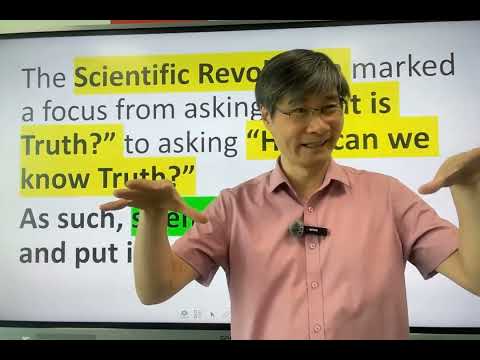
Video thumbnail
youtube.com/watch?v=CjtUnKcU1IA ↗ Analyzed 2026-03-14 by claude-opus-4-6

Viewer Advisory

  • The historical content about the Scientific Revolution (Copernicus, Galileo, Kepler, Newton) is generally reliable but simplified for a classroom setting.
  • The claim that AI and other technologies are 'scams' is factually incorrect and reflects the speaker's bias against institutional science rather than engagement with actual research.
  • The theological explanation for why the Scientific Revolution happened only in Western Europe is one theory among many and is not widely accepted as a sole explanation by historians of science.
  • The characterization of non-Western civilizations as 'primitive' in their science ignores substantial achievements in Chinese, Islamic, and Indian science and technology.
  • The leap from Kuhn's philosophy of science to the claim that modern civilization 'cannot innovate' is not supported by Kuhn's own work.
  • The Newton-to-Christian-Zionism narrative is presented as a revelatory hidden history but relies on selective reading of Newton's private papers and oversimplified causal chains.
  • The speaker's confident dismissal of emerging technologies demonstrates the very resistance to new paradigms that Kuhn describes — an irony apparently lost on the speaker.
Central Thesis

The Scientific Revolution was driven by theological assumptions rooted in monotheism and powered by individual genius and faith, but modern science has degenerated into an imperial bureaucracy that suppresses innovation and is incapable of the paradigm-shifting breakthroughs that founded it.

  • Dante's Divine Comedy established three foundational ideas — God is within us, we have the capacity to discover universal laws, and we can master these laws — that drove the Renaissance, Reformation, and Scientific Revolution.
  • Three theological assumptions underlie the Scientific Revolution: monotheism, intelligent design of the universe, and God's endowment of humans with the capacity to discover that design — which is why the revolution happened in Western Europe rather than China, the Islamic world, or India.
  • Premodern science (sacred geometry, astrology, alchemy) focused on the spiritual world and relied on intuition and imagination, while modern science focuses on the material world and relies on the scientific method.
  • The scientific method — hypothesis, experimentation, peer review — was formalized by Francis Bacon and institutionalized through bodies like the Royal Society of London.
  • Scientific breakthroughs come from intuition, imagination, and faith rather than methodical process, as demonstrated by Einstein daydreaming at a patent office, Newton's theological motivations, and Galileo's conviction despite weak evidence.
  • Thomas Kuhn showed that science progresses through paradigm shifts and revolutions, not gradual accumulation, and that embracing a new paradigm requires faith rather than evidence.
  • Modern science has become an imperial bureaucracy characterized by political control, over-specialization, lack of accountability, insularity, and gatekeeping that would exclude the very geniuses (Galileo, Newton, Einstein) who founded it.
  • Artificial intelligence, nanotechnology, and genetic engineering are 'illusions,' 'hocus pocus,' or 'deliberate scams' that are not achievable within the current scientific framework.
  • Newton was a Christian Zionist whose theological work promoted the return of Jews to Jerusalem, connecting to the Balfour Declaration and contemporary Middle Eastern politics.
Qualitative Scorecard 2.4 / 5.0 average across 7 axes
Historical Accuracy ▸ Expand
The lecture gets the broad strokes of the Scientific Revolution correct: Copernicus's devout Catholicism and Church support, the nuanced nature of Galileo's conflict with the Church (personality-driven rather than simple science-vs-religion), Newton's theological and alchemical interests, Kepler's three laws, and the founding of the Royal Society in 1660. However, several claims are inaccurate or misleading: the claim that Egyptians knew the sun was the center of the universe (they did not — Ra being a sun god does not equal heliocentric cosmology); the claim that 'Einstein was really bad at mathematics' (Einstein excelled in mathematics, though he needed help from Marcel Grossmann with tensor calculus); the characterization of Newton as a 'founder' of Christian Zionism is a stretch — while Newton held millenarian views, the Christian Zionist movement as such is typically traced to the 19th century; the Dunning-Kruger effect is consistently mispronounced as 'Dunning Cougar'; and the claim that AI 'will not get any better' was demonstrably wrong within months of the lecture.
3
Argumentative Rigor ▸ Expand
The lecture makes sweeping claims without adequate support. The central argument — that modern science is an 'imperial bureaucracy' incapable of innovation — is asserted rather than demonstrated. Calling AI, nanotechnology, and genetic engineering 'scams' or 'illusions' with no engagement with actual research in these fields is intellectually irresponsible. The leap from Kuhn's observation that science progresses through paradigm shifts to the conclusion that modern science cannot innovate does not follow logically — Kuhn himself did not draw this conclusion. The argument that the Scientific Revolution happened in Western Europe because of monotheistic theology ignores multiple competing explanations (institutional, economic, geographic) and the considerable scientific achievements of Islamic civilization. The Einstein-Bohr debate is mischaracterized: both Einstein and Bohr were rigorous, and Einstein was not simply 'wrong' — his challenges deepened understanding of quantum mechanics and led to the EPR paradox and Bell's theorem.
2
Framing & Selectivity ▸ Expand
The lecture is highly selective in its evidence. The portrayal of premodern science as limited to sacred geometry, astrology, and alchemy omits enormous practical achievements in agriculture, engineering, metallurgy, and medicine across ancient civilizations. The characterization of China, Egypt, and India as 'primitive societies' practicing only mystical science ignores their substantial empirical achievements. The lecture cherry-picks examples of intuition in science (Einstein daydreaming, Newton's theology) while ignoring the vast majority of scientific progress that came through systematic, methodical work. The dismissal of modern science as bureaucracy ignores that peer review, replication, and institutional science have produced unprecedented technological progress. The connection from Newton to Christian Zionism to the Balfour Declaration to contemporary Middle East politics is a highly selective causal chain that omits most of the actual historical factors.
2
Perspective Diversity ▸ Expand
The lecture presents a single perspective — that genius and faith drive science while bureaucracy stifles it — without engaging with alternative views. No consideration is given to the view that institutional science, despite its problems, has been extraordinarily productive. No engagement with historians of science who challenge the 'great man' narrative (e.g., social constructionists, historians emphasizing institutional and economic factors). The Eurocentric framing — the Scientific Revolution happened in Europe because of monotheistic theology — is presented without engaging with scholars who attribute it to other factors (capitalism, competition among states, printing press, geographic factors). The dismissal of AI as a 'scam' shows no engagement with actual AI researchers or the substantial literature on AI capabilities and limitations.
2
Normative Loading ▸ Expand
The lecture is moderately normatively loaded. The characterization of modern science as an 'imperial bureaucracy' carries strong negative connotations. Calling AI, nanotechnology, and genetics 'deliberate scams,' 'hocus pocus,' and 'illusions' is evaluative rather than analytical. However, much of the historical content (Copernicus, Galileo, Newton, Kepler) is presented relatively neutrally, and the Galileo narrative is actually more nuanced than the typical science-vs-religion framing. The speaker acknowledges the 'remarkable power of science' and the effectiveness of the scientific method before critiquing its bureaucratization, showing some balance.
3
Determinism vs. Contingency ▸ Expand
The lecture shows some awareness of contingency — noting that Galileo's conflict with the Church was driven by his personality rather than inevitable structural factors, and acknowledging that Copernicus's heliocentrism was initially supported by the Church. However, the overarching narrative is deterministic: monotheism necessarily led to the Scientific Revolution, science necessarily became a stifling bureaucracy, and Christian Zionism necessarily connects Newton to contemporary Middle Eastern conflict. The claim that the Scientific Revolution could only have happened in monotheistic Western Europe due to theological prerequisites is rigidly deterministic and ignores contingent factors.
3
Civilizational Framing ▸ Expand
The lecture employs a Eurocentric civilizational framework with significant blind spots. China, Egypt, and India are explicitly labeled 'primitive societies' whose science was limited to sacred geometry, astrology, and alchemy — a characterization that ignores enormous empirical and technological achievements. The Scientific Revolution is attributed entirely to Western European monotheistic theology, with no acknowledgment of Islamic contributions to the scientific method or Chinese technological innovations. The comparison of modern science to 'the Imperial bureaucracy of China' is used pejoratively, framing Chinese civilization as the archetype of stagnant bureaucracy.
2
Overall Average
2.4
Civilizational Treatment
CHINA

China is characterized in two ways, both negative: first, as a 'primitive society' whose science was limited to understanding sacred geometry as 'Chi' or 'life force' — ignoring millennia of Chinese technological innovation; second, as the archetype of stifling bureaucracy, with modern science compared unfavorably to 'the Imperial bureaucracy of China.' The speaker states that the Scientific Revolution could not have happened in China due to lack of monotheistic theological foundations.

UNITED STATES

The United States is not directly discussed in the main lecture, but Christian Zionism's migration to America is mentioned in the Newton tangent. American scientific institutions are implicitly criticized as part of the modern 'imperial bureaucracy' of science.

THE WEST

Western Europe is treated as the unique birthplace of modern science due to its monotheistic theology — a framing that privileges Western civilization's intellectual traditions while diminishing others. The Catholic Church receives surprisingly nuanced treatment, with the speaker emphasizing that it was not anti-science and supported Copernicus.

Named Sources

primary_document
Dante Alighieri / The Divine Comedy
Presented as the intellectual origin of the Scientific Revolution, with specific passages from Paradiso (Beatrice's dialogue with Dante about divine laws) used to argue that Dante established the framework for scientific inquiry by proposing that God created laws underlying the universe that humans are meant to discover.
? Unverified
primary_document
Ptolemy / The Almagest
Discussed as the foundational geocentric cosmological text, noting its mathematical sophistication and acceptance for over a thousand years. The speaker accurately notes it was refined by Islamic scholars.
✓ Accurate
primary_document
Copernicus / On the Revolutions of the Celestial Spheres
Discussed as proposing the heliocentric model in 1543, with the nuanced point that Copernicus was a devout Catholic supported by Church figures, and that his mathematics were less refined than Ptolemy's.
✓ Accurate
primary_document
Galileo Galilei / Dialogue Concerning the Two Chief World Systems
Detailed account of Galileo's conflict with the Church, emphasizing that the conflict was driven by Galileo's personality and claim to interpret scripture rather than by the Church being anti-science per se.
✓ Accurate
primary_document
Isaac Newton / Principia Mathematica
Credited with providing the mathematical proof for the heliocentric model through laws of planetary motion and gravity, while also emphasizing Newton's theological and alchemical pursues.
✓ Accurate
book
Francis Bacon / The New Atlantis
Presented as the blueprint for modern scientific bureaucracy, with specific passages quoted describing specialized offices for experimentation, auditing, and theorizing.
✓ Accurate
book
Thomas Kuhn / The Structure of Scientific Revolutions
Multiple passages read aloud and discussed at length. Used to argue that science progresses through paradigm shifts requiring faith rather than evidence, and that 'normal science' is mere puzzle-solving within an existing paradigm. The speaker extends Kuhn's argument to claim modern science has become a stifling bureaucracy.
? Unverified
book
Jeremy Narby / The Cosmic Serpent
A passage is read arguing that science's central ideas come 'from beyond the limits of rationalism,' citing Descartes dreaming of an angel, Einstein daydreaming, and Watson scribbling on a newspaper. Used to support the claim that genius comes from intuition rather than method.
? Unverified
scholar
John Maynard Keynes
Referenced as having purchased Newton's papers at auction in the 1930s and being shocked to discover they were mostly theology and alchemy rather than mathematics.
✓ Accurate

Vague Appeals to Authority

  • 'The Egyptians knew that the sun was the center of the universe — that's why their God was a Sun God Ra' — conflates sun worship with heliocentric cosmological knowledge without evidence.
  • 'Most scientists would tell you that Ptolemy's book is better' than Copernicus's — presented as consensus without specific citation.
  • 'A lot of scientists are now trying to reexamine' the Big Bang model — vague appeal to unnamed scientific skepticism.
  • 'Einstein was really bad at mathematics' — a commonly repeated but misleading claim presented as fact.
  • 'Newton is actually one of the founders of a movement called Christian Zionism' — presented as fact with the qualifier 'I think' but without scholarly citation for this specific claim about Newton's role.

Notable Omissions

  • No mention of Islamic Golden Age contributions to science and the scientific method, despite discussing the transmission of Ptolemy's work through Arabic translations. Al-Hazen (Ibn al-Haytham), who pioneered experimental methodology centuries before Bacon, is entirely absent.
  • No discussion of Chinese contributions to science and technology (gunpowder, printing, compass, paper) despite the lecture's claim that China, Egypt, and India practiced only 'primitive' science. Joseph Needham's extensive documentation of Chinese scientific achievement is not engaged.
  • No engagement with the 'Needham Question' — why China didn't develop modern science despite its technological achievements — which directly challenges the speaker's theological explanation for why the Scientific Revolution happened only in Western Europe.
  • Karl Popper's falsificationism, a major alternative to Kuhn's paradigm theory, is entirely absent despite being central to philosophy of science.
  • No mention of the replication crisis in modern science, which would actually support the speaker's argument about bureaucratic science but with specific evidence rather than sweeping claims.
  • Paul Feyerabend's 'Against Method,' which argues for epistemological anarchism in science, would support the speaker's anti-bureaucracy thesis but is not cited.
  • The Dunning-Kruger effect is discussed but the speaker does not cite the actual 1999 paper by Dunning and Kruger, calling them 'Dunning Cougar' throughout.
Sweeping dismissal 00:51:39
The speaker dismisses AI, nanotechnology, and genetic engineering as 'essentially illusions, hocus pocus, magic, or you can even go as far as to say they are deliberate scams.'
Delegitimizes three major fields of scientific research in a single sentence without engaging with any evidence, using emotionally loaded language ('scams,' 'hocus pocus') to foreclose serious discussion.
Appeal to romantic genius 00:43:38
Einstein is repeatedly presented as 'just daydreaming' at a patent office, and Newton is characterized as primarily a theologian and alchemist for whom mathematics was a 'hobby.'
Creates a romantic narrative of genius-as-divinely-inspired-outsider that supports the anti-institutional thesis, while downplaying the years of rigorous mathematical training and systematic work that actually produced these breakthroughs.
False equivalence 00:54:24
Descartes dreaming of an angel is compared to Muhammad's revelation from Gabriel, both presented as equivalent to Einstein's daydream about relativity — all characterized as 'religious' inspiration.
Collapses the distinction between religious revelation and scientific insight, supporting the thesis that science and religion cannot be separated, while ignoring that Einstein's 'daydream' was grounded in years of physics study.
Reductio ad bureaucracy 00:52:32
The speaker compares modern science to 'the Imperial bureaucracy of China' and argues that scientists are more likely to become 'corrupt bureaucrats' than to achieve breakthroughs.
Uses the negative connotations of 'bureaucracy' and 'corruption' to characterize the entire modern scientific enterprise, without engaging with its actual track record of producing revolutionary technologies.
Rhetorical question cascade 00:51:57
On AI: 'Is it any good? No it's not. Will it get any better? No it won't.' Answers his own questions immediately without pause for reflection.
Presents contested claims as self-evident truths through rapid-fire self-answered questions, preventing the audience from formulating their own assessment.
Selective historical analogy 01:09:42
The speaker argues that Galileo, Newton, and Einstein would not be admitted to graduate school today — Galileo because he's arrogant, Newton because he's 'crazy,' and Einstein because he's 'bad at mathematics.'
Creates an emotionally compelling argument against institutional science by personifying the problem through beloved historical figures, while relying on caricatures rather than accurate descriptions of these scientists.
Motte-and-bailey 01:10:28
The speaker moves between the defensible claim that science has institutional problems (political control, over-specialization) and the radical claim that modern civilization is 'incapable of innovation.'
When challenged, the speaker can retreat to the moderate position (science has institutional problems) while the radical claim (civilization cannot innovate) is the one that shapes the audience's takeaway.
Causal chain construction 01:14:01
Newton's theological interests → Christian Zionism → migration to America → Balfour Declaration → contemporary Middle East conflict, presented as a coherent causal chain.
Creates an illusion of deep historical understanding by drawing a straight line through centuries of complex history, suggesting that contemporary events are best understood through this single thread while omitting the vast majority of relevant historical factors.
Pedagogical authority assertion 00:15:15
'I need you to memorize this chart' — the speaker repeatedly frames his interpretive claims as facts to be memorized rather than arguments to be evaluated.
Leverages the classroom setting to present interpretive frameworks as established knowledge, discouraging critical evaluation by students who are primed to treat the material as exam-ready facts.
Conspiratorial framing 01:15:40
Newton is described as part of a 'secret society' with John Locke, considering themselves 'the true church,' plotting to achieve Christian Zionism with 'unlimited resources and unlimited power.'
Transforms Newton's private theological correspondence into a grand conspiracy narrative, implying that shadowy networks of powerful individuals continue to drive world events through religious conviction.
⏵ 00:51:54
Artificial intelligence is the example that we are most familiar with. So I'm sure you've all used ChatGPT. Is it any good? No it's not. Will it get any better? No it won't.
Reveals the speaker's willingness to make confident empirical claims about technology without evidence. This prediction was falsified within months as AI capabilities continued to advance rapidly. Demonstrates the irony of a lecture about scientific paradigm shifts dismissing a paradigm shift in progress.
⏵ 00:51:28
These are not possible within the current scientific framework that we have today. In fact I would make the argument that these three are essentially illusions, hocus pocus, magic, or you can even go as far as to say they are deliberate scams.
The speaker dismisses AI, nanotechnology, and genetics as 'scams' — ironically employing the same dismissive certainty he attributes to the geocentric establishment that rejected Copernicus and Galileo. By Kuhn's own framework, which the speaker just endorsed, dismissing new paradigms as 'hocus pocus' is exactly what defenders of the old paradigm do.
⏵ 00:52:32
The field that is most like the Imperial bureaucracy of China is science today. Science is above nation, it is above government, it does things by itself.
Uses imperial China as a pejorative comparison for modern science, revealing the speaker's tendency to treat Chinese civilization as the archetype of stagnation. Also ironically, Chinese imperial bureaucracy was one of history's most effective governance systems, enabling enormous population growth and technological innovation.
The speaker uses 'Imperial bureaucracy of China' as synonymous with stagnation and corruption, but China's civil service examination system was historically admired for its meritocracy and efficiency. The comparison inadvertently reveals the speaker's civilizational bias — China represents decay and rigidity in his framework, even when discussing European institutions.
⏵ 01:09:31
Science was initiated, inspired by the genius of Galileo, Newton, and Einstein. But today science has developed to a point where it no longer welcomes Galileo, Newton, or Einstein.
Encapsulates the lecture's central thesis in memorable terms. While the claim about institutional gatekeeping has some merit, it ignores that modern science has produced more breakthroughs in the last century than in all previous centuries combined.
⏵ 00:14:44
That is why the revolution happened in Western Europe and not say in China or the Islamic world or India. Because you need these three theological assumptions.
Reveals a strongly Eurocentric framework that attributes the Scientific Revolution solely to monotheistic theology, ignoring Islamic contributions to scientific methodology and Chinese technological achievements. This theological determinism contradicts the lecture's own emphasis on contingency and individual genius.
The speaker's claim that China lacked the theological foundations for science ignores that Chinese civilization produced gunpowder, the compass, printing, and advanced mathematics — technologies Europe adopted. The 'theological prerequisites' argument is a post-hoc rationalization that conveniently explains European supremacy while dismissing Chinese and Islamic achievements.
⏵ 00:53:30
Genius does not come from hard work. It does not come from scientific process or scientific method. It comes from intuition, imagination, and inspiration.
A sweeping claim that contradicts extensive research on the role of deliberate practice, institutional support, and systematic methodology in scientific discovery. While intuition plays a role, virtually all major scientific breakthroughs required years of rigorous preparation.
⏵ 00:05:03
The major ancient civilizations are China, Egypt, and India... these are three major sciences in the primitive societies — China, Egypt, and India.
The speaker first calls China, Egypt, and India 'major ancient civilizations' then within minutes relabels them 'primitive societies.' This casual reclassification reveals a hierarchical civilizational framework where non-Western societies are acknowledged as ancient but characterized as primitive in their intellectual achievements.
Calling China a 'primitive society' regarding science ignores that China invented paper, printing, gunpowder, and the compass — the 'Four Great Inventions' that Francis Bacon himself credited with transforming Europe. The civilization the speaker dismisses as 'primitive' directly enabled the Scientific Revolution he celebrates.
⏵ 00:53:06
It's more likely that they will take all these billions of dollars the government's giving them and they'll just waste it all. Why? Because they can. It's much easier for people to be lazy, greedy, and corrupt than it is for them to become God.
Characterizes the entire scientific establishment as lazy, greedy, and corrupt without evidence. This is a populist anti-expert sentiment dressed in intellectual language.
⏵ 01:17:36
There are very powerful people in this world who believe in this and who want to make this come true... It's not really a prophecy. It's really a plan.
Transforms Newton's private theological writings into evidence of an ongoing conspiracy by powerful Christian Zionists to engineer the end times. This conspiratorial framing is characteristic of the speaker's approach across the series — attributing geopolitical events to the deliberate plans of shadowy networks.
⏵ 01:10:14
Don't worry about artificial intelligence, don't worry about billionaires living forever, don't worry about nanotechnology. Worry about the fact that we've come to a point in our civilization where we are now incapable of innovation.
The lecture's concluding message dismisses three of the most transformative technological developments of the 21st century in order to assert an unfalsifiable claim about civilizational decline. The irony is that the speaker is essentially doing what he accuses the geocentric establishment of doing — dismissing paradigm-shifting developments because they don't fit his existing framework.
prediction Artificial intelligence (specifically ChatGPT) is not good and will not get any better.
00:51:57 · Falsifiable
disconfirmed
Since this lecture (April 2025), AI capabilities have continued to advance significantly. Claude, GPT, and other models have demonstrated substantial improvements in reasoning, coding, and multimodal capabilities. The claim that AI 'will not get any better' is demonstrably false.
prediction AI, nanotechnology, and genetic engineering are essentially 'illusions' or 'scams' that are not achievable within the current scientific framework.
00:51:28 · Falsifiable
disconfirmed
All three fields have produced concrete, measurable results: AI models are widely used in industry, CRISPR gene editing has produced FDA-approved therapies (e.g., Casgevy for sickle cell disease), and nanomedicine has delivered vaccines (mRNA lipid nanoparticles in COVID-19 vaccines). Calling these fields 'scams' is factually incorrect.
claim Modern civilization has reached a point where it is incapable of innovation.
01:10:28 · Not falsifiable
unfalsifiable
This is too vague and sweeping to be falsified — any innovation could be dismissed as incremental, and 'incapable' is never strictly testable.
Verdict

Strengths

The lecture provides a genuinely useful and nuanced account of several historical episodes: the portrayal of Galileo's conflict with the Church as driven by his personality and hubris rather than a simple science-vs-religion narrative is well-supported by historical scholarship; the discussion of Newton's theological and alchemical interests is accurate and corrects the popular image of Newton as a purely rational scientist; the engagement with Thomas Kuhn's 'Structure of Scientific Revolutions' introduces students to genuine philosophy of science; and the emphasis on the role of intuition and imagination in scientific discovery, while overstated, contains an important truth that institutional science can undervalue. The lecture's historical narrative from Ptolemy through Einstein is generally accurate in its broad outlines.

Weaknesses

The lecture suffers from several critical weaknesses: the dismissal of AI, nanotechnology, and genetics as 'scams' is factually wrong and intellectually irresponsible in an educational setting; the claim that 'Einstein was really bad at mathematics' perpetuates a myth; the characterization of China, Egypt, and India as 'primitive societies' is deeply Eurocentric and ignores substantial scholarship on non-Western scientific traditions; the theological determinism argument (the Scientific Revolution required monotheism) is a monocausal explanation that ignores the rich historical literature on multiple contributing factors; the jump from Kuhn's paradigm theory to 'civilization is incapable of innovation' is a non sequitur; and the Newton-to-Christian-Zionism-to-Middle-East causal chain oversimplifies centuries of complex history. The Dunning-Kruger effect is ironically relevant: the speaker exhibits the very pattern he describes — high confidence in fields (AI, philosophy of science, technology forecasting) where his understanding appears limited.

Cross-References

BUILDS ON

  • Previous Civilization lectures on Dante and the Divine Comedy (referenced as 'previous classes' and 'last week'), specifically discussions of Beatrice's dialogue with Dante in Paradiso.
  • Previous Civilization lectures on the Renaissance and the Protestant Reformation, which the speaker reviews at the lecture's opening.
  • Geo-Strategy lectures discussing Christian Zionism and its influence on US foreign policy, particularly regarding Israel and Iran (connected through the Newton-Christian Zionism tangent).
  • Earlier lectures on the Peloponnesian War and Greek tragedy (the speaker uses the concept of 'hubris' from Greek tragedy to describe Galileo).

CONTRADICTS

  • The speaker's dismissal of AI as a 'scam' that 'will not get any better' contradicts the broader series' emphasis on predicting technological and geopolitical developments — if the speaker cannot accurately assess a technology visible in real-time, it undermines confidence in more distant predictions.
  • The claim that civilization is 'incapable of innovation' sits uneasily with claims made in the Geo-Strategy series about China's shipbuilding capacity and technological advancement, which would presumably require considerable innovation.
This lecture reveals a consistent pattern across the series: the speaker is willing to make sweeping, confident claims about complex topics (AI is a scam, civilization cannot innovate, the Scientific Revolution was caused solely by monotheism) without engaging with contrary evidence or specialist literature. The lecture also demonstrates the series' tendency to connect disparate historical events into grand causal narratives (Dante → Scientific Revolution → Newton → Christian Zionism → Israel → Middle East conflict) that serve a predetermined thesis about civilizational trajectories. The anti-institutional, anti-expert sentiment expressed here (scientists as 'corrupt bureaucrats') parallels the series' broader skepticism toward Western institutions while treating non-Western and anti-establishment perspectives more favorably.