Predictive History Audit / Systematic Content Analysis
Civilization
Episode 46 · Posted 2025-04-22

The Revolution of Reason

This lecture introduces a three-part series on the French Revolution, which the speaker calls the most significant event in human history. The first half establishes a framework of four successive worldviews — animistic, polytheistic, monotheistic, and modern/deist — and argues the French Revolution was the turning point from the monotheistic to the modern period. The speaker then surveys the European middle class (bourgeoisie, petite bourgeoisie, proletariat) and argues the Enlightenment was fundamentally a movement for middle-class identity formation. The second half provides close readings of key Enlightenment texts: Descartes' Meditations on First Philosophy, Goethe's Faust, Kant's 'What is Enlightenment?', and three works by Rousseau (Emile, Discourse on the Origin of Inequality, and The Social Contract). The lecture concludes by arguing that Rousseau's concept of the 'general will' became the ideological foundation of the French Revolution, distinguishing it from the more pragmatic American Revolution.

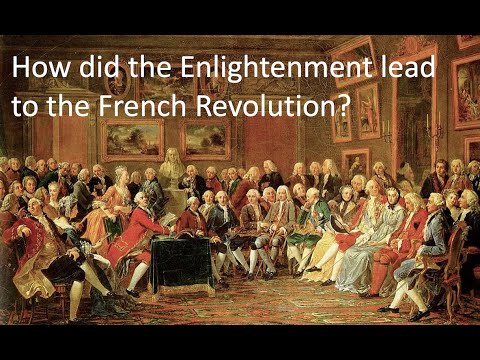
Video thumbnail
youtube.com/watch?v=5HwZx5kQm9o ↗ Analyzed 2026-03-14 by claude-opus-4-6

Viewer Advisory

  • This is a pedagogical lecture with an explicitly stated interpretive framework, not a balanced survey of Enlightenment thought. Key thinkers (Locke, Montesquieu, Hume) and major projects (the Encyclopédie) are entirely omitted.
  • The characterization of Christianity as a Roman imperial tool of control is a minority scholarly position presented as established fact.
  • The speaker's personal educational philosophy (children shouldn't attend school before 12-16) is presented alongside Rousseau's arguments in a way that may lead viewers to conflate historical analysis with contemporary advocacy.
  • The preview of Robespierre as 'misunderstood and underrated' signals a forthcoming sympathetic treatment that viewers should approach critically, given Robespierre's central role in the Terror.
  • Despite teaching in China and briefly acknowledging Chinese censorship, the speaker does not apply his Enlightenment principles of free expression critically to the Chinese context.
  • The lecture is at its best when reading primary sources and at its weakest when making sweeping historical generalizations — viewers should distinguish between these modes.
Central Thesis

The French Revolution was fundamentally a religious crusade that replaced the monotheistic worldview with a new religion of reason, made possible by three types of genius — the poet (Rousseau), the prophet (Robespierre), and the prince (Napoleon) — and its success depended on the active cooperation of all three.

  • Human history has been shaped by four successive worldviews — animistic, polytheistic, monotheistic, and modern/deist — each believing itself superior to the previous and seeking to displace it.
  • The Enlightenment was primarily a movement through which the rising middle class established a distinct group identity based on education, achievement, and morality, differentiating themselves from both the nobility and the peasantry.
  • The Enlightenment's substitution of 'reason' for Dante's 'love' as the central organizing principle of human life was a fateful divergence, because reason without love's interconnectedness can justify concentration camps and nuclear bombs.
  • Rousseau's concept of the 'general will' — that people acting from reason alone would converge on the common interest — became the ideological basis of the French Revolution but is fundamentally idealistic and impractical.
  • The French Revolution's attempt to destroy Christianity and establish a secular state based on reason led to civil wars between revolutionary urbanites and religious peasants.
  • Christianity was originally developed as a tool of control by the Roman Empire to assimilate Jews and barbarian migrants, not as an organic spiritual movement.
  • Schools are primarily designed to control children rather than educate them, and Rousseau's argument that children should not be formally educated before age 12 is essentially correct.
Qualitative Scorecard 2.9 / 5.0 average across 7 axes
Historical Accuracy ▸ Expand
The lecture's direct readings of primary sources (Descartes, Goethe, Kant, Rousseau) are generally accurate and well-selected. The four-worldview framework is a reasonable pedagogical simplification. However, several claims are historically problematic: Christianity being 'a mechanism developed by the Roman Empire' to assimilate Jews and barbarians ignores three centuries of pre-Constantinian Christianity and is not the consensus scholarly view; the claim that only two countries don't use the metric system (US and UK) is inaccurate as the UK officially adopted metric and several other countries (Myanmar, Liberia) are commonly cited as non-metric; the claim that Dante's central principle was 'love' while the Enlightenment's was 'reason' is a valid interpretive distinction but oversimplifies both; the dismissal of Voltaire as 'not a very deep thinker' is a minority view among historians of philosophy. The bourgeoisie/petite bourgeoisie/proletariat framework is reasonable but somewhat anachronistic for the pre-revolutionary period.
3
Argumentative Rigor ▸ Expand
The lecture presents a coherent framework connecting Enlightenment ideas to the French Revolution, and the primary source readings effectively support the argument. The poet/prophet/prince typology (Rousseau/Robespierre/Napoleon) is an elegant organizing device. However, several logical leaps weaken the argument: the transition from 'reason can justify anything including concentration camps' to the general framework is asserted without development; the claim that the Enlightenment was 'fundamentally' a middle-class identity project reduces complex intellectual history to social function; and the distinction between Dante's 'love' and the Enlightenment's 'reason' is presented as the key difference but not rigorously argued. The speaker does acknowledge limitations ('I know it's a bit simple') and explicitly flags problematic ideas (calling Rousseau's measurement concept 'actually a really dumb idea'), which shows some intellectual honesty.
3
Framing & Selectivity ▸ Expand
The lecture is selective but reasonably transparent about its selectivity. The speaker explicitly states he is oversimplifying and that the framework is 'good enough' for pedagogical purposes. The selection of thinkers is defensible (Descartes, Goethe, Kant, Rousseau) though the omission of Locke and Montesquieu is significant given their direct relevance to revolutionary constitutionalism. The dismissal of Voltaire is suspiciously convenient — it removes the Enlightenment's most famous advocate for religious tolerance and empiricism, allowing the lecture to focus on the more radical Rousseau. The framing of Christianity as a Roman imperial tool, while containing a grain of truth about Constantinian adoption, is presented one-sidedly without acknowledging the religion's pre-imperial history or its genuine spiritual appeal.
3
Perspective Diversity ▸ Expand
The lecture presents a single interpretive framework throughout — the Enlightenment as middle-class identity formation leading to revolutionary crusade. No alternative interpretations are seriously engaged with: the Enlightenment as genuine intellectual progress, as economic transformation, or as part of broader global intellectual exchange (Islamic Golden Age influences, Chinese civil service examination system). The speaker's personal views on education (agreeing with Rousseau that children shouldn't attend school before 12-16) are presented alongside the historical material without clearly distinguishing between historical analysis and personal opinion. The comparison between the French and American revolutions is noted but only briefly, without exploring the American perspective in any depth.
2
Normative Loading ▸ Expand
The lecture is moderately normatively loaded but less so than the speaker's geopolitical lectures. The speaker explicitly states 'none of these beliefs is inherently superior to the other,' which is commendably neutral. However, normative judgments creep in: calling the French Revolution 'the most significant event in human history' is evaluative; describing Robespierre as 'one of the most misunderstood and underrated individuals in human history' telegraphs a revisionist sympathy; the aside about schools being designed to 'control children' rather than educate them is a strong normative claim presented as factual observation; and the distinction between love and reason, where reason can justify 'concentration camps, nuclear bombs, genocide,' loads the Enlightenment with negative associations. The speaker does flag when he's offering personal opinion ('I myself also believe very heavily in this idea').
3
Determinism vs. Contingency ▸ Expand
The lecture presents a somewhat deterministic progression from animistic to polytheistic to monotheistic to modern worldviews, driven by structural forces (civilization, mass society, gunpowder revolution). However, the speaker introduces significant contingency through the poet/prophet/prince framework, explicitly arguing that the French Revolution required the cooperation of three specific individuals and that 'the odds were completely against the French Revolution.' The acknowledgment that 'most revolutions will fail' and that class loyalties shift according to circumstance also introduces contingency. The claim that 'without the French Revolution, modernity could not happen' is deterministic in retrospect but acknowledges the revolution was 'entirely unpredictable.'
3
Civilizational Framing ▸ Expand
This lecture is primarily about European intellectual history and does not heavily engage in civilizational comparison. The framing is largely internal to European development. When China is mentioned, it is in passing and neutral — the speaker references Confucius as an example of deference to authority, notes that his students are Chinese middle class, uses Beijing as an example of particular vs. general will, and briefly mentions Mao Zedong as a 'petite bourgeoisie' provincial elite. The speaker's willingness to openly discuss Chinese censorship laws in front of Chinese students, using Kant's framework, is notable and somewhat courageous.
3
Overall Average
2.9
Civilizational Treatment
CHINA

China is mentioned neutrally and in passing: Confucius as an example of intellectual authority, students as Chinese middle class, Beijing as an example in a thought experiment about general vs. particular will, Mao as a provincial petit bourgeois. The speaker explicitly discusses Chinese censorship as a constraint on his teaching, using Kant's public/private reason distinction.

UNITED STATES

America is mentioned briefly as one of two countries not using the metric system, framed as opposition to the French Revolution's legacy. The American Revolution is noted as fundamentally different from the French Revolution in rejecting Rousseau's idealistic view of human nature.

THE WEST

The West/Europe is the primary subject of the lecture and is treated as the site of a specific intellectual development — the Enlightenment — without strong positive or negative valence. European colonialism and imperialism are not discussed despite being direct consequences of the ideas covered.

Named Sources

primary_document
René Descartes — Meditations on First Philosophy
Passages are read aloud and analyzed to demonstrate the Enlightenment's emphasis on individual reason and systematic doubt as the path to truth. The speaker correctly identifies 'cogito ergo sum' and the tautological nature of Descartes' proof of God's goodness.
✓ Accurate
primary_document
Johann Wolfgang von Goethe — Faust
Extended passages from both Part I and Part II are read to illustrate the Enlightenment's optimistic view of human curiosity and God's mercy. The Faust-Mephistopheles wager is presented as a rewriting of the Book of Job with an Enlightenment sensibility.
✓ Accurate
primary_document
Immanuel Kant — 'What is Enlightenment?'
Extended passages are read to introduce Kant's definition of enlightenment as emergence from self-imposed immaturity, his argument for absolute freedom of expression, and his distinction between the public and private use of reason.
✓ Accurate
primary_document
Jean-Jacques Rousseau — Emile, or On Education
Passages are read to present Rousseau's argument that children should not be formally educated before age 12, as their faculty of reason has not yet developed. The speaker uses this to argue that modern schooling is primarily about social control.
✓ Accurate
primary_document
Jean-Jacques Rousseau — Discourse on the Origin of Inequality
The famous opening passage on private property is read to argue that inequality, war, and patriarchy originate from the concept of private property.
✓ Accurate
primary_document
Jean-Jacques Rousseau — The Social Contract
Multiple passages are read covering the general will, the relationship between freedom and law, population growth as a measure of good government, and the rejection of Christianity as incompatible with republican government. Described as 'the bible of the French Revolution.'
✓ Accurate
primary_document
The Book of Job (Bible)
Summarized as background for understanding Goethe's Faust. The speaker presents Job as a story designed to inspire fear and obedience, which Faust then reinterprets with Enlightenment confidence.
✓ Accurate
primary_document
Dante — The Divine Comedy
Referenced as a prophetic precursor to the Enlightenment whose central principle was love rather than reason, a distinction the speaker argues is crucial.
? Unverified

Vague Appeals to Authority

  • 'As I keep on mentioning in this class, it is the religious worldview that underpins society and civilization' — presented as an established principle without sourcing.
  • 'Christianity was a mechanism developed by the Roman Empire in order to assimilate the Jews and then later on to assimilate barbarians' — a highly contested historical claim presented as course-established fact without scholarly attribution.
  • 'Most historians consider them [British and European Enlightenments] part of the same historical movement' — unnamed historians invoked to set up the speaker's contrarian distinction.
  • 'If you look at most revolutions this is how it works' — broad generalization about revolutionary dynamics without citing comparative revolution scholarship.

Notable Omissions

  • No engagement with scholarly debate about the Enlightenment's relationship to religion (e.g., Jonathan Israel's 'Radical Enlightenment' thesis vs. moderate Enlightenment scholarship by Robert Darnton or Roger Chartier).
  • No mention of the Scottish Enlightenment (Hume, Smith, Ferguson) as a distinct tradition, despite discussing the British/European distinction.
  • No discussion of Locke, who was arguably more influential than Rousseau on constitutional theory and whose social contract theory preceded Rousseau's.
  • No mention of Montesquieu's Spirit of the Laws and its influence on separation of powers, which was central to both the American and French revolutions.
  • No engagement with critiques of Rousseau's general will concept (e.g., Benjamin Constant's argument that it enables tyranny of the majority, or Isaiah Berlin's critique of positive liberty).
  • The claim that Christianity was 'a tool of control for the Roman Empire' ignores extensive scholarship on early Christianity as a grassroots movement (e.g., Rodney Stark, Wayne Meeks) and the three centuries of persecution before Constantine.
  • No mention of the Encyclopédie (Diderot and d'Alembert), arguably the signature Enlightenment project.
  • Voltaire is dismissed as 'not a very deep thinker' without engaging with his actual philosophical contributions (e.g., on tolerance, on the Lisbon earthquake, on English institutions).
Grand historical framing 00:00:07
The French Revolution is introduced as 'the most significant event in human history' and the 'most radical turning point in human history' — superlatives that elevate the lecture's subject matter to maximum importance.
Creates a sense of occasion and importance that frames the entire three-lecture series, encouraging students to pay close attention. The hyperbolic framing also positions the speaker as someone offering uniquely important knowledge.
Typological framework (poet/prophet/prince) 00:11:25
The speaker introduces a tripartite model — the poet (Rousseau), the prophet (Robespierre), and the prince (Napoleon) — as the three types of genius required for a successful revolution.
Creates a memorable narrative structure that organizes three complex historical figures into archetypal roles, making the material more accessible while also lending the analysis an air of universal applicability. The framework predetermines how each figure will be evaluated in subsequent lectures.
Direct address and contemporary relevance 00:58:25
When discussing Kant's distinction between public and private use of reason, the speaker applies it directly to his own situation as a teacher in China who must choose between being an 'employee of a school in China' following censorship laws or a 'citizen of the world' dedicated to human progress.
Makes abstract Enlightenment philosophy immediately concrete and personally relevant to the students, while also implicitly positioning the speaker as someone who has chosen intellectual integrity over institutional compliance — enhancing his authority.
Provocative assertion as settled fact 00:07:36
'Christianity was a mechanism developed by the Roman Empire in order to assimilate the Jews and then later on to assimilate barbarians who were economic migrants into the Roman Empire. Basically, it was a tool of control for the Roman Empire.'
Presents a highly contested interpretation of Christian origins as established course knowledge ('as you learn in this class'), bypassing the need to argue the case or acknowledge alternative scholarly views. Students absorb a radical reinterpretation of Christianity as background assumption.
Pedagogical self-deprecation 00:54:25
After reading Kant on how students rely on teachers rather than thinking for themselves: 'It's just easier for you to just sit there and take notes rather than to actually read these texts for yourself and understand them yourself. That's why we rely on me.'
Uses Kant's argument against his own pedagogical authority, creating a paradox that charms the audience while also reinforcing the Enlightenment values of independent thought — though the entire lecture structure (authoritative teacher lecturing to note-taking students) contradicts the stated ideal.
Personal testimony to reinforce historical argument 01:05:41
After presenting Rousseau's argument against formal education before age 12, the speaker adds: 'I myself also believe very heavily in this idea. I don't want to send my kids to school before age 12, possibly even age 16... I work in a school so I don't really trust schools.'
Blurs the line between historical analysis and personal advocacy, lending Rousseau's 18th-century argument contemporary credibility through the speaker's professional experience while not acknowledging the extensive developmental psychology literature that both supports and challenges Rousseau's position.
Foreshadowing with negative valence 00:31:32
When distinguishing between Dante's 'love' and the Enlightenment's 'reason': 'If you're capable of reasoning by yourself, you can reason anything including concentration camps, nuclear bombs, genocide.'
Plants a seed of critique within what is otherwise a sympathetic presentation of Enlightenment ideas, creating dramatic tension and foreshadowing the darker consequences of the French Revolution that will be covered in later lectures.
Socratic leading questions 00:06:14
Throughout the lecture, the speaker asks questions like 'Does that make sense?' and 'Any questions so far?' which function less as genuine invitations for dialogue and more as pacing devices and comprehension checks that create the appearance of collaborative learning.
Creates an illusion of interactive pedagogy while maintaining complete narrative control. The questions rarely invite genuine intellectual challenge — they confirm comprehension of the speaker's predetermined framework.
Strategic oversimplification with acknowledgment 00:10:43
'I know it's a bit simple but for the purpose of this class it's good enough' — said about the four-worldview framework.
Pre-empts criticism of the framework's oversimplification while still employing it as though it were adequate for analysis. The acknowledgment of simplicity paradoxically gives the speaker permission to use the simplified framework without further qualification.
Delayed critique to maintain suspense 01:17:41
After presenting Rousseau's argument that population growth measures good government, the speaker adds: 'Now what we will learn later on is this is actually a really dumb idea.'
Creates anticipation for future lectures while signaling that the speaker is not an uncritical advocate for every idea he presents, building credibility. However, the critique is deferred rather than developed, leaving students with the original idea as their primary takeaway.
⏵ 00:00:07
The French Revolution... I believe to be the most significant event in human history.
Sets the stakes for the entire three-lecture series and reveals the speaker's Eurocentric framing of world history. Many historians would consider the agricultural revolution, the invention of writing, or the industrial revolution as equally or more significant.
A lecturer who in other series critiques Western-centric historical narratives here places a European event at the absolute pinnacle of human significance, ahead of all developments in Chinese, Islamic, Indian, or other civilizations.
⏵ 00:07:36
Christianity was a mechanism developed by the Roman Empire in order to assimilate the Jews and then later on to assimilate barbarians who were economic migrants into the Roman Empire. Basically, it was a tool of control.
Presents a reductively instrumentalist view of Christianity's origins that ignores three centuries of pre-Constantinian grassroots growth, persecution, and genuine spiritual appeal. This framing reduces one of the world's major religions to a cynical state project.
The speaker's willingness to describe Christianity as a state tool of control while teaching in China — where the state exercises direct control over religious practice, appoints bishops, and restricts religious expression — creates an unacknowledged parallel. The Chinese Communist Party's management of religion (including the Three-Self Patriotic Movement and the Chinese Patriotic Catholic Association) fits the 'mechanism of control' description at least as well.
⏵ 00:31:32
If you're capable of reasoning by yourself, you can reason anything including concentration camps, nuclear bombs, genocide.
A genuinely insightful observation about the limits of pure reason divorced from moral sentiment. This is the lecture's most philosophically interesting moment, connecting Enlightenment optimism to its darkest consequences.
⏵ 00:58:25
I'm your teacher... I can perceive myself as an employee of a school in China. Therefore, I must be aware of censorship laws in China... But if I see myself as a free individual in service of human progress, then my job is to enlighten you.
A remarkably candid moment where the speaker explicitly acknowledges Chinese censorship and positions himself as choosing intellectual freedom over institutional compliance. This is both courageous in context and revealing of the speaker's self-conception as an Enlightenment figure.
The speaker invokes Kant's freedom of expression to justify his own teaching practice, yet in his geopolitical lectures he has been notably uncritical of China's extensive censorship apparatus, internet restrictions, and suppression of dissent. Kant's 'absolute freedom of expression' principle, which the speaker endorses here, is systematically violated by the Chinese state without comparable criticism from the speaker.
⏵ 00:12:38
Robespierre is in my opinion one of the most misunderstood and underrated individuals in human history.
Telegraphs a revisionist sympathy for Robespierre that will shape the next lecture. Most mainstream historical assessments acknowledge Robespierre's role in the Terror (tens of thousands executed). Calling him 'underrated' signals the speaker will offer a sympathetic reappraisal.
⏵ 01:09:08
Schools are not designed to educate children. Schools are first and foremost designed to control children.
Reveals the speaker's deeply skeptical view of institutional education, presented as factual observation rather than opinion. Ironic given that the speaker is delivering this message within the institutional context of a school.
The speaker critiques schools as systems of control while teaching in China, where the education system is explicitly designed to instill 'Xi Jinping Thought' and ideological conformity — a far more direct example of educational control than the generic Western school systems Rousseau was critiquing.
⏵ 01:11:47
Man is born free and everywhere he is in chains. Here is one who thinks he is the master of others yet is more enslaved than they are.
The speaker reads Rousseau's most famous line and interprets it to mean that systems of oppression enslave the masters as much as the enslaved — a reading that depoliticizes the quote by universalizing suffering rather than identifying specific oppressors.
⏵ 01:17:04
The government under which the population shrinks is the worst. Over to you calculators. Count, measure, compare.
The speaker reads Rousseau's claim that population growth is the best measure of good government — and then notes 'this is actually a really dumb idea.' This is one of the few moments where the speaker critically evaluates a source rather than endorsing it.
By Rousseau's own metric, China's government — presiding over four consecutive years of population decline and record-low births (7.92 million in 2025) — would be among 'the worst.' The speaker flags this as a bad idea but doesn't make this connection explicit, despite teaching Chinese students.
⏵ 01:19:08
Genuine Christians are made to be slaves and they know it and don't mind much. This short life counts for too little in their eyes.
The speaker reads Rousseau's harsh assessment of Christianity as inherently servile, which serves as the philosophical justification for the French Revolution's attack on the Church. The speaker presents this without rebuttal.
⏵ 01:07:42
The savage is an explorer. The savage is a problem solver. The savage is free and independent to make his own destiny.
The speaker reads Rousseau's 'noble savage' argument with evident enthusiasm, presenting the contrast between the dull, habitual peasant and the free, reasoning 'savage' as Rousseau's educational ideal. The uncritical use of 'savage' in 2025 is notable.
claim The ideas of the Enlightenment thinkers covered in this lecture will be shown, over the course of the semester, to lead to communism and World War II.
00:08:44 · Not falsifiable
unfalsifiable
This is a pedagogical claim about future course content, not a testable prediction about world events.
Verdict

Strengths

The lecture's greatest strength is its extensive use of primary sources — the speaker reads substantial passages from Descartes, Goethe, Kant, and Rousseau, allowing students to engage directly with Enlightenment thought. The four-worldview framework, while simplified, provides a useful scaffolding for understanding the intellectual revolution the Enlightenment represented. The speaker's pedagogical style is engaging, using contemporary examples (the Chinese middle class, Beijing road investment, rice vs. potatoes) to make 18th-century European philosophy accessible. The observation about the crucial difference between Dante's 'love' and the Enlightenment's 'reason' is genuinely insightful and sets up a thoughtful critique of Enlightenment rationalism. The willingness to flag problematic ideas (calling Rousseau's population metric 'a really dumb idea') demonstrates intellectual honesty absent from some of the speaker's other lectures.

Weaknesses

The lecture suffers from several significant omissions and distortions: the characterization of Christianity as purely a Roman imperial control mechanism is historically inaccurate and ideologically driven; the dismissal of Voltaire as 'not a very deep thinker' appears designed to simplify the narrative rather than reflect scholarly consensus; the complete omission of Locke, Montesquieu, and the Encyclopédie creates a misleadingly narrow picture of the Enlightenment; the blurring between historical analysis and personal advocacy (especially regarding Rousseau's educational philosophy) undermines scholarly objectivity; and the speaker's personal endorsement of not sending children to school before age 12-16 introduces an eccentric pedagogical opinion as though it follows naturally from Enlightenment philosophy. The treatment of class dynamics, while useful, is somewhat anachronistic in applying Marxist categories to the pre-revolutionary period.

Cross-References

BUILDS ON

  • Earlier Civilization lectures covering Dante's Divine Comedy and its concept of love as the 'light of heaven' (referenced repeatedly as foundational).
  • Previous lectures on the Renaissance, Reformation, Scientific Revolution, and Gunpowder Revolution (referenced as 'as we discussed').
  • Earlier lectures on polytheistic worldviews including Greek mythology (Hector vs. Achilles) and Roman religion.
  • Previous coverage of the transition from feudalism to nation-states and the development of absolute monarchies.
This lecture is notably different in character from the Geo-Strategy series — it is a genuine history-of-ideas lecture rather than a geopolitical analysis. The speaker is at his strongest when reading and interpreting primary sources, which he does extensively and with evident enthusiasm. The lecture contains no geopolitical predictions, no game theory, and minimal contemporary political commentary (aside from the brief aside about Chinese censorship and French-Islamic tensions). The poet/prophet/prince framework echoes the speaker's general tendency toward tripartite typologies seen in other lectures. The sympathetic framing of Robespierre signals that the next lecture may offer a revisionist defense of revolutionary violence, consistent with the speaker's pattern across series of sympathizing with actors typically viewed negatively in Western historiography.