Named Sources
book
? Unverified
Immanuel Kant / Critique of Pure Reason
Central text of the lecture. The speaker presents Kant's epistemology — noumena/phenomena distinction, a priori synthetic knowledge, space and time as pure intuitions, the twelve categories, and the three-stage process of apprehension-reproduction-recognition. The speaker admits he has not completed reading it.
book
✓ Accurate
Immanuel Kant / Critique of Practical Reason
Referenced for Kant's moral philosophy, specifically the categorical imperative and its three formulations (universal law, humanity as end, autonomous will).
book
? Unverified
G.W.F. Hegel / Phenomenology of Spirit
Presented as Hegel's major work introducing the concept of Geist and the dialectic. The speaker admits he is not an expert on Hegel and warns his interpretation may not match Hegel's words.
book
? Unverified
Dante Alighieri / Divine Comedy
Presented as the original source of the thesis that 'imagination is the animating force of the universe and love is the unifying force,' which Kant and Hegel then systematized. This is an idiosyncratic interpretive frame not standard in philosophical scholarship.
scholar
✓ Accurate
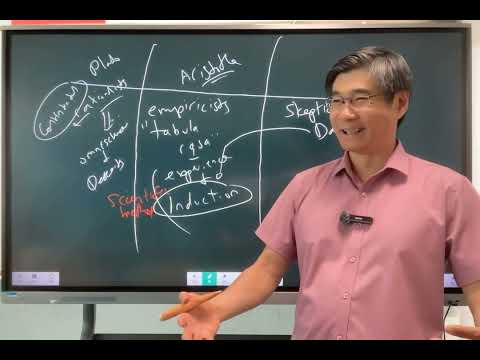
Plato
Presented as one of two foundational Western philosophers, characterized as a dualist whose Form of the Good became the basis for Christianity and whose rationalist descendants include Descartes, Leibniz, and Spinoza.
scholar
✓ Accurate
Aristotle
Presented as the materialist counterpart to Plato, focused on the prime mover, telos, observation, and experience — the basis for science and empiricism.
scholar
✓ Accurate
David Hume
Presented as the skeptic who negated induction through the black swan argument and argued true knowledge is impossible, prompting Kant to write the Critique of Pure Reason in response.
scholar
✓ Accurate
John Locke
Presented as the chief empiricist who proposed tabula rasa (blank slate) theory, which Kant refuted by showing a priori synthetic knowledge must exist.
scholar
? Unverified
Albert Einstein
Cited as having read Kant at age 16 and being heavily influenced by Kantian ideas of spacetime in developing the theory of relativity. Also used to illustrate the quantum mechanics debate through the EPR paradox and quantum entanglement.
scholar
? Unverified
Jean-Jacques Rousseau
Referenced for the concept of the 'general will,' which the speaker connects to Kant's categorical imperative as its individualized form.
Vague Appeals to Authority
- 'Neuroscience is telling us today that we hallucinate reality' — no specific neuroscientists, studies, or papers cited.
- 'If you study quantum mechanics you will discover a lot of ideas were heavily influenced by Kant' — no specific physicists or works cited beyond Einstein.
- 'He's actually regaining popularity in our age because of the idea of the Geist' — no specific scholars or movements cited for the Hegel revival.
- 'We have not made major advances in science' since WWII — an extraordinary claim presented without any supporting evidence or definition of 'major advance.'
Notable Omissions
- No engagement with standard Kant scholarship (e.g., Henry Allison, Paul Guyer, Christine Korsgaard) that would provide more accurate readings of the Critique.
- No mention of the significant philosophical responses to Kant from Fichte, Schelling, or the post-Kantian idealist tradition that bridges Kant and Hegel.
- No discussion of the extensive criticism of Hegel's system from analytic philosophy (Russell, Popper's 'The Open Society and Its Enemies').
- No acknowledgment that the Dante-to-Kant intellectual lineage is not a standard reading in philosophical historiography.
- No mention of Kant's political philosophy ('Perpetual Peace') despite claiming Kant 'conceptualized the United Nations.'
- No discussion of the Copenhagen interpretation vs. many-worlds interpretation when discussing quantum mechanics, or any actual physicists working on these problems.
- The claim that Einstein's relativity was inspired by Kant, while containing a grain of truth (Einstein did read Kant), vastly overstates the direct intellectual influence compared to Maxwell, Lorentz, and Mach.
- No engagement with contemporary philosophy of mind or cognitive science that would complicate the simple 'Kant was right' narrative (e.g., embodied cognition, predictive processing).
- No mention of non-Western philosophical traditions that address similar epistemological questions (Buddhist philosophy of mind, Chinese philosophy).