Predictive History Audit / Systematic Content Analysis
Civilization
Episode 56 · Posted 2025-05-29

What Marx Got Wrong

This lecture examines Karl Marx's philosophy by first reviewing its intellectual foundations in Kant and Hegel, then presenting Marx's theory of dialectical materialism, class struggle, and the teleological progression from feudalism through capitalism to communism. The speaker praises Marx's diagnosis of capitalism's problems — its all-consuming nature, consolidating inequality, and four forms of alienation — as brilliant and still relevant. However, the lecture argues Marx got fundamental things wrong: religion, not economics, drives human history; people seek status, not class; history is cyclical and contingent rather than linear and inevitable; and the vanguard concept inevitably produces authoritarian bureaucracies. The lecture connects these critiques to contemporary issues including China's education system, the North Korea/South Korea comparison, and Trump's political appeal, concluding that capitalism and communism share the same materialist worldview and have jointly created modern alienation.

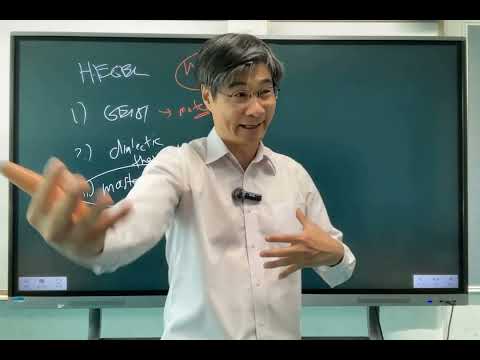
Video thumbnail
youtube.com/watch?v=m24LnQ-Ksjk ↗ Analyzed 2026-03-14 by claude-opus-4-6

Viewer Advisory

  • The argument that Protestantism drove capitalism is Max Weber's famous thesis from 1905, not the speaker's original insight — read Weber's 'The Protestant Ethic and the Spirit of Capitalism' for the actual source and its extensive scholarly debate.
  • The claim that North Koreans are happier than South Koreans contradicts virtually all available evidence, including defector testimony, and the speaker provides no evidence beyond fertility rate differentials (which have many other explanations).
  • The romanticization of the Cultural Revolution ignores an estimated 500,000-2,000,000 deaths and millions persecuted — survivors' testimony directly contradicts the 'people were happier' claim.
  • The 'elite overproduction' concept presented as the speaker's framework is Peter Turchin's thesis.
  • The critique of Marx for monocausal economic determinism applies equally to the speaker's own monocausal religious determinism.
  • The lecture is delivered to Chinese students in an educational setting, which contextualizes both the pointed critiques of Chinese education and the more provocative claims about the Cultural Revolution.
Central Thesis

Marx brilliantly diagnosed capitalism's problems but fundamentally misunderstood human nature — people are driven by religion, status, and the need for God rather than by economics and class consciousness — which is why communism inevitably degenerated into theocratic personality cults rather than producing workers' paradise.

  • Marx's dialectical materialism inverted Hegel's idealism, placing economics as the base and ideas as superstructure, but this inversion was a fundamental error inherited from the Young Hegelians' misreading of Hegel.
  • The transition from hunter-gatherer to agricultural society was driven by religion, not economic scarcity, as evidenced by hunter-gatherers being taller and better-fed than early farmers.
  • The transition from feudalism to industrial capitalism was driven by the Protestant Reformation's psychological anxiety about predestination, not by technology — essentially Max Weber's thesis presented without attribution.
  • Marx made three fundamental errors: people care about religion not economics, people want God not heaven (material utopia), and people seek status not class.
  • Communism and capitalism are 'the same religion' — both are materialist ideologies that reduce humans to economic animals and both derive from Christianity.
  • Communist states (USSR, China, North Korea) inevitably became theocracies with cults of personality because they fulfilled the human need for religion and status that Marx denied.
  • Capitalism has survived partly by adopting communist policy prescriptions (child labor laws, universal education, workers' rights).
  • China's combination of communism and capitalism has created 'the worst possible society' that is destroying children through extreme educational pressure.
  • North Koreans are 'probably happier' than South Koreans because they have religion, purpose, and meaning while South Koreans have only money and competition.
  • Bakunin correctly predicted that a vanguard elite would destroy communism from within by becoming a self-perpetuating technocratic bureaucracy.
Qualitative Scorecard 2.4 / 5.0 average across 7 axes
Historical Accuracy ▸ Expand
The broad philosophical history (Kant → Hegel → Marx) is reasonably accurate, and the Communist Manifesto's publication context (1848 revolutions, potato famine) is correct. Marx's relationship with Engels and Bakunin is accurately portrayed. However, several specific claims are problematic: attributing 'God is dead' to Hegel rather than Nietzsche; claiming hunter-gatherers were 'on average like six foot' (archaeological evidence suggests 5'8"-5'10" on average, varying by population); the claim that the transition to agriculture was driven purely by religion oversimplifies a complex, multi-causal process debated by archaeologists (Göbekli Tepe supports a religious role but doesn't establish religion as sole cause); and presenting Weber's Protestant Ethic thesis without attribution while treating it as the speaker's own original insight.
3
Argumentative Rigor ▸ Expand
The lecture's central argument — that Marx misunderstood human nature because religion matters more than economics — suffers from the same reductionism it criticizes in Marx. Just as Marx reduced everything to economics, the speaker reduces everything to religion, substituting one monocausal explanation for another. The claim that 'people care about religion not economics' is asserted rather than demonstrated, and the evidence offered (hunter-gatherer height, Protestant ethic, North Korean fertility rates) is cherry-picked and does not support the sweeping generalization. The argument that North Koreans are 'probably happier' than South Koreans is made without any credible evidence and ignores defector testimony, famine history, and human rights documentation. The claim that Chinese people were happier during the Cultural Revolution is historically irresponsible given the documented mass suffering. The lecture also conflates different types of 'religion' (institutional religion, cult of personality, quasi-religious ideological commitment) without distinguishing between them.
2
Framing & Selectivity ▸ Expand
The lecture is highly selective. Weber's thesis is presented without attribution. The critique of Marx omits Marx's own later revisions and the extensive post-Marxist scholarship that addresses these objections. The North Korea comparison selects only fertility rate as evidence while ignoring GDP, freedom indices, nutrition, life expectancy, and defector testimony. The Cultural Revolution is mentioned only as an event that 'removed the old elite' and enabled economic growth — the mass violence, persecution, destruction of cultural heritage, and human suffering are entirely omitted. The speaker presents his counter-thesis (religion drives history) with the same certitude he criticizes in Marx, without acknowledging that this is itself a contested position in historiography.
2
Perspective Diversity ▸ Expand
The lecture presents essentially one perspective: the speaker's own synthesis of Weber (unattributed), Turchin (unattributed), and anti-materialist philosophy. No alternative critiques of Marx are presented — there is no engagement with liberal critiques (Popper, Hayek), no engagement with analytical Marxist responses to these objections, no consideration that the relationship between religion and economics might be bidirectional rather than one-directional. Student questions are fielded but answered with the speaker's predetermined framework rather than used to genuinely explore alternative viewpoints.
2
Normative Loading ▸ Expand
Despite the academic setting, the lecture is heavily normatively loaded. Marx is described as a 'prophet' and 'genius' but his theory as 'wrong' and 'too simple.' The speaker calls Chinese education 'unconscionable' and 'evil' — emotionally charged language that replaces analysis. China's combination of communism and capitalism is called 'the worst possible society.' North Korea's poverty is dismissed as 'capitalist brainwashing.' The Cultural Revolution is romanticized. Capitalism is described as an 'evil religion' that has 'enslaved' humanity. These are evaluative judgments presented as analytical conclusions.
2
Determinism vs. Contingency ▸ Expand
Interestingly, the lecture explicitly criticizes Marx's determinism and acknowledges randomness and contingency in history — listing the monophysite revolution, gunpowder revolution, Protestant Reformation, and Age of Exploration as contingent factors. However, the speaker then replaces Marx's economic determinism with his own religious determinism: 'It's religion that drives human history, not economics.' The critique of linear progress is sound, but the replacement framework is itself quite deterministic, just with a different prime mover.
3
Civilizational Framing ▸ Expand
The lecture's civilizational framing is complex. China receives both criticism and implicit sympathy — the speaker criticizes Chinese education as 'unconscionable' and Chinese bureaucrats as lacking 'imagination' and 'empathy,' but also suggests communism in China was really a traditional peasant rebellion and that Chinese people were happier during the Cultural Revolution. The West is treated as the source of both capitalism and communism — branches of Christianity that have jointly conquered the world. North Korea receives surprisingly favorable treatment as a theocratic society with purpose and meaning.
3
Overall Average
2.4
Civilizational Treatment
CHINA

China is characterized ambivalently: its communist revolution is reframed as a traditional peasant rebellion with communist veneer; its current system is called 'the worst possible society' combining the worst of communism and capitalism; its education system is called 'evil' and 'unconscionable'; but ordinary Chinese people during the Cultural Revolution are said to have been happier than today. The speaker notes 'America has conquered China' through shared materialism. Chinese bureaucrats are described as having 'no imagination' and 'no empathy.'

UNITED STATES

America is mentioned primarily as the paradigmatic capitalist society. Trump's appeal is explained through the lens of religious need — he gives people 'emotional solidarity' and 'a belief in a better world' that Democrats fail to provide. America's cultural influence is presented as having 'conquered China' through shared materialist values.

RUSSIA

Russia is mentioned only briefly as a site where communist revolution occurred despite Marx's prediction it should happen in Germany, and as an example of communist theocracy under Stalin. No contemporary Russian politics discussed.

THE WEST

The West is implicitly characterized as the source of both capitalism and communism, which are presented as branches of Christianity that have spread materialism globally. European colonialism is mentioned as a factor in capitalism's rise through the Age of Exploration.

Named Sources

scholar
Immanuel Kant
Reviewed as the foundation of modern epistemology — the idea that reason is innate and we construct our experienced reality through categories of space and time. Presented as having three unresolved problems (no proof of objective reality, no source for reason, no uniformity guarantee) that Hegel then resolved.
? Unverified
scholar
Georg Wilhelm Friedrich Hegel
Presented as resolving Kant's three problems through the concept of the Geist, the dialectic (thesis-antithesis-synthesis), and the master-slave dialectic. The speaker correctly identifies Marx as building on and inverting Hegel's idealism. However, the speaker incorrectly attributes 'God is dead' to Hegel rather than Nietzsche — Hegel discussed the 'death of God' in his Philosophy of Religion but in a very different context.
✗ Inaccurate
primary_document
Karl Marx / The Communist Manifesto
Opening and closing passages read aloud. Praised as 'beautifully written' and 'poetry.' Used to illustrate Marx's Hegelian framework — the spectre of communism as the Geist manifesting in history.
✓ Accurate
primary_document
Karl Marx / Capital
Mentioned as Marx's most famous work, noting that Engels completed it because Marx was 'extremely undisciplined' and procrastinated. Not substantively discussed.
✓ Accurate
primary_document
Karl Marx / Early letters on production and individuality
A passage from Marx's early writings (likely the 1844 Manuscripts or the James Mill excerpt) is read aloud to illustrate Marx's vision of unalienated production where creating for others affirms one's individuality. Used sympathetically to show Marx's humanistic idealism.
✓ Accurate
book
Thomas Piketty / Capital in the Twenty-First Century
Cited for the argument that financial returns (5%) systematically exceed manufacturing returns (2%), leading to financialization and unsustainability of capitalism. Presented as working within the Marxist tradition.
✓ Accurate
book
Carroll Quigley / Tragedy and Hope
Referenced as a Georgetown historian who argued capitalism goes through three phases: consumer capitalism, financial capitalism, and monopoly capitalism. Used to support the claim that capitalism inevitably leads to crisis.
? Unverified
scholar
Mikhail Bakunin
Presented as Marx's anarchist rival who correctly predicted that a vanguard elite would become a self-perpetuating bureaucracy that brutalizes humanity. Extended passage quoted about the dangers of scientific/technocratic domination. Applied to contemporary AI and Chinese bureaucracy.
✓ Accurate

Vague Appeals to Authority

  • 'As we discussed before' and 'as we discussed last class' — repeated references to previous lectures as established fact without providing the underlying evidence.
  • 'We know because if you dig up skeletons of hunter-gatherers, they're taller than farmers' — references archaeological evidence without citing specific studies or sites.
  • 'And this has been confirmed by neuroscience, by artificial intelligence, micro mechanics' — claims Kant's epistemology has been confirmed by modern science without citing any specific research.
  • 'There was a huge news that a nine-year-old kid in Beijing killed himself' — anecdotal current event used to support sweeping claims about Chinese education without broader statistical context.
  • 'Most of these kids will develop depression by age 14' — sweeping claim about Chinese children without citing any study or data source.

Notable Omissions

  • Max Weber's 'The Protestant Ethic and the Spirit of Capitalism' is the lecture's most glaring omission — the entire argument about Protestantism driving capitalism is Weber's thesis, presented without any attribution to Weber.
  • No engagement with analytical Marxism or post-Marxist thought (G.A. Cohen, Erik Olin Wright, Ernesto Laclau) that has addressed many of the critiques raised.
  • No discussion of Marx's own later self-corrections, including his interest in Russian peasant communes and his increasing skepticism about unilinear historical development.
  • No engagement with Gramsci's concept of cultural hegemony, which directly addresses the religion/ideology gap the speaker identifies.
  • No reference to Durkheim's work on religion and social solidarity, which provides a more rigorous sociological framework for the claims being made.
  • No engagement with the extensive literature on happiness economics (Easterlin Paradox, World Happiness Report) when making claims about relative happiness in North Korea vs South Korea.
  • Peter Turchin's 'elite overproduction' thesis is used without attribution when discussing why revolutions occur.
  • No mention of the vast human cost of the Cultural Revolution (estimated 500,000 to 2 million deaths, millions persecuted) when claiming people were happier during that period.
Opening thought experiment 00:00:24
The speaker presents two scenarios — being a wealthy lawyer vs. surviving on an island with strangers — and suggests many people would be happier in the second scenario because humans want purpose and community.
Primes the audience to accept the lecture's anti-materialist thesis before any evidence is presented. The thought experiment is designed to produce a counterintuitive answer that makes the audience receptive to the claim that economics doesn't drive human satisfaction.
Unattributed appropriation 00:29:00
The entire argument that Protestantism's anxiety about predestination drove the development of capitalism is Max Weber's 'Protestant Ethic and the Spirit of Capitalism' (1905), presented without ever naming Weber.
Allows the speaker to present a well-known scholarly thesis as his own original insight, enhancing his authority while depriving the audience of the ability to read the original source and its extensive critiques.
False equivalence 00:35:17
'Capitalism and communism are the same religion' — presented as a profound insight that resolves the apparent contradiction of two opposing systems.
Collapses an enormously complex historical and ideological relationship into a neat formula that supports the speaker's thesis that materialism is the shared enemy. This oversimplification prevents the audience from understanding the real differences between these systems and their actual historical interactions.
Shock value assertion 01:03:35
'If I had to bet which nation had the best future, I would bet North Korea over South Korea' and 'if you go to North Korea, they're probably happier than they are in South Korea.'
Generates a dramatic counterintuitive claim that rivets audience attention and demonstrates the speaker's willingness to challenge conventional wisdom. The provocation substitutes for evidence and makes the audience feel they are receiving forbidden insight.
Selective evidence from archaeology 00:26:35
Claims hunter-gatherers were 'on average like six foot' while farmers were 'on average maybe five foot' to prove economics didn't drive the agricultural transition.
Uses a real but exaggerated data point (height differences between hunter-gatherers and early farmers) to support a sweeping monocausal claim (religion drove agriculture), ignoring that height differences demonstrate nutritional impact but don't prove religion was the cause of transition.
Emotional appeal through child suffering 01:09:00
The story of a nine-year-old in Beijing who killed himself, connected to the speaker's own seven-year-old son, used to condemn Chinese education as 'unconscionable and evil.'
Transforms an analytical discussion of capitalism and communism into a visceral emotional appeal. The anecdote personalizes the abstract argument and makes disagreement feel like indifference to child suffering.
Socratic leading questions 00:10:03
Throughout the lecture: 'Does that make sense?' 'Right?' 'Okay?' — repeated dozens of times, always after presenting a contestable claim as if it were self-evident.
Creates a rhythm of assertion-confirmation that discourages critical questioning. Students who might disagree face social pressure to nod along with the implied consensus.
Romanticization of suffering 01:12:16
'I would argue that even though China was a lot poorer during the Cultural Revolution, people were a lot happier during the Cultural Revolution than they are today.'
Romanticizes a period of documented mass persecution, famine, and violence to support the thesis that material deprivation with ideological purpose is preferable to material comfort without it. Erases the experiences of millions who suffered.
Appeal to prophetic authority 00:40:42
Marx is described as a 'prophet,' a 'poet prophet preaching of a new world to come,' from 'ten generations of Harvard professors' (rabbis), a 'genius' whose family 'were all geniuses.'
Elevates Marx to religious-prophetic status before critiquing him, which paradoxically reinforces the speaker's own authority — if Marx was a genius-prophet and even he got it wrong, how much more impressive is the speaker's correction?
Historical determinism replacement 00:26:57
After criticizing Marx for believing history is driven by economics, the speaker asserts 'It's religion that drives human history, not economics' with equal certainty and without acknowledging the irony.
Replaces one monocausal determinism with another while the audience is primed to accept the replacement because they've just been shown the flaws in the original. The structural similarity of the two claims goes unexamined.
⏵ 00:26:54
It's not economics that drives human history. It's religion that drives human history.
This is the lecture's core counter-thesis to Marx, presented with the same absolutist certainty the speaker criticizes in Marx. Reveals the speaker's tendency to replace one monocausal explanation with another rather than embracing the complexity he claims to champion.
⏵ 01:03:52
If I had to bet which nation had the best future, I would bet North Korea over South Korea.
Perhaps the lecture's most provocative claim. Reveals the speaker's willingness to make extreme assertions that contradict virtually all conventional analysis. North Korea remains one of the world's poorest and most repressive states; this prediction serves as a useful calibration point for the speaker's analytical framework.
⏵ 01:08:41
What China is doing to children is unconscionable... we make kids sit in school for like 10 hours a day. They have no childhood. They have no freedom. They have no happiness.
A rare moment of direct, passionate criticism of China's contemporary system from the speaker. Notable because it acknowledges real human costs of the Chinese system, though it attributes these to the fusion of communism and capitalism rather than to specific policy choices.
⏵ 01:10:23
In China we've combined communism and capitalism to create the worst possible society.
A strikingly negative assessment of contemporary China that goes beyond most Western criticism. The speaker, who teaches in China, is willing to make sweeping condemnations of the system he operates within, though the 'worst possible society' framing is hyperbolic.
⏵ 01:12:16
I would argue that even though China was a lot poorer during the Cultural Revolution, people were a lot happier during the Cultural Revolution than they are today.
A deeply controversial claim that romanticizes a period in which an estimated 500,000 to 2 million people were killed, millions more persecuted, and the country's cultural heritage systematically destroyed. The speaker qualifies 'maybe not us' (suggesting awareness this applies less to educated urbanites) but the claim is historically irresponsible.
The speaker elsewhere criticizes Marx for being 'too simple in his understanding of human history,' yet this claim about Cultural Revolution happiness is itself a dramatic oversimplification that ignores massive documented suffering — exactly the kind of ideologically-motivated historical revisionism the lecture nominally criticizes.
⏵ 00:35:17
Capitalism and communism are the same religion.
Encapsulates the lecture's attempt to transcend the capitalism-communism dichotomy by identifying shared materialist premises. While intellectually provocative, it collapses vast differences in political economy, human rights outcomes, and lived experience into a neat formula.
⏵ 00:55:44
People want to believe in God. People want a leader. People want a religion. And Trump for all his failings he understands that and gives people what they really want which is emotional solidarity.
Reveals the speaker's framework for understanding democratic politics — voters are driven by quasi-religious needs rather than material interests. While there is genuine insight here about the limits of purely economic messaging, the framing implicitly treats religious/emotional motivation as more authentic than rational deliberation.
The speaker criticizes Marx for not understanding that people need religion and God-like leaders, then applies this insight favorably to explain Trump's appeal. But the same framework — people following a charismatic leader who offers emotional solidarity over material improvement — could equally describe the cult of personality around Xi Jinping, which the speaker criticizes in China.
⏵ 00:48:20
Marx was a prophet. He doesn't think of himself as a prophet. He doesn't know he's a prophet, but he's really a prophet.
Reveals the speaker's own quasi-religious framework for understanding intellectual history — thinkers are prophets whether they know it or not. This framing supports the lecture's thesis that everything is ultimately religious, but it also undermines the scientific analysis the speaker claims to offer.
⏵ 01:11:13
So that's part of the capitalist brainwashing where you measure the success of society based on its wealth.
Said in response to a student asking why North Korea is so poor. The speaker dismisses material poverty as a metric of societal success, calling it 'capitalist brainwashing.' This reveals the extent to which the speaker's anti-materialist framework leads to dismissing real human deprivation.
The speaker accuses capitalism of 'brainwashing' people into valuing material wealth, but this could equally describe ideological indoctrination in North Korea, where citizens are taught that their poverty is actually spiritual superiority — a form of state brainwashing the speaker appears to endorse.
⏵ 01:06:46
These people in charge now want to make AI the dominant religion of the world. They want to make humans slave to AI.
Connects Bakunin's 19th-century warnings about technocratic rule to contemporary AI development. While the concern about technocratic overreach has merit, the leap from Bakunin to AI-as-religion is made without engagement with actual AI policy or development.
claim Over the next few years, as the economic crisis worsens around the world, people are going to refer back to the communist manifesto.
00:46:03 · Not falsifiable
unfalsifiable
Too vague to test — no specific timeframe, no measurable threshold for 'referring back to' the Communist Manifesto.
prediction If I had to bet which nation had the best future, I would bet North Korea over South Korea.
01:03:52 · Falsifiable
untested
Long-term prediction. As of March 2026, North Korea remains one of the world's poorest countries despite GDP growth from arms sales to Russia. South Korea remains a top-15 global economy. No indicators suggest North Korea is on a trajectory to surpass South Korea by any standard metric.
Verdict

Strengths

The lecture provides a genuinely accessible introduction to Marx's philosophical framework and its Kantian-Hegelian roots, which is pedagogically valuable for students encountering these ideas for the first time. The reading of primary sources (Communist Manifesto, Marx's early letters, Bakunin) is a genuine strength that exposes students to important texts. The critique of Marx's economic determinism draws on legitimate intellectual traditions (Weber, though unattributed) and raises valid points about the role of religion and culture in historical change. The observation that capitalism adopted many Marxist policy prescriptions (worker protections, universal education) is historically accurate and often overlooked. The frank criticism of Chinese education represents a willingness to challenge the audience's assumptions in their own context.

Weaknesses

The lecture's most serious weakness is replacing Marx's economic monocausalism with religious monocausalism while criticizing Marx for being 'too simple.' Max Weber's Protestant Ethic thesis is presented as the speaker's own insight — a significant scholarly attribution failure. The claims about North Korean happiness and Cultural Revolution nostalgia are historically irresponsible, ignoring well-documented mass suffering, famine, and political persecution. The North Korea prediction (better future than South Korea) appears designed for shock value rather than analytical rigor. The lecture conflates very different phenomena under 'religion' — institutional faith, cult of personality, quasi-religious ideology, existential meaning-seeking — without distinguishing between them, which weakens the analytical framework considerably. Peter Turchin's elite overproduction thesis is also used without attribution. The dismissal of material poverty as 'capitalist brainwashing' when a student asks about North Korea's poverty crosses from contrarianism into apologetics for a totalitarian regime.

Cross-References

BUILDS ON

  • Previous Civilization lecture on Kant and Hegel (referenced as 'last class' and 'Tuesday')
  • Earlier lectures on the monophysite revolution, gunpowder revolution, and Protestant Reformation (referenced when summarizing factors behind industrial capitalism)
  • Previous discussion of Carroll Quigley (referenced as 'we discussed him last week')
  • Earlier lecture on the hunter-gatherer to agriculture transition (referenced as 'the first class I ever taught')
  • Upcoming lecture on Freud (previewed as 'next Tuesday')
This lecture is part of a sequence (Kant → Hegel → Marx → Freud) examining foundational Western thinkers. The speaker's consistent framework across lectures privileges religion and psychology over economics as drivers of history. The lecture reveals the speaker's educational context — teaching in China to Chinese students — which explains both the pointed critiques of Chinese education and the Cultural Revolution claims. The pattern of presenting established scholarly arguments (Weber, Turchin) without attribution continues from other lectures in the series.