Predictive History Audit / Systematic Content Analysis
Game Theory
Episode 10 · Posted 2026-03-05

The Law of Asymmetry

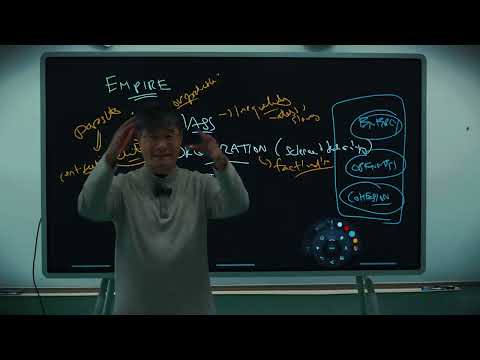
This lecture presents the 'Law of Asymmetry' as a theoretical framework for understanding why the United States will lose its ongoing war with Iran. The speaker argues that empires possess three advantages — mass, organization, and immunity from death — which paradoxically become disadvantages over time through inequality, elite overproduction, and hubris. Applied to the US-Iran conflict, the speaker contends that America's technological superiority, propaganda control, and monetary power are actually liabilities that breed dependency, censorship, and unreliable proxies. The lecture analyzes American military strategy (decapitation, air supremacy, arming insurgents) and argues each element will inadvertently strengthen Iranian society by creating energy, openness, and cohesion. The lecture concludes with a dramatic shift into metaphysical territory, citing a Substack article about US troops being told the war is for Armageddon and the return of Jesus, before declaring that the war is ultimately about controlling 'human consciousness' — the true currency of power.

Video thumbnail
youtube.com/watch?v=t5oisJiorsU ↗ Analyzed 2026-03-14 by claude-opus-4-6

Viewer Advisory

  • The 'Law of Asymmetry' as presented is an unfalsifiable framework where every possible outcome confirms the thesis — this is not how legitimate social science works.
  • The lecture assumes the US-Iran conflict will escalate to ground invasion, but as of March 2026 it remains an air/missile campaign, making much of the analysis inapplicable.
  • The attribution of the war to Christian Zionist Armageddon theology based on one article is a major inferential leap presented as near-certain.
  • The final 'grand reveal' about human consciousness has nothing to do with game theory and represents a shift from analysis to metaphysical assertion.
  • The lecture's characterization of American 'information control' ignores that the speaker freely publishes on American platforms — something that would be impossible if he directed similar criticism at China on Chinese platforms.
  • Academic scholarship on asymmetric warfare (Arreguín-Toft, Mack, Lyall & Wilson) offers far more rigorous and nuanced analysis of when and why weak actors prevail.
  • The lecture presents Iran as destined to become more unified through conflict, but historical examples cut both ways — external pressure has also caused states to fragment (Yugoslavia, Libya, Syria).
Central Thesis

The 'Law of Asymmetry' dictates that an empire's strengths inevitably become weaknesses, and the US-Iran war will be won by Iran because American strategy will inadvertently create the energetic, open, and cohesive society that Iran needs to defeat the empire.

  • Empires possess three advantages (mass, organization, death/immunity) that become disadvantages over time: mass breeds inequality, organization breeds elite overproduction and factionalism, and immunity from consequences breeds hubris.
  • A weaker enemy can defeat an empire if it develops three qualities: energy (motivation), openness (willingness to learn), and cohesion (unity of purpose).
  • America's specific advantages — technology, propaganda, and money — produce dependency on technology, suppression of dissent ('drinking your own Kool-Aid'), and unreliable bribed proxies.
  • America faces three critical problems: lack of political will, insufficient manufacturing capacity for a prolonged war, and inability to absorb casualties.
  • Iran possesses three advantages — Shia faith/martyrdom, mountainous terrain, and Persian nationalist identity — though each also carries risks (zealotry, isolation, ethnic divisions).
  • American strategy (decapitation, air supremacy with carpet bombing and soft targeting, arming insurgents) will paradoxically strengthen Iran by solving elite overproduction, uniting urban and rural populations, and activating Persian nationalism.
  • Iran's guerrilla warfare strategy of 'hide and seek' can outlast America's need for a quick, cheap victory.
  • The war may be driven by Christian Zionist eschatology — the belief that conflict in Iran will trigger Armageddon and the return of Jesus.
  • The ultimate purpose of the war is to control 'human consciousness,' which is the true source of all power and reality.
Qualitative Scorecard 1.9 / 5.0 average across 7 axes
Historical Accuracy ▸ Expand
The broad historical examples are roughly correct: Persia did lose to Greece, Alexander's smaller force did conquer the Persian Empire, and the Romans did rise from a tribal state. Peter Turchin's elite overproduction theory is accurately attributed and fairly represented. The Khamenei assassination reference is factually accurate (Feb 28, 2026). However, several claims are problematic: the assertion that 'only 50% of Iranians are Persians' is roughly correct (estimates range 50-65%) but the implication that this makes Iran uniquely vulnerable to ethnic fragmentation ignores that many multi-ethnic states are stable. The claim that Iranians 'were willing to agree to all terms' in nuclear talks is unverified. The list of 'three great civilizations of the ancient world' (Jews, Greeks, Persians) is arbitrary and excludes Egypt, Mesopotamia, India, and China. The claim that empires last 'maybe 28 years, maybe 300 years' is vague and inaccurate — many empires lasted far longer (Roman Empire, Byzantine Empire, Ottoman Empire, Chinese dynasties).
3
Argumentative Rigor ▸ Expand
The argument has a neat theoretical structure (empire advantages → disadvantages; underdog qualities → victory) but the logic is circular and unfalsifiable. Every American action is reinterpreted as actually helping Iran: killing leaders 'solves elite overproduction,' bombing cities 'unites urban and rural populations,' arming minorities 'activates Persian nationalism.' This heads-I-win-tails-you-lose framework means no evidence could ever disconfirm the thesis. The leap from one Substack article about a single commander's religious speech to 'that is why this war is happening' is an extraordinary inferential leap. The final claim that the war is about 'human consciousness' and 'the soul of humanity' abandons empirical analysis entirely for unfalsifiable metaphysics. The lecture also assumes a ground invasion is the inevitable endgame despite the current conflict being exclusively an air campaign.
2
Framing & Selectivity ▸ Expand
The lecture is highly selective. It frames every American advantage as secretly a disadvantage while treating Iranian disadvantages (zealotry, ethnic divisions, terrain as prison) as minor hurdles that will be overcome. The American military is characterized only through negative attributes (lazy, arrogant, dependent) while the Iranian response is characterized through positive attributes (resilient, innovative, motivated). No cases where technologically superior forces successfully defeated insurgencies are mentioned (Malayan Emergency, Sri Lankan Civil War). The Substack article about one commander's religious speech is elevated to explain the entire war. The framing consistently presents America as unable to learn or adapt — contradicted by the US military's extensive doctrinal revisions after Iraq and Afghanistan.
2
Perspective Diversity ▸ Expand
The lecture presents a single analytical perspective with no engagement with alternative viewpoints. No voice argues that the US might have legitimate security concerns regarding Iran's nuclear program. No Iranian dissident or reformist perspective is included — Iran is treated as a monolithic entity that will naturally cohere. No American military strategist's perspective is considered. No consideration of the possibility that air power alone (without ground invasion) might achieve US objectives. No acknowledgment that many Iranians fled the Islamic Republic and oppose the regime. The classroom format involves students reading text aloud but no genuine intellectual exchange or challenging questions.
1
Normative Loading ▸ Expand
The lecture is heavily loaded with normative judgments presented as analytical conclusions. American allies are 'vassals.' Ethnic opposition groups in Iran are dismissed as 'hustlers' who want to 'rip off the US government.' The American strategy is described using morally charged language: 'soft targeting' of hospitals, 'double tap' strikes on rescuers, creating 'as much fear and anxiety as possible.' Christian Zionists are called 'crazy Christians' and 'religious fanatics.' Trump's relationship with religious leaders is framed as them seeing him as 'Messiah.' The final section abandons analytical language entirely for mystical/prophetic register: 'the soul of humanity,' 'human consciousness,' 'reality itself,' 'the grand secret behind the world.'
2
Determinism vs. Contingency ▸ Expand
The lecture is rigidly deterministic. The 'Law of Asymmetry' is presented as an iron law that guarantees the empire will fall and the underdog will win. Every American strategic action is predetermined to backfire. Iran 'should triumph over America' — stated as a logical certainty, not a possibility. The framework leaves zero room for contingency: no consideration that Iranian leadership might make catastrophic errors, that internal divisions might prove fatal, that diplomatic interventions might alter the trajectory, or that the US might adapt its strategy. Even the 'grand reveal' about consciousness controlling reality reinforces determinism — the outcome is predetermined by metaphysical forces. The only acknowledged uncertainty is whether America will launch a ground invasion.
1
Civilizational Framing ▸ Expand
The lecture employs stark civilizational dichotomies. Iran/Persia is romanticized as 'one of the greatest civilizations in human history' with a culture that is 'vast, beautiful, and deep,' dating back 5,000 years. The American empire is characterized as lazy, arrogant, incompetent, and driven by hubris. The framing presents civilizational identity as Iran's key advantage while characterizing America's identity primarily through imperial pathology. The final section frames the conflict as a war for 'the soul of humanity' — elevating it to civilizational-eschatological significance.
2
Overall Average
1.9
Civilizational Treatment
UNITED STATES

The US is consistently characterized as a declining empire afflicted by inequality, elite factionalism, hubris, technological dependency, propaganda-induced delusion ('drinking your own Kool-Aid'), and inability to learn from mistakes. American allies are 'vassals.' American-backed proxies are 'hustlers' and 'scammers.' The American military is described as lazy, arrogant, and dependent on technology. American strategy is described in terms of war crimes (carpet bombing, soft targeting hospitals, double-tap strikes). The war's motivation is attributed to 'crazy Christians' pursuing Armageddon. No positive or even neutral characterization of American strategic thinking is offered.

THE WEST

The West is not discussed as a collective concept, but American allies (Five Eyes, Europe, East Asia) are characterized as 'vassals' of the American empire whose populations can be drawn upon for imperial wars. BBC is listed alongside CNN and NYT as American propaganda instruments.

Named Sources

scholar
Peter Turchin
Cited as the originator of the concept of 'elite overproduction' — the idea that too many elites competing for limited power positions leads to political instability, factionalism, and wars. Applied to both historical empires and contemporary America.
✓ Accurate
journalist
John Larson / Substack article: 'US troops were told Iran war is for Armageddon, the return of Jesus'
Read aloud in class as evidence that the Iran war is motivated by Christian Zionist eschatology. An NCO's complaint letter to the Military Religious Freedom Foundation (MRFF) is quoted extensively, describing a commander framing the war as fulfilling the Book of Revelation.
? Unverified
other
Military Religious Freedom Foundation (MRFF)
Referenced as the organization to which dissenting soldiers sent their complaint about religious framing of the war.
? Unverified
primary_document
Book of Revelation
Referenced indirectly through the soldier's complaint — a commander cited Revelation to justify the Iran war as triggering Armageddon and the return of Jesus.
? Unverified

Vague Appeals to Authority

  • 'Most analysts will tell you it is suicidal for the American military to invade Iran' — no specific analysts named.
  • 'For years, America has been planning to invade Iran. And for years, the generals were like, No, that's suicidal' — no specific planning documents or generals cited.
  • 'We know for a fact that the Iranians were willing to agree to all terms of the Americans' in nuclear talks — no source provided for this claim.
  • 'There's reporting that the generals are telling the soldiers this is a war for Jesus' — only one Substack article cited, presented as broader pattern.
  • 'We've seen it in Libya and Syria before' — American strategy compared to these conflicts without specifics.
  • 'As we discussed last semester, in the ancient world there were three great civilizations: the Jews, the Greeks, and the Persians' — highly reductive claim presented as established fact.

Notable Omissions

  • No engagement with academic literature on asymmetric warfare (Ivan Arreguín-Toft's 'How the Weak Win Wars,' Andrew Mack's original 1975 paper on asymmetric conflict) — despite the lecture's title directly invoking this concept.
  • No discussion of the actual military balance: Iran's specific capabilities, order of battle, missile inventory, or defense doctrine.
  • No mention of Iran's nuclear program or its status post-June 2025 strikes (warhead development authorized Oct 2025).
  • No consideration of diplomatic channels, ceasefire possibilities, or international mediation efforts.
  • No discussion of China's role as Iran's major economic partner and oil customer.
  • No engagement with the actual political dynamics of the Trump administration's Iran policy beyond Christian Zionism.
  • No mention of the Strait of Hormuz blockade's economic effects — a major strategic development.
  • No discussion of Russia's role or the Russia-Iran strategic partnership treaty.
  • The concept of 'asymmetric warfare' in modern military studies is far more nuanced than presented — it includes cyber warfare, information operations, and economic warfare, none of which are discussed.
  • No consideration that the US might achieve its objectives through air power alone without needing a ground invasion — the entire framework assumes ground invasion is the endgame.
Unfalsifiable theoretical framework 00:37:44
The 'Law of Asymmetry' is constructed so that every American action confirms the thesis: killing leaders 'solves elite overproduction,' bombing 'creates cohesion,' arming minorities 'activates nationalism.' No outcome could disconfirm the framework.
Creates the illusion of predictive power by ensuring any evidence can be reinterpreted as supporting the conclusion. The audience cannot identify what would count as counter-evidence.
Dialectical inversion 00:15:53
Each American advantage is systematically reframed as a disadvantage: technology → dependency, propaganda → self-delusion, money → unreliable proxies. Each American strategy is reframed as helping Iran.
Creates an elegant intellectual structure that feels revelatory — the audience experiences the thrill of seeing beneath surface appearances. But the technique works regardless of whether the inversions are empirically true.
Socratic leading questions 00:13:12
Throughout the lecture: 'Okay? Does that make sense?' 'Right?' 'Okay, does that make sense, guys?' These rhetorical checkpoints create the appearance of student engagement while advancing predetermined conclusions.
Maintains the illusion of collaborative discovery while the speaker controls the entire direction of analysis. Students are prompted to confirm understanding, not to challenge premises.
Escalating reveal / narrative climax 00:51:32
The lecture builds from geopolitical analysis to military strategy to a 'grand reveal' that the war is about 'human consciousness' and 'the soul of humanity' — 'the grand secret behind the world.'
The escalating structure creates intellectual momentum that carries the audience past critical scrutiny. By the time the unfalsifiable metaphysical claim arrives, the audience has been primed by seemingly rational analysis to accept it.
Single-source generalization 00:49:31
One Substack article about one military commander's religious speech is elevated to explain the entire motivation for the US-Iran war: 'That is why this war is happening.'
A single anecdote is treated as representative of systemic intent, allowing the speaker to attribute the entire war to Christian Zionist eschatology without broader evidence.
False exhaustion of alternatives 00:50:02
'Because quite honestly, there's no other reason. It's hard for me to come up with another reason' — after presenting Christian Zionism as the explanation for the war.
By claiming inability to identify alternative explanations, the speaker frames a speculative theory as the only plausible one, despite obvious alternatives (strategic interests, Israeli lobbying, nuclear proliferation concerns, domestic politics).
Emotional anchoring through read-aloud 00:47:02
Having a student read the soldier's complaint letter aloud, with the speaker interrupting to provide dramatic commentary: 'Oh my god!' 'What is this crap?' 'THE WORLD IS ENDING. YEAH!'
The performative reading creates emotional engagement and group solidarity. The speaker's theatrical interruptions model the 'correct' emotional response for the audience, framing shock and outrage as the appropriate reaction.
Historical pattern-matching 00:01:30
The Persians defeating Greece, Alexander conquering Persia, Romans rising from tribes, Vikings, Aztecs — all stacked to establish that underdogs always defeat empires.
The rapid accumulation of examples creates an impression of an iron historical law, while concealing the many cases where empires successfully crushed smaller opponents (Carthage, countless colonial conquests, Soviet suppression of Hungary/Czechoslovakia).
Relatable analogy to trivialize complexity 00:16:07
Comparing American military technology dependency to students becoming 'dumber' from using ChatGPT: 'Same with technology.'
Makes a complex military-strategic claim feel intuitively obvious by anchoring it to students' daily experience, bypassing the need for evidence about actual military technology dependency.
Prophetic register / mystical framing 00:51:35
'The real power, the real currency in the world is not money. It is human consciousness... This is a war for the very soul of humanity... Everything that you see today, it's all an illusion.'
Shifts the lecture from falsifiable geopolitical analysis to unfalsifiable metaphysical claims, positioning the speaker as a prophet revealing hidden truths rather than an analyst making testable arguments.
⏵ 00:01:22
The law of asymmetry states that... it's usually the underdog that has the advantage.
The core thesis of the lecture, presented as a 'law' rather than a tendency. This framing elevates a historical observation into a deterministic principle that guarantees Iranian victory.
⏵ 00:14:26
America controls information space. It controls the internet. It controls the world's most powerful media including the New York Times, CNN, BBC. It controls YouTube. It controls Google.
Reveals the speaker's view of American media as a unified propaganda apparatus. The irony of making this claim on YouTube — one of the platforms he says America 'controls' — is unacknowledged.
China operates the Great Firewall, blocks YouTube/Google/CNN entirely, controls all domestic media through the CCP propaganda department, and imprisons journalists. The speaker criticizes American 'information control' while publishing freely on American platforms, whereas this lecture itself would face censorship if it criticized Chinese policy on Chinese platforms.
⏵ 00:14:29
Propaganda means that America controls information space... America does not want you to know something. It can hide it from you. America can control the discourse. It can control how you think about the world.
Frames American media influence as totalitarian thought control, ignoring the vibrant dissent ecosystem in American media that includes the very platforms the speaker uses.
China's censorship apparatus is orders of magnitude more comprehensive — from the Great Firewall to real-time social media monitoring to disappearing critics. The speaker's own ability to publish this lecture criticizing the US on American platforms directly contradicts his claim of American information totalitarianism.
⏵ 00:09:06
The problem with death is that if there are no consequences to your actions, you become arrogant, you become lazy, and you become incompetent.
Applied exclusively to the American empire, but this principle of impunity breeding incompetence is a universal observation applicable to any powerful actor.
This description could apply to China's handling of the COVID-19 outbreak, its property sector crisis, or its demographic collapse — all cases where an insular elite refused to acknowledge mistakes due to lack of accountability. The CCP's suppression of dissent fits the 'no consequences' → hubris pattern the speaker describes.
⏵ 00:49:23
That is why this war is happening... there are some crazy Christians in the American military, in American government, that want to use this war to end the world, to force Jesus to return.
The speaker elevates one Substack article into the causal explanation for a major war, demonstrating the lecture's tendency to prefer dramatic, conspiratorial explanations over mundane geopolitical analysis.
⏵ 00:51:35
The real power, the real currency in the world is not money. It is human consciousness... This is a war for the soul of humanity.
The lecture's 'grand reveal' abandons empirical analysis for unfalsifiable metaphysics. This is presented as the culmination of a semester-long game theory course, yet it has nothing to do with game theory.
⏵ 00:53:06
Everything that you believe, everything that you see today, it's all an illusion. The reality, the truth is that consciousness is a source of all power, of reality itself.
Reveals the lecture series' trajectory from ostensible social science toward mystical/metaphysical claims. This is being presented to students as the 'grand secret' of a game theory course.
⏵ 00:17:42
It's telling people to shut up and obey. You're not allowed to point out that this war is stupid and America can't win this war. Otherwise, you'll be kicked out.
Characterizes American wartime discourse as totalitarian suppression of dissent, presented without evidence of specific censorship actions.
In China, anti-war dissent is suppressed far more thoroughly. During the Russia-Ukraine war, Chinese social media users who expressed sympathy for Ukraine were censored. Citizens who question any CCP policy face detention, not merely social disapproval. The speaker describes American discourse suppression while operating in a country (China) with vastly more comprehensive censorship.
⏵ 00:21:27
America shipped all its factories to China. So, America doesn't have that many factories.
Accurately identifies US manufacturing decline as a strategic vulnerability, echoing arguments from across the political spectrum. However, presented without nuance — the US still has the world's second-largest manufacturing output by value.
⏵ 00:40:28
For the longest time, the Persian national identity was suppressed by the theocracy because they want to create a grand religion that unites all ethnicities.
A rare moment of critical analysis of Iran's own government. However, the speaker then argues this suppression will be overcome by American attack, turning even Iran's internal problems into a source of eventual strength.
China's suppression of ethnic identities (Uyghurs, Tibetans) in favor of a unified 'Chinese' identity parallels exactly the Iranian theocracy's suppression of Persian nationalism in favor of Islamic unity. The speaker notes Iran's approach critically but never applies the same framework to China's ethnic policies.
prediction The United States will lose the war against Iran.
00:00:32 · Falsifiable
untested
War began Feb 28, 2026 and is ongoing as of March 2026. The US campaign has been air/missile strikes, not ground invasion. Too early to determine outcome.
prediction American bombing and strategy will make Iranian society more energetic, open, and cohesive, ultimately strengthening Iran.
00:37:44 · Falsifiable
partially confirmed
Mojtaba Khamenei elected Supreme Leader under IRGC pressure after father's assassination. Iran retaliating fiercely across 9+ countries. Some evidence of nationalist galvanization, but regime also weakened by leadership decapitation.
prediction America will use a strategy of decapitation (killing leadership/command and control) against Iran.
00:34:57 · Falsifiable
confirmed
Khamenei was assassinated in a US-Israeli strike on Feb 28, 2026, confirming decapitation as a core strategy.
prediction America will carpet bomb Iran and engage in soft targeting (hospitals, infrastructure) and double-tap strikes.
00:36:04 · Falsifiable
partially confirmed
900+ strikes in 12 hours on Feb 28, 2026 confirm massive aerial bombardment. Specific claims of hospital targeting and double-tap strikes not independently verified as of analysis date.
prediction America will arm and bribe ethnic insurgents (Baloch, Kurds, Azaris) to rebel against Iran's central government.
00:29:05 · Falsifiable
untested
No evidence of US-backed ethnic insurgencies in Iran as of March 2026. War is air/missile campaign only.
prediction Iran will respond with guerrilla warfare — hiding in mountains and launching rockets at GCC countries and Israel.
00:42:22 · Falsifiable
confirmed
Iran retaliated across 9 countries including GCC states; IRGC blockaded Strait of Hormuz. Consistent with asymmetric/guerrilla response predicted.
prediction The grand question is whether America will launch a ground invasion of Iran, which would mean they've lost.
00:43:42 · Falsifiable
disconfirmed
As of March 2026, the US-Iran war remains an air/missile campaign. No ground troops have been deployed to Iran.
claim This war is 'World War III' — the last and final war of all human history, fought for control of human consciousness.
00:52:37 · Not falsifiable
unfalsifiable
prediction The Iranians were willing to agree to all American terms in nuclear talks, but the US attacked anyway.
00:45:12 · Falsifiable
disconfirmed
Iran refused to halt all uranium enrichment as demanded. Talks broke down before Operation Midnight Hammer. Iran was NOT willing to accept all US terms.
Verdict

Strengths

The lecture offers a genuinely useful conceptual framework for understanding why powerful states can lose asymmetric conflicts — a well-established finding in political science and military studies. The application of Peter Turchin's elite overproduction theory to contemporary American politics is intellectually productive. The analysis of Iran's ethnic composition and potential vulnerability to divide-and-conquer strategies shows real regional knowledge. The identification of American manufacturing decline as a strategic constraint is a mainstream concern shared by the Pentagon itself. The prediction that the US would pursue decapitation and aerial bombardment strategies was accurate. The discussion of how external attack can paradoxically unite a fractured society draws on real historical precedents (the Blitz strengthening British resolve, the Iran-Iraq War consolidating the Islamic Republic).

Weaknesses

The lecture's central framework is circular and unfalsifiable — every American action is reinterpreted as secretly helping Iran, making the thesis immune to disconfirmation. The 'Law of Asymmetry' is presented as an iron law but is actually a selective reading of history that ignores the many cases where powerful states crushed weaker opponents. The lecture completely ignores that the current US-Iran conflict is an air campaign, not a ground invasion, undermining the entire analytical framework built around occupation and guerrilla warfare. The attribution of the war to Christian Zionist eschatology based on a single Substack article is an extraordinary leap. The 'grand reveal' about human consciousness abandons any pretense of social science analysis for unfalsifiable mysticism, and has no connection to game theory despite being the culminating lecture of a game theory course. The lecture contains no engagement with academic literature on asymmetric warfare despite directly invoking the concept. The deterministic framework leaves no room for contingency, adaptation, or alternative outcomes.

Cross-References

BUILDS ON

  • Geo-Strategy #8: The Iran Trap — the speaker explicitly continues his prediction that the US will lose the Iran war, and references 'last class' where military/strategic positions were discussed.
  • Previous Game Theory lectures — the speaker references 'our entire class is on game theory' and 'all this course' as building toward the consciousness reveal.
  • Civilization series lectures — references 'as we discussed last semester' regarding Persian, Greek, and Jewish civilizations.
  • Previous lecture on Sunni-Shia relations — 'as we discussed last class, the Sunnis and the Shia have never really gotten along.'

CONTRADICTS

  • Geo-Strategy #8: The Iran Trap predicted a ground invasion scenario ('Operation Iranian Freedom') as the core of the conflict. This lecture implicitly acknowledges the war is an air campaign, not a ground invasion, but still frames the ground invasion question as the 'grand question' rather than acknowledging the earlier prediction's form was wrong.
This lecture marks a significant shift in the series. While earlier lectures (Geo-Strategy #8) presented themselves as geopolitical analysis grounded in historical analogies and game theory, this episode transitions into metaphysical/mystical territory with the 'grand reveal' about human consciousness. The pattern across the series shows increasing unfalsifiability: from specific predictions (Trump wins, Haley VP, ground invasion) to structural claims (law of asymmetry) to metaphysical assertions (consciousness as reality). The speaker's framework has also evolved to become fully non-falsifiable — where Geo-Strategy #8 made predictions that could be wrong, this lecture's 'law of asymmetry' framework reinterprets any outcome as confirming the thesis.