Predictive History Audit / Systematic Content Analysis
Game Theory
Episode 11 · Posted 2026-03-10

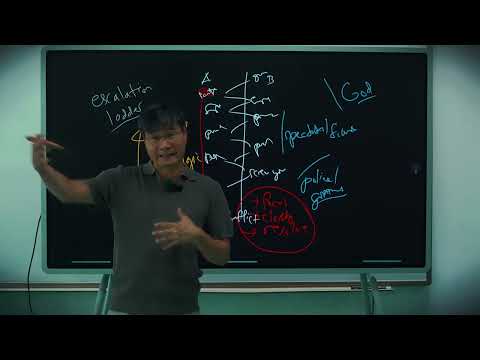
The Law of Escalation

This lecture introduces the 'Law of Escalation' — the claim that control over escalation dynamics matters more than escalation dominance (i.e., having bigger weapons). Using a schoolyard bully analogy, the speaker argues that Iran possesses greater strategic flexibility than the US-Israel alliance because Iran can calibrate its responses selectively while the US is locked into a blunt, linear escalation ladder. The lecture makes three predictions about the US-Iran war: ground troops will be deployed, nuclear weapons will not be used, and the Al-Aqsa mosque will be destroyed. A game theory analysis of four players (US, Iran, Israel, Saudi Arabia) argues that Israel, Saudi Arabia, and Iran all have incentives to draw the US into a prolonged ground war that would destroy American power, and that the US is compelled to fight due to its Mackinder-style heartland containment doctrine.

Video thumbnail
youtube.com/watch?v=fz-Dan7NRss ↗ Analyzed 2026-03-14 by claude-opus-4-6

Viewer Advisory

  • The 'Law of Escalation' is presented as the speaker's original theory but closely resembles well-established concepts in strategic studies (Schelling's work on commitment and coercion, Kahn's escalation framework) — the lack of attribution obscures whether the speaker is aware of this literature.
  • The schoolyard bully analogy is not a neutral analytical tool — it preloads the moral judgment that the US is an illegitimate aggressor.
  • The game theory analysis does not use actual game theory methodology; it is informal strategic speculation labeled as game theory for authority.
  • The prediction that ground troops are inevitable has been tested by nearly a year of air-only warfare and has not yet materialized.
  • The claim that Israel, Saudi Arabia, and Iran are all secretly working to destroy the US lacks evidence and attributes conspiratorial coordination to actors with genuinely conflicting interests.
  • The lecture ignores or minimizes massive damage inflicted on Iran (leadership decapitation, nuclear program destruction, infrastructure degradation) while emphasizing Iran's strategic advantages, creating a distorted picture of the conflict's trajectory.
Central Thesis

In the US-Iran war, Iran holds the strategic advantage despite lacking escalation dominance because it possesses superior escalation control — the ability to calibrate responses flexibly — while the US, Israel, and Saudi Arabia all have converging interests in forcing a prolonged ground war that would ultimately destroy American power in the Middle East.

  • Control is more important than dominance in escalation dynamics: the party that can calibrate its responses strategically will prevail over the party with merely bigger weapons.
  • The US follows a linear, blunt escalation ladder (decapitation → military targets → economic embargo → civilian infrastructure → secret weapons → biochemical → nuclear), while Iran has a branching decision tree with more strategic options.
  • Iran's closure of the Strait of Hormuz gives it calibration power — it can selectively allow passage to potential allies (China, GCC states willing to pay) while blocking adversaries.
  • The US military has an inverted cost pyramid (air-dominant, soldier-light) that is unsustainable in a real war of attrition, necessitating a return to infantry-heavy force structure and thus ground troops.
  • Israel wants the US to lose a prolonged ground war so Israel can become the sole hegemon in the Middle East; therefore Israel will not use nuclear weapons as that would end the war too quickly.
  • Saudi Arabia wants all three rivals (US, Iran, Israel) weakened so it can control Middle Eastern trade routes as oil revenues decline.
  • The US is compelled to fight because its grand strategy requires preventing Eurasian heartland unification, and Iran is the geographic linchpin connecting Russia, China, and the Middle East.
Qualitative Scorecard 2.1 / 5.0 average across 7 axes
Historical Accuracy ▸ Expand
The lecture correctly identifies the basic structure of the US-Iran conflict and the Strait of Hormuz's strategic importance. The description of US strikes escalating from decapitation to military targets to civilian infrastructure roughly matches the actual sequence (Khamenei assassination, military strikes, oil depot attacks). However, the lecture treats decapitation as having already failed when in fact Khamenei was assassinated just days before this lecture was uploaded, and the consequences are still unfolding. The characterization of Saudi-Iran relations (theocracy vs monarchy, Sunni vs Shia) is broadly accurate. The heartland theory is a legitimate geopolitical framework but is presented without attribution and oversimplified. The claim that 1991 and 2003 Iraq wars were 'not real wars' is historically problematic — they involved hundreds of thousands of troops and significant casualties.
3
Argumentative Rigor ▸ Expand
The central argument — that control beats dominance — is asserted through analogy rather than demonstrated. The schoolyard bully thought experiment is engaging but proves nothing about state-level conflict. The 'Law of Escalation' is presented as the speaker's own theory but lacks formal definition, empirical support, or engagement with the extensive academic literature on escalation dynamics. The game theory analysis assigns neat motivations to four players without evidence: the claim that Israel wants to destroy the US military is extraordinary and entirely unsupported. The cost pyramid argument (US has an inverted force structure) ignores that the US has fought this war through air power alone for a year with no apparent need for ground troops. The claim that Iran has 'far more advantages' than the US is contradicted by the facts on the ground — Iran's supreme leader was just assassinated and its nuclear program destroyed.
2
Framing & Selectivity ▸ Expand
The lecture systematically presents evidence favoring Iran's strategic position while omitting countervailing facts. Iran is described as 'active,' having a 'clear strategy,' and possessing 'flexibility,' while the US is described as 'passive,' lacking clear objectives, and 'inflexible.' This framing ignores that the US has successfully executed decapitation strikes, destroyed nuclear facilities, and maintained air superiority — all while avoiding the ground war the speaker insists is inevitable. The lecture was uploaded March 10, 2026, just days after the Feb 28 strikes that killed Khamenei and devastated Iranian infrastructure, yet presents Iran as strategically dominant. The bully analogy frames the US as the aggressor by definition, prejudicing the entire analysis.
2
Perspective Diversity ▸ Expand
The lecture presents a single analytical perspective with predetermined conclusions. Student questions are acknowledged but redirected to support the speaker's framework. One student (Allan) raises a legitimate objection — why would the US risk its entire system for Iran? — and receives a response that simply reasserts the heartland theory rather than engaging with the question's implications. No alternative theories of US-Iran relations are considered. No Iranian domestic politics beyond a monolithic 'unified elite' are discussed. No consideration of the possibility that air strikes alone might achieve US objectives. The framing consistently presents Iran as the clever underdog and the US as the blundering bully.
2
Normative Loading ▸ Expand
The bully analogy is deeply normatively loaded: the US is literally cast as a schoolyard bully who 'preys on everyone,' charges 'taxes,' develops 'hubris,' and is 'fat and ugly.' Iran is the brave new kid who 'doesn't care' about social pressure and remains 'focused.' This is not neutral analysis — it embeds a moral judgment into the analytical framework from the outset. The characterization of the 1991 and 2003 Iraq wars as 'video games' trivializes actual military operations and casualties. Describing US strategy as 'let's destroy Iran, we don't care how, we don't care why' attributes mindless aggression to US decision-making. The Israeli attacks on civilian infrastructure are correctly labeled as potentially violating international law, but no similar scrutiny is applied to Iran's Strait of Hormuz blockade.
2
Determinism vs. Contingency ▸ Expand
The lecture presents an almost fully deterministic framework. The US 'has no choice but to fight this war.' Ground troops 'have to be used.' Israel 'wants the United States to lose.' Saudi Arabia 'has no choice in this matter.' The escalation ladder 'must' be followed in sequence. Each player's strategy is presented as structurally determined with no room for agency, miscalculation, diplomatic innovation, or contingent events. The speaker explicitly states 'if I miss one, then all my theory is wrong,' framing the analysis as an all-or-nothing prediction — but then presents each step as inevitable, which undermines the acknowledged possibility of being wrong.
2
Civilizational Framing ▸ Expand
The bully analogy creates a stark moral hierarchy: the US is the oppressive bully extracting tribute from a captive school (the international system), while Iran is the principled newcomer who refuses to submit. This framing goes beyond strategic analysis into civilizational characterization. The US is portrayed as having no legitimate interests — only imperial extraction and hubris. Iran's strategy is consistently presented as rational, calibrated, and justified, while the US strategy is blunt, confused, and aggressive. Israel is characterized as cynically manipulating its own ally toward destruction.
2
Overall Average
2.1
Civilizational Treatment
CHINA

China is mentioned briefly and positively — as a country that would be 'let through' the Strait of Hormuz by Iran, suggesting Iran views China as a friendly or neutral party. China receives 40% of its oil through the strait, making it a beneficiary of Iran's selective blockade strategy.

UNITED STATES

The United States is characterized as a schoolyard bully who extracts tribute, develops hubris, has a confused and unclear strategy, fights 'video game' wars against weak opponents, and is being manipulated by all three other players (Israel, Saudi Arabia, Iran) into self-destruction through a ground war. The US is described as passive, inflexible, and lacking strategic clarity.

RUSSIA

Russia is mentioned only in passing as part of the BRICS heartland unification that threatens US hegemony. No negative characterization; Russia is simply positioned as a natural part of the emerging Eurasian order.

Named Sources

other
Escalation ladder / escalation dominance theory
Presented as the dominant geopolitical theory that the speaker seeks to challenge. The concept of escalation dominance (whoever has more powerful weapons wins) is set up as a foil for the speaker's alternative 'Law of Escalation' where control beats dominance.
? Unverified
scholar
Mackinder's Heartland Theory
Used without attribution to explain US grand strategy — that America must prevent Eurasian heartland unification to maintain naval-based hegemony. Presented as the primary motivation for the US-Iran war.
? Unverified

Vague Appeals to Authority

  • 'The dominant theory is that whoever has escalation dominance has the most advantage' — no specific theorist or work cited for this framing.
  • 'This is a very important idea in my game theory model' — the speaker's 'game theory model' is referenced as authoritative but never formally defined or published.
  • 'We're already seeing arguments in the American political system against the use of weapons against civilians' — no specific politicians, debates, or sources cited.
  • 'There's a lot of concern online that Israel is preparing a nuclear strike on Iran' — attributed to unnamed online sources.
  • 'As you may have seen the news that the Israelis attacked an oil depot in Tehran' — specific news event referenced but no source cited.

Notable Omissions

  • No engagement with Herman Kahn's 'On Escalation' (1965), the foundational work on escalation ladder theory that the lecture claims to challenge.
  • No mention of Thomas Schelling's work on bargaining, commitment, and strategic behavior — the actual game-theoretic framework for analyzing escalation.
  • No discussion of how decapitation of Khamenei (which already happened Feb 28, 2026) affects Iran's strategic coherence, despite claiming decapitation 'didn't work.'
  • No acknowledgment that Saudi Arabia has actively refused to cooperate with the US against Iran, directly contradicting the claim that Saudi Arabia wants to destroy Iran through this war.
  • No discussion of Iran's actual military losses, which have been substantial (nuclear sites destroyed, leadership assassinated, military infrastructure degraded).
  • No engagement with professional escalation management literature (e.g., Forrest Morgan's work at RAND on escalation dynamics).
  • No consideration that the US might achieve its objectives through air power alone without ground troops, which is exactly what has happened so far.
  • No mention of the Iran nuclear program's actual status — warhead development authorized after June 2025 strikes, contradicting the linear escalation model.
Extended analogy as analytical framework 00:13:50
The schoolyard bully analogy — where the US is a bully collecting lunch money taxes, Iran is a brave new kid who refuses to pay, and the bully's friends (allies) begin defecting — structures the entire lecture's analysis of the US-Iran conflict.
By embedding the analysis within a morally loaded analogy, the speaker predetermines the audience's sympathies before any geopolitical facts are introduced. The analogy makes the US inherently the aggressor and Iran inherently the underdog, foreclosing alternative framings.
Neologism/coined law 00:11:55
'The Law of Escalation: Control is more important than dominance' — presented as a formal theoretical principle of the speaker's 'game theory model.'
Elevating a debatable assertion to the status of a 'law' gives it unearned authority and makes it harder for students to challenge. The formulation also obscures that this insight, to the extent it's valid, has been extensively explored in existing strategic studies literature (Schelling, Kahn).
False dilemma through cost pyramid 00:40:45
The speaker argues the US must either win the war in 'like two days' with its air-dominant force or inevitably shift to a ground-heavy force structure. No middle options (sustained air campaign, limited objectives, diplomatic settlement) are considered.
By presenting only two extreme options — instant victory or ground invasion — the speaker makes the ground troop prediction seem logically inevitable rather than one of many possible outcomes.
Categorical dismissal 00:41:01
'1991 the Persian Gulf War, 2003 the Iraq War, these are not real wars' — dismissing two major military conflicts as 'video games' because the US was dominant.
Allows the speaker to discard historical evidence that air-dominant US force structures can achieve military objectives, preserving the thesis that ground troops are inevitable.
Appeal to theoretical necessity 00:04:32
'According to game theory this is yes. United States will send in ground troops. According to game theory this is no [nukes].' Game theory is invoked as producing definitive answers rather than probabilistic assessments.
Attributing predictions to 'game theory' lends them scientific authority, despite the analysis being informal strategic speculation rather than formal game-theoretic modeling with defined payoff matrices.
Conspiratorial attribution of motives 00:45:15
Israel's strategy is described as wanting to 'destroy CENTCOM and destroy Iran' so that 'you are the sole hegemon in the Middle East,' and Israel 'wants the United States to lose this war.'
Attributes to Israel an extraordinary secret objective — deliberately destroying its primary military patron — without any evidence. This transforms a standard alliance relationship into a conspiracy, making any Israeli action interpretable as anti-American manipulation.
Socratic leading questions 00:22:26
Throughout the lecture: 'Does that make sense to you guys?' 'All right?' 'Okay?' repeated dozens of times, creating a rhythm of assertion followed by assumed agreement.
The constant checking for agreement creates social pressure on students to accept each claim before moving to the next, building an unquestioned logical chain where challenging any link becomes progressively harder.
Hedged absolutism 00:05:25
'I am 100% confident that nukes will not be used at this time in this war. And if I'm wrong, I apologize to the world... but at the same time, we'll all be dead anyway, so it doesn't really matter.'
Combines absolute confidence (100%) with a joke that deflects accountability. The humor makes the prediction seem more casual and confident than a serious analytical claim should be, while the '100% confident' framing lends it certainty.
Structural determinism 00:54:29
'United States has no choice but to fight this war because that's their entire strategy to maintain hegemony in the world to prevent the heartland from unifying.'
By framing US action as structurally determined ('no choice'), the speaker eliminates the need to consider alternative US strategies, diplomatic options, or domestic political constraints — simplifying the analysis but sacrificing accuracy.
Escalation ladder as unfalsifiable framework 00:25:57
The speaker argues nuclear weapons cannot be used until biochemical weapons are deployed first, and since biochemical weapons haven't been used, nuclear weapons are off the table — but if events skip steps, the 'law' would simply be disproven rather than providing predictive power.
Creates a framework that appears predictive (no nukes yet!) but could easily be falsified by events while providing no mechanism for the speaker to be proven wrong in the near term since the 'later steps' haven't been reached.
⏵ 00:12:02
Control is more important than dominance.
The central theoretical claim of the lecture, elevated to the status of a 'law.' This inverts conventional security analysis and frames the weaker party (Iran) as strategically advantaged — a recurring theme across the speaker's lectures.
⏵ 00:05:25
I am 100% confident that nukes will not be used at this time in this war. And if I'm wrong, I apologize to the world. But at the same time, we'll all be dead anyway, so it doesn't really matter.
Reveals the speaker's performative confidence style — absolute certainty paired with a joke that deflects accountability. This has proven correct so far, lending the speaker credibility, though the reasoning (escalation ladder sequencing) may be coincidentally right for wrong reasons.
⏵ 00:41:01
1991 the Persian Gulf War, 2003 the Iraq War, these are not real wars... those were just video games.
Dismisses two major military operations involving hundreds of thousands of troops and tens of thousands of casualties as 'not real wars.' This rhetorical move allows the speaker to exclude inconvenient evidence that air-dominant US forces can achieve objectives without ground invasion.
⏵ 00:22:16
By calibrating your movements strategically, you can manipulate the bully into self-destruction.
Reveals the speaker's framing: the US is a bully that can be 'manipulated into self-destruction.' This is not neutral analysis but a normative argument that US power is illegitimate and self-defeating. The metaphor precludes any consideration that the US might have legitimate security interests.
China's own approach to territorial disputes in the South China Sea closely resembles the 'bully' archetype the speaker describes — incrementally asserting control, demanding compliance from smaller neighbors, and escalating against those who resist. The speaker never applies his bully framework to Chinese behavior.
⏵ 00:49:26
Israel wants the United States to lose this war. And that means a long war that destroys the American political will to fight any more foreign wars.
Perhaps the lecture's most provocative claim — that Israel is deliberately engineering the destruction of its own primary military patron. This extraordinary assertion is presented without any evidence and would be deeply controversial in any mainstream foreign policy forum.
⏵ 00:47:05
If you're Israel, you don't want to use nukes. Why? Because nukes would end the war too quickly. You want to drag this war out as long as possible to force the United States to send in ground troops.
Illustrates the speaker's tendency to attribute maximally cynical motives to US allies while treating adversary states as rational actors pursuing legitimate interests. Israel is cast as deliberately prolonging a war to trap its own ally.
⏵ 00:33:49
The United States doesn't know what it wants. It wants to destroy Iran. What does that mean? It could mean regime change. It could mean economy collapses. It could mean the civilian population starves.
Characterizes the US as lacking strategic clarity while portraying Iran as having a clear, calibrated strategy. This asymmetric framing — confused bully vs. strategic underdog — structures the entire analysis but is an analytical choice, not an empirical finding.
Iran's own strategic objectives have shifted dramatically during this conflict — from deterrence to retaliation to Strait closure to survival following Khamenei's assassination. The 'clear strategy' attribution to Iran is as much a projection as the 'confused strategy' attribution to the US.
⏵ 00:46:02
Even though United States and Israel are allies, their optimal strategy is different. Their objectives are different. In fact, they're in conflict.
This is a defensible analytical point — allies often have divergent interests — but the speaker takes it to an extreme by claiming Israel's optimal outcome is mutual US-Iran destruction. The reasonable observation is weaponized into a conspiracy theory.
⏵ 00:53:01
The greatest threat to American power is the heartland unifying... the BRICS nations Russia, Iran and China are coming together and if they come together, that's a major piece of the heartland.
Deploys Mackinder's heartland theory (without attribution) to explain US motivation for the Iran war. While heartland theory is a legitimate geopolitical framework, the speaker presents it as the sole explanation for US behavior, ignoring nuclear proliferation concerns, alliance commitments, and domestic political factors.
The speaker presents Eurasian integration as a natural and benign process, ignoring that China's Belt and Road Initiative is itself a form of the same hegemonic behavior attributed to the US — using economic infrastructure to bind peripheral states into dependence on a central power.
⏵ 00:40:45
For every one ship America can build, China can build 232 ships... you cannot fight a war like this.
This statistic (confirmed by ONI data) is deployed to support the argument that the US cannot sustain a war of attrition. While the manufacturing gap is real, the speaker uses it to imply the US is militarily helpless, ignoring qualitative advantages, existing stockpiles, and allied production capacity.
prediction The United States will send ground troops into Iran.
00:04:34 · Falsifiable
disconfirmed
As of March 2026, the US-Iran war remains an air/missile campaign. No ground troops have been deployed to Iran.
prediction Nuclear weapons will not be used in this war.
00:05:25 · Falsifiable
confirmed
As of March 2026, no nuclear weapons have been used in the US-Iran conflict despite multiple escalatory rounds including the Feb 28, 2026 campaign.
prediction The Al-Aqsa mosque will be destroyed by Israeli religious extremists.
00:04:41 · Falsifiable
untested
No confirmed destruction of the Al-Aqsa mosque as of March 2026.
prediction Nuclear weapons cannot be used until biochemical weapons have first been deployed, following the escalation ladder sequence.
00:25:57 · Falsifiable
unfalsifiable
This is presented as a general law rather than a specific prediction. No biochemical or nuclear weapons have been used, so the sequential claim remains untested in this conflict.
prediction Iran will ultimately win this war against the United States.
00:34:43 · Falsifiable
untested
War is ongoing as of March 2026. Iran has suffered significant damage (Khamenei assassinated, nuclear program set back) but Strait of Hormuz blockade is effective. Outcome undetermined.
prediction Israel, Saudi Arabia, and Iran will work together to force the US into a ground invasion against US interests.
00:48:51 · Falsifiable
partially confirmed
Saudi Arabia refused airspace for US strikes and condemned the attacks, suggesting it is not cooperating with the US. However, Saudi Arabia is not actively 'working with' Iran or Israel to force a ground invasion. The claim of a three-way conspiracy to trap the US remains largely unsupported.
prediction If the heartland (Russia-Iran-China) is allowed to unify, it will displace American hegemony by creating rail-based trade that bypasses US naval dominance.
00:53:07 · Falsifiable
untested
BRICS cooperation is increasing but full heartland integration remains distant. The Iran war has disrupted Iran's role as a corridor between Russia and China.
Verdict

Strengths

The lecture introduces a genuinely useful conceptual distinction between escalation dominance and escalation control. The observation that the party with more options (strategic flexibility) can sometimes outmaneuver the party with more powerful weapons is well-supported by historical cases and academic literature, even if the speaker doesn't cite that literature. The multi-dimensional framing of warfare (narrative, political, economic, military) is sophisticated and pedagogically valuable. The cost pyramid concept — distinguishing cheap assets (soldiers) from expensive ones (aircraft) and their implications for sustainability — is a legitimate military-economic insight. The no-nuclear-weapons prediction has proven correct so far. The identification of divergent interests among nominal allies (US, Israel, Saudi Arabia) is analytically sound as a general principle.

Weaknesses

The lecture suffers from several critical analytical failures: (1) It was uploaded March 10, 2026 — just 10 days after the Feb 28 strikes that killed Khamenei and devastated Iranian military infrastructure — yet presents Iran as strategically dominant without acknowledging these massive setbacks to Iranian capability and leadership. (2) The ground invasion prediction has not materialized despite nearly a year of conflict; the US has prosecuted the war entirely through air/missile strikes, directly contradicting the 'inverted cost pyramid must be corrected' thesis. (3) The claim that Israel wants the US to lose is extraordinary and unsupported by any evidence. (4) The Saudi Arabia analysis has been quietly revised from Geo-Strategy #8 without acknowledging the earlier prediction was wrong. (5) The bully analogy is so normatively loaded that it functions as propaganda rather than analysis. (6) The speaker's 'game theory model' is never formally specified and bears no resemblance to actual game theory (no payoff matrices, no equilibrium analysis, no formal modeling).

Cross-References

BUILDS ON

  • Geo-Strategy #8 ('The Iran Trap') — the earlier lecture predicted the US-Iran war and introduced the game theory framework of four players with divergent interests. This lecture applies those concepts to the ongoing war.
  • Previous Game Theory lectures in the series — the speaker references his 'game theory model' and concepts taught in earlier classes.
  • Earlier lectures on the Strait of Hormuz and its strategic importance — referenced as background knowledge.
  • The speaker mentions 'next class' will cover the Al-Aqsa mosque prediction and 'the Greater Israel Project,' indicating this is part of a multi-lecture arc on the Iran war.

CONTRADICTS

  • Geo-Strategy #8 predicted Saudi Arabia would be part of the US-led coalition against Iran. This lecture now positions Saudi Arabia as wanting to destroy the US, which contradicts the earlier framing but aligns better with actual events (Saudi Arabia refused airspace and condemned strikes).
  • Geo-Strategy #8 predicted a ground invasion scenario with US troops becoming 'hostages.' This lecture maintains that prediction but the war has proceeded as an air campaign for nearly a year without ground troops, undermining the claimed inevitability.
The speaker consistently adapts his framework to fit unfolding events while maintaining core predictions. The Saudi Arabia analysis has shifted from 'coalition member' to 'secretly wants to destroy the US,' suggesting post-hoc rationalization. The ground invasion prediction persists despite a year of air-only warfare, with the speaker now arguing it 'must' happen due to cost pyramid logic. The pattern of attributing maximum strategic clarity to adversaries (Iran, China, Russia) and maximum confusion/hubris to the US and its allies continues across the series. The bully analogy is a more developed version of the 'hubris' theme from Geo-Strategy #8.