Unfalsifiable game-theoretic reasoning
00:44:00
The speaker argues that internal factions must be providing intelligence to enemies because 'according to game theory that's the best explanation,' while explicitly admitting 'I don't have evidence.'
Elevates speculation to analytical conclusion by invoking the authority of 'game theory' while the actual reasoning is simply that internal betrayal is a possible explanation. The admission of no evidence is buried within a confident assertion.
Gang analogy for state behavior
00:10:14

The speaker uses a gang war analogy — 'let's just use an analogy, imagine in the streets there are two gangs at war' — to explain why nations shouldn't assassinate each other's leaders.
Reduces complex international relations to a simplified street-level metaphor that makes the speaker's conclusions seem intuitive and self-evident, while glossing over the many differences between gang dynamics and state behavior.
Eschatological framing presented as analytical
00:47:47

The speaker extensively presents the Jerusalem religious faction's worldview — divine soul vs. animal soul, redemption through suffering, the Messiah's imminent arrival — then concludes sympathetically that 'maybe this is the intention of the universe.'
Blurs the line between descriptive analysis of religious factions and normative endorsement of their worldview. By spending extensive time on the theological framework and ending with 'maybe this is a good thing,' the speaker implicitly validates the eschatological perspective.

When a student asks whether the Messiah would affect China, the speaker responds: 'China doesn't matter. Only Israel matters. United States, China, Russia does not matter.'
Shuts down a legitimate question about China's relevance by adopting the Jerusalem religious faction's worldview as the analytical frame, presenting what is actually one faction's belief as the lecture's operative assumption.
Conspiracy framing through rhetorical questions
00:07:37
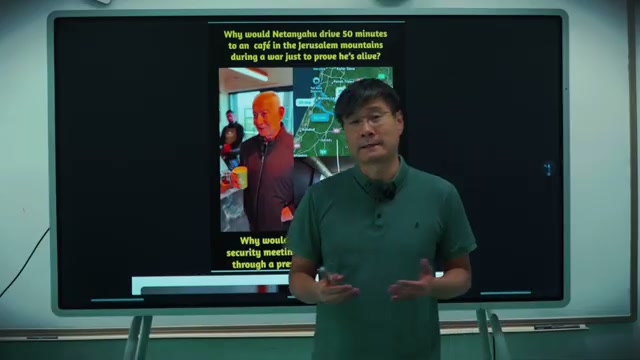
Regarding Netanyahu: 'People are speculating that he is dead... There have been cabinet meetings and Netanyahu usually chairs them and he's not there... there are fake AI videos of him giving speeches and it's pretty blatant.'
Presents unverified online speculation as worthy of serious analytical attention. While the speaker says he doesn't believe Netanyahu is dead, the extensive discussion normalizes conspiracy thinking and primes the audience to distrust official information.
False equivalence between political parties
00:18:45

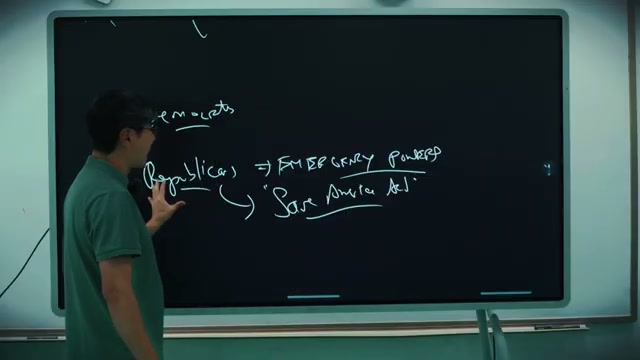
Democrats are described as supporting war to destroy Republicans; Republicans are described as supporting war to invoke emergency powers. Both are presented as equally cynical.
Creates a 'both sides are equally corrupt' narrative that delegitimizes democratic politics entirely, paving the way for the lecture's conclusion that democracy itself is doomed.
Loaded metaphor: 'parasites' and 'circle jerk'
00:24:19

Finance and AI sectors are called 'parasites' and their investment patterns described as 'a circle jerk' where 'I give you a billion dollars, then you give me a billion dollars, and now we have $2 billion.'
Delegitimizes both the financial and technology sectors through visceral, contemptuous language that forecloses serious economic analysis. The 'circle jerk' metaphor oversimplifies complex capital flows into a crude caricature.
Historical analogy deployed as proof of inevitability
00:29:38
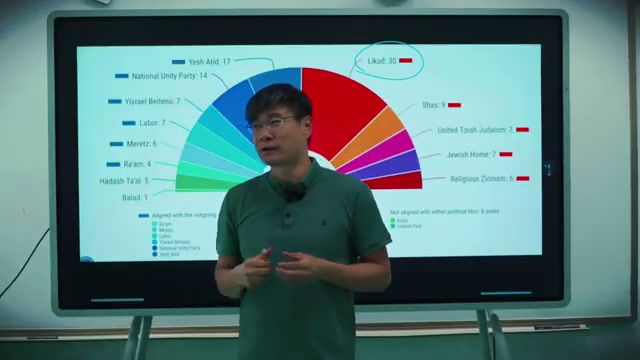
The speaker cites the factionalism among Jews during the Roman siege of Jerusalem in 70 CE as evidence that 'the Jews have always had this problem' of infighting, implying the current Israeli divisions are historically inevitable.
Two-thousand-year-old events are used to essentialize Jewish political behavior as inherently fractious, creating a sense of historical inevitability that naturalizes current divisions and forecloses the possibility of Israeli unity.
Pedagogical Socratic method with predetermined conclusions
00:12:36

The speaker poses three questions (how are leaders dying? why? what does it mean?) then structures the lecture to arrive at his predetermined answer: internal factions are betraying their own leaders.
Creates the appearance of open inquiry and student-driven discovery while actually channeling the audience toward a single speculative conclusion that the speaker has already decided upon.
Sweeping deterministic conclusion
00:45:42

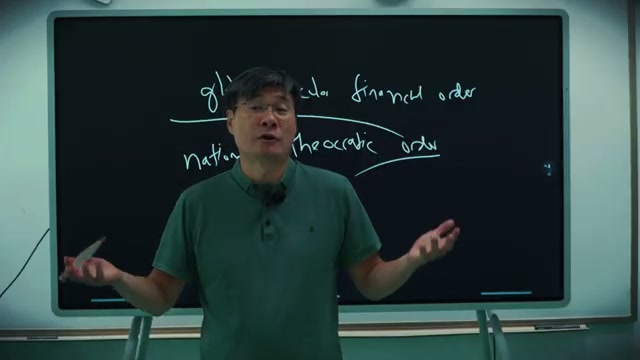
'Israel abandons democracy and embraces theocracy. America will also abandon democracy and embrace theocracy because that is a general trend of the world.'
Presents a radical civilizational prediction as a simple factual statement, without qualification, evidence, or acknowledgment of alternative outcomes. The casual delivery makes an extraordinary claim seem unremarkable.
prediction
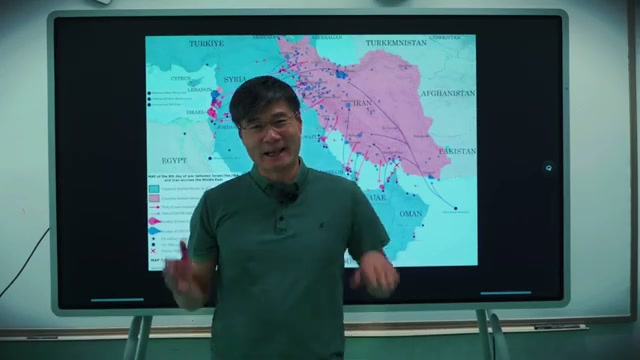
The Americans will eventually have no choice but to launch a ground invasion of Iran.
untested
Through May 1, 2026 (Day 63): No ground invasion. However, status reverted from disconfirmed because Apr 7-8 ceasefire collapsed (Apr 11-12 Islamabad talks failed after 21 hours; Apr 13 Trump ordered naval blockade; Apr 17-21 Iran reversed Hormuz position; Apr 21 Iran cancelled talks; Apr 22 Trump indefinitely extended ceasefire that's actually ongoing strikes; Apr 30 cabinet briefing introduced ground options 'that could include ground forces'). 192nd MP Battalion (~150 NG logistics) is first NG mobilization. Murkowski plans AUMF debate May 11. Prediction now actively live again rather than failed. [June 1, 2026 update] The prediction remains live, but the near-term trajectory is de-escalation toward a 60-day ceasefire MOU, not ground commitment. As of June 1, 2026 (Day 95) there are still ZERO US ground troops in Iran. Since the Apr 30 Cooper/Caine cabinet briefing that first put ground-inclusive options on the table, the trajectory reversed toward de-escalation: through late May US and Iranian negotiators reached a tentative 60-day ceasefire MOU (Iran pledging never to develop or purchase a nuclear weapon; a negotiated Hormuz reopening with no tolls + Iranian mine-clearing + proportional blockade lift), pending final approval by Trump and Mojtaba Khamenei -- not signed as of June 1 (Trump requested edits May 31 rather than signing). The principal US instrument remains the naval blockade (CENTCOM: ~118 vessels redirected + 5 disabled). The named deal-failure alternative is an air/strike package ('end it a different way'; Hegseth at the Shangri-La Dialogue: 'more than capable' of resuming strikes), not a ground order. No new ground-deployment order, no third ARG, no draft. Israel's capture of Beaufort Castle in Lebanon (May 31) is an Israeli ground operation in Lebanon, NOT US ground troops in Iran. [August 1, 2026 monthly update — Day 156] Still ZERO US ground troops in Iran; the war remains air, naval and maritime-interdiction only. Since the June 1 scoring the record has moved substantially — and net downward on the ground rung. A thirteen-night US air campaign (July 12-25) ended in a pause on July 25-26; strikes resumed July 30 with a 'heavy wave' against dozens of IRGC targets along the Gulf littoral (Bandar Abbas, Qeshm, Kish, Abu Musa, Bushehr, Kazerun, Farashband, Abadan, Ahvaz) — but NOT Kharg. On July 31 four outlets (WSJ, CBS, CNN, Axios) reported a multi-day campaign against power plants, refineries, Tehran's electricity grid and dual-use bridges, framed as forcing capitulation ('At some point, they're going to say, We just can't take it anymore'). NO ground element and NO Kharg operation appears in any version of that reporting. The amphibious rung actually FELL: on July 26 the Tripoli ARG offloaded ~2,500 Marines of the 31st MEU at Okinawa with no relief ARG announced, leaving USS Boxer the sole deployed ARG fleet-wide. Foreign Policy's survey of former commanders (July 27) found the US 'does not appear to be moving toward a major ground operation in Iran,' and Trump said on July 22 'we have other people that will do the ground campaign for us.' Countervailing signals exist and are logged: the Pentagon was reported on July 24 readying options for weeks of limited ground operations (Kharg plus coastal raids) pending approval, and July 30 produced the war's first ambiguous shaping signal — but every EXECUTION indicator remains at zero: no landing, no embarkation, no MEU tasking, no airborne insertion, no draft. Independent confirmation this cycle: CFR's Global Conflict Tracker records that 'no significant US ground force commitment is documented' and that operations have 'remained primarily aerial and naval.' The Kharg seizure requirement is still assessed at ~1,200+ troops against anti-personnel and anti-armour mines emplaced on the landing shoreline itself plus added MANPADS, with experts calling holding the island the harder problem. US theatre strength is above 50,000 — roughly 10,000 above baseline — and none of it is inside Iran. US casualties stand at 18 KIA / 685 wounded; CFR records ~1,701 documented Iranian civilian deaths, up to 3.2 million displaced, and a ~$37.5B war cost.
prediction
Kharg Island will be a flash point in the war, with the US potentially seizing it to destroy Iran's oil export capacity.
partially confirmed
Through May 1, 2026: Kharg Island was struck (Mar 13 + Apr 7) and Trump discussed seizing it. The Apr 30 cabinet briefing escalated this further: CENTCOM's 'short and powerful' options include Hormuz seizure 'that could include ground forces' and special-forces uranium-recovery missions. Flash point prediction correct in direction; full seizure not yet executed but option formally on table. [August 1, 2026 monthly update — Day 156] Still ZERO US ground troops in Iran; the war remains air, naval and maritime-interdiction only. Since the June 1 scoring the record has moved substantially — and net downward on the ground rung. A thirteen-night US air campaign (July 12-25) ended in a pause on July 25-26; strikes resumed July 30 with a 'heavy wave' against dozens of IRGC targets along the Gulf littoral (Bandar Abbas, Qeshm, Kish, Abu Musa, Bushehr, Kazerun, Farashband, Abadan, Ahvaz) — but NOT Kharg. On July 31 four outlets (WSJ, CBS, CNN, Axios) reported a multi-day campaign against power plants, refineries, Tehran's electricity grid and dual-use bridges, framed as forcing capitulation ('At some point, they're going to say, We just can't take it anymore'). NO ground element and NO Kharg operation appears in any version of that reporting. The amphibious rung actually FELL: on July 26 the Tripoli ARG offloaded ~2,500 Marines of the 31st MEU at Okinawa with no relief ARG announced, leaving USS Boxer the sole deployed ARG fleet-wide. Foreign Policy's survey of former commanders (July 27) found the US 'does not appear to be moving toward a major ground operation in Iran,' and Trump said on July 22 'we have other people that will do the ground campaign for us.' Countervailing signals exist and are logged: the Pentagon was reported on July 24 readying options for weeks of limited ground operations (Kharg plus coastal raids) pending approval, and July 30 produced the war's first ambiguous shaping signal — but every EXECUTION indicator remains at zero: no landing, no embarkation, no MEU tasking, no airborne insertion, no draft. Independent confirmation this cycle: CFR's Global Conflict Tracker records that 'no significant US ground force commitment is documented' and that operations have 'remained primarily aerial and naval.' The Kharg seizure requirement is still assessed at ~1,200+ troops against anti-personnel and anti-armour mines emplaced on the landing shoreline itself plus added MANPADS, with experts calling holding the island the harder problem. US theatre strength is above 50,000 — roughly 10,000 above baseline — and none of it is inside Iran. US casualties stand at 18 KIA / 685 wounded; CFR records ~1,701 documented Iranian civilian deaths, up to 3.2 million displaced, and a ~$37.5B war cost.
prediction
Saudi Arabia may declare war on Iran, which would invoke a mutual defense pact with Pakistan and open an eastern front.
disconfirmed
Saudi Arabia refused airspace and condemned strikes on Iran. UK hosted 41-nation Hormuz conference without US (Apr 2). Saudi actively pursuing diplomatic path, not military. No Pakistan mutual defense pact invoked.
prediction
Japan and South Korea may be forced into the war because of their dependence on GCC energy.
untested
Japan and South Korea severely affected by Hormuz blockade (Day 35). Iran allows 5 nations through selectively but Japan and South Korea not among them. Both affected economically but have not joined the military campaign as of Apr 3, 2026.
claim
Benjamin Netanyahu may be dead or seriously injured, based on his absence from public appearances and alleged AI-generated videos.
untested
Netanyahu has been publicly active throughout the war — ordering Lebanon security zone expansion, announcing direct talks with Lebanon (Apr 9), coordinating with Trump/Witkoff. No credible evidence of death or serious injury. The speaker himself said he does not believe Netanyahu is dead. Evidence strongly points toward disconfirmation but formally maintaining untested as the claim is about hidden injury.
claim
Internal factions within Israel and Iran are providing HUMINT to their enemies to eliminate domestic rivals, explaining the successful decapitation strikes.
unfalsifiable
Speaker explicitly acknowledges 'I don't have evidence' for this claim. It is a speculative game-theoretic inference.
claim
The Democrats support the Iran war because they believe it will be unpopular and destroy Trump and the Republican party, allowing them to win midterms and the 2028 presidential election.
unfalsifiable
Attributes a unified strategic motive to the entire Democratic party without evidence. No sourced statements from Democratic leadership confirm this calculus.
prediction
Republicans may invoke emergency powers to suspend the constitution and delay elections if the war goes badly.
untested
No emergency powers invoked to suspend elections as of Apr 3, 2026. Hegseth fired Army Chief Randy George (Apr 2-3) — unprecedented wartime move but not related to election suspension.
prediction
Both the private credit bubble (~$2 trillion) and the AI bubble will burst, and the political party in power will determine which sector gets bailed out.
untested
Neither bubble has burst as of Apr 3, 2026. Oil at $109/bbl; IEA warns April supply 'much worse' than March. Economic disruption from Hormuz severe but no bubble collapse yet.
prediction
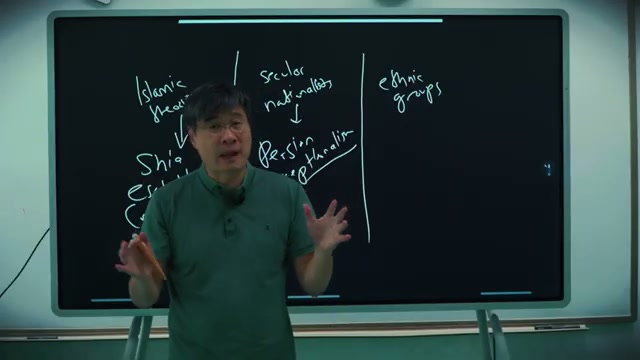
The world will transition from a secular financial order to a nationalist theocratic order over the next 5-10 years, with Iran, Israel, and America all becoming more theocratic.
untested
A sweeping civilizational prediction. Some trends toward religious nationalism are observable in Israel and parts of the US, but characterizing this as a global transition to 'theocracy' is speculative.
prediction
The world is headed toward an economic depression — a splintering and rupture — with severe austerity (no avocados in supermarkets, no vacation flights to Maldives).
partially confirmed
Oil at $109/bbl (Brent); WTI surpassed Brent. IEA warns April supply 'much worse' than March. 2,000+ ships stranded at Hormuz. Severe economic disruption ongoing but a full global depression has not been declared. Direction correct but magnitude overstated so far.
claim
With Ali Larijani dead, it is now almost impossible to foresee a ceasefire in the Iran war.
partially confirmed
Two-week ceasefire mediated by Pakistan began Apr 7-8, 2026, despite Larijani's assassination — initially appeared to disconfirm. However, ceasefire collapsed: Apr 11-12 Islamabad talks failed after 21 hours; Apr 13 Trump ordered naval blockade; Apr 21 Iran cancelled Apr 21 Islamabad talks and Vance pulled from delegation; Apr 22-23 IRGC seized 2 ships; Apr 25-27 Witkoff/Kushner Pakistan trip cancelled; Apr 27 Iran's Hormuz-for-blockade proposal rejected by Rubio; Apr 29 Trump rejected Iran proposal in Axios. Diplomacy has been remarkably fragile. The directional claim that durable ceasefire would be elusive is partially borne out, though brief pauses occurred.