Predictive History Audit / Systematic Content Analysis
Game Theory
Episode 15 · Posted 2026-03-24

The Return of History

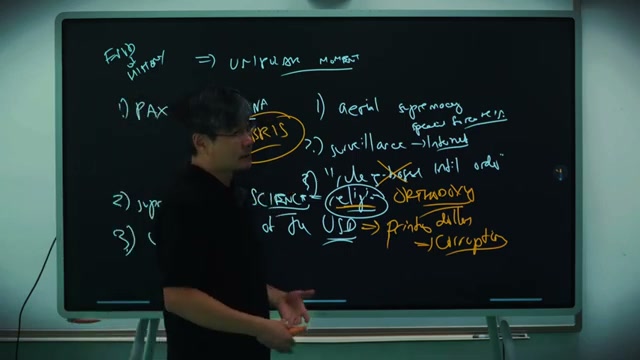
This lecture argues that the US-Iran war signals the end of the post-Cold War 'unipolar moment' and the beginning of a new, more dangerous era. The speaker identifies three pillars of the unipolar order — Pax Americana (military dominance, CIA, surveillance), the supremacy of science, and the universality of the US dollar — and argues all three have decayed through hubris, orthodoxy, and corruption. He then outlines a framework for national survival based on shifting from efficiency to resilience, requiring three transformations: materialism to spirituality, individualism to community, and transferring power from old to young. The second half surveys resource vulnerabilities (food, water, energy), predicts massive migration, the return of regional trading blocs, and offers speculative forecasts including a Russia-Germany alliance, Israeli regional hegemony ('Pax Judaica'), an American 'Holy Empire' rebuilt through Christianity, and techno-Marxist AI surveillance states.

Video thumbnail
youtube.com/watch?v=zAer-Mqe7tQ ↗ Analyzed 2026-03-24 by claude-opus-4-6

Viewer Advisory

  • The lecture moves from analysis to prophecy, presenting speculative worst-case scenarios as certainties. Real trends (energy dependency, aging, food security) are identified but then extrapolated to extreme conclusions (slavery, feudalism, genocide) without rigorous analysis.
  • The speaker promotes COVID vaccine skepticism and frames scientific consensus as religious dogma — this is not 'critical thinking' but selective anti-institutionalism.
  • The internet-as-surveillance-conspiracy claim is historically inaccurate.
  • The dismissal of 20-30 years of technological innovation is flatly wrong.
  • The speaker appears to teach at a Chinese institution but never applies his critique of information control, surveillance, or imperial hubris to China — a glaring analytical blind spot.
  • The Russia-Germany alliance prediction contradicts overwhelming evidence.
  • The religious prescription ('become religious for survival') and the normalization of slavery's return cross professional boundaries for academic instruction.
  • The speaker's own predictions from Geo-Strategy #8 (Russian nuclear guarantee, US ground troops trapped in Iran) have been disconfirmed, but no self-correction or acknowledgment appears in this lecture.
Central Thesis

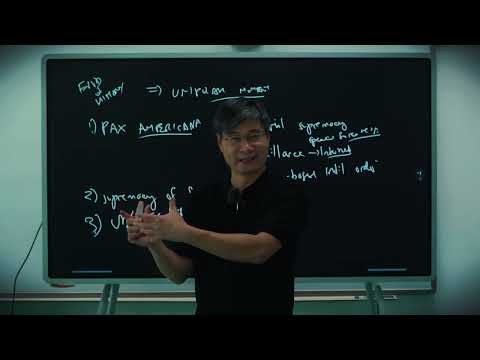
The Iran war marks the irreversible end of the American unipolar moment, and nations must shift from efficiency-oriented globalization to resilience-oriented regionalism — embracing spirituality, community, and youth empowerment — or face collapse, famine, and enslavement.

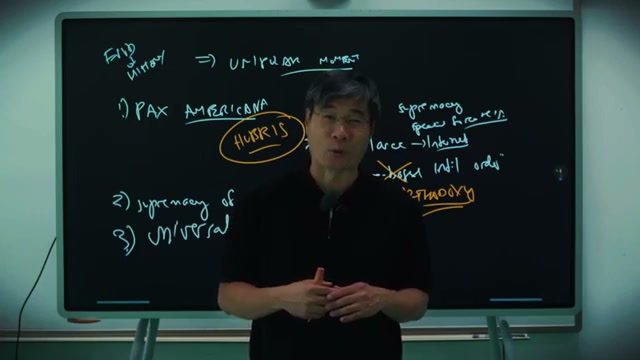
  • The unipolar moment rested on three pillars: Pax Americana (aerial supremacy, CIA, special forces), the supremacy of science as a global religion, and the universality of the US dollar.
  • All three pillars have decayed: Pax Americana bred hubris and violated its own rules-based order; science became orthodoxy rather than innovation; dollar printing enabled corruption and inequality.
  • The American empire has become 'corrupt, self-indulgent, lazy, arrogant' and the Iran war is a symptom of this decline, not merely a policy choice.
  • The global economy is entirely dependent on cheap petroleum, and the Hormuz disruption threatens its foundation.
  • China is vulnerable because it imports 75% of its oil and 25% of its food, and its megacities are liabilities rather than assets.
  • Nations must shift from materialism to spirituality, from individualism to community, and from gerontocracy to youth empowerment to survive.
  • Japan is the nation most likely to solve the aging crisis because its elderly have a cultural obligation to the nation.
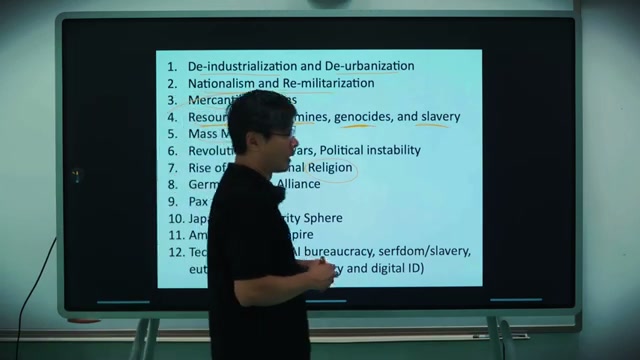
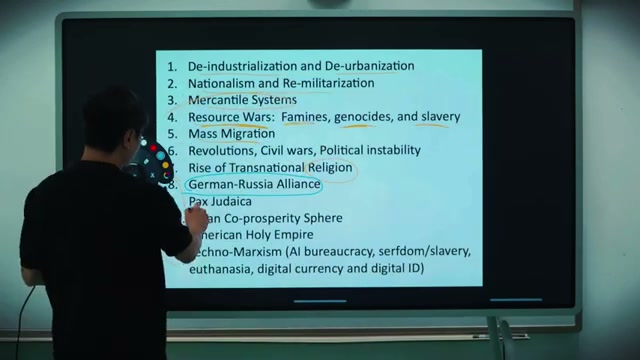
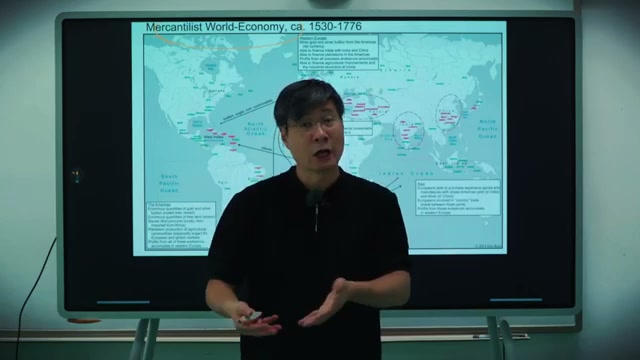
  • The future will see a return to regional trading blocs (mercantilism), resource wars, famines, genocides, and the return of slavery.
  • Israel's strategic goal is to become the regional hegemon ('Pax Judaica') and will eventually partition the Middle East with Iran.
  • America will survive due to geographic advantages and will be rebuilt as a 'Holy Empire' through Christianity.
Qualitative Scorecard 1.7 / 5.0 average across 7 axes
Historical Accuracy ▸ Expand
The lecture makes several factually incorrect or misleading claims. The characterization of Silicon Valley as producing 'only food delivery apps' for 20-30 years ignores smartphones, AI, mRNA technology, reusable rockets, and many other transformative innovations. The claim that the internet was created as a 'mass surveillance system over the entire human population' is a conspiratorial distortion of ARPANET's military-academic origins. Fukuyama's thesis is oversimplified to the point of strawman. The claim about COVID vaccines — that they were developed too quickly and that questioning them represents 'critical thinking' — ignores decades of prior coronavirus and mRNA research. The China oil/food import statistics are approximately correct. The GCC surplus timing linked to China's industrialization is broadly accurate. The mercantile empire trade network history is a reasonable simplification.
2
Argumentative Rigor ▸ Expand
The argument proceeds through sweeping assertions rather than rigorous logic. The central claim that the unipolar moment is irreversibly ending due to the Iran war is asserted rather than demonstrated — no mechanism is provided for why this particular conflict is terminal rather than one of many crises the unipolar order has survived (Kosovo, Iraq, Afghanistan, 2008 financial crisis, COVID). The leap from 'oil prices are high' to 'civilization will collapse, slavery will return' involves enormous causal gaps. The three-pillar framework is presented as self-evident but each pillar's supposed 'decay' is asserted with minimal evidence. The prediction of 100x migration acceleration is stated without any analytical basis. The claim that non-religious societies are less resilient has no empirical support — highly secular Scandinavian countries consistently rank among the world's most resilient. The logical structure frequently follows: identify a real trend → extrapolate to extreme conclusion → present extreme conclusion as inevitable.
2
Framing & Selectivity ▸ Expand
Evidence is cherry-picked to support a predetermined narrative of civilizational collapse. The lecture highlights petroleum dependency while ignoring the global energy transition (solar is now the cheapest energy source in history in many markets). Food vulnerability is emphasized without mentioning the Green Revolution, GMOs, or food technology advances. The aging crisis is presented without discussing automation, robotics, and AI as potential solutions. The freedom map is used selectively — the speaker argues freedom enables resilience, but then favorably frames systems like Japan's cultural obligation (a non-democratic mechanism) and even predicts AI surveillance states as functional. Migration is presented purely as a crisis without acknowledging its economic benefits. The overall framing consistently selects worst-case scenarios while ignoring countervailing factors, creating an artificially apocalyptic picture.
2
Perspective Diversity ▸ Expand
The lecture presents a single analytical perspective throughout — the speaker's own civilizational-decline framework. No alternative viewpoints are engaged: no consideration of liberal internationalist perspectives on how institutions adapt to multipolarity; no engagement with techno-optimist arguments about innovation solving resource constraints; no discussion of how previous 'end of the world' predictions (Club of Rome, Y2K, peak oil in the 2000s) proved wrong; no acknowledgment that many scholars see multipolarity as manageable rather than catastrophic. The classroom format reinforces this through students providing expected answers to leading questions. The speaker dismisses anyone who thinks the war might end and normalcy return as 'living in a fantasy world,' foreclosing the most common analytical perspective.
1
Normative Loading ▸ Expand
Heavy normative loading throughout. America is characterized as 'corrupt, self-indulgent, lazy, arrogant.' Science is described as having become a 'religion' with scientists as 'transnational priests' — a dismissive framing. The COVID vaccine discussion is presented as the speaker bravely questioning orthodoxy while others sheepishly comply ('How dare you question science? You are a peasant'). The internet is cast as a surveillance conspiracy. Young people are told to 'learn real skills' like milking cows rather than cryptocurrency trading. Religion is prescribed as necessary for survival. The language consistently carries moral judgment: globalization is presented as having been a trick, the dollar as illusory, baby boomers as selfish. These are normative positions presented as analytical findings.
2
Determinism vs. Contingency ▸ Expand
The lecture is rigidly deterministic. The speaker states repeatedly that the old world is 'over,' there is 'no going back,' and nations must 'adapt or die.' No contingency is acknowledged: no possibility that the Iran war ends in negotiated settlement, no possibility that technology mitigates resource constraints, no possibility that institutions adapt, no possibility that the speaker's predictions are simply wrong. The binary framing — survive or be 'eliminated,' 'survival of the fittest' — leaves zero room for the messy middle outcomes that characterize most historical transitions. The future is presented as inevitable: slavery will return, famines will occur, nations will collapse. Historical determinism is the lecture's core methodology.
1
Civilizational Framing ▸ Expand
The lecture employs broad civilizational categories with consistent asymmetries. America is simultaneously the most capable nation (creative, entrepreneurial, resource-rich) and a decaying empire (corrupt, hubristic, self-indulgent). This paradox is never resolved. China is acknowledged as vulnerable (food/water/oil imports, megacities) but is treated with relative neutrality compared to the US. Israel is given extraordinary agency — credited with the strategic vision to use the Iran war to displace America from the Middle East. The Global South is portrayed as passive victims of structural forces. East Asian societies are criticized for being non-religious. The overall framing privileges civilizational categories over political, economic, or institutional analysis.
2
Overall Average
1.7
Civilizational Treatment
CHINA

China is treated as genuinely vulnerable — dependent on imported oil (75%) and food (25%), burdened with problematic megacities, and 'not in the green' for food security. The speaker acknowledges China as a pillar of the global economy but frames it as fragile. However, China's strategic planning, reserves, and adaptation capacity are never discussed. China is neither demonized nor idealized — it is presented as a large nation facing structural vulnerabilities, which is a more balanced treatment than the US or Israel receives.

UNITED STATES

America receives contradictory treatment. On one hand, it is characterized as corrupt, hubristic, self-indulgent, lazy, and arrogant — an empire in terminal decline whose science produces only 'food delivery apps' and whose dollar is a tool of corruption. On the other hand, the speaker calls Americans 'the most creative, most entrepreneurial, most energetic people in the world' and says he 'would not bet against America.' The resolution is that America must transform from a secular empire to a Christian 'Holy Empire' — essentially a moral renewal narrative.

RUSSIA

Russia is mentioned only in the context of a predicted future alliance with Germany. The speaker acknowledges Germany and Russia may war for 5-10 years first but presents their eventual alliance as rational and natural. This is strikingly favorable to Russia given the ongoing Ukraine war and Germany's massive rearmament specifically against Russian aggression.

THE WEST

The West is characterized primarily through its aging crisis and cultural decay — baby boomers who are selfish, young people who gamble and trade cryptocurrency, and populations too materialistic and individualistic to make necessary sacrifices. Western science is dismissed as orthodoxy. Western industrial nations are described as gerontocracies incapable of transferring power to the young. The overall framing is that Western civilization's current form is unsustainable and must transform radically or collapse.

Named Sources

scholar
Francis Fukuyama / 'The End of History and the Last Man'
Used as the foil for the lecture's central argument. Fukuyama's thesis that liberal consumer democracy represents the endpoint of human political evolution is presented and then argued to be proven wrong by the Iran war and the collapse of the unipolar moment.
✗ Inaccurate
data
GCC current account surplus data (chart shown)
A chart is shown depicting GCC countries' current account surpluses starting around 2005, attributed to China's rising oil demand. Used to argue the China-GCC trade relationship is the foundation of the global economy.
? Unverified
data
Global air passenger data (chart shown)
A chart showing air passenger growth from 1950 to present is used to illustrate how Pax Americana enabled cheap global travel, which the speaker claims is ending.
? Unverified
data
Undersea internet cable map
A map of undersea cables is shown to argue that Iran could disrupt 20-30% of global internet connectivity by cutting cables in the Persian Gulf/Indian Ocean region.
? Unverified
data
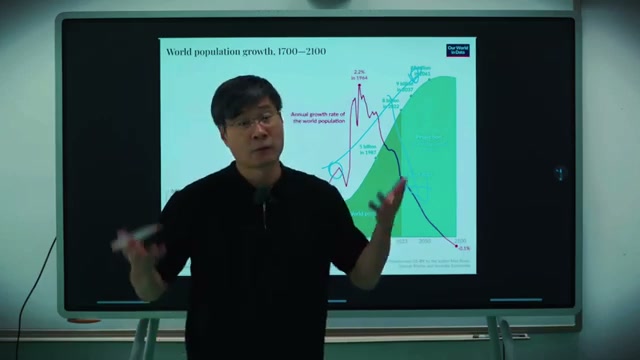
World population growth chart
Used to argue that population growth since WWII is unsustainable and that a 'massive shrinkage' through food scarcity is coming.
? Unverified
data
Fertilizer production/consumption maps
Maps showing ammonia production (in the north) and fertilizer-dependent agriculture (in the south) are used to argue that disruption to fertilizer trade could cause mass famine in the Global South.
? Unverified
data
Freedom House / Freedom Index map
A freedom map is briefly referenced to argue that countries with less freedom will be less resilient during crises because leaders will make selfish decisions without public accountability.
? Unverified
data
Aging population projections (2020 vs 2050)
Maps showing elderly population distribution in 2020 and projected 2050 are used to argue that the entire northern hemisphere will face aging crises requiring immigrant labor.
? Unverified

Vague Appeals to Authority

  • 'It is not possible for the planet to sustain 8 billion people' — stated as fact without citing any resource analysis, carrying capacity study, or environmental science.
  • 'The internet was created not to actually help you communicate... was actually to have a mass surveillance system over the entire human population' — a conspiratorial reframing of ARPANET's actual history without any sourcing.
  • 'The American Empire controls science' — stated as self-evident without evidence of how scientific publishing or research funding constitutes 'control.'
  • 'For the past 20-30 years we've seen very little in terms of technological innovation' — asserted without engagement with any innovation metrics, patent data, or technology literature.
  • 'China imports a quarter of its food' — approximately correct but stated without a source.
  • 'It's something that national leaders in the world have been talking about right now. Food scarcity.' — appeals to unnamed world leaders' conversations.

Notable Omissions

  • No engagement with Fukuyama's actual argument beyond the simplified 'end of history' label — Fukuyama acknowledged that history could 'restart' and wrote extensively about political decay. The speaker treats the thesis as more simplistic than it is.
  • No mention of renewable energy transitions (solar, wind, nuclear) as an alternative to petroleum dependency — the entire argument assumes permanent oil dependence.
  • No engagement with agricultural technology (vertical farming, drought-resistant crops, precision agriculture) that could mitigate food security concerns.
  • No consideration of desalination technology for water scarcity — treats water scarcity as an unsolvable problem.
  • No engagement with demography scholarship (e.g., Hans Rosling's work showing population growth is slowing, or the UN's revised population projections showing potential peak and decline).
  • No mention of China's massive strategic petroleum reserve, Belt and Road energy infrastructure, or efforts to diversify energy sources — China is treated as passively vulnerable.
  • No discussion of how the current Iran war might end short of civilizational collapse — diplomatic options, ceasefire mechanisms, war exhaustion, and economic pressure are dismissed as 'fantasy.'
  • No engagement with international relations scholarship on multipolarity (e.g., John Mearsheimer, Barry Buzan, Amitav Acharya) — the framework is entirely the speaker's own.
  • The Malthusian framework (population exceeds resources → catastrophe) has been repeatedly disproven by technological progress, but this intellectual history is never addressed.
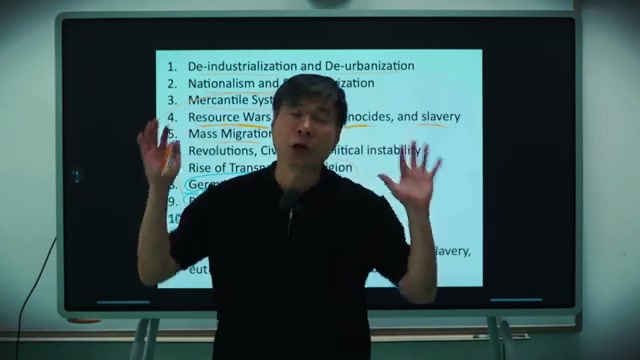
Apocalyptic framing with false urgency 00:38:30
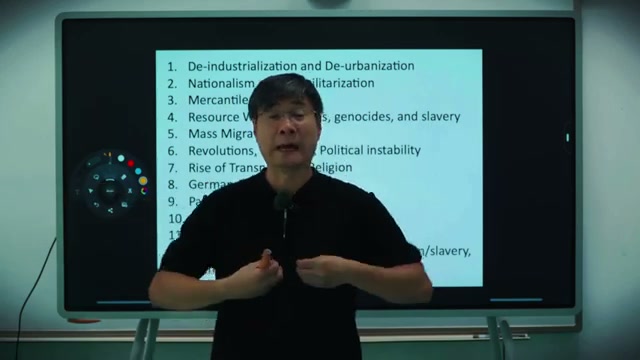
Frame at 00:38:30
The speaker repeatedly states 'you have to choose to adapt to this new world or you will die. It's that simple' and 'if you're not in the green, you should be worrying right now' — presenting speculative long-term trends as immediate existential threats.
Creates an atmosphere of crisis that makes the audience receptive to extreme conclusions (return of slavery, famines, genocides) that would otherwise be questioned. The urgency discourages critical evaluation.

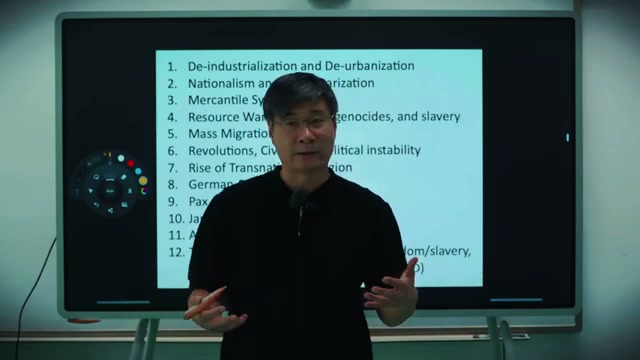
Straw man / oversimplification 00:00:40
Frame at 00:00:40
Fukuyama's 'End of History' thesis is reduced to 'liberal consumer democracy where people feel empowered to have the freedom to buy whatever they want' — ignoring Fukuyama's actual nuanced arguments about recognition, thymos, and political development.
Creates an easy target to knock down, making the speaker's counter-thesis seem more compelling than it would be against Fukuyama's actual arguments.
Anti-intellectual populism disguised as critical thinking 00:05:34
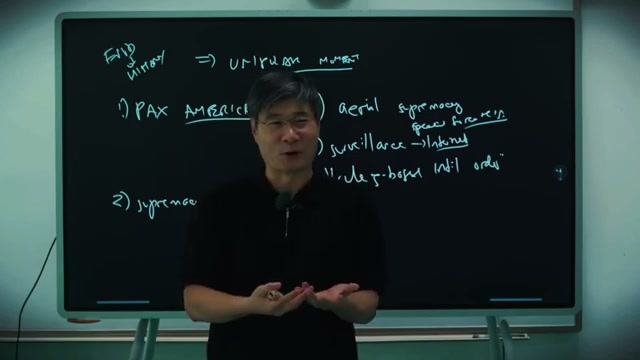
Frame at 00:05:34
The speaker recounts questioning COVID vaccines and being told 'How dare you question science? You are a peasant,' positioning vaccine skepticism as brave critical thinking and scientific consensus as religious dogma.
Flatters the audience into thinking that rejecting expert consensus is sophisticated thinking, while establishing the speaker as a courageous truth-teller who sees through establishment orthodoxy.
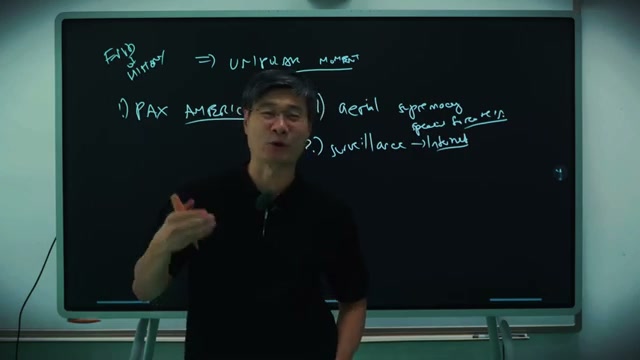
Conspiratorial reframing 00:03:29
Frame at 00:03:29
'The internet was created not to actually help you communicate and to watch pornography. Was actually to have a mass surveillance system over the entire human population so that the Pentagon knew exactly the vibe or the culture of each region.'
Transforms a complex history (ARPANET → academic internet → commercial internet → surveillance capitalism) into a simple conspiracy narrative that positions all technological progress as imperial control, undermining trust in institutions and priming the audience for other conspiratorial claims.
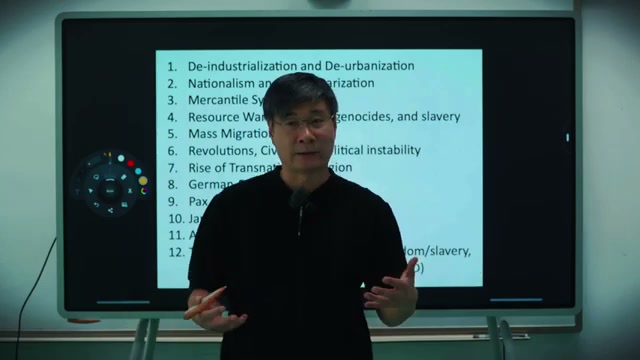
False binary / excluded middle 00:38:06
Frame at 00:38:06
The speaker dismisses anyone who thinks 'this war will end soon and then we'll go back to things before' as 'living in a fantasy world' — presenting only two options: permanent civilizational collapse or naive denial.
Forecloses the most likely outcome (partial disruption followed by adaptation) and forces the audience to choose between the speaker's apocalyptic vision or being labeled naive.
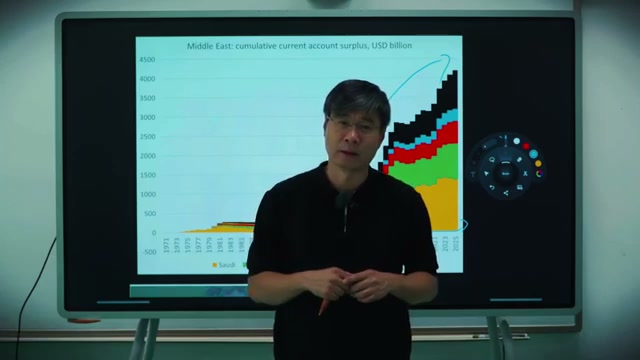
Socratic leading questions 00:19:16
Frame at 00:19:16
The speaker asks students what happened in 2004-2005 to make GCC countries wealthy, then guides them to the answer 'China.' Asks 'What's your computer based on?' and students answer 'Petroleum.'
Creates the appearance of student-driven discovery while guiding toward predetermined conclusions. The classroom setting lends institutional authority to what is essentially speculative futurism.
Catastrophe cascade 00:24:49
Frame at 00:24:49
The speaker builds a chain: oil disruption → food scarcity → water scarcity → mega-city collapse → mass migration → cultural conflict → civil war → slavery → genocide, with each step treated as inevitable rather than contingent.
Each step in the cascade makes the next seem more plausible by cumulative association, even though each individual link involves enormous causal leaps and ignores mitigation mechanisms.
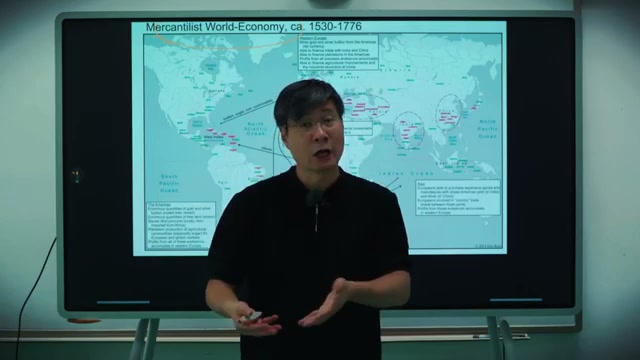
Historical romanticism / appeal to deep time 00:36:43
Frame at 00:36:43
The return to mercantilism, regional trading blocs, and even slavery is presented not as catastrophe but as a return to historical normalcy — 'for most of human history, this was what we did' and 'from most of human history, humans were the cheap entity.'
Normalizes extreme predictions (slavery, feudalism) by framing them as natural historical defaults rather than horrifying regressions, reducing the audience's resistance to accepting these scenarios.
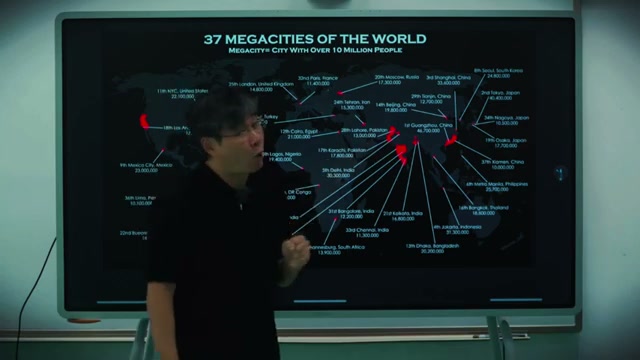
Selective vulnerability analysis 00:31:15
Frame at 00:31:15
China's food (25% imported) and oil (75% imported) dependencies are highlighted, but no mention is made of China's strategic petroleum reserves, domestic food production initiatives, or Belt and Road diversification. Meanwhile, America's dependencies are not analyzed at all.
Creates an impression of informed analysis by citing real statistics while omitting context that would complicate the narrative. The asymmetric treatment of different nations' vulnerabilities serves the overarching framework.
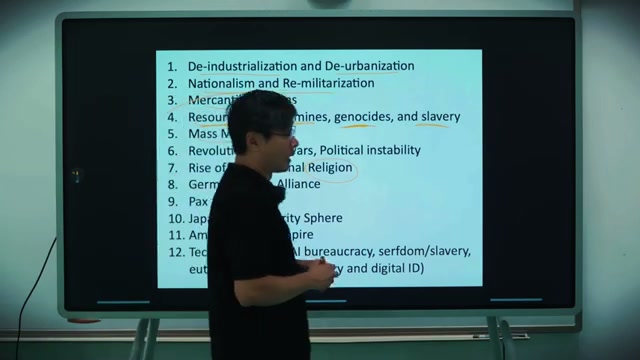
Prescriptive spiritualism as geopolitical analysis 00:40:44
Frame at 00:40:44
'If you are not religious, I actually recommend looking into the possibility of becoming a religion. It's going to be very useful for what's going to happen later on.'
Transforms what should be an analytical lecture about geopolitics into a quasi-prophetic sermon, blurring the line between political analysis and spiritual prescription. The classroom setting makes this particularly inappropriate.
Frame at 00:11:43 ⏵ 00:11:43
The American empire has become corrupt, self-indulgent, lazy, arrogant.
Encapsulates the lecture's characterization of the US — not as a complex polity with competing factions and self-correcting mechanisms, but as a monolithic entity in moral decline. This is a civilizational judgment, not political analysis.
China under Xi Jinping faces its own corruption crises (the anti-corruption campaign has punished over 4.7 million officials), self-indulgent elite consumption (the 'princelings'), and arrogance in foreign policy (wolf warrior diplomacy, South China Sea militarization). The speaker never applies this moral vocabulary to China despite teaching in what appears to be a Chinese university.
Frame at 00:06:13 ⏵ 00:06:13
How dare you question science? You are a peasant. Have you gone to school?
Presented as the response the speaker received when questioning COVID vaccines. Positions the speaker as a courageous contrarian challenging orthodoxy. This is the lecture's most explicit anti-establishment moment, equating scientific consensus with religious dogma.
The speaker presents himself as bravely questioning scientific orthodoxy, but in China — where he appears to teach — questioning the government's official narrative on COVID origins, lockdown policies, or Wuhan lab safety is far more dangerous than questioning vaccines in Western democracies. The speaker's 'critical thinking' is selectively applied to Western scientific institutions while avoiding any critique of Chinese information control.
Frame at 00:03:29 ⏵ 00:03:29
The internet was created not to actually help you communicate... was actually to have a mass surveillance system over the entire human population so that the Pentagon knew exactly the vibe or the culture of each region.
Reveals the speaker's conspiratorial framework — complex historical developments are recast as deliberate imperial machinations. This sets the tone for the entire lecture's treatment of Western institutions as fundamentally deceptive.
China operates the Great Firewall, the most extensive internet censorship and surveillance system in human history, monitoring its 1+ billion internet users in real time. The speaker attributes surveillance motives to the Pentagon's creation of the internet while apparently operating within — and never mentioning — China's actual, operational mass surveillance system.
Frame at 00:09:40 ⏵ 00:09:40
Don't tell me Silicon Valley is a center of innovation in the world. All they do is make food delivery apps.
This dismissal of Silicon Valley — which produced the iPhone, modern AI, cloud computing, CRISPR applications, mRNA platforms, reusable rockets, and more — reveals the speaker's willingness to make sweeping factual claims in service of his narrative.
China's tech sector (Alibaba, Tencent, ByteDok) is often criticized for exactly this — scaling existing innovations (super-apps, e-commerce, food delivery) rather than producing foundational breakthroughs. The speaker's criticism of Silicon Valley more accurately describes China's tech ecosystem, which he never mentions.
Frame at 00:40:44 ⏵ 00:40:44
If you are not religious, I actually recommend looking into the possibility of becoming a religion. It's going to be very useful for what's going to happen later on.
This prescription crosses from geopolitical analysis into spiritual counsel, revealing the lecture's quasi-prophetic character. The speaker positions himself not just as an analyst but as a guide for personal salvation through the coming tribulation.
Frame at 00:38:33 ⏵ 00:38:33
You have to choose to adapt to this new world or you will die. It's that simple.
The lecture's core rhetorical move — reducing complex geopolitical transitions to a binary of adaptation or death. This eliminates nuance, partial outcomes, and the possibility that the speaker's predictions are wrong.
Frame at 00:41:33 ⏵ 00:41:33
Remember the entire point of this war in Iran from Israel's perspective is to knock out America from the Middle East and establish itself as the local hegemon.
Restates the 'Pax Judaica' thesis from earlier lectures — that Israel is deliberately engineering American decline. This is an extraordinary claim about Israel's most important alliance, presented as self-evident background knowledge.
Frame at 00:36:43 ⏵ 00:36:43
If you can no longer have access to cheap oil, what you do is you enslave people. And that's the way historically we've done things.
Normalizes the return of slavery as a natural historical response to energy scarcity, ignoring the vast technological and institutional differences between the modern world and pre-industrial societies. Reveals extreme historical determinism.
China's Xinjiang internment camps, documented by multiple investigations as involving forced labor, represent a contemporary form of state-directed enslavement. The speaker warns of slavery's return as a future possibility while teaching in a country where it is already documented in the present.
Frame at 00:44:28 ⏵ 00:44:28
America is so incredibly incredibly wealthy. It's protected by two oceans. It really controls Canada and Mexico... the Americans are the most creative, the most entrepreneurial, the most energetic people in the world. So I would not bet against America.
Strikingly contradicts the earlier characterization of America as 'corrupt, self-indulgent, lazy, arrogant.' This cognitive dissonance — America is simultaneously in terminal decline AND the most capable nation — is never resolved. The speaker hedges his apocalypticism with American exceptionalism.
Frame at 00:38:06 ⏵ 00:38:06
If you really believe that next week Donald Trump and Iran are going to come to a peace agreement... you're living in a fantasy world.
Dismisses diplomatic resolution as impossible — a hallmark of the lecture's deterministic framework. The speaker cannot imagine peace because his entire analytical structure depends on permanent crisis.
claim The Iran war marks the permanent end of the unipolar moment — 'we're not going back to the old world.'
00:46:46 · Not falsifiable
unfalsifiable
Depends on how 'unipolar moment' is defined and the timeframe; the concept of American hegemony ending is a broad analytical framework rather than a testable prediction.
prediction In the future, flights will be very expensive and vacations will be unaffordable.
00:22:04 · Falsifiable
partially confirmed
Oil at $112/bbl (Mar 22, 2026), sustained above $100 since Mar 8. Airline costs rising. However, flights have not become 'unaffordable' — they are more expensive but still operational. The prediction overstates the magnitude.
prediction Iran could easily cut undersea internet cables, disrupting internet for 20-30% of the world including Africa, India, the Middle East, and parts of Europe.
00:22:29 · Falsifiable
untested
As of Mar 24, 2026, Iran has not cut undersea cables despite the ongoing war. The capability claim may be overstated.
prediction There will eventually be an alliance between Russia and Germany in Europe.
00:41:11 · Falsifiable
disconfirmed
Germany has massively rearmed (83-108B EUR budget, 650B over 5 years, 3.5% GDP target, 260K troops) explicitly in response to Russia. Relations are frozen with economic decoupling ongoing. Policy explicitly rejects rapprochement. The speaker himself notes they may war first for 5-10 years, but the framing of eventual alliance contradicts all current trajectories.
prediction Israel will come to dominate the Middle East as regional hegemon ('Pax Judaica'), knocking America out of the region.
00:41:46 · Falsifiable
untested
Israel is conducting aggressive military operations (decapitation campaign, ground ops in Lebanon, strikes on Iran) but the US has ~50,000 troops in the Middle East and is deeply engaged, not withdrawing.
prediction If America leaves the scene, Israel and Iran will partition the Middle East — Iran controls Hormuz, Israel controls the Levant.
00:42:18 · Falsifiable
untested
Israel and Iran are currently in active military conflict including assassinations and strikes on each other's infrastructure. The premise of US withdrawal has not occurred.
prediction Japan will resolve the aging/gerontocracy crisis within the next 5-10 years, with the elderly voluntarily ceding power to the young.
00:17:01 · Falsifiable
untested
No evidence of such a transformation in Japan. Japan's record defense budget (9.04T yen) suggests traditional institutional continuity rather than generational power transfer.
prediction Christianity will be the force that rebuilds America after multiple crises, transforming it into an 'American Holy Empire.'
00:45:31 · Not falsifiable
unfalsifiable
Vaguely defined prediction with no clear criteria for confirmation. American religious attendance continues to decline by most measures.
prediction Mass migration from the Global South to Europe and North America will accelerate by 100 times current levels.
00:32:42 · Falsifiable
untested
Migration pressures exist and are increasing, but a 100x acceleration would imply billions of migrants — an extraordinary claim with no supporting evidence.
prediction The return of slavery is a likely future trend as cheap oil becomes unavailable.
00:39:54 · Falsifiable
untested
Modern slavery already exists in various forms, but the speaker is predicting a return to institutional slavery as a replacement for fossil fuel energy — an extraordinary claim.
claim Silicon Valley has produced no real innovation in the past 20-30 years — only food delivery apps and scaling of existing technology.
00:09:40 · Falsifiable
disconfirmed
This is factually wrong. The past 20-30 years saw transformative innovations: smartphones (2007), cloud computing, CRISPR gene editing, mRNA vaccine technology, large language models/AI, autonomous vehicles, reusable rockets (SpaceX), and many more. The claim that only 'food delivery apps' were produced is a gross distortion.
prediction Nation states may break apart into city states in the future.
00:47:56 · Falsifiable
untested
claim China imports 75% of its oil and 25% of its food, making it highly vulnerable to trade disruption.
00:31:15 · Falsifiable
confirmed
China imports approximately 72-75% of its crude oil (confirmed by multiple sources). China imports significant food but the 25% figure is approximate — China is a major importer of soybeans, grains, and other foods. The vulnerability claim is directionally correct.
prediction Some nations will institute AI surveillance states ('techno-Marxism') to control populations and marshal limited resources.
00:45:50 · Falsifiable
untested
China's social credit system and surveillance infrastructure already partially fits this description, but the speaker frames this as a future development across multiple nations.
claim East Asian societies (Japan, China, Korea, Vietnam) being non-religious is a problem for their future resilience.
00:37:42 · Not falsifiable
unfalsifiable
Normative claim based on the speaker's framework that spirituality is necessary for resilience. No empirical basis provided.
Verdict

Strengths

The lecture identifies several genuine trends worth monitoring: the fragility of petroleum-dependent global supply chains, the aging crisis in industrialized nations, food security vulnerabilities in import-dependent countries, and the geopolitical significance of the Hormuz Strait. The efficiency-to-resilience framework is a useful analytical lens that echoes serious work by scholars like Nassim Taleb (antifragility) and supply chain analysts. The observation that megacities are vulnerable to disruption is valid. The China vulnerability statistics (75% oil imports, 25% food imports) are approximately correct and the implications are worth considering. The speaker asks students to think about structural forces rather than just personalities or events, which is pedagogically valuable.

Weaknesses

The lecture suffers from extreme historical determinism, treating speculative worst-case scenarios as inevitable outcomes. The factual accuracy is poor in several areas — dismissing Silicon Valley's innovations, mischaracterizing the internet's origins as a surveillance conspiracy, and promoting vaccine skepticism as critical thinking. The logic consistently involves enormous leaps from real trends to apocalyptic conclusions without considering mitigation, adaptation, or alternative outcomes. The Russia-Germany alliance prediction contradicts all current evidence. The 100x migration acceleration and return-of-slavery predictions are extraordinary claims with no supporting analysis. The lecture prescribes religion as a geopolitical survival strategy without any empirical basis. The speaker contradicts himself on America's character without resolution. No actual game theory methodology is employed despite the series title. The lecture increasingly resembles prophecy rather than analysis.

Cross-References

BUILDS ON

  • Geo-Strategy #8: 'The Iran Trap' — the speaker references his earlier prediction of US-Iran war and Israel's strategy to become regional hegemon ('Pax Judaica'), and the game theory analysis of actors' motivations.
  • Previous Game Theory lectures — the lecture appears to be a capstone that synthesizes themes from the entire Game Theory series, referencing frameworks and arguments developed across the semester.
  • Earlier lectures on Pax Americana, the rules-based international order, and the three pillars of the unipolar moment — these appear to have been developed across multiple lectures.
  • Civilization series — the speaker references concepts of civilizational decline, hubris, and historical cycles that were likely developed in earlier lectures on ancient civilizations.

CONTRADICTS

  • Geo-Strategy #8: 'The Iran Trap' — the earlier lecture predicted Russia would serve as a 'nuclear guarantor' preventing strikes on Iran, which has been disconfirmed. This lecture does not update or acknowledge this failed prediction.
  • Geo-Strategy #8: 'The Iran Trap' — predicted a ground invasion with US troops trapped as 'hostages,' but the current war is air/missile-only. This lecture implicitly abandons the ground invasion scenario without acknowledging the shift.
  • The speaker's own characterization of America contradicts itself within this lecture: 'corrupt, self-indulgent, lazy, arrogant' (00:11:43) vs. 'the most creative, most entrepreneurial, most energetic people in the world' (00:44:54).
This lecture represents a significant escalation in the speaker's claims compared to earlier entries in the corpus. While Geo-Strategy #8 made specific, testable military predictions, this lecture moves into broad civilizational prophecy — predicting the return of slavery, famines, genocides, and feudal city-states. The shift from analytical framework to prophetic register suggests the speaker's confidence has been boosted by the confirmed Iran war prediction, leading to increasingly sweeping and unfalsifiable claims. The lecture also reveals the speaker's prescriptive agenda more clearly than previous entries: advocating for religion, community, de-urbanization, and generational power transfer. The 'Game Theory' label is increasingly nominal — no actual game theory methodology is employed.