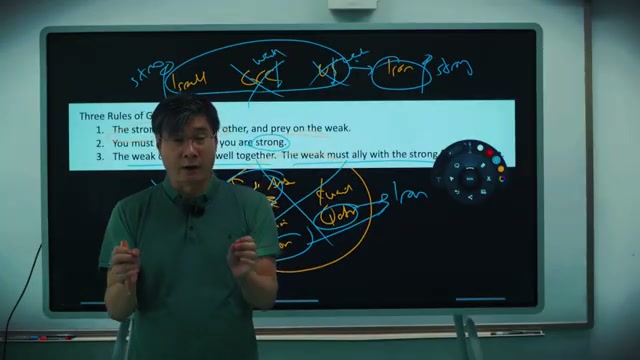
Video clip montage with sardonic commentary
00:00:00

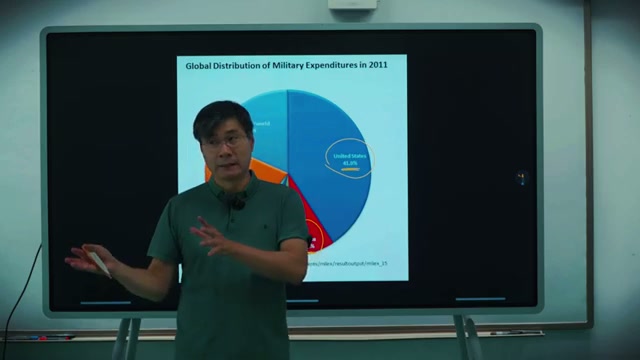
The lecture opens with clips of Trump, Leavitt, Hegseth, and Bessent, each followed by the speaker's mocking interpretation: 'We didn't expect them to fight back,' 'American genius at work,' 'we negotiate with bombs, man.'
Establishes American incompetence as the baseline through officials' own words, then amplifies it with sarcastic framing. The audience sees real footage reinterpreted through the speaker's lens before any analysis begins, anchoring all subsequent arguments to the premise of American failure.
Strategic framework presentation (four dimensions of war)
00:10:29

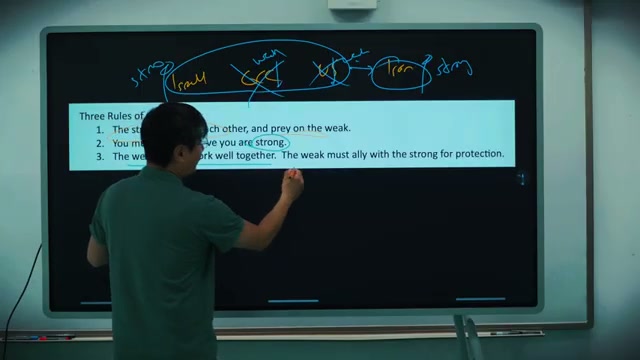
The speaker introduces a 'four dimensions of war' framework (narrative, political, economic, military) and then uses it to show that America fights on only one dimension while Iran fights on all four.
Creates an appearance of systematic analytical rigor while actually loading the framework to produce a predetermined conclusion. The framework is not derived from military science but constructed to highlight American limitations and Iranian strengths.

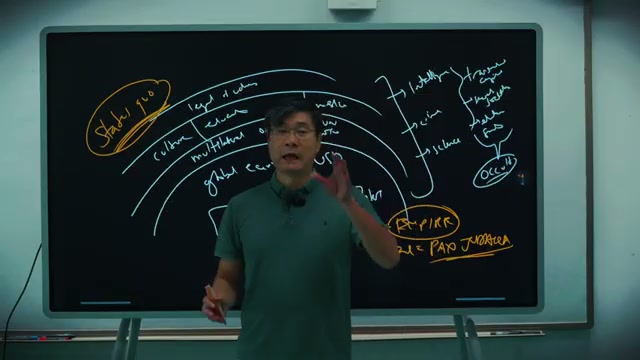
The speaker presents a layered world model: empire, finance, global economy, multilateral organizations, culture/education/media, then adds 'intelligence, crime, science' controlled by 'transnational capital, secret societies, elite families, and the occult.'
Gradually normalizes conspiracy theory by embedding it within an otherwise plausible structural analysis. Each layer seems reasonable until 'secret societies' and 'the occult' are introduced as organizing principles, but by then the audience has accepted the framework.
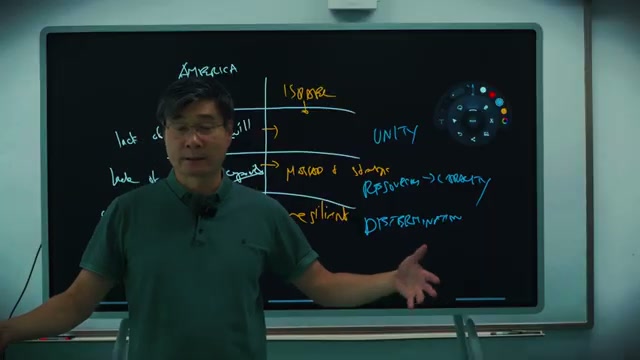
The speaker compares empires to startup companies pitching to venture capitalists (the 'global elite'), with Company A (America: experienced but complacent) versus Company B (Israel: hungry, determined, all-or-nothing).
Translates geopolitics into familiar business language, making the extraordinary claim that a 'global elite' chooses empires like investors choose startups seem intuitive. The analogy obscures the fundamental difference between investment decisions and geopolitical power transitions.
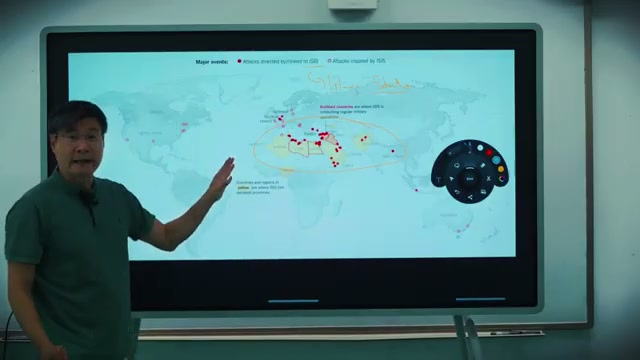
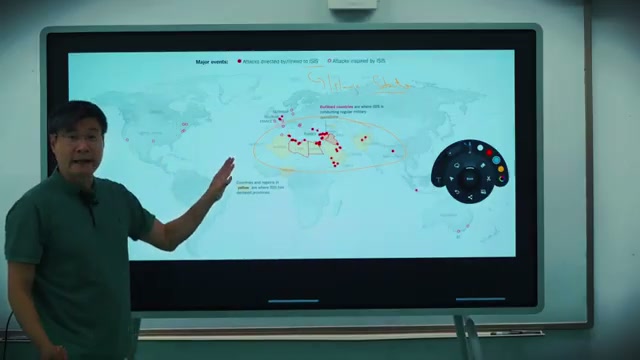
ISIS attacks everywhere in the Middle East except Israel, therefore ISIS is a Mossad creation.
Presents absence of evidence as evidence of conspiracy. The logical gap (many explanations exist for why ISIS doesn't attack Israel, including Israel's security apparatus, geographic isolation, and ISIS's focus on intra-Muslim conflicts) is not acknowledged.
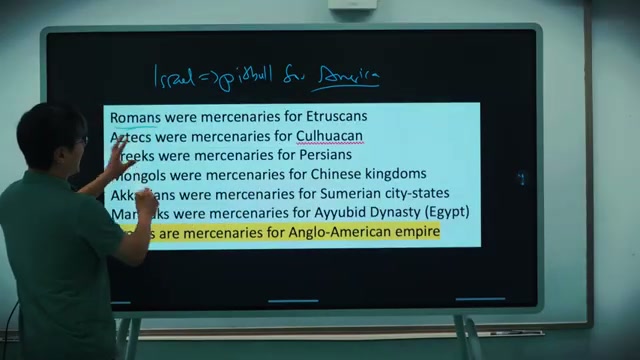
Romans, Aztecs, Greeks, Mongols, Akkadians, and Mamluks are all cited as mercenaries who replaced their patrons, establishing a 'pattern throughout human history' that Israel will follow.
Creates an impression of historical inevitability through rapid-fire enumeration. Each example is radically oversimplified (the Romans were not simply 'mercenaries for the Etruscans') but the accumulation of examples overwhelms critical scrutiny.

After playing Bessent's clip about unsanctioning Iranian oil: 'Our plan is this. We're going to let the Iranians sell their oil and MAKE A LOT OF money and then they'll be destroyed.'
Reduces a complex economic strategy to an absurdity through selective restatement, making the audience laugh at American policymakers rather than engage with the actual strategic logic of oil market management.
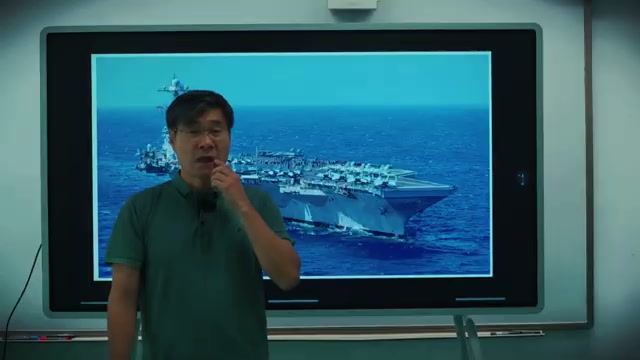
Three explanations for the Gerald Ford's withdrawal are presented as equally plausible — laundry room fire, Iranian missile hit, or combat limitations — with the conclusion 'whichever story is true, it doesn't paint a good picture.'
By presenting an unverified conspiracy theory (missile hit) alongside the official explanation and a third option, the speaker creates a 'heads I win, tails you lose' framework where all possibilities support his thesis.
Classroom authority with correction
01:02:34
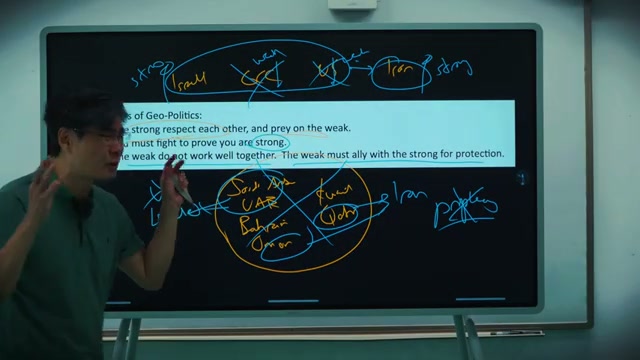
When a student asks 'if Israel really defeated America,' the speaker interrupts: 'No, no, no, no. I didn't say Israel will defeat America... Let's be clear about language.'
Demonstrates pedagogical control while creating plausible deniability. The speaker's thesis clearly implies Israel is working against American interests, but by correcting the student's plain-language summary, he can claim he never said Israel would 'fight' or 'defeat' America — just 'replace' it.
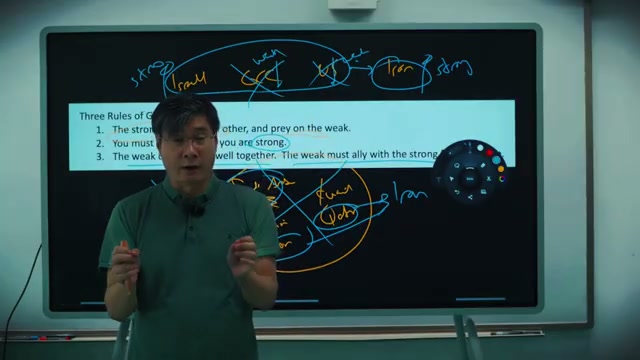
'This is all theory... It's meant to be fun. It's meant to make us more curious about the world... This is not meant to be prophecy.'
Placed near the end after an hour of confident assertions, this disclaimer serves as inoculation against criticism rather than genuine epistemic humility. The entire lecture has been presented with conviction; the caveat allows the speaker to retreat to 'just asking questions' if challenged.
prediction
America will lose the war in Iran.
untested
War ongoing — Day 35 as of Apr 3. Air campaign continues; Trump vowed 2-3 more weeks of 'extremely hard' strikes in primetime address (Apr 1). No clear winner yet. Hegseth fired Army Chief of Staff Randy George during wartime (unprecedented). UK 41-nation Hormuz conference without US (Apr 2). Araghchi says Iran prepared for 6 months of war.
prediction
Ground troops will be sent into Iran, possibly by this weekend (late March 2026).
disconfirmed
DISCONFIRMED. May 1, 2026 (Day 63): Late March passed with NO US ground troops in Iran; April passed; the entire window the speaker named has expired. As of May 1, only 192nd MP Battalion Connecticut National Guard (~150 logistics-support soldiers) deployed Apr 30 — first NG mobilization but a small logistics contingent, not a ground-invasion force. USS Gerald R. Ford LEAVING theatre Apr 30 (309-day record deployment). Apr 30 CENTCOM/Caine FIRST cabinet-level formal presentation of military options including Hormuz seizure that 'could include ground forces' — first material upward shift in ground probability since war began, but Trump has not ordered kinetic ground action. Ground-invasion probability remains LOW-BUT-NON-ZERO. The specific weekend/late-March prediction is decisively wrong. [June 1, 2026 update] Disconfirmation holds and is reinforced as the conflict moves toward a negotiated ceasefire rather than a ground war. As of June 1, 2026 (Day 95) there are still ZERO US ground troops in Iran. Since the Apr 30 Cooper/Caine cabinet briefing that first put ground-inclusive options on the table, the trajectory reversed toward de-escalation: through late May US and Iranian negotiators reached a tentative 60-day ceasefire MOU (Iran pledging never to develop or purchase a nuclear weapon; a negotiated Hormuz reopening with no tolls + Iranian mine-clearing + proportional blockade lift), pending final approval by Trump and Mojtaba Khamenei -- not signed as of June 1 (Trump requested edits May 31 rather than signing). The principal US instrument remains the naval blockade (CENTCOM: ~118 vessels redirected + 5 disabled). The named deal-failure alternative is an air/strike package ('end it a different way'; Hegseth at the Shangri-La Dialogue: 'more than capable' of resuming strikes), not a ground order. No new ground-deployment order, no third ARG, no draft. Israel's capture of Beaufort Castle in Lebanon (May 31) is an Israeli ground operation in Lebanon, NOT US ground troops in Iran. [August 1, 2026 monthly update — Day 156] Disconfirmation holds and hardens. The named window expired months ago and Day 156 has now passed with ZERO US ground troops in Iran. Beyond mere elapsed time, the evidence moved against a ground option this cycle: the Tripoli ARG offloaded ~2,500 Marines of the 31st MEU at Okinawa on July 26 with no relief ARG announced (USS Boxer now the sole deployed ARG fleet-wide); Foreign Policy's July 27 survey of former commanders found no movement toward a major ground operation; and the July 31 coercive package reported by the WSJ, CBS, CNN and Axios pursues Iranian capitulation by bombing power plants, refineries, Tehran's grid and dual-use bridges — with no ground element and no Kharg operation in any account. CFR's Global Conflict Tracker independently records 'no significant US ground force commitment.' The Kharg option has been available, staffed and repeatedly reported for four months without being taken.
prediction
Trump will call a national draft.
untested
No draft has been called as of March 27, 2026. [August 1, 2026 monthly update — Day 156] No national draft has been called. Verified this cycle: **there is no active US draft**; reinstating conscription requires authorisation from both Congress and the President during a national emergency; and the sole change of record is administrative — the scheduled switch to **automatic Selective Service registration at the end of 2026**, which removes the opportunity to object at the point of registration but is a registration mechanism, not a mobilisation. A coalition of organisations is publicly campaigning to end draft preparations, which evidences live debate rather than imminent conscription. At Day 156, with 18 US KIA, 685 wounded and theatre strength above 50,000 sustained by volunteers, manpower pressure has not produced a draft call. Untested. Reconciled against the project's own draft-indicator record this cycle: the statutory mandate is **unchanged and matches the prediction exactly** — automatic registration of men aged **18-26** must begin **December 19, 2026** under the December 2025 NDAA provision, which passed with bipartisan support. But the implementing machinery moved backwards: on **July 23, 2026 the Selective Service System WITHDREW** the proposed automatic-registration rules it had submitted to the White House on March 30, after the White House held them for nearly four months without acting. No explanation was given and the rules have not been re-proposed. That is the draft indicator's **first backward movement of the war**. With the rulemaking pulled and no mobilisation authorised, a national draft call is further away at Day 156 than at any earlier point in the war. Untested.
prediction
Israel will replace America as the dominant empire in the Middle East.
untested
Long-term prediction. Israel is conducting extensive military operations (decapitation campaign, Lebanon ground ops) but the war is ongoing.
prediction
Israel and Iran will eventually cooperate as the two regional powers after America retreats from the Middle East.
untested
Long-term prediction. Currently Israel and Iran are in active conflict; Israel has assassinated 5 senior Iranian officials.
prediction
The GCC states will be forced to choose between Israel and Iran, with Qatar and Oman siding with Iran, and Saudi Arabia and UAE siding with Israel.
untested
GCC states are under enormous pressure. Saudi Arabia refused airspace for Iran strikes. UAE has intercepted 372+ ballistic missiles. Alignments remain fluid.
prediction
Economic collapse (stock market crash, high oil) will cause civil war in America, forcing military retreat from the Middle East.
untested
Oil has exceeded $100/bbl and reached $126; economic stress is real but no civil war or military retreat has occurred.
claim
The USS Gerald Ford was withdrawn from the war theater after 3 weeks because it was either hit by an Iranian missile, suffered an internal fire proving it non-resilient, or was found to have severe combat limitations.
untested
Cannot verify the specific claims about the Gerald Ford's withdrawal. The speaker presents three competing narratives without confirming which is true.
claim
Iran has shot down at least one F-35 stealth fighter jet.
untested
Unverified claim. Iran has claimed F-35 shootdowns but independent confirmation is unavailable due to wartime information fog.
claim
ISIS is a Mossad creation and operation.
untested
This is a conspiracy theory not supported by mainstream intelligence analysis. The evidence offered (ISIS doesn't attack Israel, some agents were allegedly Mossad) is circumstantial and contested.
claim
Only 40% of the American population currently supports the war with Iran.
untested
OSV News (Apr 1) cited polls showing most Americans disapprove of the Iran war. Specific 40% figure not independently verified but direction appears correct. [August 1, 2026 monthly update — Day 156] Not resolved for the date claimed, but the trajectory is now documented. **Reuters/Ipsos put support for the war at roughly one in three (about 33%) on July 27, 2026 — the lowest reading of the conflict.** That is directionally consistent with the lecture's assertion of minority support and in the same neighbourhood as its 40% figure, but it is a July 2026 measurement and cannot verify a March 26, 2026 claim. Corroborating context: the House passed a war-powers resolution 215-208 on June 3 with four Republicans crossing over, and White House political aides were reported 'strongly opposed' to the July 31 escalation. Remains untested pending identification of a contemporaneous poll matching the lecture date and the specific figure.
claim
Trump has asked for $200 billion to fund the Iran war.
untested
Specific figure cited without source. Cannot verify independently.
claim
The war has effectively lifted sanctions on Iran, allowing Iran to earn $14 billion from oil sales, exceeding its entire $10 billion annual military budget.
partially confirmed
US did unsanction Russian oil (confirmed by Bessent clip shown). Iran has been allowed through Hormuz for 5 nations including China. The $14 billion and $10 billion figures are unverified but the general dynamic of sanctions relief through war is consistent with Trita Parsi's analysis (cited in the lecture).