Predictive History Audit / Systematic Content Analysis
Game Theory
Episode 17 · Posted 2026-03-31

The Great Reset

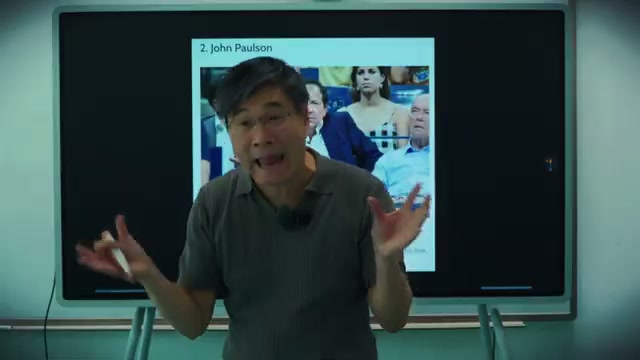
This lecture argues that financial collapses are not natural phenomena but are deliberately engineered by a transnational financial elite operating through institutions like the Bank of International Settlements (BIS). The speaker traces the history of this system from the Glorious Revolution of 1688 and the creation of the Bank of England, through the Federal Reserve, to the 2008 financial crisis, which he claims was triggered intentionally by those who profited from it (e.g., John Paulson). He argues that the BIS orchestrated China's post-2008 economic rise by manipulating exchange rates, but that China's unwillingness to assume global hegemony means transnational capital will next shift to Israel, facilitated by an engineered collapse of the US economy. The lecture concludes by predicting an imminent US financial crisis that will enable this capital transfer, framing Trump's economic pain as a necessary step to rid America of parasitic transnational capital.

Video thumbnail
youtube.com/watch?v=VbowBTJWKBo ↗ Analyzed 2026-03-31 by claude-opus-4-6

Viewer Advisory

  • The speaker explicitly states he has never studied economics and is not a professor, yet presents a comprehensive theory of global financial manipulation as fact.
  • The lecture conflates correlation with causation throughout — China growing after 2008 does not mean the BIS caused it; Paulson profiting from the crisis does not mean he engineered it.
  • References to 'secret societies,' 'the Illuminati,' and 'the occult' signal a conspiracy theory framework, not analytical rigor.
  • The claim that Israel will become the center of global trade is unsupported by any economic analysis.
  • Virtually every claim in the lecture is unfalsifiable — if the system is controlled by a hidden elite, any evidence against the theory can be dismissed as part of the illusion.
  • The lecture systematically misrepresents major philosophers (Locke, Hume, Bentham, Marx, Darwin, Freud) and the intellectual traditions they represent.
  • China receives consistently favorable treatment while the entire Western tradition is dismissed as materialist propaganda — viewers should consider why the speaker's critical lens is applied selectively.
Central Thesis

Financial collapses are engineered by transnational capital operating through institutions like the BIS, and the next engineered collapse will shift the global center of economic gravity from the United States to Israel.

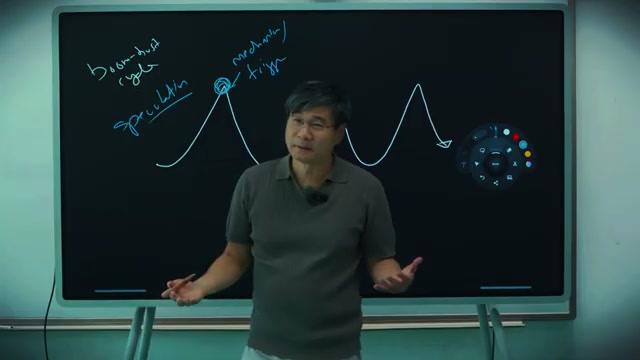
  • The boom-bust cycle is not a natural feature of capitalism but is orchestrated by a financial elite who profit from collapses.
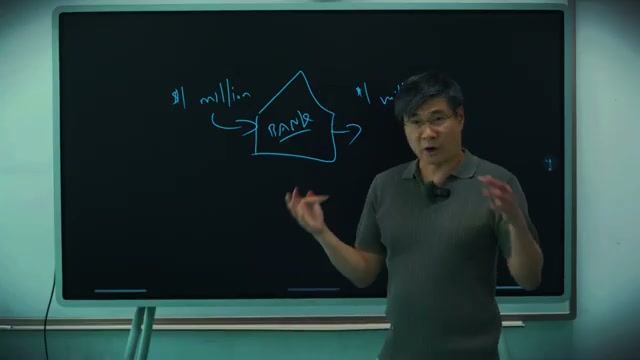
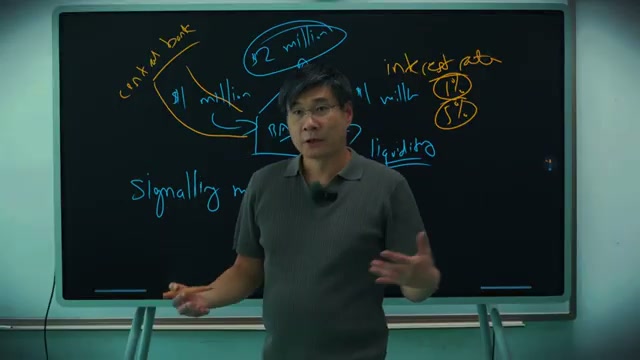
  • Banks create money through lending (fractional reserve banking), and the interest rate functions as a coordination signal for banks rather than a guide for consumer behavior.
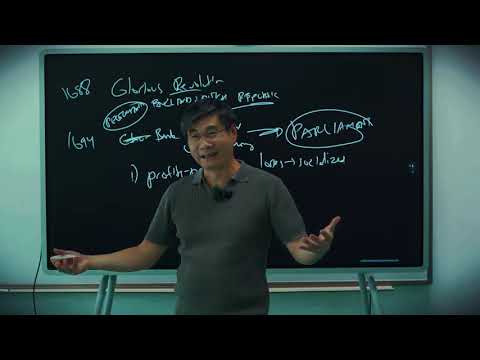
  • The Glorious Revolution of 1688 created a system where the Bank of England privatized profits and socialized losses through parliamentary debt.
  • British empiricism, skepticism, utilitarianism, Marxism, Darwinism, and Freudianism were all sponsored by transnational capital to promote materialism and undermine religion.
  • American robber barons (Rockefeller, Carnegie, JP Morgan, Vanderbilt) were agents of the City of London who created the Federal Reserve as a replica of the Bank of England.
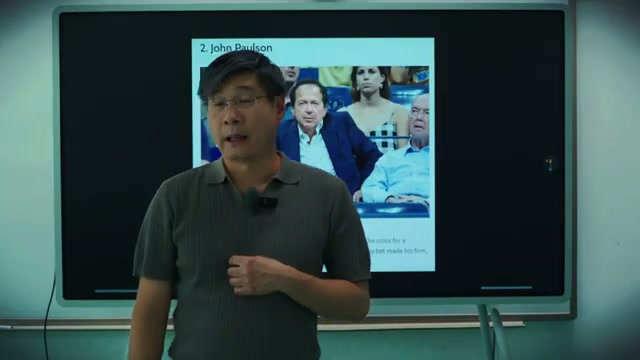
  • The 2008 financial crisis was deliberately triggered because certain actors (like John Paulson) could make more money from collapse than from continuation.
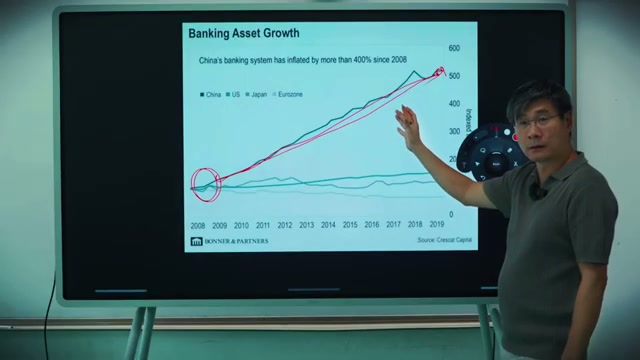
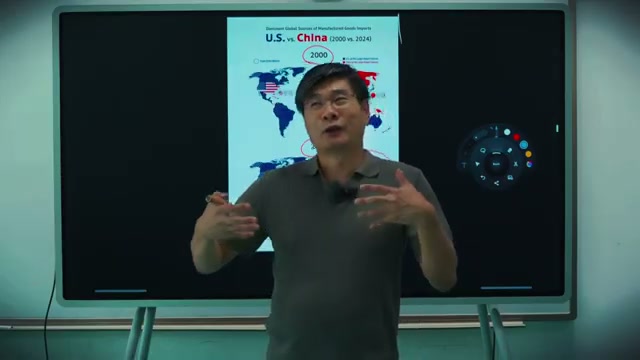
  • The BIS orchestrated China's post-2008 rise by manipulating the RMB-USD exchange rate upward, signaling the world to trade with China.
  • China's debt is localized rather than nationalized, which prevents systemic implosion despite massive bank balance sheets.
  • Transnational capital will shift from America to Israel because Israel offers wars (profit), rebuilding (capital demand), and control of global trade routes.
  • An engineered US economic collapse is coming and will create conditions for civil war, but this pain is necessary for America to rid itself of parasitic transnational capital.
Qualitative Scorecard 1.4 / 5.0 average across 7 axes
Historical Accuracy ▸ Expand
Several factual errors undermine credibility. The speaker misattributes a book called '1929' to Andrew Ross Sorkin (Sorkin wrote 'Too Big to Fail'; the classic on 1929 is Galbraith's 'The Great Crash, 1929'). The Federal Reserve Act was signed in 1913, not 1914 as implied. The characterization of fractional reserve banking as banks 'printing their own money' is misleading — banks create credit, not currency. The claim that Locke, Hume, Bentham, Marx, Darwin, and Freud were all 'sponsored by transnational capital' to promote materialism is historically unfounded — these thinkers emerged from diverse intellectual traditions across centuries. The Bank of England's characterization as purely 'private' and 'not accountable to the public' ignores its parliamentary charter. JP Morgan's consolidation during 2008 is broadly accurate, as is the BIS's role facilitating Nazi-era transactions (as documented in LeBor's book). Paulson's profits are in the right range (~$15-20B). The broad historical arc (Glorious Revolution, Bank of England, US robber barons, Glass-Steagall repeal, 2008 crisis) contains recognizable events but with conspiratorial causation layered onto them.
2
Argumentative Rigor ▸ Expand
The lecture's central argument — that financial collapses are engineered by a shadowy elite — relies entirely on post hoc ergo propter hoc reasoning and cui bono logic. The fact that some actors profited from the 2008 crisis is taken as proof they caused it, which is a fundamental logical fallacy. The claim that the BIS 'orchestrated' China's rise is supported only by temporal correlation (China grew after 2008) without any causal mechanism beyond exchange rate appreciation, which has well-documented alternative explanations. The speaker repeatedly disclaims expertise ('I've never studied economics,' 'I'm not even a professor') while making sweeping claims about how the entire global financial system operates. The argument that 'bubbles don't have to collapse' because banks can 'roll over' defaults ignores mark-to-market accounting, counterparty risk, and the mechanics of securitization. The leap from 'China won't be hegemon' to 'therefore Israel will be the next center of global capital' is entirely unsupported. The lecture is structured as a series of assertions, not arguments.
1
Framing & Selectivity ▸ Expand
The lecture is maximally selective in its evidence. Every historical event is interpreted through a single lens — deliberate elite manipulation — while alternative explanations are either dismissed ('that's what they teach you in economics class') or simply not mentioned. The 2008 crisis is presented as an inside job while ignoring the massive literature on systemic risk, regulatory failure, and misaligned incentives. China's economic growth is attributed entirely to BIS manipulation while ignoring 40+ years of Chinese domestic reform. The selection of Locke, Hume, Bentham, Marx, Darwin, and Freud as 'agents of transnational capital' cherry-picks major intellectual figures and reframes them without engagement with their actual ideas. The Bank of England's role in British industrialization, governance reform, and public finance is reduced to 'making wars profitable.' No countervailing evidence is presented at any point.
1
Perspective Diversity ▸ Expand
A single conspiratorial perspective is presented throughout with no engagement with alternative viewpoints. There is no consideration that business cycles might have structural causes in capitalism (as mainstream economics argues). There is no engagement with scholars of the 2008 crisis who offer non-conspiratorial explanations. There is no discussion of China's own agency in its economic development. There is no acknowledgment that Israel's economy, while technology-oriented, is far too small to serve as the center of global capital. The classroom format features student questions, but these are either leading questions that the speaker redirects, or genuine questions that are deferred to 'next class.' No dissenting voice is given any airtime.
1
Normative Loading ▸ Expand
The lecture is heavily normatively loaded despite the speaker's disclaimers about just engaging in 'speculation for fun.' The global financial system is consistently described as a 'scam,' 'Ponzi scheme,' and 'illusion.' Transnational capital is characterized as a 'parasite' and 'cancer' on the American host. Banks are described as taking money from 'stupid people' and 'the stupidest people.' The entire Western intellectual tradition from Locke to Freud is reduced to propaganda for 'money is God.' The characterization of liberty as merely 'the freedom to make and spend money' is a reductive normative judgment presented as descriptive analysis. The phrase 'money is God' is repeated as a characterization of Western civilization. However, the speaker does maintain a somewhat conversational, pedagogical tone and occasionally acknowledges uncertainty.
2
Determinism vs. Contingency ▸ Expand
The lecture presents an entirely deterministic view of history in which all major economic events — the Napoleonic wars, the 2008 crisis, China's rise, the coming US collapse — are orchestrated by a small group of financial elites who 'plan decades ahead.' There is zero room for contingency, accident, unintended consequences, democratic agency, or competing interests within the elite. The BIS is presented as essentially omnipotent in its ability to direct global economic flows. The coming US collapse is presented as inevitable ('we're going to be sure that it will happen'). No scenario in which the predicted sequence of events might not occur is considered. Even Trump's MAGA movement is incorporated into the deterministic framework as serving the interests of ridding America of transnational capital.
1
Civilizational Framing ▸ Expand
The lecture implicitly frames Western civilization as uniquely corrupted by materialism, with the entire intellectual tradition from Locke to Freud presented as propaganda for 'money is God.' The United States is portrayed as a host body parasitized by transnational capital. Israel is given a curiously dual treatment — simultaneously part of the conspiratorial elite (as the next destination for transnational capital) and a rational strategic actor pursuing the Greater Israel project. China is treated relatively favorably as a country that wisely avoids the hegemon trap.
2
Overall Average
1.4
Civilizational Treatment
CHINA

China is presented sympathetically as a country that was used by transnational capital (BIS-orchestrated rise after 2008) but is wise enough not to take on the burdens of hegemony — it 'doesn't want to be the hegemon' and avoids military bases overseas. Chinese debt is described as cleverly structured (localized rather than nationalized). No criticism of Chinese governance, human rights, financial opacity, or the actual reasons for China's debt problems (real estate bubble, local government financing vehicles) is offered. China is portrayed as having essentially no agency in its own economic rise — everything was orchestrated by the BIS.

UNITED STATES

The United States is characterized as a host body parasitized by transnational capital since the creation of the Federal Reserve. American intellectual and cultural life is presented as manufactured propaganda ('media, education, and culture' creating 'values and norms' that maintain the illusion). The American economic system is described as a 'giant scam' and 'Ponzi scheme.' However, the lecture offers a somewhat hopeful note that Trump's economic disruption may represent America purging itself of the parasite, suggesting a potential positive future — though at the cost of immense pain including possible civil war.

THE WEST

Western civilization broadly is characterized as built on materialist philosophy designed to serve financial elites. The entire Enlightenment tradition — empiricism, skepticism, utilitarianism — is reduced to a project of making 'money is God.' Christianity is implicitly presented as the authentic Western tradition that materialism displaced. The 'rules-based international order' (WTO, UN) is dismissed as a facade concealing elite control.

Named Sources

journalist
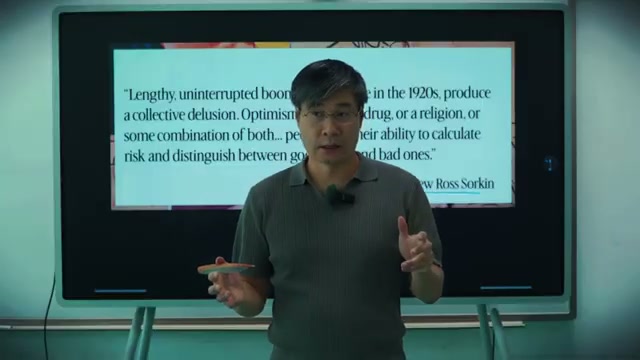
Andrew Ross Sorkin — described as writing a book called '1929'
A quote about collective delusion during lengthy booms is read aloud and attributed to Sorkin. Used to present the mainstream explanation for financial bubbles before the speaker offers his alternative 'engineered collapse' theory.
✗ Inaccurate
book
Tower of Basel (by Adam LeBor)
A passage about Nazi Germany's dependence on the BIS for financial transactions through neutral countries is read aloud. Used to establish that the BIS facilitated Nazi financing and is therefore amoral and purely profit-driven.
✓ Accurate
primary_document
Plato's Cave (The Republic)
Used as a metaphor for how the financial elite create a false reality through media, education, and culture, keeping the public unaware of the true power structure.
✗ Inaccurate
scholar
John Locke
Presented as a thinker sponsored by transnational capital to promote materialism through empiricism, arguing that private property is a 'god-given right' and that knowledge beyond experience (including God) is not feasible.
✗ Inaccurate
scholar
David Hume
Presented as promoting skepticism that undermines all knowledge including religious belief, furthering the materialist agenda of transnational capital.
✗ Inaccurate
scholar
Jeremy Bentham / John Stuart Mill
Presented as creators of utilitarianism, which the speaker reduces to 'if it gives us pleasure, it must be good,' equating liberty with the freedom to make and spend money.
✗ Inaccurate
other
John Paulson
Cited as making $20 billion by betting against the housing market in 2008, used as evidence that the financial crisis was deliberately engineered by insiders.
? Unverified
other
Jamie Dimon / JP Morgan Chase
Cited as profiting from the 2008 crisis by consolidating the banking industry, buying failing banks cheaply to become the largest bank in America.
✓ Accurate

Vague Appeals to Authority

  • 'The internet knows this but I've never studied economics' — uses audience familiarity as a substitute for credentials while simultaneously disclaiming expertise.
  • 'This is not known but one major consequence of the great financial crisis is that transnational capital encouraged China to print money' — presents conspiratorial claim as hidden knowledge without any sourcing.
  • 'There are people behind the scenes who have the power to cause economies to rise and to fall' — foundational claim of the lecture presented as self-evident fact.
  • 'Transnational capital, secret societies, and elite families' — names categories of alleged power without identifying specific organizations or individuals beyond the BIS.
  • 'The occult... which we'll study later on' — vague reference to occult power underpinning the financial elite, deferred without elaboration.
  • 'Israel controls Africa' — extraordinary geopolitical claim stated without any evidence or explanation.
  • 'These guys plan decades ahead' — attributes long-range strategic planning to 'transnational capital' without evidence of coordination mechanisms.

Notable Omissions

  • No engagement with mainstream economics on business cycles (Keynes, Minsky, Schumpeter, Hayek) despite the lecture being centrally about boom-bust cycles.
  • No discussion of the Federal Reserve's actual governance structure, dual mandate, or how monetary policy decisions are made — treated as a monolithic tool of transnational capital.
  • No mention of China's own domestic policy decisions (Deng Xiaoping's reforms, WTO accession 2001, stimulus program) as explanations for its post-2008 growth — all agency attributed to BIS.
  • No engagement with the extensive academic literature on the 2008 financial crisis (Reinhart & Rogoff, Admati & Hellwig, the FCIC report).
  • No discussion of regulatory responses to 2008 (Dodd-Frank, Basel III) that would complicate the narrative of unchecked financial elite power.
  • No mention of Israel's actual economic fundamentals, GDP, trade volumes, or why a country of 10 million in an active war zone would become the center of global trade.
  • No acknowledgment that China's exchange rate appreciation was driven by massive trade surpluses, capital inflows, and US pressure (via Treasury reports) — not BIS manipulation.
  • No discussion of the Glass-Steagall debate's complexity — many economists argue its repeal was not a primary cause of the 2008 crisis.
  • Complete omission of any voices skeptical of grand conspiracy theories in finance — the entire heterodox economics tradition (post-Keynesian, MMT, institutional economics) that critiques finance without resorting to conspiracy.
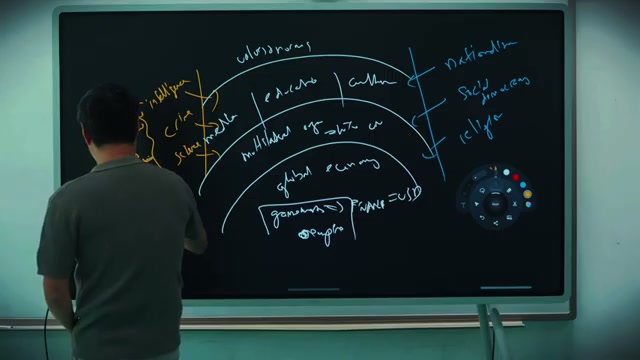
Conspiracy narrative structure 00:08:00
Frame at 00:08:00
The lecture builds a comprehensive alternative history where every major event from 1688 to 2026 is orchestrated by 'transnational capital' operating through the Bank of England, BIS, and secret societies — a unified explanatory framework for all of modern economic history.
Creates a totalizing narrative that is internally consistent and compelling precisely because it explains everything. Once accepted, any counter-evidence can be incorporated as further proof of the conspiracy (e.g., regulatory reform after 2008 is just window dressing).
False expertise disclaimer 00:02:09
Frame at 00:02:09
'The internet knows this but I've never studied economics. I don't know much about economics... I'm not an expert. I'm not even a professor. Just see this as a fun class where we're going to explore some fun topics that have no scholarly basis.'
Pre-empts academic criticism by framing the lecture as entertainment, while simultaneously making definitive claims about how the global financial system operates. The disclaimer allows the speaker to be wrong without consequence while still influencing the audience's beliefs.
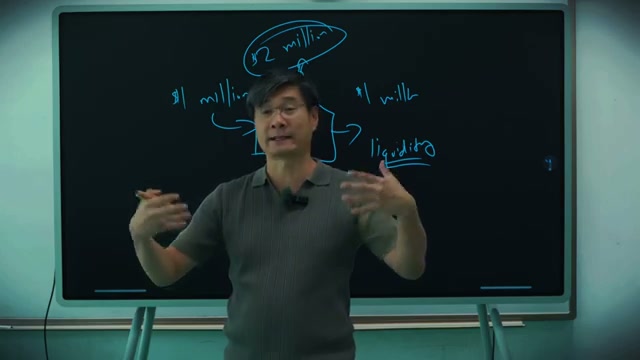
Socratic revelation 00:04:43
Frame at 00:04:43
The speaker asks how much money the bank has after taking in $1M and lending out $1M, lets students answer 'zero,' then reveals the answer is '$2 million' — presenting fractional reserve banking as a shocking hidden truth.
Creates a sense of discovery and insider knowledge. The audience feels they are learning something hidden from them by mainstream education, priming them to accept subsequent, more extraordinary claims.
Temporal correlation as causation 00:47:17
Frame at 00:47:17
Charts showing China's banking expansion and export growth beginning around 2008 are presented as proof that the BIS orchestrated China's rise: 'This is all being orchestrated by the Bank of Natural Settlements, by a few people working behind the scenes.'
Visual data makes the correlation seem compelling, while the conspiratorial interpretation is stated as fact rather than argued. The audience sees the pattern and accepts the explanation without considering alternative causes (Chinese stimulus, QE-driven capital flows, WTO integration).
Personalized analogy 00:34:14
Frame at 00:34:14
The speaker uses student names (Amber, Vincent) to walk through how CDOs and credit default swaps work, making the abstract financial mechanics feel personal and accessible: 'I lend a million dollars to Amber... But then Vincent says to me, Hey, Mr. Jeff, I bet you that Amber will not default.'
Translates complex financial instruments into a simple interpersonal scam narrative, making the 'engineered collapse' thesis feel intuitive and obvious. The simplification removes all the systemic complexity that would complicate the conspiracy theory.
Reductio ad absurdum of mainstream thought 00:11:01
Frame at 00:11:01
The speaker characterizes mainstream economics as teaching that bubbles collapse due to 'gravity' — 'it's just a law of gravity... This this just happens naturally in this game. It's no one's fault. It's just like we were too lazy and corrupt.'
Creates a straw man of mainstream economic theory, making it sound naive and evasive, which positions the speaker's conspiracy theory as the only alternative that takes the question seriously.
Intellectual genealogy as conspiracy 00:19:05
Frame at 00:19:05
Locke, Hume, Bentham, Mill, Marx, Darwin, and Freud are presented in rapid succession as agents of transnational capital promoting materialism: 'these are the three major philosophers of materialism... Sex is awesome, guys. Okay, that's what we should be doing.'
Delegitimizes the entire Western intellectual tradition by reducing centuries of independent philosophical development to a coordinated propaganda campaign. The casual, irreverent tone makes the dismissal seem authoritative rather than simplistic.
Deferred authority 00:53:33
Frame at 00:53:33
Multiple major claims are deferred to future lectures: 'this is something we'll discuss next class' appears at least five times, covering America's long-term strategy, the global impact of the financial shift, and Israel's control of Africa.
Allows extraordinary claims to stand without scrutiny by promising future elaboration. The audience accepts the claim provisionally, but the deferral ensures it is never actually defended within this lecture.
Disease/parasite metaphor 00:54:55
Frame at 00:54:55
Transnational capital is repeatedly characterized as a 'parasite' and 'cancer' on the American host: 'It's like a cancer, right? Have you guys been through cancer treatment? It's painful. Chemotherapy, they do surgery on you.'
Transforms an abstract economic argument into visceral, emotionally charged imagery. The cancer metaphor implies that the financial system is not just unfair but pathological, making radical action (economic collapse) seem like necessary medical intervention.
Narrative bootstrapping from credible to incredible 00:00:00
Frame at 00:00:00
The lecture begins with well-known facts (fractional reserve banking, the 2008 crisis, John Paulson's profits, BIS history) and gradually escalates to conspiracy claims (BIS orchestrated China's rise, secret societies control the economy, Israel will become the center of global trade).
By establishing credibility with verifiable facts early, the audience's critical defenses are lowered by the time more extraordinary claims are introduced. The transition from mainstream economic facts to conspiracy theory is gradual enough that no single step triggers skepticism.
Frame at 00:00:20 ⏵ 00:00:20
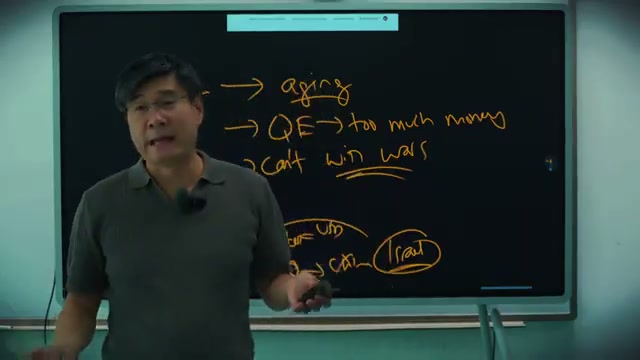
Financial collapse do not happen accidentally or naturally. It has to be engineered.
States the lecture's central thesis in its opening seconds. The absolute framing ('has to be') reveals the deterministic conspiratorial worldview that structures the entire analysis.
China's own engineered financial events — the 2015 stock market crash where state intervention failed to prevent a $5 trillion loss, or the controlled demolition of the Evergrande/real estate bubble — are never mentioned. If financial collapses are engineered, China's financial management should face the same scrutiny.
Frame at 00:03:56 ⏵ 00:03:56
There are people behind the scenes who have the power to cause economies to rise and to fall.
Foundational assertion of the lecture's worldview — that a small group of individuals controls the entire global economy. No evidence is offered; it is stated as axiomatic.
China's economy is far more centrally directed than Western economies — the CCP Politburo Standing Committee literally sets GDP targets and directs state banks to lend. If 'people behind the scenes' controlling economies is sinister, China's system is the most explicit example.
Frame at 00:12:29 ⏵ 00:12:29
Transnational capital, secret societies, and elite families. Some people call them the Illuminati.
Explicitly invokes conspiracy theory frameworks (secret societies, Illuminati) as structural features of the global system. The casual delivery normalizes what would otherwise be recognized as extraordinary claims requiring extraordinary evidence.
Frame at 00:05:37 ⏵ 00:05:37
Money is just an idea. It's a concept. It's a collective hallucination.
While containing a kernel of truth about fiat currency, this framing is used to imply that the entire financial system is a deliberate illusion maintained by elites, rather than an emergent social institution. Sets up the audience to accept conspiratorial explanations.
Frame at 00:35:10 ⏵ 00:35:10
It's all a giant scam because only a few people control the entire system. This is how you make $20 billion in this game.
Reduces the entire 2008 financial crisis — involving millions of decisions by thousands of institutions across dozens of countries — to a simple scam run by a few people. The oversimplification is presented as clarity.
China's own financial system is far more concentrated — state-owned banks dominate, the PBOC operates under CCP direction, and connected insiders receive preferential access to capital. The 'few people controlling the system' description fits China's state-directed economy more precisely than the decentralized Western financial system.
Frame at 00:49:56 ⏵ 00:49:56
China's not interested in being a hegemon. In other words, military power.
Presents China's lack of global military presence as benign disinterest rather than strategic choice or capability constraint. This favorable framing contrasts sharply with the hostile treatment of US and Israeli power projection.
China has built the world's largest navy by hull count, constructed and militarized artificial islands in the South China Sea, increased defense spending to ~$230B annually, and conducted aggressive military exercises around Taiwan. Characterizing China as 'not interested in military power' ignores the most significant peacetime military buildup since the Cold War.
Frame at 00:51:02 ⏵ 00:51:02
Your only option now is Israel. And that's why I believe that this war in Iran, what it will do is shift the center of gravity from America to Israel.
The logical leap from 'China won't be hegemon' to 'therefore Israel' is presented as self-evident. Israel — a country of 10 million currently fighting wars on multiple fronts — is cast as the inevitable next center of global capital, a claim that would be dismissed by virtually any economist or geopolitical analyst.
Frame at 00:38:55 ⏵ 00:38:55
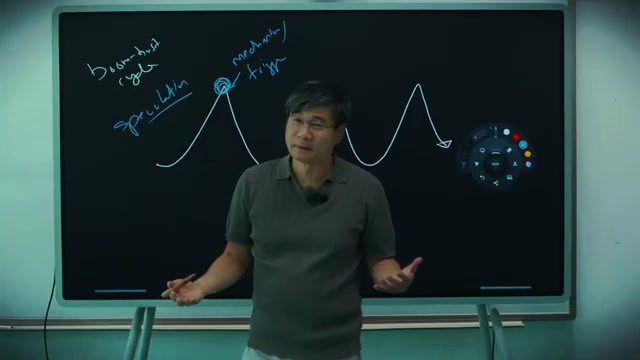
Bubbles don't have to collapse. They collapse when it's profitable for a few individuals to make it collapse.
Encapsulates the lecture's core economic thesis. While containing a grain of truth about the role of short-sellers and market manipulation, it grossly overstates the ability of any individual or group to control systemic financial dynamics.
Frame at 00:54:40 ⏵ 00:54:40
Donald Trump who believe that this pain is necessary in order for America to become great again... Make America great again. And how do you do that? You get rid of these parasites.
Reframes Trump's economic disruption as a deliberate purging of transnational capital — incorporating MAGA populism into the conspiracy framework. Trump becomes both a victim of and a conscious participant in the system's transformation.
Frame at 00:02:09 ⏵ 00:02:09
The internet knows this but I've never studied economics. I don't know much about economics... I'm not an expert. I'm not even a professor.
Remarkable disclaimer at the opening of a lecture that goes on to make sweeping claims about how the global financial system has operated for 300 years. The admission is immediately followed by claims that would be rejected by actual economists.
prediction The US economy/stock market will experience an engineered collapse, triggered suddenly by transnational capital.
00:53:00 · Falsifiable
untested
No major US stock market collapse has occurred as of March 2026, though markets have been volatile due to Iran war and tariffs. The prediction is vague on timing ('we don't know when it will happen').
prediction Transnational capital will shift from the United States to Israel.
00:51:07 · Falsifiable
untested
No evidence of major capital flows shifting to Israel. Israel is currently engaged in active warfare in Lebanon and against Iran, making it a high-risk investment environment.
prediction Israel will become the hub of global trade due to its geographic location and control of Africa.
00:56:28 · Falsifiable
untested
No evidence of Israel becoming a global trade hub. The claim that 'Israel controls Africa' is unsubstantiated.
prediction The Greater Israel project will proceed, involving conquest of the Middle East followed by rebuilding.
00:56:06 · Falsifiable
partially confirmed
Israel has significantly expanded military operations — four IDF divisions in southern Lebanon, strikes throughout Tehran, decapitation campaign against Iranian leadership. Finance Minister Smotrich called for annexation of southern Lebanon to Litani River (Mar 23, 2026). However, this is far from 'conquering the Middle East' or becoming a global economic center.
prediction Economic collapse in America will create conditions for civil war.
00:54:33 · Falsifiable
untested
No US economic collapse or civil war conditions as of March 2026.
prediction After transnational capital leaves, America will have a 'much brighter future.'
00:55:00 · Not falsifiable
unfalsifiable
Too vague and conditional on prior predictions to be testable.
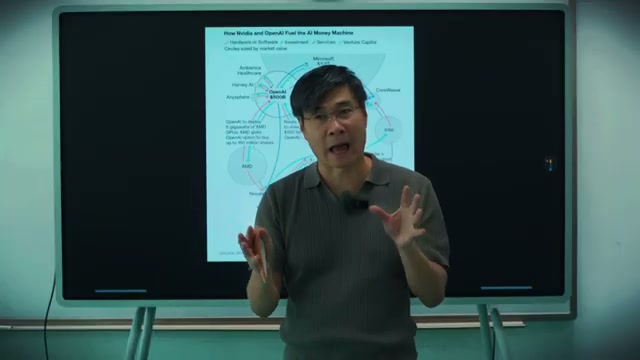
prediction The private credit bubble ($2 trillion) and the AI bubble will be collapsed simultaneously by transnational capital.
00:51:30 · Falsifiable
untested
Neither bubble has collapsed as of March 2026, though AI valuations have been under pressure.
claim The Iran war demonstrates that the American military is not as strong as people think.
00:52:31 · Falsifiable
partially confirmed
The US has faced significant challenges: 15 KIA, 300+ wounded, Hormuz blockade unbroken after 32 days, Iranian missiles have penetrated air defenses (hitting Prince Sultan Air Base, near Dimona). However, US has destroyed two-thirds of Iran's missile/drone production and maintained air superiority.
claim AI products like ChatGPT lose money every time they are used and the AI industry is a Ponzi scheme.
00:38:25 · Falsifiable
partially confirmed
OpenAI was reported to be losing money on inference costs in 2024, though margins have improved. Calling the entire AI industry a 'Ponzi scheme' is a significant overstatement — major tech companies generate substantial revenue from AI products.
claim The BIS orchestrated China's post-2008 economic rise through exchange rate manipulation.
00:44:07 · Not falsifiable
unfalsifiable
The RMB did appreciate against the USD after 2008, and Chinese bank lending did explode. But attributing this to BIS orchestration rather than Chinese government policy, US quantitative easing, and market forces is an unfalsifiable conspiratorial claim.
claim The 2008 financial crisis was deliberately engineered by actors who profited from the collapse.
00:33:40 · Not falsifiable
unfalsifiable
John Paulson did profit ~$15-20B by shorting the housing market. But profiting from a collapse does not prove engineering it. The Financial Crisis Inquiry Commission, academic studies, and journalistic investigations attribute the crisis to systemic failures, deregulation, and misaligned incentives — not deliberate sabotage.
claim The Bank of England was a private bank not accountable to the public.
00:14:59 · Falsifiable
partially confirmed
The Bank of England was indeed privately owned from 1694 until nationalization in 1946. However, it operated under a royal charter and parliamentary oversight, so 'not accountable to the public' oversimplifies its governance structure.
Verdict

Strengths

The lecture contains some genuinely useful educational content: the explanation of fractional reserve banking, while oversimplified, introduces students to an important concept; the discussion of the Glass-Steagall repeal and its role in the 2008 crisis reflects a real debate in economics; the use of Adam LeBor's 'Tower of Basel' to discuss the BIS's Nazi-era complicity draws on legitimate historical scholarship; the observation that institutional investors consolidated property ownership after 2008 is well-documented; and the speaker's acknowledgment that he is not an economist, while insufficient as a disclaimer, at least signals intellectual honesty about his limitations.

Weaknesses

The lecture suffers from fundamental intellectual failures. It commits the classic conspiracy theory error of working backward from outcomes to infer intent — because some actors profited from the 2008 crisis, they must have caused it. The entire Western intellectual tradition from Locke to Freud is dismissed as propaganda for 'money is God' in a few minutes, demonstrating breathtaking superficiality. The claim that the BIS orchestrated China's rise is presented without evidence and ignores China's own domestic policy decisions. The prediction that transnational capital will shift to Israel ignores basic economic realities — Israel's GDP is smaller than that of Illinois. The speaker explicitly disclaims economic expertise yet makes definitive claims about global financial mechanisms. The Federal Reserve date is wrong. The Sorkin attribution appears to be wrong. The argument contains no falsifiable mechanism for distinguishing between a naturally occurring crisis and an 'engineered' one, making the entire thesis unfalsifiable by design.

Cross-References

BUILDS ON

  • Previous Game Theory lectures establishing the 'game masters' and 'Plato's cave' frameworks — the speaker references having 'explained this before.'
  • Geo-Strategy #8 ('The Iran Trap') — the Iran war is referenced as demonstrating American military weakness.
  • Earlier lectures on the 'Greater Israel project' and Israel's strategic ambitions — referenced as established concepts.
  • Previous lecture apparently covering the structure of the global system (empire, game masters, countervailing forces) — speaker summarizes and applies to this scenario.
  • Future lecture promised on 'what the long-term American strategy is' and 'what happens after this financial shift.'

CONTRADICTS

  • Geo-Strategy #8's prediction that US troops would become 'trapped' in Iran — this lecture's framing of American military weakness contradicts the specific ground-invasion scenario, as no ground troops have been deployed in Iran.
This lecture represents a significant escalation in conspiratorial framing compared to earlier episodes. While Geo-Strategy #8 offered geopolitical analysis with identifiable actors and falsifiable predictions, Game Theory #17 constructs an unfalsifiable meta-narrative about a shadowy financial elite controlling all of history. The shift from specific geopolitical predictions to grand conspiracy theory marks a departure from the series' earlier, more grounded analysis. The recurring pattern of favorable treatment of China and Russia while characterizing the West as corrupt continues. The 'Greater Israel project' narrative thread is becoming more central to the overall framework, with Israel now cast as the successor to American economic hegemony.