Ironic reversal / Socratic provocation
00:09:52

The speaker repeatedly says 'Trump is an idiot' and 'this war is stupid' before reversing: 'But what if Trump WANTS to destroy the American empire? Then he'd be a genius.' This pattern is repeated at least eight times throughout the lecture.
Creates a dramatic intellectual journey for the audience — from conventional wisdom ('Trump is dumb') to counterintuitive insight ('Trump is genius'). The repetition normalizes the reversal and makes the audience feel they've discovered a hidden truth. Also provides plausible deniability: the speaker can claim he was just exploring a hypothesis.

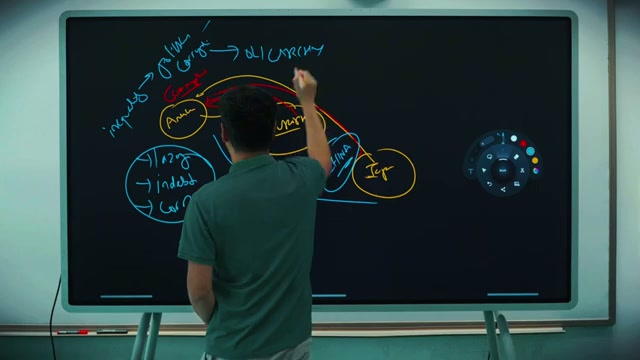
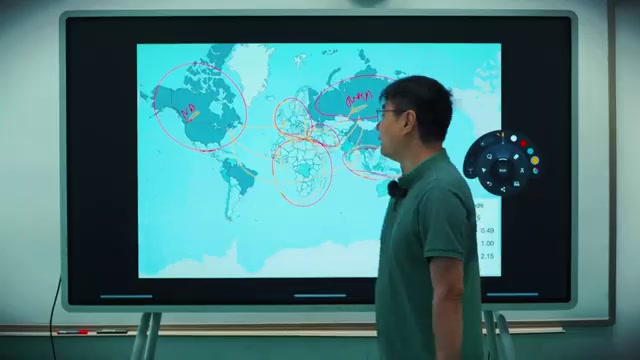
Three consecutive resource maps (oil, nitrogen/fertilizers, water) are presented to show that North America and Russia are the most resource-rich and stable regions, with the conclusion that these maps 'tell us where in the future' conflict and stability will be.
Geographic/resource determinism makes the argument feel scientific and inevitable. Static resource maps are treated as predictive of dynamic geopolitical outcomes, obscuring the many intervening variables (technology, trade, diplomacy, climate) that determine actual outcomes.
Endorsement through attribution
00:29:54
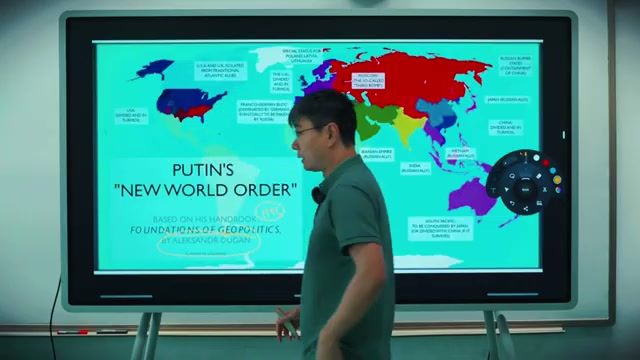
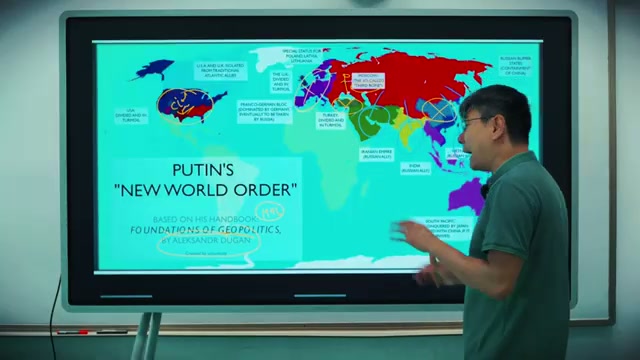
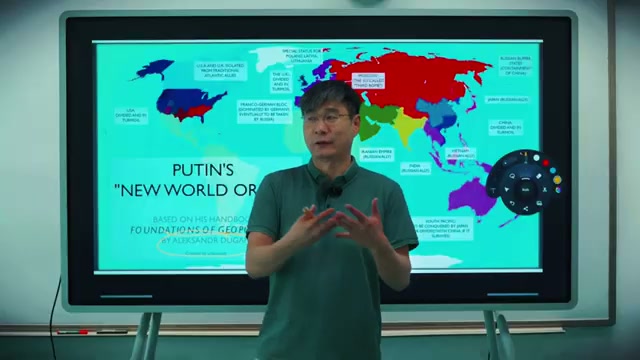
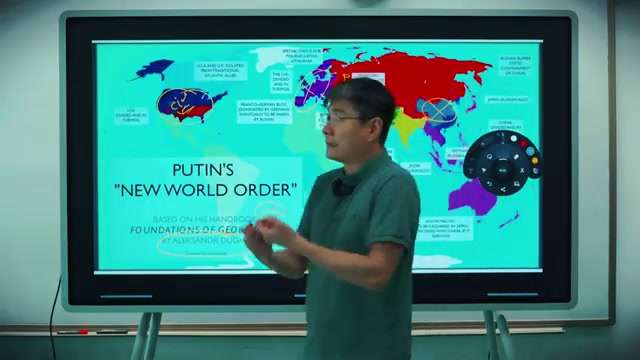
The speaker presents Dugin's 'Third Rome' thesis at length, calls Dugin 'one of the smartest geopolitical thinkers alive today,' and states 'in my opinion he is absolutely correct.'
By openly endorsing Dugin, the speaker aligns himself with a specific ideological tradition (Eurasianist/anti-liberal) while presenting it as neutral geopolitical analysis. The endorsement lends Dugin authority while Dugin's framework lends the lecture intellectual structure.
False balance / rhetorical hedging
00:19:27
'Yes, I understand Donald Trump's an idiot. I understand this war in the Middle East is stupid, but from a long-term game theory perspective, the United States wins from this disaster.'
Creates an appearance of balanced analysis ('I acknowledge the counterargument') while the actual argument is entirely one-directional. The hedging phrases serve as concessions that are immediately negated, making the audience feel the conclusion is all the more robust for having 'survived' the objection.
Conspiracy-to-strategy reframing
00:07:00

The 'Pentagon pizza index,' empty gay bars, and Polymarket bets are presented as three converging indicators that a ground invasion 'has been approved and it will happen very very soon.'
Informal, anecdotal, and humorous indicators are stacked together to create a sense of insider knowledge and pattern recognition. The audience is positioned as receiving intelligence rather than speculation.
Normative claims as analytical description
00:39:52
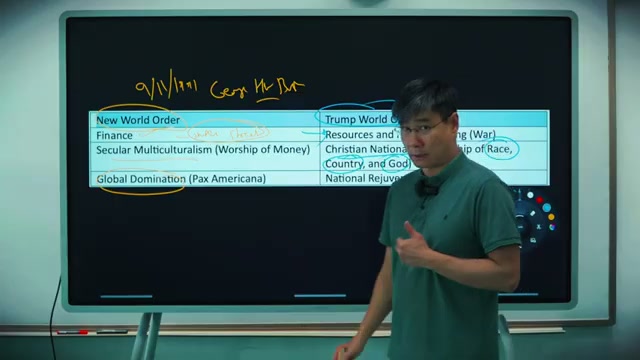
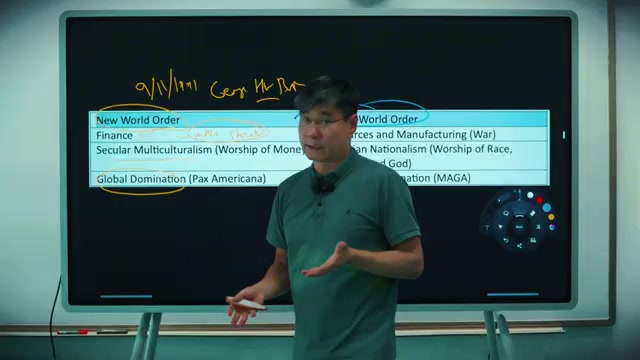
Trump World Order's pillars are described as 'Christian nationalism — our love of the white race, our nation, and God' and the rejection of 'stupidity such as DEI, woke politics, transgenderism.'
Highly charged normative positions (white nationalism, anti-DEI) are embedded within an ostensibly descriptive analytical framework. By presenting these as 'what Trump believes' rather than what the speaker advocates, the speaker can circulate these ideas while maintaining analytical distance.

The entire lecture works backward from the conclusion ('Trump benefits') to construct an explanation ('therefore it was the plan'). The structure assumes the outcome proves the intention.
By starting with 'who benefits?' and working backward, any negative outcome for competitors and positive outcome for the US becomes evidence of deliberate strategy rather than accident, luck, or collateral effect.

Trump's strategy is presented as copying Putin's proven playbook in Ukraine, making Trump's actions seem both rational and precedented: 'Putin has already proven that the strategy works in Ukraine.'
By anchoring Trump's strategy to Putin's (which is presented as successful), the speaker makes the thesis seem more plausible. If Putin's version works, Trump's must too — even though the contexts differ enormously.

The 'Pentagon pizza index' and 'empty gay bars' near the Pentagon are presented as genuine intelligence indicators of imminent military action.
Mixes humor with conspiracy thinking. The audience laughs at the absurdity but absorbs the underlying claim that ground invasion is imminent. The informality makes the claim harder to challenge directly.
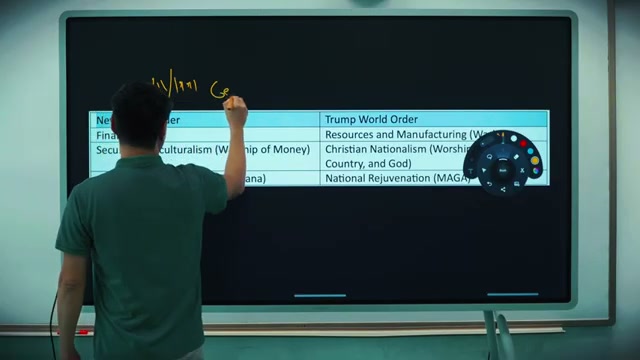
The lecture frames the current moment as a civilizational turning point: Bush's New World Order giving way to Trump's World Order, with the entire global system collapsing and being rebuilt along new lines.
Positions the audience as witnesses to a world-historical transformation, creating a sense of urgency and importance that encourages acceptance of the speaker's framework as essential to understanding the moment.
prediction
A ground invasion of Iran will happen very soon — possibly this weekend, certainly this month (April 2026).
disconfirmed
DISCONFIRMED. May 1, 2026: April 2026 ended with NO ground invasion of Iran. The full window the speaker named has expired. Only 192nd MP Battalion (~150 NG logistics troops) deployed Apr 30 — first NG mobilization but not a ground-invasion force. USS Ford leaving theatre Apr 30. Apr 30 CENTCOM/Caine FIRST cabinet-level formal presentation of military options including Hormuz seizure that 'could include ground forces' — first material upward shift in ground probability, but presentation ≠ execution. Trump has not ordered kinetic ground action. Ground-invasion probability LOW-BUT-NON-ZERO. The specific April 2026 timeframe is decisively wrong. [June 1, 2026 update] Disconfirmation holds and is reinforced as the conflict moves toward a negotiated ceasefire rather than a ground war. As of June 1, 2026 (Day 95) there are still ZERO US ground troops in Iran. Since the Apr 30 Cooper/Caine cabinet briefing that first put ground-inclusive options on the table, the trajectory reversed toward de-escalation: through late May US and Iranian negotiators reached a tentative 60-day ceasefire MOU (Iran pledging never to develop or purchase a nuclear weapon; a negotiated Hormuz reopening with no tolls + Iranian mine-clearing + proportional blockade lift), pending final approval by Trump and Mojtaba Khamenei -- not signed as of June 1 (Trump requested edits May 31 rather than signing). The principal US instrument remains the naval blockade (CENTCOM: ~118 vessels redirected + 5 disabled). The named deal-failure alternative is an air/strike package ('end it a different way'; Hegseth at the Shangri-La Dialogue: 'more than capable' of resuming strikes), not a ground order. No new ground-deployment order, no third ARG, no draft. Israel's capture of Beaufort Castle in Lebanon (May 31) is an Israeli ground operation in Lebanon, NOT US ground troops in Iran. [August 1, 2026 monthly update — Day 156] Disconfirmation holds and hardens. The named window expired months ago and Day 156 has now passed with ZERO US ground troops in Iran. Beyond mere elapsed time, the evidence moved against a ground option this cycle: the Tripoli ARG offloaded ~2,500 Marines of the 31st MEU at Okinawa on July 26 with no relief ARG announced (USS Boxer now the sole deployed ARG fleet-wide); Foreign Policy's July 27 survey of former commanders found no movement toward a major ground operation; and the July 31 coercive package reported by the WSJ, CBS, CNN and Axios pursues Iranian capitulation by bombing power plants, refineries, Tehran's grid and dual-use bridges — with no ground element and no Kharg operation in any account. CFR's Global Conflict Tracker independently records 'no significant US ground force commitment.' The Kharg option has been available, staffed and repeatedly reported for four months without being taken.
prediction
If a ground invasion goes ahead, America would lose the war because Iran's terrain and preparations make it unwinnable.
untested
No ground invasion has occurred to test this. The air/missile campaign continues without ground troops in Iran. [June 1, 2026 update] The prediction remains live, but the near-term trajectory is de-escalation toward a 60-day ceasefire MOU, not ground commitment. As of June 1, 2026 (Day 95) there are still ZERO US ground troops in Iran. Since the Apr 30 Cooper/Caine cabinet briefing that first put ground-inclusive options on the table, the trajectory reversed toward de-escalation: through late May US and Iranian negotiators reached a tentative 60-day ceasefire MOU (Iran pledging never to develop or purchase a nuclear weapon; a negotiated Hormuz reopening with no tolls + Iranian mine-clearing + proportional blockade lift), pending final approval by Trump and Mojtaba Khamenei -- not signed as of June 1 (Trump requested edits May 31 rather than signing). The principal US instrument remains the naval blockade (CENTCOM: ~118 vessels redirected + 5 disabled). The named deal-failure alternative is an air/strike package ('end it a different way'; Hegseth at the Shangri-La Dialogue: 'more than capable' of resuming strikes), not a ground order. No new ground-deployment order, no third ARG, no draft. Israel's capture of Beaufort Castle in Lebanon (May 31) is an Israeli ground operation in Lebanon, NOT US ground troops in Iran. [August 1, 2026 monthly update — Day 156] The antecedent still has not obtained: ZERO US ground troops in Iran at Day 156, and the conditional therefore remains untestable rather than wrong. What changed this cycle cuts against the antecedent ever obtaining. The July 12-25 air campaign ended in a pause; strikes resumed July 30 along the Gulf littoral but not at Kharg; and the July 31 package reported by four outlets seeks Iranian capitulation through air attack on power plants, refineries, Tehran's grid and dual-use bridges — the same leverage a Kharg seizure was designed to supply, reassigned to airpower, with no ground element in any version. The amphibious rung fell on July 26 when the Tripoli ARG offloaded ~2,500 Marines of the 31st MEU at Okinawa with no relief ARG, leaving USS Boxer the sole deployed ARG fleet-wide. CFR's Global Conflict Tracker independently records 'no significant US ground force commitment' and operations 'primarily aerial and naval.' Planning signals persist (July 24: Pentagon readying limited Kharg/coastal-raid options pending approval), but every execution indicator is at zero: no landing, no embarkation, no MEU tasking, no airborne insertion, no draft. Theatre strength above 50,000, none inside Iran; 18 US KIA / 685 wounded.
prediction
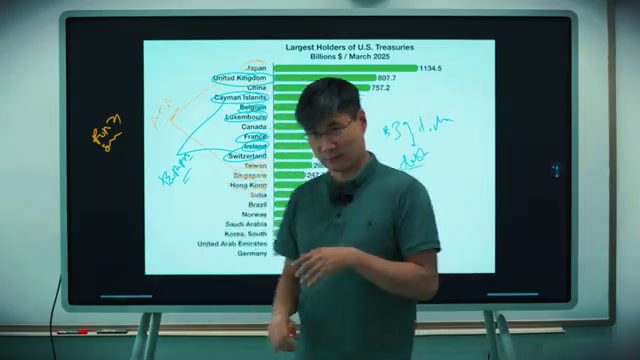
If America loses the Iran war, the American empire would die — forced out of the Middle East, losing the petrodollar and the US dollar as global reserve currency.
untested
War ongoing but US has not been 'forced out' of Middle East. Dollar remains reserve currency. Oil is priced at ~$105/bbl but dollar has not collapsed.
claim
By mid-April the world will run out of oil (attributed to JP Morgan).
disconfirmed
DISCONFIRMED. May 1, 2026: The world has NOT run out of oil. Brent peaked $144.42 dated spot Apr 7; intraday $126.41 Apr 30 (4-year high); closed $114.01 Apr 30. Oil supply severely disrupted but flowing. SPR drawdowns sustained. The JP Morgan analysis predicted severe constraints, not zero supply. 'Running out' is categorically wrong.
claim
Trump's true goal is to deliberately destroy the American empire and collapse the global economy to rebuild America as a resource/manufacturing fortress.
unfalsifiable
This is the lecture's central thesis — an interpretation of Trump's intentions that cannot be verified or falsified since it attributes hidden strategic genius to actions that could equally reflect incompetence, ideology, or lobbying pressures.
prediction
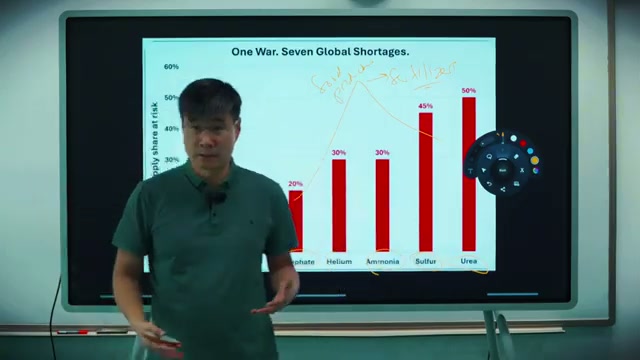
The Middle East war will knock out oil production from Saudi Arabia, Iran, Iraq, UAE, and Kuwait, leaving only North America and Russia as suppliers.
partially confirmed
Hormuz blockade has severely disrupted Gulf oil exports. Qatar gas halted, UAE refineries shut, Kuwait hit. IEA (Apr 1): April supply crunch "much worse" than March. But Saudi rerouted ~5M bbl/day to Yanbu (Red Sea), so Saudi production NOT knocked out. Iran selectively allows 5 nations through Hormuz. North America and Russia are NOT the only suppliers — Saudi Yanbu route, non-Hormuz producers continue. Oil at ~09/bbl; WTI surpassed Brent (unusual reversal). Partially confirmed — disruption is massive but not total knockout.
prediction
Russia is restructuring its entire economy for permanent war production and will primarily be a war economy in four to five years.
partially confirmed
Russia's military-industrial output has increased significantly, and civilian industry has declined relative to military production. However, characterizing Russia as transitioning to a 'permanent war economy' overstates the evidence — Russia's economy remains diversified though heavily war-tilted.
claim
Russia's invasion of Ukraine was not a response to NATO but was to implement Dugin's 'Third Rome' grand vision.
unfalsifiable
This is an interpretive claim about Russian strategic motivation. Dugin's influence on Putin is debated among Russia scholars — some see him as marginal, others as influential. The claim cannot be definitively confirmed or refuted.
claim
Western civilization will collapse because secularism, individualism, and liberalism are 'antihuman' values that break apart community.
unfalsifiable
This is a normative/philosophical claim presented as analytical prediction. The characterization of liberal values as 'antihuman' is a value judgment, not an empirical claim.
prediction
America will invade Cuba very soon.
disconfirmed
Cuba is in severe crisis (energy collapse, protests, communist party office torched) and US-Cuba secret talks are ongoing. But no invasion appears imminent — US is pursuing diplomatic/economic pressure, not military action. [August 1, 2026 monthly update — Day 156] DISCONFIRMED. The lecture aired April 2, 2026; four months have passed with no US invasion of Cuba, no invasion force generated for one, and no observable move in that direction. US policy toward Havana stayed on the sanctions-plus-talks track (US-Cuba contacts described as 'very preliminary'), while Cuba's crisis deepened on its own terms — grid collapse, mass May Day mobilisation, fuel exhaustion. Decisively, the administration's one active regime-change track in the hemisphere resolved into the **opposite** instrument: US-backed Venezuelan transition talks opened on **August 1, 2026** with Jorge Rodríguez leading the government delegation and Dinorah Figuera the opposition — a negotiated path, not an invasion. Meanwhile American military attention and force structure have been absorbed by the Iran theatre (50,000+ personnel, 18 KIA, ~$37.5B). Status changed from untested to disconfirmed.
claim
Dugin predicted civil war in the United States as left and right go to war against each other.
untested
Political polarization in the US is severe but no civil war has materialized. Attribution to Dugin is accurate — Foundations of Geopolitics does discuss fomenting internal divisions in the US.
prediction
China will be dragged into conflict because its water resources from the Tibetan plateau are needed by Southeast Asia and India.
untested
Water tensions over the Mekong and Brahmaputra rivers are real and documented, but no armed conflict has resulted. China has built upstream dams creating diplomatic friction but not war.