Conspiracy narrative construction
00:24:22
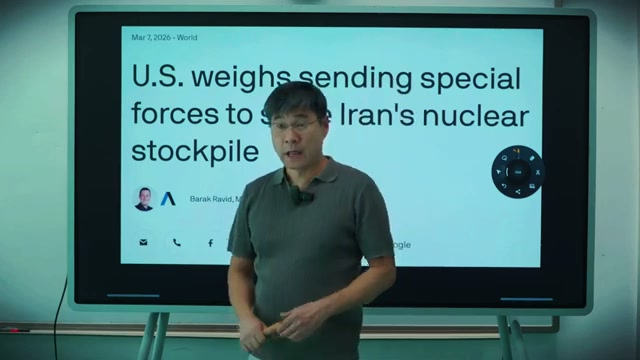
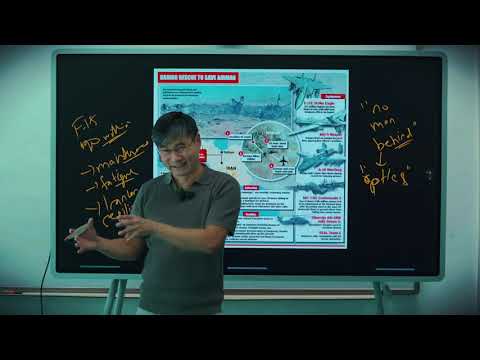
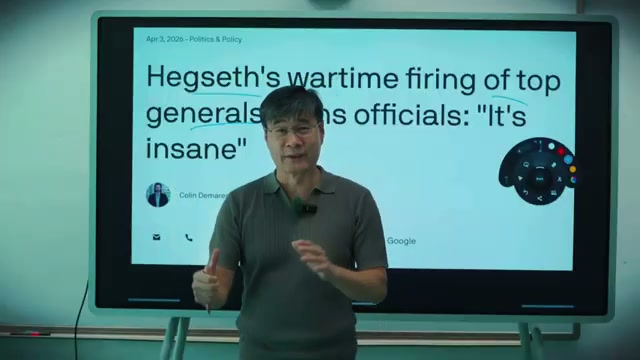
The speaker takes confirmed facts (F-15E shootdown, rescue operation, MC-130J losses, WaPo Pentagon plans leak, Hegseth firings) and weaves them into a conspiracy narrative: the rescue was a cover for a failed uranium-theft mission, the generals were fired for refusing to execute it, and the whole thing was scripted as a Hollywood movie.
Creates a compelling alternative narrative that makes the audience feel they have insider knowledge. The conspiracy is unfalsifiable — any evidence that contradicts it (e.g., the rescue details checking out) is dismissed as part of the cover story.
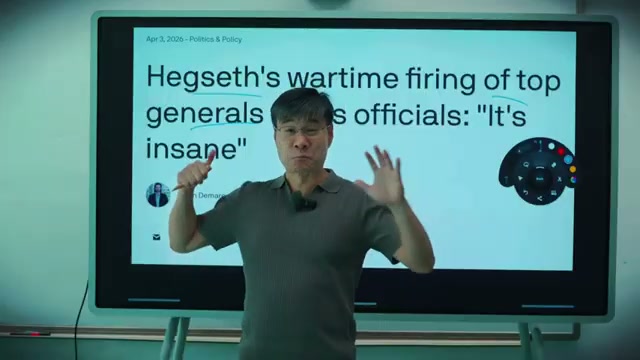
The speaker constructs imagined dialogue between Trump and his generals: Trump says 'THIS IS A BRILLIANT PLAN. THIS IS A GREAT MOVIE. LET'S DO THIS, GUYS.' The generals respond 'Oh my god, he is insane. Oh my god, we are so screwed.' Then: 'Well then you're fired.'
Makes the speculative narrative vivid and emotionally compelling. The constructed dialogue portrays Trump as delusional and generals as helpless, creating a dramatic narrative that feels like insider reporting even though it's entirely invented.
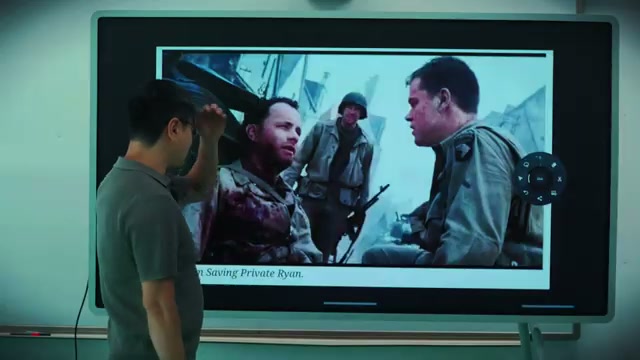
Three Hollywood-military case studies are stacked sequentially: Saving Private Ryan (fictional narrative creates mythology), Black Hawk Down (book truth vs. movie fiction), Jessica Lynch (Pentagon fabricated rescue narrative). Each builds on the last to establish the pattern before applying it to the Iran rescue.
Creates an impression of an irrefutable historical pattern. By the time the speaker reaches the Iran rescue, the audience has been primed to assume Pentagon deception as the default explanation.
Socratic leading questions with predetermined answers
00:31:38

The speaker asks what three things you need to win a war, then provides his framework (economics, organization, logistics). He then asks whether America is focusing on any of these — the implied answer being 'no.' Students are guided to the predetermined conclusion.
Creates the appearance of intellectual discovery while funneling the audience toward predetermined conclusions. The framework excludes other legitimate war-winning factors (technology, alliances, intelligence, will) that might complicate the thesis.

The speaker cites a paper by 'Kennor Merles at Brown University' on Pentagon-Hollywood collaboration, having a student read three key findings aloud. The Brown University affiliation lends institutional credibility to the broader conspiracy thesis.
Elevates the Hollywood-Pentagon thesis from conspiracy theory to academic finding. The paper's actual argument (Pentagon shapes recruitment messaging through entertainment) is much narrower than the speaker's claim (Pentagon fights wars as if scripting movies), but the academic citation makes the broader claim seem validated.
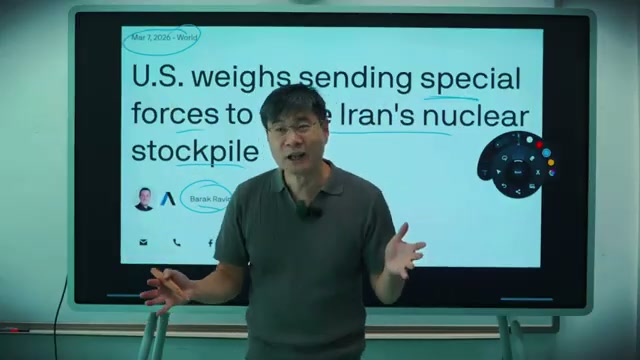
The speaker repeatedly dismisses the rescue narrative as implausible: 'Are you seriously going to send in like a hundred guys into the middle of Iran and like hope they can sneak into a military base and steal that uranium and then run away?' and 'Are you seriously going to build an airport by yourself in the middle of Iran and hope the Iranians don't notice?'
Uses the audience's intuitive sense of implausibility to reject the official narrative, while simultaneously proposing an alternative (failed uranium theft) that is equally or more implausible — but which has been given a veneer of evidence through the Axios and WaPo citations.
False equivalence of strategic objectives
00:49:33

The speaker frames Iran's and America's war objectives as compatible: Iran wants America out of the Middle East; America wants to destroy Iran. He concludes both will achieve their objectives, making peace impossible because 'both nations think they'll win.'
Creates an illusion of balanced analysis while embedding a deeply pessimistic and deterministic conclusion. The framework ignores that these objectives are actually in direct conflict (if America destroys Iran, Iran hasn't pushed America out; if Iran pushes America out, America hasn't destroyed Iran) and that partial outcomes or negotiated settlements are possible.
Emotional anchoring through civilian casualties
00:04:12

The lecture opens with discussion of Trump threatening to destroy Iranian power plants, bridges, and universities, followed by a claim that 'the first day of the war, the Americans killed 168 school girls in southern Iran,' and a description of young Iranians forming human chains around power plants.
Establishes an emotional frame of American cruelty before the analytical argument begins. The unverified '168 school girls' claim and the human-chain imagery create moral outrage that primes the audience to accept the subsequent conspiracy theory about American military incompetence and propaganda.

'Americans live in their own fantasy world created by Hollywood. And the realities of war are too far away for them to care about.' Also: 'Americans are no longer sane.'
Collapses an enormously diverse nation of 330+ million into a single caricature — Hollywood-addled, fantasy-dwelling, indifferent to war's reality. This totalizing characterization forecloses nuance and makes American defeat seem culturally inevitable.
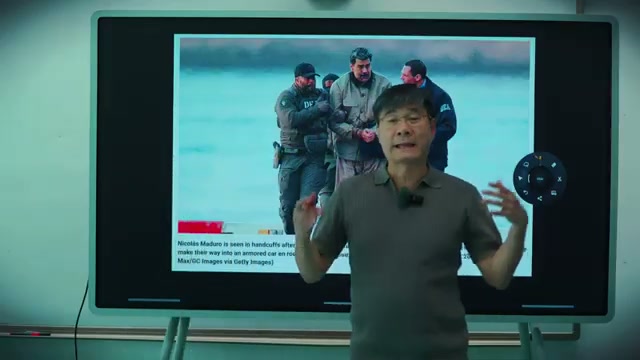
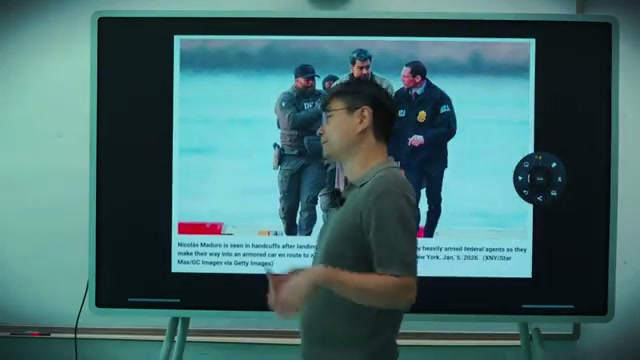
The speaker cites the successful capture of Maduro in Venezuela as the reason Trump believed a similar operation could work in Iran: 'Donald Trump believes this... he believes that we did this in Venezuela, we can do this in Iran.'
Creates a causal chain linking Venezuelan success to Iranian hubris. However, the speaker gets the date wrong ('June 3rd' instead of January 3, 2026) and omits key differences (Venezuela had no air defense, was a surprise operation, and involved a single target — not a fortified nuclear facility in mountainous terrain).
claim
The F-15E rescue operation was actually a failed ground invasion to seize Iran's enriched uranium, not a pilot rescue.
unfalsifiable
Speculative conspiracy theory. The confirmed facts (F-15E shootdown Apr 3, WSO rescued Apr 5 after 36-hour evasion, MC-130Js destroyed in sand) are consistent with the official rescue narrative. The WaPo Pentagon ground op plans (Mar 29) and Axios article (Mar 7) are real but describe Kharg Island operations, not uranium theft. No independent evidence supports the uranium theft theory.
claim
Hegseth fired the top Army generals because they refused to execute Trump's plan to build a forward operating base inside Iran.
unfalsifiable
Hegseth did fire Gen. Randy George (Army Chief of Staff), Gen. David Hodne (Training Command), and Maj. Gen. William Green on Apr 2-3, 2026. No official reason was given. The speaker's explanation is speculative — multiple other explanations exist including policy disagreements or Trump-era civil-military tensions.
prediction
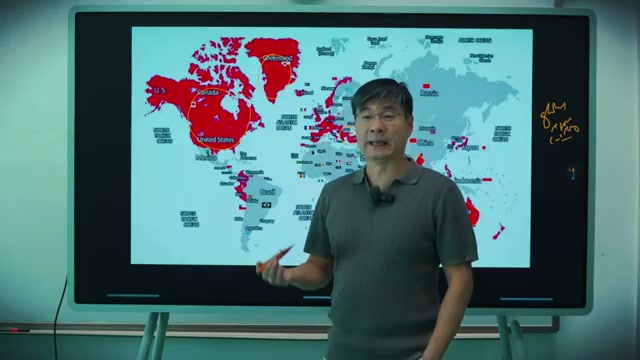
Russia will militarize its shadow fleet of ~1,000 ships, providing mercenaries to engage the US Navy in a war of attrition over the next 1-2 years.
untested
No evidence of Russian shadow fleet militarization as of April 7, 2026. Russia's shadow fleet (~600-800 tankers per Western estimates, not 1,000) is used for sanctions evasion, not naval warfare.
prediction
Germany must go to war and has no choice in the matter due to energy supply disruptions from Russia and the GCC.
untested
Germany has approved massive rearmament (€108B budget, 260K troops target, 3.5% GDP), but this is defensive buildup within NATO, not independent war-making. No indication Germany is preparing for offensive war. [August 1, 2026 monthly update — Day 156] Germany is building military-service machinery but has not gone to war. The **Wehrdienstmodernisierungsgesetz entered into force January 1, 2026**, keeping service voluntary while making registration, a fitness questionnaire and medical evaluation mandatory for men born 2008 or later, and requiring Bundeswehr consent for men aged 17-45 to spend more than three months abroad; 'needs-based conscription' is reserved for a Bundestag decision if recruitment targets fail, with cohort drafts assessed as possible from July 2027. Germany has also committed to a €4B joint defence package with Ukraine (5,000 AI-enabled strike drones, Patriot funding). But Germany is not a belligerent, German-Russian relations remain frozen with economic decoupling continuing, and no German entry into war has occurred. Untested.
claim
German males aged 17-45 are not allowed to leave the country for more than 3 months without army permission, as a prelude to a national draft.
confirmed
Germany reinstated compulsory military service questionnaires in 2025 and is expanding the Bundeswehr, but the specific travel restriction claim for males 17-45 could not be verified against major news sources. May be an exaggeration or mischaracterization of draft registration requirements. [August 1, 2026 monthly update — Day 156] CONFIRMED, and with unusual precision. Germany's Act to Modernize Military Service (Wehrdienstmodernisierungsgesetz, WDModG) entered into force on **January 1, 2026**. Under it, male persons who have reached the age of **17** must obtain the consent of the competent Bundeswehr career centre if they intend to leave the Federal Republic for longer than **three months**, and the obligation runs to age **45** — applying **even when no state of emergency has been declared**. That matches the claim's age band, duration threshold, permission requirement and the absence of an emergency trigger. The 'prelude to a national draft' framing is also supported by the statute's own architecture rather than by inference: service remains formally voluntary, but men born in 2008 or later must complete a mandatory fitness-and-willingness questionnaire and medical evaluation (voluntary for women), and the Bundestag is to decide on **'needs-based conscription'** if Bundeswehr growth targets are missed — the Defence Ministry assesses that entire cohorts could be drafted from **July 2027**, beginning with men born in 2008. Status changed from untested to confirmed. (Library of Congress Global Legal Monitor, January 28, 2026; Bundesregierung; euobserver; Euronews, April 4, 2026; deutschland.de, web-verified August 1, 2026.)
prediction
America will ultimately lose the Iran war because the Iranians are fighting a 'real war' focused on economics, organization, and logistics while America focuses on optics.
untested
May 1, 2026 (Day 63): War continues. US 15 KIA, 399 wounded. Iran 3,597+ killed (HRANA Apr 7). Iran rial 1.8M/USD record low Apr 29. Iran maintains Hormuz blockade. Trump indefinitely extended ceasefire Apr 22 with blockade continuing. Pentagon comptroller: $25B war cost. Trump rejected Iran Hormuz-for-blockade proposal Apr 27. Neither side has achieved decisive victory; allied disaffection growing (UK refused blockade support, Merz says US 'humiliated'). Untested but trending toward stalemate, not US victory.
prediction
At the end of this war, both Iran and America will achieve their strategic objectives — Iran pushes America out of the Middle East and damages the global economy; America destroys Iran as a viable nation-state.
untested
War is ongoing. Partial evidence for both: Iran has successfully blockaded Hormuz and disrupted the global economy (oil past $100/bbl, 2,000+ ships stranded); US/Israel have devastated Iranian infrastructure and assassinated 10+ senior officials. Neither full outcome has materialized.
prediction
More ground invasion attempts will follow because Trump and the Pentagon view the failed operation as a success and will try again.
untested
May 1, 2026 (Day 63): No further ground operations have occurred. Naval blockade since Apr 13 + air strikes continue. Apr 30 CENTCOM/Caine FIRST cabinet-level formal presentation of military options including Hormuz seizure that 'could include ground forces' — first material upward shift in ground probability since war began, but Trump has not approved kinetic ground action. Only 192nd MP Battalion (~150 NG logistics) deployed Apr 30. USS Ford leaving theatre. Ground-ops probability LOW-BUT-NON-ZERO. [June 1, 2026 update] The prediction remains live, but the near-term trajectory is de-escalation toward a 60-day ceasefire MOU, not ground commitment. As of June 1, 2026 (Day 95) there are still ZERO US ground troops in Iran. Since the Apr 30 Cooper/Caine cabinet briefing that first put ground-inclusive options on the table, the trajectory reversed toward de-escalation: through late May US and Iranian negotiators reached a tentative 60-day ceasefire MOU (Iran pledging never to develop or purchase a nuclear weapon; a negotiated Hormuz reopening with no tolls + Iranian mine-clearing + proportional blockade lift), pending final approval by Trump and Mojtaba Khamenei -- not signed as of June 1 (Trump requested edits May 31 rather than signing). The principal US instrument remains the naval blockade (CENTCOM: ~118 vessels redirected + 5 disabled). The named deal-failure alternative is an air/strike package ('end it a different way'; Hegseth at the Shangri-La Dialogue: 'more than capable' of resuming strikes), not a ground order. No new ground-deployment order, no third ARG, no draft. Israel's capture of Beaufort Castle in Lebanon (May 31) is an Israeli ground operation in Lebanon, NOT US ground troops in Iran. [August 1, 2026 monthly update — Day 156] Still ZERO US ground troops in Iran; the war remains air, naval and maritime-interdiction only. Since the June 1 scoring the record has moved substantially — and net downward on the ground rung. A thirteen-night US air campaign (July 12-25) ended in a pause on July 25-26; strikes resumed July 30 with a 'heavy wave' against dozens of IRGC targets along the Gulf littoral (Bandar Abbas, Qeshm, Kish, Abu Musa, Bushehr, Kazerun, Farashband, Abadan, Ahvaz) — but NOT Kharg. On July 31 four outlets (WSJ, CBS, CNN, Axios) reported a multi-day campaign against power plants, refineries, Tehran's electricity grid and dual-use bridges, framed as forcing capitulation ('At some point, they're going to say, We just can't take it anymore'). NO ground element and NO Kharg operation appears in any version of that reporting. The amphibious rung actually FELL: on July 26 the Tripoli ARG offloaded ~2,500 Marines of the 31st MEU at Okinawa with no relief ARG announced, leaving USS Boxer the sole deployed ARG fleet-wide. Foreign Policy's survey of former commanders (July 27) found the US 'does not appear to be moving toward a major ground operation in Iran,' and Trump said on July 22 'we have other people that will do the ground campaign for us.' Countervailing signals exist and are logged: the Pentagon was reported on July 24 readying options for weeks of limited ground operations (Kharg plus coastal raids) pending approval, and July 30 produced the war's first ambiguous shaping signal — but every EXECUTION indicator remains at zero: no landing, no embarkation, no MEU tasking, no airborne insertion, no draft. Independent confirmation this cycle: CFR's Global Conflict Tracker records that 'no significant US ground force commitment is documented' and that operations have 'remained primarily aerial and naval.' The Kharg seizure requirement is still assessed at ~1,200+ troops against anti-personnel and anti-armour mines emplaced on the landing shoreline itself plus added MANPADS, with experts calling holding the island the harder problem. US theatre strength is above 50,000 — roughly 10,000 above baseline — and none of it is inside Iran. US casualties stand at 18 KIA / 685 wounded; CFR records ~1,701 documented Iranian civilian deaths, up to 3.2 million displaced, and a ~$37.5B war cost.
prediction
Trump will escalate to attacking Iranian power plants, bridges, and universities, pushing Iran to total war and striking GCC targets in retaliation.
partially confirmed
Trump has set Apr 7 8PM ET deadline threatening power plants, bridges, and desalination. He already ordered destruction of Iran's largest bridge (B1 bridge Tehran-Karaj, Apr 2-3). Universities not yet struck. Iran has already struck GCC targets (Kuwait desalination, Al-Ahmadi refinery, Ras Laffan). The escalation spiral is occurring but total-war threshold not fully crossed.
prediction
The war will lead to global famine due to fertilizer shortages from disrupted Middle Eastern energy supplies during planting season.
partially confirmed
FAO warned (Apr 14) that 'clock is ticking' on global food crisis. Fertilizer prices 15-20% higher in H1 2026. Natural gas production down 20%, prices up 70%. IRC warned of 'food security timebomb.' 17M in Yemen at acute food insecurity. Strait carries ~30% of globally traded fertilizers. Direction correct — severe disruption to food supply chain underway — but full famine has not yet materialized as of April 15.
prediction
A movie will eventually be made about the pilot rescue in Iran, similar to Saving Private Ryan.
untested
claim
40% of Russia's oil exports have gone offline due to Ukrainian drone strikes on oil terminals.
disconfirmed
Russia's oil export revenues NEARLY DOUBLED to $19 billion in March 2026 (CNBC), profiting enormously from the Hormuz crisis and higher global oil prices. Ukrainian drone strikes have hit some Russian oil infrastructure but Russia has rerouted volumes and maintained export capacity. The 40% figure is categorically wrong.