Predictive History Audit / Systematic Content Analysis
Game Theory
Episode 2 · Posted 2026-01-08

Why Schools Suck

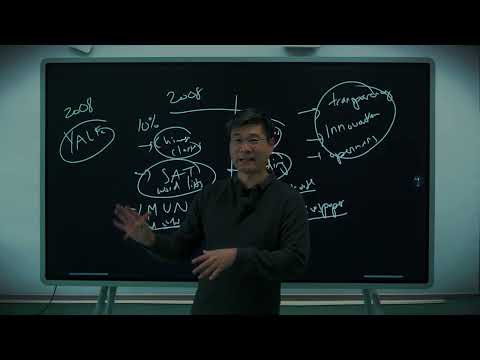
This lecture applies game theory to analyze why schools fail at their stated educational mission. The speaker uses his personal experience setting up a study-abroad program at Shenzhen Middle School in 2008 as a case study, describing how his innovative reforms (seminars, reading programs, a student-run coffeehouse and daily newspaper) were successful by educational metrics but led to his firing because they disrupted the established game played by stakeholders. He identifies six players (students, parents, teachers, administrators, government, colleges) and argues that their converging self-interests -- parents wanting 'face' and white teachers, teachers doing minimum work, administrators protecting relationships with powerful parents, and government wanting compliance -- produce schools that prioritize appearances over learning. The lecture introduces a framework of societal 'superstructure' measured by cohesion, openness, and energy, arguing that as societies mature and generate wealth, all three metrics decline, making schools worse.

Video thumbnail
youtube.com/watch?v=kS-muAuq62E ↗ Analyzed 2026-03-14 by claude-opus-4-6

Viewer Advisory

  • Despite the series title, no formal game theory is actually taught -- the analysis uses game theory vocabulary informally to frame the speaker's personal observations.
  • The speaker's personal narrative is entirely one-sided; consider that there may have been legitimate reasons for resistance to his reforms that he does not present.
  • The extreme cynicism about all stakeholders (parents, teachers, administrators, colleges) may contain grains of truth but should not be taken as a complete picture of educational dynamics.
  • The 'superstructure' framework is not established social science -- it is the speaker's own analytical construct.
  • The lecture primarily analyzes Chinese international schools serving wealthy families, a very specific niche, but draws universal conclusions about education globally.
  • The speaker's dismissal of American higher education as uniformly 'crappy' reflects bias rather than balanced analysis.
Central Thesis

Schools fail at their educational mission because the game played by stakeholders (parents, teachers, administrators) converges on a set of incentives that reward appearances, compliance, and minimal effort rather than genuine learning.

  • The three purposes of school -- literacy, core competencies (critical thinking, collaboration, communication), and lifelong learning -- are undermined by the actual incentive structures within schools.
  • All players in the education game are motivated to achieve the best results with the least effort, which leads to grade inflation, cheating, and superficial metrics of success.
  • Parents prioritize 'face' (social status) over genuine education, treating international schooling as a luxury product and valuing white teachers as markers of prestige rather than educational quality.
  • Teachers and administrators are primarily motivated by job security and minimal effort, not by educational ideals.
  • The 'superstructure' of society -- measured by cohesion, openness, and energy -- determines the quality of schools; as societies generate wealth and inequality, all three decline.
  • Reform is only possible within the convergence point of stakeholder interests; attempting to create an entirely new game outside these boundaries leads to rejection and ostracism.
  • Chinese schools in the 1980s were better because the society had higher cohesion, openness, and energy due to poverty creating genuine motivation to learn.
  • Ivy League colleges and American universities primarily want students who will pay tuition, not genuinely passionate learners.
Qualitative Scorecard 2.4 / 5.0 average across 7 axes
Historical Accuracy ▸ Expand
The lecture makes relatively few specific historical claims, relying primarily on the speaker's personal anecdote and broad generalizations. The characterization of Finland's education system as valuing teachers and producing good outcomes is broadly accurate. The claim about 1980s Chinese schools being 'amazing' is debatable -- while there was genuine educational motivation, the system was also deeply constrained by ideology and resource scarcity. The claims about literacy decline and attention spans are stated as fact without sourcing. The personal narrative about Shenzhen Middle School cannot be independently verified but is presented with sufficient specificity to be plausible.
3
Argumentative Rigor ▸ Expand
The lecture's argument suffers from several logical weaknesses. First, the speaker's personal experience at one school is generalized to explain why 'most schools' globally fail -- a massive inductive leap from a single case. Second, the game theory framework is applied informally without any actual game-theoretic methodology (no payoff matrices, no equilibrium analysis, no formal modeling). Third, the argument is circular: schools are bad because stakeholders have bad incentives, and stakeholders have bad incentives because society is declining, and society is declining because of wealth and inequality -- but no causal mechanism is rigorously established. Fourth, the 'superstructure' framework (cohesion, openness, energy) is introduced as if it were established theory but appears to be the speaker's own invention, presented without theoretical grounding. Fifth, the speaker's self-serving narrative -- he was an innovative reformer rejected by a corrupt system -- is presented as objective analysis rather than one perspective on a complex organizational situation.
2
Framing & Selectivity ▸ Expand
The lecture is highly selective. The speaker presents only evidence that supports his thesis: his own success story, the dysfunction of Chinese international schools, and Finland as a foil. Counterexamples are not discussed: schools that have successfully reformed, education systems that function well despite wealth (Singapore, South Korea in certain respects), or the genuine achievements of the Chinese education system. The personal narrative is especially one-sided -- the speaker was fired and rejected, but only his perspective on why is presented. The possibility that his reforms may have had legitimate problems (unsustainable pace, cultural insensitivity, autocratic management style -- which he himself acknowledges being called a 'dictator') is acknowledged but not seriously explored.
2
Perspective Diversity ▸ Expand
The lecture presents a single analytical perspective throughout. While the speaker identifies multiple stakeholders, he assigns motivations to all of them from his own viewpoint rather than engaging with their actual perspectives. Parents are uniformly characterized as status-seeking and superficial. Teachers are uniformly characterized as lazy. Administrators are uniformly characterized as conflict-averse. Students are characterized as primarily social rather than academic. No stakeholder group is allowed to speak for itself or present a more nuanced self-understanding. The only 'diverse' element is the student questions, but these are brief and the speaker controls the framing of responses.
2
Normative Loading ▸ Expand
Despite presenting itself as objective game-theoretic analysis, the lecture is heavily normatively loaded. The title itself -- 'Why Schools Suck' -- is evaluative. The speaker consistently characterizes stakeholders in unflattering terms: parents want 'white faces' and 'face,' teachers want to 'get by,' colleges 'just want the money,' administrators 'hide in their office.' American higher education is dismissed as providing 'a crappy education.' The speaker positions himself as a heroic reformer unfairly punished by a corrupt system. The language throughout carries implicit moral judgments about what education should be, while claiming to describe 'the way things are.'
2
Determinism vs. Contingency ▸ Expand
The lecture has a somewhat deterministic framing through the 'superstructure' concept -- societies inevitably move from high cohesion/openness/energy to low as they generate wealth. However, the speaker does acknowledge some contingency: reform is 'possible but only within a subset of the convergence point,' suggesting incremental change is achievable. The Finland example implicitly suggests that decline is not universal. The speaker also acknowledges that not 'all schools' are bad. However, the overall arc -- from energetic young societies to corrupt mature ones -- is presented as a general law without discussing conditions under which it might not hold.
3
Civilizational Framing ▸ Expand
The lecture touches on civilizational themes but is primarily focused on education rather than geopolitics. China is treated with a mix of criticism (contemporary education system, status-obsessed parents, compliance-oriented government) and nostalgia (1980s schools were 'amazing'). The US/West receives dismissive treatment: American universities provide 'crappy education' and just want money; 'white faces' are valued superficially as status markers. Finland receives positive treatment as an ideal. The framing is less ideologically charged than the speaker's geopolitical lectures but still contains embedded judgments.
3
Overall Average
2.4
Civilizational Treatment
CHINA

China receives the most detailed treatment. Contemporary Chinese education is criticized for excessive testing, book-burning after gaokao, status-obsessed parents, and government prioritizing compliance over innovation. However, 1980s China is nostalgically idealized as having amazing schools with motivated teachers and students. The speaker acknowledges he was 'subverting traditional Chinese values' and positions himself as an outsider reformer in the Chinese system.

UNITED STATES

American higher education is dismissively characterized: colleges 'just want the money,' they'll accept anyone who pays, and they provide 'a crappy education in America.' Ivy League schools are said to primarily want students from powerful families, not the best students. The speaker's own Yale education is mentioned as a credential but American education is otherwise treated negatively.

THE WEST

The West is primarily referenced through the 'white faces' motif -- Western teachers are valued by Chinese parents as status symbols rather than for educational quality. This frames Western presence in Chinese education as superficial and commodified.

Named Sources

other
Personal experience at Shenzhen Middle School (2008)
The speaker's primary evidence is his own experience setting up a study-abroad program in Shenzhen, including establishing seminars, a 5,000-book English library, a student-run coffeehouse, and a daily newspaper. He claims the program became the most famous in South China with the best college admissions record, but he was fired and called a 'dictator.'
? Unverified
other
Finland's education system
Cited as a positive example of a country with high cohesion, openness, and energy that produces excellent schools by paying teachers well, giving them high status and autonomy.
✓ Accurate

Vague Appeals to Authority

  • 'As you know the purpose of school is to train you...' -- states educational purposes as self-evident without citing educational philosophy or research.
  • 'Around the world people are losing the capacity to read and to write' -- broad claim made without citation of literacy data or research.
  • 'People lose focus after about 5 minutes' -- attention span claim presented as fact without sourcing any cognitive science research.
  • 'When you go to university the professors there are so shocked that you don't read books' -- anecdotal generalization presented as universal.
  • 'In China in maybe 1980s, the schools were amazing here' -- nostalgic claim about 1980s Chinese education without specific evidence or metrics.
  • 'Colleges don't care... they just want students who are willing to pay money to get a crappy education in America' -- sweeping dismissal of US higher education without evidence.

Notable Omissions

  • No engagement with education research literature (e.g., John Hattie's 'Visible Learning,' PISA data, or any peer-reviewed education studies).
  • No discussion of actual game theory scholarship or formal models -- Nash equilibrium, prisoner's dilemma, mechanism design -- despite the series title.
  • No consideration of successful education reform movements (charter schools, Montessori, project-based learning) that have worked within existing stakeholder dynamics.
  • No acknowledgment that China's gaokao system, while stressful, has produced genuine academic achievement by global standards (e.g., strong PISA performance).
  • No discussion of structural factors like class size, funding, teacher training pipeline, or curriculum standards that education researchers identify as key drivers.
  • The speaker's personal narrative is entirely one-sided; no consideration of legitimate reasons stakeholders may have resisted his reforms (cultural sensitivity, sustainability, community buy-in).
  • No mention of education scholars who have studied Chinese education reform specifically (e.g., Yong Zhao, Kai-ming Cheng).
Personal narrative as evidence 00:05:22
The speaker tells an extended story about his experience at Shenzhen Middle School in 2008, describing his innovations, success, and subsequent firing, using this single personal experience as the evidentiary foundation for a global analysis of education.
Makes the argument emotionally compelling and establishes the speaker's authority as someone who has been 'in the trenches,' while obscuring that a single anecdote cannot support universal claims about education systems worldwide.
Hero narrative / martyrdom framing 00:12:00
The speaker describes himself as an innovative reformer who set up 'the best study abroad program in all of China,' was 'the first' to do everything, and was rewarded by being fired and called a 'dictator' and an expletive.
Positions the speaker as a visionary prophet rejected by a corrupt establishment, which primes the audience to accept his analysis as the truth that entrenched interests don't want to hear. The self-aggrandizing framing discourages critical examination of why he might have actually been fired.
Cynical reductionism 00:18:00
Each stakeholder group is reduced to a single cynical motivation: parents want 'face,' teachers want to 'get by,' administrators want to 'protect relationships with parents,' government wants 'no problems,' colleges 'just want the money.'
Creates the appearance of penetrating insight by stripping away stated motivations to reveal 'real' ones, but the reductions are so extreme they become caricatures. The technique makes the analysis feel provocative and honest while actually oversimplifying complex human motivations.
Provocative racial observation 00:25:54
The speaker states that international schools in China use 'white faces' as their 'main marketing tool' and that parents equate white teachers with school quality regardless of actual teaching ability.
Creates a shock of recognition in the Chinese student audience while positioning the speaker as someone brave enough to say uncomfortable truths. The observation contains a kernel of truth about status signaling but is presented as the dominant rather than one of many factors in school choice.
False dichotomy between ideals and reality 00:48:08
'Game theory, it's not about ideas. It's not about ideals. It's not the way things should be. It's the way things are.'
Frames the speaker's cynical interpretation as 'reality' while dismissing any more optimistic or nuanced view as naive idealism. This rhetorical move makes it difficult for students to push back without appearing unsophisticated.
Socratic leading questions 00:24:33
Throughout the lecture, the speaker asks questions like 'Is that true?' and 'Does that make sense?' after making assertions, creating the appearance of dialogue while actually seeking confirmation rather than genuine inquiry.
Creates the illusion of student-driven discovery while the speaker controls the framing. Students are positioned as confirming the speaker's analysis rather than developing their own.
Strategic self-deprecation 00:15:51
The speaker frames his initial assumptions as naive: 'Clearly this is wrong... clearly I was wrong about who they were,' then presents his revised cynical analysis as hard-won wisdom.
The before/after structure (naive idealism → worldly realism) models the intellectual journey the speaker wants students to undertake, making his cynical conclusions seem like the natural endpoint of mature thinking.
Pseudo-scientific framework 00:30:20
The speaker introduces 'cohesion, openness, and energy' as three metrics for understanding societal development, presenting them as analytical tools despite having no established basis in social science research.
Gives the analysis an appearance of systematic rigor by presenting the speaker's personal framework as if it were an established analytical methodology, lending unearned authority to his conclusions.
Nostalgic idealization 00:32:12
The speaker claims that in 1980s China, 'the schools were amazing,' teachers 'felt respected,' students 'enjoyed learning,' and 'kids did less work' but 'learned a lot more.'
Creates a golden age narrative that makes current decline seem more dramatic and validates the speaker's thesis about societal decay, while glossing over the many problems of 1980s Chinese education (limited access, ideological constraints, resource scarcity).
Universalizing from a specific context 00:38:53
The speaker analyzes Chinese international schools specifically but frequently extends conclusions to 'most places around the world' and 'most schools' globally without justification.
Transforms a critique of a specific niche (Chinese international schools serving wealthy families) into a universal theory of educational failure, giving the argument much broader scope than the evidence supports.
⏵ 00:02:53
In fact, they make you hate learning.
Encapsulates the lecture's central provocative claim -- schools achieve the opposite of their stated mission. Sets the rhetorical frame for the entire lecture.
⏵ 00:13:11
The word that everyone used to describe me was not reformer, not visionary, not idealist, not dreamer, but dictator.
Reveals the speaker's self-conception as a misunderstood visionary. The dramatic listing of rejected positive labels followed by the negative one creates a martyrdom narrative. Notably, the speaker does not seriously examine whether the 'dictator' label might have been partially earned.
⏵ 00:18:01
Everyone wants to achieve the best results by doing the least amount of work possible. People are lazy and people are greedy. It's that simple, guys.
Reveals the speaker's reductionist view of human motivation that underpins the entire analysis. While containing a grain of truth about incentive structures, this extreme simplification excludes intrinsic motivation, professional pride, and genuine care for children that do exist in education systems.
⏵ 00:22:38
They just want students who are willing to pay money to get a crappy education in America.
Reveals deep cynicism about American higher education. While there are legitimate criticisms of international student recruitment practices, dismissing all of American higher education as 'crappy' is a sweeping normative judgment presented as analytical insight.
The speaker criticizes American colleges for treating education as a business, but Chinese universities face similar criticisms -- credential inflation, rote learning, and the gaokao system reducing education to a single exam score. The speaker's own school in Shenzhen was also operating in a market-driven education landscape.
⏵ 00:25:54
International schools have white faces, right? White faces. This is the main marketing tool of international schools.
One of the lecture's most provocative claims, addressing racial dynamics in Chinese international education. The speaker uses this to illustrate how superficial signifiers replace genuine quality assessment, but the bluntness of the claim risks reducing complex cultural dynamics to a single racial observation.
⏵ 00:45:03
I was subverting traditional Chinese values.
A moment of unusual self-awareness where the speaker acknowledges that his reforms were not just pedagogically different but culturally transgressive. This admission undermines his earlier framing that resistance was purely due to stakeholder laziness and self-interest.
⏵ 00:19:31
The government is like, you know what? I don't want innovation in this country. Even though I say I want it.
A pointed critique of the Chinese government's relationship to innovation -- publicly demanding it while structurally suppressing it. This is one of the lecture's more politically charged observations, delivered casually in a classroom setting.
The speaker criticizes the Chinese government for claiming to want innovation while actually wanting compliance, but this same dynamic -- a gap between stated ideals and actual priorities -- applies to the speaker's own framework. He claims to teach game theory (implying analytical rigor) while actually teaching his personal philosophy through anecdote.
⏵ 00:48:08
Game theory, it's not about ideas. It's not about ideals. It's not the way things should be. It's the way things are.
Reveals the speaker's epistemological claim -- that his analysis represents objective reality rather than one interpretive framework. This is a common rhetorical move in the Predictive History corpus: presenting the speaker's perspective as uniquely aligned with 'how things really are.'
⏵ 00:28:45
So, as long as schools are teaching you how to obey authority, how to comply, how to do what you're told, they're happy. You're a good school.
A critique of the Chinese government's actual priorities for education -- producing compliant citizens rather than innovative thinkers. This is a politically significant statement to make in a Chinese classroom and reveals the speaker's willingness to critique the state.
⏵ 00:40:35
Whatever you do, whatever game you set up has to be within this convergence point in order for players to accept it.
The lecture's most genuinely useful analytical insight -- that reform must work within existing stakeholder dynamics rather than trying to impose an entirely new system from outside. This is the speaker learning from his own failure and producing a practical lesson about institutional change.
claim Schools will continue to decline as societies generate more wealth and inequality, leading to further erosion of cohesion, openness, and energy.
00:33:00 · Not falsifiable
unfalsifiable
This is a broad structural claim about civilizational decline applied to education, lacking specific testable criteria.
Verdict

Strengths

The lecture succeeds as pedagogy in several ways: it uses a topic familiar to students (school) to introduce game theory concepts, making abstract ideas concrete. The personal narrative is engaging and honest in its self-criticism (acknowledging he was called a dictator, acknowledging his assumptions were wrong). The core insight -- that institutional outcomes reflect converging stakeholder interests rather than anyone's stated ideals -- is genuinely useful and well-illustrated. The observation about reform needing to work within the convergence point of stakeholder interests is practical wisdom with broad applicability. The critique of Chinese parents valuing 'face' over education, while blunt, touches on real dynamics in Chinese international education. The lecture is refreshingly willing to criticize all stakeholders including the Chinese government.

Weaknesses

The lecture suffers from significant analytical shortcomings: it claims to teach 'game theory' but uses none of the formal methodology of the field -- no payoff matrices, no equilibrium concepts, no strategic interaction models. The analysis is built entirely on one personal anecdote generalized to global education, which is methodologically unsound. The characterization of stakeholders is reductively cynical -- reducing all parents to status-seekers, all teachers to lazy workers, and all colleges to money-grubbers ignores the genuine complexity of these groups. The 'superstructure' framework (cohesion, openness, energy) is presented as analytical but appears to be the speaker's personal invention without theoretical grounding. The heroic self-narrative (innovative reformer punished by corrupt system) goes essentially unquestioned. The nostalgic idealization of 1980s Chinese education ignores the severe limitations of that era. American higher education is dismissed wholesale as 'crappy' without engagement with its actual strengths and contributions.

Cross-References

BUILDS ON

  • Game Theory #1 (referenced as 'last class') -- discussed the dating game as an example of game theory, and introduced the concept of 'superstructure' and how societies are born, mature, and die.
This lecture is notable within the Predictive History corpus for being focused on education rather than geopolitics, and for using the speaker's personal experience as the primary evidence base. It introduces the 'superstructure' framework (cohesion, openness, energy) that likely recurs in later Game Theory lectures when analyzing nations and geopolitical actors. The cynical reductionism applied to education stakeholders here mirrors the approach applied to geopolitical actors in other series (Geo-Strategy, Civilization) -- all actors are reduced to self-interested rational agents, and stated ideals are dismissed as cover for material interests. The lecture also reveals the speaker's background as a Yale-educated Chinese-American working in Chinese education, providing context for his perspective across other lecture series.