Predictive History Audit / Systematic Content Analysis
Game Theory
Episode 21 · Posted 2026-04-21

World War Trump

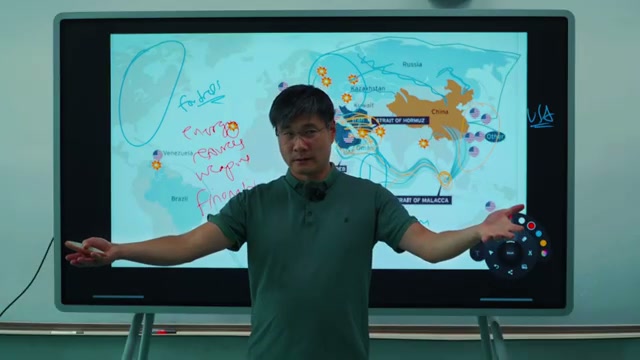
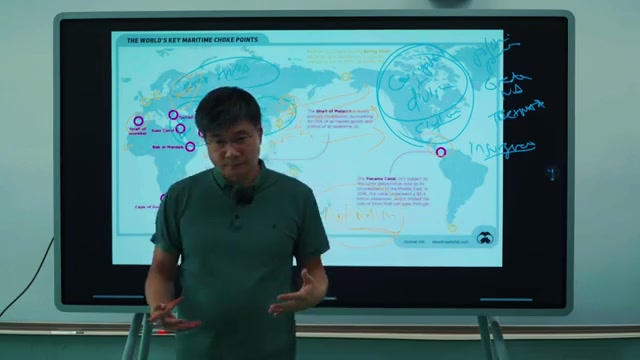
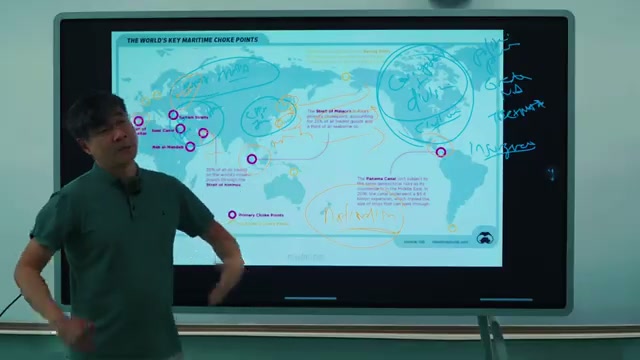
Delivered during the Apr 8 Iran ceasefire and on the eve of its announced expiry, this lecture argues that the US-Iran war is not about Iran at all but about an American imperial strategy articulated in the January 2026 National Defense Strategy: control the world's maritime chokepoints (Hormuz, Malacca, Panama, Gibraltar), force a world perpetually at war to depend on US energy, weapons, and dollar-denominated financing, and thereby engineer a new Marshall-Plan-style reflation of the American industrial base. The speaker reads long extracts from the NDS aloud with his daughter and interprets phrases like 'peace through strength,' 'burden-sharing,' and 'deterrence by denial' as a coded program of hegemony, vassalage, and containment of China. He then argues that three conditions are required for the plan to work — a national draft, 'continuity of agenda' via a Trump third term, and an AI-enabled surveillance/police state (ICE buildup, $500B Operation Stargate data centers) — and that nationalism, corruption, and political polarization will cause the plan to backfire and accelerate imperial collapse. The lecture closes with a Q&A in which the speaker concedes the US may lose the Iran war but insists this is irrelevant because controlling chokepoints, not defeating Iran, is the real objective.

Video thumbnail
youtube.com/watch?v=Ts-AA6LQf6I ↗ Read time: ~14 min
Analyzed 2026-04-22 by claude-opus-4-6

Viewer Advisory

  • Watch this lecture for the NDS close reading and the chokepoint-control framing — both are analytically useful and unusually well-sourced for this series. Discount heavily the totalizing claim that every US action is a coordinated execution of a single plan, the unfalsifiable 'pre-arranged theatre' claim about the House vote, and the attribution of the refinery fire wave to deliberate US/Russian sabotage. Notice what is absent: the UK's public refusal to support the US Hormuz blockade (Apr 13-14), the 41-nation Hormuz conference that excluded the US (Apr 2), the Supreme Court's IEEPA ruling constraining Trump's coercive toolkit (Feb 20), and any account of intra-administration or intra-Pentagon dissent. Notice also that the near-term predictions the framework stands on — Dec 2026 national draft, $1.5T FY2027 Pentagon budget, Trump third term, retreat to Western Hemisphere — are all testable in coming months and years, and should be used to audit the framework rather than accepted on its current confidence level. Treat the 'Technate' and 'greater North America' language as the ideologically loaded terms they are — they come from 1930s Technocracy Movement literature and are most prominent in contemporary conspiracy circles.
Central Thesis

The Iran war is a subordinate move within a larger American imperial strategy — encoded in the January 2026 National Defense Strategy — of controlling global maritime chokepoints, manufacturing perpetual regional conflicts, and forcing the world into dollar-denominated dependence on US energy, weapons, and credit; this strategy will produce short-term imperial reflation but collapse in the medium term under nationalism, corruption, and internal division.

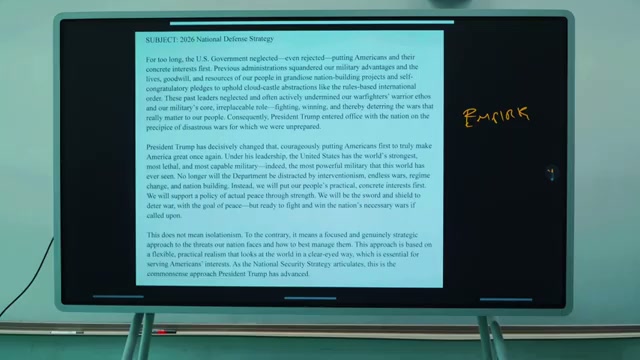
  • The January 2026 National Defense Strategy (Hegseth Pentagon) is a blueprint for a new American hegemony based on 'concrete interests,' abandonment of the rules-based international order, and an unconstrained 'warrior ethos' that drops rules of engagement.
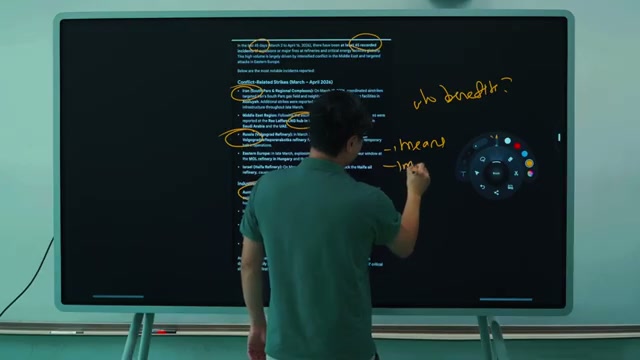
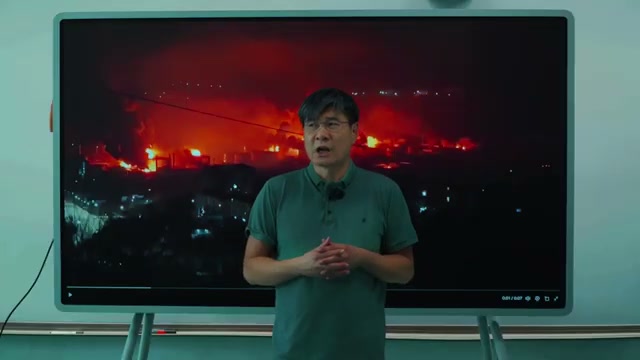
  • Over 50 oil refineries worldwide have been set on fire in 45 days; the beneficiary is either the US or Russia, and the events are most plausibly read as deliberate rather than accidental.
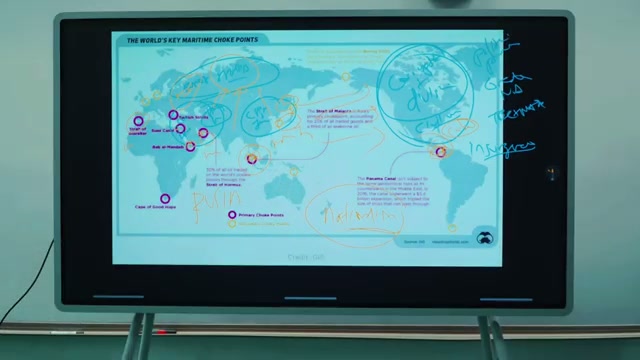
  • The US-Iran war is unwinnable in conventional terms but this is irrelevant — the American objective is not to defeat Iran but to make Iran permanently chaotic and thereby control the Strait of Hormuz.
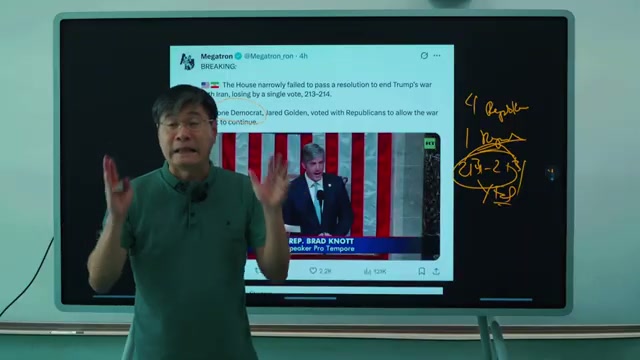
  • The Democrats' failed 214-213 War Powers Resolution vote was pre-arranged political theatre; both parties are aligned in supporting the war and the Pentagon's imperial rollout.
  • America is moving to a wartime economy: Pentagon budget from $1T to $1.5T (and projected $2T), Defense Production Act subsidies to GM/Ford for munitions, automatic draft registration for 18-26 year-olds starting December.
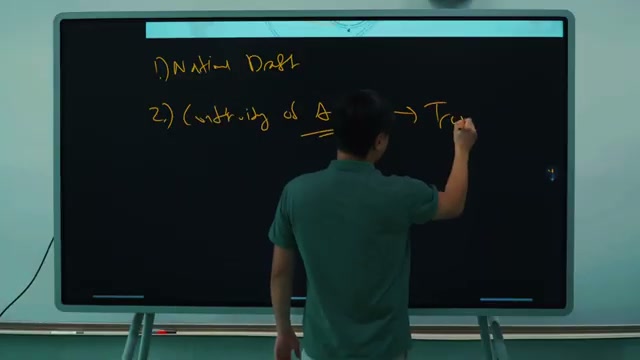
  • The strategy requires (1) a national draft, (2) 'continuity of agenda' via a Trump third term, and (3) an AI-enabled police/surveillance state — with ICE's $90B budget and Operation Stargate's $500B data-center buildout as the visible infrastructure of that police state.
  • America is tightening control of global chokepoints: Hormuz via the Iran campaign and blockade, Malacca via a new Indonesia military deal, Panama via renewed US pressure, Gibraltar via a Morocco cooperation deal, and Arctic approaches via a planned takeover of Greenland.
  • The deeper aim is to force China — which currently gets ~20% of its oil from Russia and the rest from the Middle East — into a position where it must buy energy and resources from the Western Hemisphere in US dollars, rescuing the dollar system.
  • Nationalism, corruption, and political polarization will cause the imperial plan to backfire over time, forcing America to retreat to the Western Hemisphere and ultimately lose its global empire, possibly accompanied by civil war at home and insurgencies in Canada/Mexico/Cuba/Venezuela/Colombia/Honduras.
  • Russia, unable to defeat the US Navy directly, will fight a war of attrition at the chokepoints (starting in Cuba) and sabotage global energy supplies in order to make the world dependent on Russia rather than America; most nations will eventually side with Russia to balance US bullying.
Qualitative Scorecard 2.1 / 5.0 average across 7 axes
Historical Accuracy ▸ Expand
The concrete documentary anchors the lecture uses — the 2026 National Defense Strategy, the Defense Production Act announcement, Operation Stargate, the ICE budget increase, the Rick Scott and Hegseth clips, the Touska seizure — are real and broadly accurately quoted. The speaker reads NDS passages verbatim rather than paraphrasing, which is unusually rigorous for this series. However, several factual claims are either shaky or wrong: '50 refineries in 45 days' is unverified; the 214-213 House vote details are not independently checkable as framed; the claim that automatic Selective Service registration equals a 'national draft' conflates two different policies; the 'Technate' invocation is introduced without acknowledging its conspiracy-theory provenance; and the inference that the refinery fire wave is attributable to US or Russian sabotage goes well beyond what open-source evidence supports. The speaker is more careful than average when reading the NDS, markedly less careful when generalizing from it.
3
Argumentative Rigor ▸ Expand
The argument structure is: read a real primary document → interpret each paragraph → jump to a totalizing conspiracy frame in which every observable American action is an execution of that document. The close reading of the NDS is legitimate and pedagogically effective; the totalizing jump is not. Key weaknesses: (1) The speaker treats every aspect of US behavior — ICE, data centers, the Iran war, Greenland, Morocco cooperation, Indonesia military agreements — as coordinated elements of a single plan, without acknowledging that simpler explanations (bureaucratic drift, policy incoherence, electoral politics) often fit better. (2) The claim that the 214-213 vote was 'pre-arranged political theatre' is presented as obvious but is a textbook unfalsifiable conspiracy move. (3) The 'means/motive/opportunity' reasoning applied to the refinery fires is sleight of hand; the category 'fires benefiting Russia or the US' is broad enough to include nearly any industrial accident. (4) The 'nationalism, corruption, and division will cause collapse' argument is structurally unfalsifiable — any imperial success can be attributed to the plan working, any failure to the predicted backfire, and the timeline ('10 or 20 years') ensures no near-term refutation. (5) There is little engagement with how the plan could fail on its own terms rather than requiring moral backlash.
2
Framing & Selectivity ▸ Expand
The framing is highly selective in ways that consistently strengthen the thesis. Evidence of allied defection from US policy (UK Hormuz refusal, France/Spain/Turkey condemnations, the 41-nation conference excluding the US) — which directly contradicts the 'vassalage' framing — is simply absent. Evidence that the Iran war has produced major diplomatic concessions by the US (ceasefire extensions, Witkoff/Kushner shuttle diplomacy) is absent. Pentagon dissent, CBO skepticism of large budget increases, and the Supreme Court IEEPA ruling are all absent. The Democrats-are-complicit framing relies on a single vote in a single chamber while ignoring ongoing intra-party debates and the Sanders/AOC war-powers activism visible in press coverage. Positive aspects: the speaker does concede in Q&A that the plan 'will backfire,' which prevents the lecture from being triumphalist about Chinese or Russian interests.
2
Perspective Diversity ▸ Expand
The lecture operates entirely from a single analytical viewpoint: a structural-materialist, imperial-cycles reading in which US behavior is explained as bloc-hegemonic maneuvering. There is no engagement with alternative frames that would be standard in any graduate IR seminar — offensive realist (Mearsheimer), defensive realist (Walt), liberal institutionalist, constructivist, or bureaucratic-politics (Allison) readings. Perspectives from within the US policy community that might see the NDS differently — e.g. as an Asia-first restraint document that actually deprioritizes Middle East wars — are not considered. Iranian domestic politics are absent entirely. The speaker's answer to the student's question 'Does China discern this?' is simply 'It's really obvious… there's nothing they can do about it' — a dismissal that forecloses inquiry.
1
Normative Loading ▸ Expand
The language is heavily evaluative throughout. America is 'a bully' whose actions are 'silly' and 'obvious'; Trump is a man whose plan is 'to just basically cheat'; the 214-213 vote is 'all political theater'; the Defense Production Act is 'total war'; ICE is 'Donald Trump's private police force'; Stargate is pure 'surveillance state.' Each of these characterizations may have defensible versions, but the speaker uses them as rhetorical hammers rather than analytical distinctions. The moral valence is consistent: the US is predatory and self-destructive, Russia is a rational balancer, China is a constrained victim, and the underlying framework is civilizational. The NDS passages are read in a deliberately flat voice to let the audience hear them as self-indicting, which is an effective but heavily loaded technique.
2
Determinism vs. Contingency ▸ Expand
The lecture alternates between two deterministic frames. In the short term, US imperial behavior is portrayed as the near-inevitable execution of a pre-written blueprint: 'once we understand the strategy, then it's very easy for us to understand how this war will progress over the next few years.' In the long term, imperial collapse is equally pre-scripted: nationalism plus corruption plus division equals retreat to the Western Hemisphere. The space for contingency — that US allies might refuse, that the Supreme Court might constrain, that the 2028 election might produce a genuine pivot, that Iran might negotiate a durable deal, that China might find workarounds the speaker does not foresee — is almost entirely absent. The speaker's own concession in Q&A that the plan will 'backfire' is framed as equally structural, not as a contingent outcome.
2
Civilizational Framing ▸ Expand
The lecture is less crudely civilizational than others in the series. The NDS readings foreground American policy documents rather than essentialized 'American character,' and the analytical spine is structural (chokepoints, trade routes, currency systems) rather than culturalist. However, the framework still leans on asymmetric civilizational treatments: Russia is rational, China is constrained, and the US is the uniquely self-destructive hegemon. The 'empires always do this and it never works out' framing treats the US as a generic empire slot in a civilizational cycle, which is both a strength (avoids US exceptionalism) and a weakness (ignores specifics).
3
Overall Average
2.1
Civilizational Treatment
CHINA

China is treated sympathetically as a constrained victim of US chokepoint strategy. The lecture emphasizes China's 20% Russian oil dependence and 80% Malacca-transited energy, and argues China has 'no choice but to work with both Russia and America.' There is no mention of China's own chokepoint aspirations (South China Sea artificial islands, Djibouti base, Kra Canal discussions), Belt and Road coercive practices toward debtor states, or the ways China's economic model itself depends on controlling trade routes.

UNITED STATES

The US is characterized as a predatory, declining empire executing a short-term-rational, long-term-suicidal plan. American leaders are presented as united in theatre (the pre-arranged vote), driven by dollar imperialism, and willing to create global chaos for systemic advantage. The possibility that US policy is a product of contested bureaucratic processes, electoral pressures, and genuine security debates is absent. The lecture refuses to consider any US action as defensively motivated.

RUSSIA

Russia is treated as a rational balancer playing a weaker hand intelligently — sabotaging energy supplies to create Russian dependency, cultivating Cuba, and waiting out US overextension. The speaker does not ask whether Russia's own chokepoint behavior (Kerch Strait, Baltic cables, Arctic route) mirrors what he criticizes in the US. Russia's failure in Ukraine and the shrinkage of Russian grain/energy market share since 2022 go unmentioned.

THE WEST

'The West' appears primarily as NATO and the G7, and is implicitly treated as a US vassal formation — Japan, South Korea, Europe are 'ordered around' by Washington. The UK's explicit refusal to support the US blockade and the 41-nation Hormuz conference that excluded the US go unmentioned. This is the single biggest selective-framing failure in the lecture.

Named Sources

primary_document
2026 National Defense Strategy (Department of War / Pentagon)
The lecture's central textual anchor. The speaker has his daughter Ivory read extended passages aloud — the preface, the 'four strategic priorities,' the China section, and the conclusion — and interprets each paragraph. This is the only source the speaker reads verbatim at length.
✓ Accurate
media
Karoline Leavitt (White House Press Secretary)
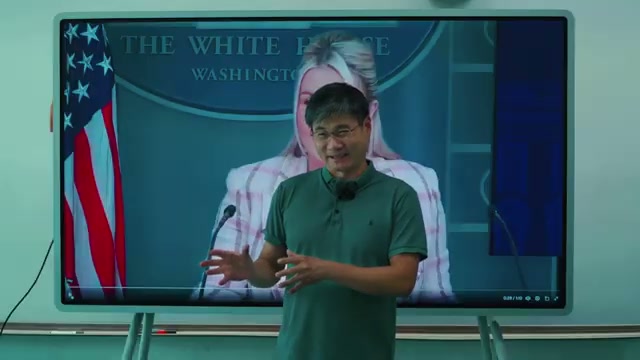
A clip of Leavitt saying the strike decision was 'a feeling the president had based on facts' is played to argue that the war's casus belli is manifestly incoherent.
✓ Accurate
media
Senator Rick Scott (R-FL)
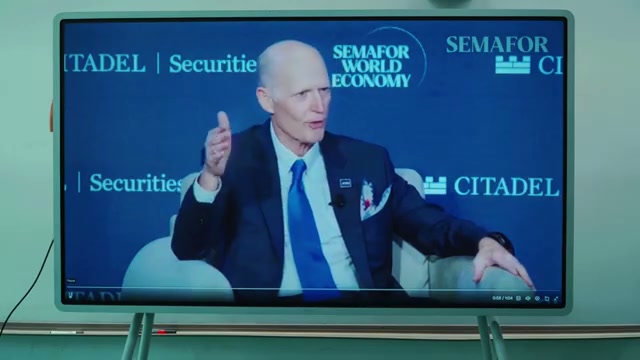
A clip in which Scott says he would find it 'a really wonderful day' if no oil ever reached China again is used to argue that even sympathetic US elites view the Iran war primarily as an instrument of China containment.
✓ Accurate
media
Pete Hegseth (Secretary of War)
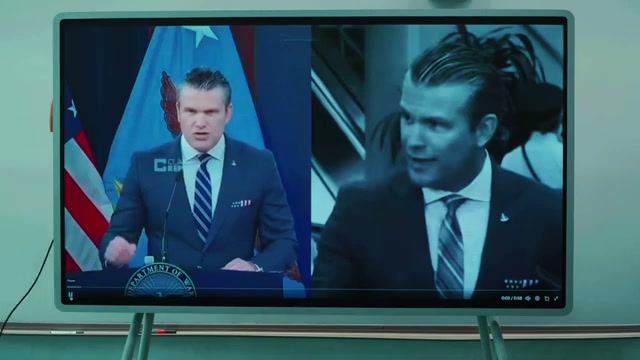
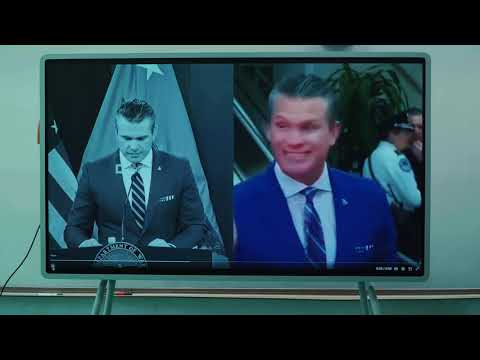
Two Hegseth clips are juxtaposed — one condemning Houthi threats against shipping as 'piracy' and 'terrorism,' the other defending US boarding of Iranian vessels — to argue the US applies inconsistent maritime rules ('piracy unless the Americans do it').
✓ Accurate
media
Donald Trump (public statements and Truth Social posts)
Multiple Trump clips/posts are used to show his contradictory war-ending / war-continuing signals and his declarations about the blockade. The speaker uses the contradictions to argue viewers should look through Trump's statements to the underlying Pentagon strategy.
✓ Accurate
media
US naval seizure of Iranian cargo ship Touska
Footage of the USS Spruance firing on and boarding the Touska (Apr 19) is played as exhibit A for the 'piracy' framing and as evidence of blockade escalation.
✓ Accurate
primary_document
Defense Production Act announcement
Cited to argue that the US is subsidizing private industry (General Motors, Ford) to make munitions and drones — characterized as a turn toward World War II-style total war.
? Unverified
other
Operation Stargate ($500B data-center program)
Used as evidence that the US is building the infrastructure for an AI surveillance state. The $500B figure and the Stargate branding are real; the interpretation (surveillance/police state) is the speaker's inference.
? Unverified
primary_document
Monroe Doctrine (rendered as 'Donro Doctrine')
Invoked to argue that the US's current treatment of the Western Hemisphere is a revival of the Monroe Doctrine — the hemisphere is treated as US territory, and Chinese/Russian trade requires American permission.
✓ Accurate
primary_document
Marshall Plan
Used as the historical parallel for the imperial-reflation strategy — America lends dollars to war-torn clients who use the loans to buy American resources and weapons, rebuilding the US industrial base. The speaker uses this analogy to argue the Trump strategy is modeled on 1950s precedent.
✓ Accurate

Vague Appeals to Authority

  • 'Over 50 refineries have been on fire these past 45 days' — no catalog or source is offered for the count.
  • 'Russia uh Russia will challenge America in these choke points. And this already happening in Cuba' — 'already happening' presented without a specific incident citation beyond the later mention that Russia is 'trying to become closer' with Cuba.
  • 'There's very little opposition. In fact, there's no opposition to Donald Trump fighting this war in Iran' — generalizes a specific House vote to a universal claim.
  • 'We can expect that thereafter it might be 2 trillion' on Pentagon budgeting — no budget document or DoD projection is cited.
  • 'Chat PT, you can't make money off that... you can't make money off digital girlfriends or digital pets' — dismissal of AI commercial value is asserted without engagement with actual enterprise revenue figures.
  • 'The vast majority of that will be stolen by people' (on the $1.5T defense budget) — corruption is asserted at scale without specific evidence.
  • 'Most of the world is ultimately going to side with Russia in order to balance United States' — asserted as a projection without intermediate indicators.
  • 'Trump's plan to stay in power is just basically cheat. He'll cheat. He'll rip the elections' — presented as certain future behavior.

Notable Omissions

  • No engagement with the actual text of the 2026 National Defense Strategy beyond the passages read — particularly its explicit sections on homeland missile defense, cost imposition, and integrated deterrence, which complicate the 'pure imperial expansion' reading.
  • No discussion of the Supreme Court's Feb 2026 IEEPA ruling (Learning Resources v. Trump) which materially constrains Trump's economic-coercion toolkit — a significant omission in a lecture about the structural coherence of Trump's strategy.
  • No treatment of China's actual energy diversification — Russian ESPO pipeline, Central Asian gas, Iran crude via ship-to-ship transfers, domestic renewables, strategic petroleum reserves — which undercuts the 'forced to buy in US dollars' framing.
  • No discussion of intra-US military and intelligence dissent on the Iran campaign (including reported Pentagon discomfort with ground options), which complicates the 'political theater' and 'unified Blob' framing.
  • No mention of the UK's refusal to support the US Hormuz blockade (Apr 13-14) or the France/Spain/Turkey/China condemnations — evidence directly relevant to whether allies are acting as obedient vassals.
  • No engagement with scholars of American grand strategy (Stephen Walt, Barry Posen, John Mearsheimer, Hal Brands, Michael Beckley) whose published work on 'restraint vs. primacy' is directly relevant.
  • No discussion of domestic political constraints on a Trump third term beyond the 22nd Amendment — no treatment of state-level ballot access, the electoral college, or active federal litigation over H.J.Res.29.
  • No mention of the Sep 2019 Aramco attack or the decades of chokepoint-based energy-security literature (Kennedy, Friedberg, Twomey, Yergin), which would contextualize the chokepoint claims and show the frame is far older than 2026.
  • No treatment of China's own South China Sea chokepoint assertion and artificial-island program, which would complicate the US-as-sole-hegemon framing.
  • The ideologically loaded invocation of 'Technate' (a 1930s Technocracy Movement concept about continental North American rationalized rule) is neither sourced nor distanced; this term is most prominent in contemporary conspiracy circles and deserves explicit handling.
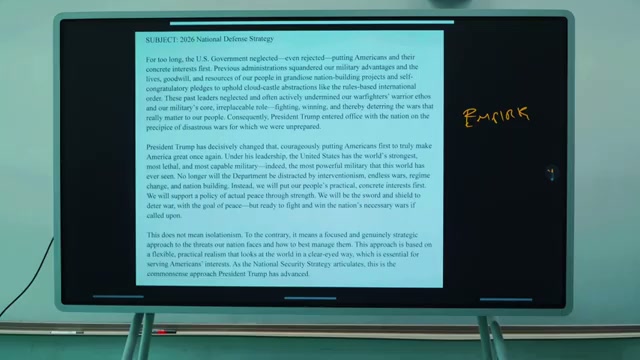
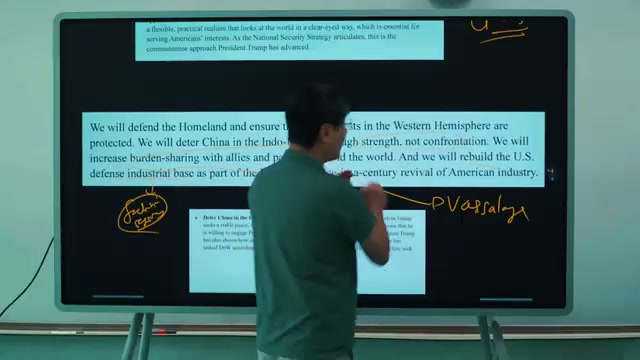
Close reading of a real primary document 00:18:13
Frame at 00:18:13
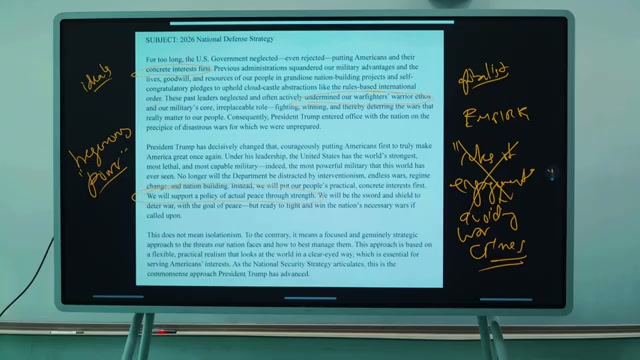
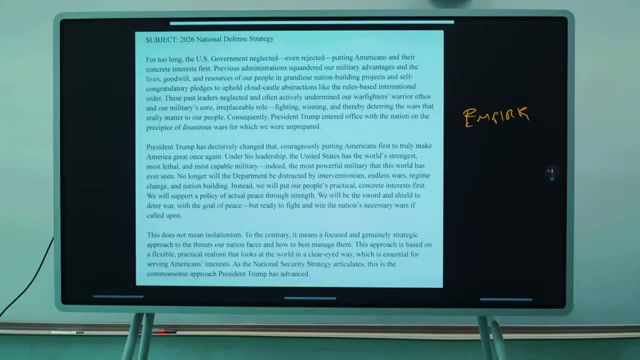
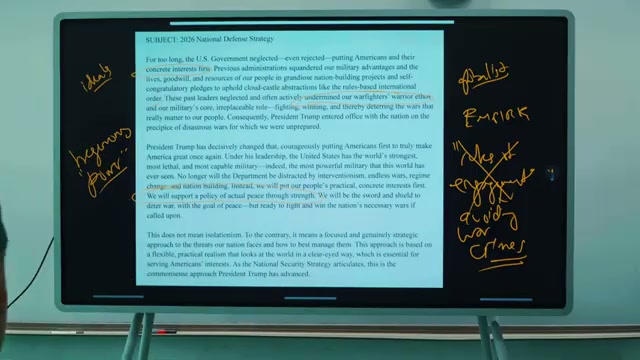
The speaker has his daughter Ivory read four extended passages from the 2026 National Defense Strategy, then interprets each paragraph phrase by phrase ('concrete interests first means…', 'rules of engagement means…', 'peace through strength means hegemony').
Lends the analysis unusual evidentiary weight for this series — the audience watches the document being read, not just summarized. This front-loads legitimate interpretive authority which is then leveraged for much more speculative claims later in the lecture.
Juxtaposition of official clips to expose hypocrisy 00:03:39
Frame at 00:03:39
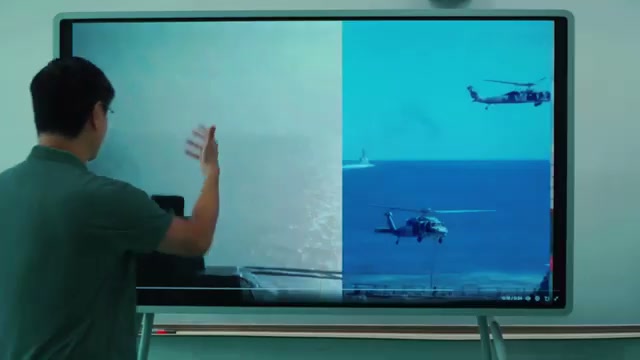
Two Pete Hegseth clips are played back-to-back: one calling Houthi ship threats 'piracy' and 'terrorism,' the other defending US seizures of Iranian vessels. 'It is wrong for the world to be pirates and to seize ships, but it's okay for the United States to do this because the United States is the one that sets the rules for the world. Duh.'
Produces a visceral 'caught on tape' moment of hypocrisy. The sarcastic 'duh' frames the contradiction as too obvious to need further argument — a rhetorically powerful but analytically lazy move, since the contradiction is real but the framing forecloses nuance (e.g., state vs. non-state actor law).
Sarcastic restatement ('a feeling based on facts') 00:07:57
Frame at 00:07:57
After playing Karoline Leavitt saying the strike decision was 'a feeling the president had based on facts,' the speaker deadpans: 'So, it was a feeling based on facts. Okay, that's why Trump start this war.'
Converts an administration communication fumble into evidence of strategic incoherence, and uses ridicule to inoculate the audience against taking future US war justifications seriously.
Conspiracy frame via pre-arrangement allegation 00:16:30
Frame at 00:16:30
On the 214-213 vote to restrict Trump's war powers: 'This is all political theater. It's all theater. Meaning that it was already pre-arranged between the Republicans and Democrats that this resolution would fail.'
Converts an ordinary party-line outcome into evidence of elite collusion, which supports the lecture's thesis that there is no real domestic opposition to the imperial strategy. The move is unfalsifiable by construction.
Hermeneutic reframe ('what this really means is…') 00:22:00
Frame at 00:22:00
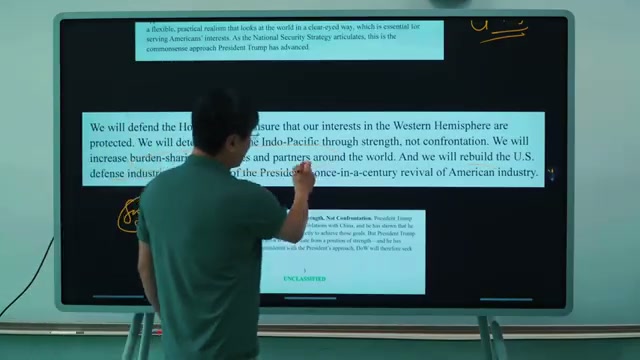
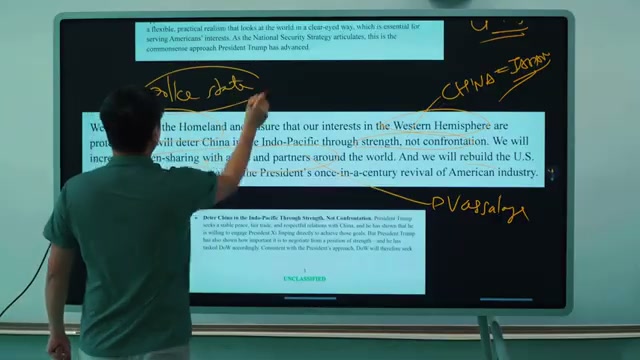
After each NDS passage, the speaker renders the document's language into brutal plain-speech: '"burden-sharing" means you're not my friend, you're my vassal'; '"peace through strength" means obey us or we bomb you'; '"defend the homeland" just basically means a police state.'
The technique is effective when it exposes genuine euphemism but slides easily into overreading. By stacking these translations, the speaker trains the audience to treat any official US language as a cipher requiring his decoding.
Means-motive-opportunity attribution 00:11:00
Frame at 00:11:00
'From this, you could figure out that the majority of these fires are being deliberately set in order to reduce the world's oil supply. And the people who can do this, the people who benefit from doing this are the Russians or the Americans.'
Borrows the language of detective work to present attribution-by-benefit as if it were evidentiary. Because the set of 'parties who would benefit from high oil prices' is broad, the argument smuggles speculation into the audience as forensic deduction.
Pedagogical call-and-response with student 00:18:13
Frame at 00:18:13
The speaker's daughter Ivory is called on to read NDS passages aloud; a student named Alan is fielded a question about Democrats' plan; another student asks whether China sees through the strategy. The speaker then answers authoritatively.
Performs a university-seminar atmosphere that lends the setting institutional authority and gives the audience the sense of guided discovery. Questions are used to introduce new thesis points rather than to stress-test existing ones.
Historical analogy (Marshall Plan, Vietnam) 00:43:24
Frame at 00:43:24
'This worked really well in 1950s under something called the Marshall Plan. Same idea where America made products and it lent money to Europe to buy products from America.' And: 'The war was not lost in Vietnam. The war was lost at home because you had too many people, too many young men protesting.'
The Marshall analogy converts an unprecedented future scheme into a familiar precedent with a happy ending (for America), making it feel more strategically coherent than it is. The Vietnam analogy flips a standard anti-war moral (protest ended an unjust war) into a cynical governance lesson (suppress protest to win wars).
Invocation of the 'Technate' without sourcing 00:53:17
Frame at 00:53:17
The desired US end-state is 'greater North America or what they call the technate… a fortress… infinite resources, infinite manpower.'
The Technate term comes from 1930s Technocracy Movement literature and is prominent in contemporary conspiracy circles. Using it without attribution lends occult-sounding legitimacy to what is otherwise a speculative geographic claim. A more rigorous lecture would introduce and either defend or distance itself from the term.
Unfalsifiable structural forecast 00:52:53
Frame at 00:52:53
'In the short term, America may seem as though it is winning but in the long term because of corruption, division and nationalism, America will be forced to retreat.' And: 'It's a short-term solution that creates long-term problems, but who cares about the long term? Let's just enjoy the short term.'
Ensures that any near-term American success confirms the plan, while any collapse confirms the backfire — the thesis cannot lose. This is the argumentative structure of all imperial-cycles frameworks and is both their explanatory power and their main epistemic liability.
Frame at 00:00:58 ⏵ 00:00:58
This war in Iran is actually part of a larger strategic vision that the United States has to maintain its empire.
The lecture's thesis statement, delivered in the first minute. It frames everything that follows as evidence for a pre-existing conclusion and signals that the speaker will treat the Iran war as a subordinate move in a larger imperial game.
Frame at 00:04:07 ⏵ 00:04:07
Threatening to shoot missiles and drones at ships, commercial ships that are lawfully transiting international waters — that is not control, that's piracy. That's terrorism.
A Hegseth clip the speaker plays to argue the US applies inconsistent standards — Hegseth condemns as 'piracy' the exact category of action the US now undertakes against Iranian vessels. It is a genuinely telling juxtaposition.
The speaker uses this clip to indict the US, but the broader framework would apply equally to the Iranian Hormuz blockade the speaker elsewhere treats as legitimate: the IRGC has fired on Indian-flagged tankers (Apr 18), seized commercial vessels, charged $2M/transit crypto tolls, and told commercial ships to route through Iranian-designated lanes. Under Hegseth's own definition, all of this would also be 'piracy' — and many major powers (UK, France, Japan, Germany, 37 others at the Hormuz conference) formally characterized it that way. The 'piracy unless we do it' frame cuts both ways; the lecture only applies it in one direction.
Frame at 00:06:44 ⏵ 00:06:44
If no oil ever goes to China again and their economy is destroyed, that would be a really wonderful day for me.
A Rick Scott clip that is genuinely damaging — a US senator openly framing Middle East policy as China containment at the cost of global economic welfare. The speaker uses it effectively as a smoking gun for his thesis.
The speaker frames Scott's statement as revealing the real American goal — starving China of energy. But the frame the speaker himself uses elsewhere in the series — that China will be forced to 'buy in US dollars' from the Western Hemisphere — is not actually consistent with Scott's goal. If the goal is to destroy China's economy, there is no dollar-imperial profit motive; if the goal is dollar imperialism, there is no need to destroy China. The lecture stitches both frames together as if they were one, without noticing the tension.
Frame at 00:17:54 ⏵ 00:17:54
Previous administrations squandered our military advantages and the lives, goodwill and resources of our people in grandiose nation-building projects and self-congratulatory pledges to uphold cloud castle abstractions like the rules-based international order.
A direct quote from the 2026 NDS, read aloud by the speaker's daughter. This is the most diagnostic passage the speaker extracts — an official US document explicitly disparaging the 'rules-based international order' as a 'cloud castle abstraction.' Genuinely notable as primary-source evidence that a major doctrinal shift has been written down.
Frame at 00:21:41 ⏵ 00:21:41
This does not mean isolationism. To the contrary, it means a focused and genuinely strategic approach to the threats our nation faces and how to best manage them.
A pivotal NDS passage the speaker uses to argue the US is not retreating but reorganizing its hegemony. This is one of the more careful moments in the lecture — the speaker lets the document speak before translating it.
Frame at 00:23:38 ⏵ 00:23:38
From now on, we're not friends. From now on, we're the boss and you do what we tell you to do.
The speaker's paraphrase of the NDS 'burden-sharing with allies' language. This is the clearest articulation of his interpretive method — official euphemism rendered as raw command — and also the point where his reading diverges most sharply from standard security-studies interpretations of 'burden-sharing' (which typically mean allies paying more of their own defense costs, not vassalage).
The speaker treats 'you do what we tell you to do' as the unique and damning signature of a declining American empire. But this is also how Beijing frames its core-interest demands on regional states (no South China Sea challenges, no Taiwan recognition, no Dalai Lama meetings, no Xinjiang questions) and how Moscow frames its sphere-of-influence demands (no NATO expansion, no Ukraine sovereignty). Every great power articulates burden-sharing as command in some register; singling out the US framing as uniquely imperial obscures this.
Frame at 00:25:16 ⏵ 00:25:16
Before America was too free and therefore America was too weak. The example is the Vietnam War when the war was not lost in Vietnam. The war was lost at home because you had too many people, too many young men protesting in on the streets.
A striking inversion — the speaker presents domestic anti-war protest as the cause of American weakness, not as a moral success. This reveals his framework: democratic accountability is an obstacle to strategic coherence. The same analytical move is then used to explain why a 'surveillance state' is the third rational requirement of imperial grand strategy.
The frame 'domestic protest weakens a great power's war-making capacity' is indistinguishable from Chinese Communist Party rhetoric justifying suppression of dissent during the 1989 Tiananmen protests and ongoing restrictions on political speech about Xinjiang, Tibet, Hong Kong, and the Cultural Revolution. If free societies are structurally disadvantaged by allowing anti-war protest, that is an argument for autocracy — which the PRC has in fact maintained, with the very consequences (suppression of information, purged historical memory, no Vietnam-style political correction) the speaker elsewhere criticizes when they appear in American policy.
Frame at 00:24:06 ⏵ 00:24:06
We don't want to destroy China. We don't want to hurt China. But we need China to obey us.
The speaker's one-line distillation of the entire NDS China section. Captures the 'control not destroy' framing that is the lecture's most analytically useful contribution.
Applied symmetrically, this is the exact logic China has pursued toward Taiwan ('we do not need to destroy Taiwan, we need Taiwan to obey us'), toward Hong Kong (National Security Law 2020), and toward smaller Southeast Asian claimants in the South China Sea. The lecture presents this logic as a distinctive feature of American imperialism; it is in fact the generic logic of any large power with regional ambitions, including the one the speaker treats most sympathetically.
Frame at 00:45:36 ⏵ 00:45:36
So Trump needs a third term, right? A Trump third term because only he can implement this plan and make America great again.
This links the lecture's imperial-strategy frame to the lecture's domestic-power frame: the third term is not a political whim but a structural requirement of the grand strategy. It is a testable claim — if no third-term push materializes, the architecture falls apart.
The notion that a leader must remain in power because only he can implement a multi-decade strategic vision is the argument the CCP has made for Xi Jinping's removal of term limits (2018) and indefinite tenure. If the argument is illegitimate when applied to Trump, it is also illegitimate when applied to Xi; if it is legitimate when applied to Xi (as much of the speaker's audience may accept), it is at least coherent when applied to Trump. The lecture condemns it in one case while implicitly treating comparable consolidation abroad as strategic rationality.
Frame at 00:58:07 ⏵ 00:58:07
First of all Democrats have no plan. This this is why Americans in so much trouble because America the Democrats have actually no plan of themselves. So even if the Democrats were to win office in 2028, what they'll probably do is continue Trump's plan because they themselves don't have any plan.
A characteristic move — bipartisan convergence is presented not as an analytical observation (that Democratic and Republican foreign policy have overlapping elite consensus) but as evidence that American democracy is hollow and the imperial plan has no domestic off-switch. Ends the lecture by collapsing the possibility of democratic correction.
The frame 'the out-party has no plan, so imperial drift continues regardless of elections' maps equally well onto single-party systems where there is no out-party at all. The structural critique makes sense, but the implicit comparison class is a multi-party system where opposition is functional — which describes the US flawed democracy better than it describes, e.g., the PRC's one-party state. If the criticism is 'Democratic opposition is inadequate,' the honest comparison is to systems with real opposition; if the criticism is 'there's no opposition,' the honest comparison class includes the PRC.
prediction The US-Iran war will not end in months but will continue for 'a few years,' possibly 10 or 20 years.
00:09:23 · Falsifiable
untested
As of Apr 22, 2026, Day 55 of the war: Trump extended the ceasefire indefinitely pending an Iranian 'unified proposal.' Blockade remains, diplomacy is fitful, and no formal end has been declared. The multi-year framing is plausible but the 10-20 year tail is far beyond the current horizon.
prediction In 'round two' the US will target Iranian civilian infrastructure — bridges, universities, reservoirs, power plants, and desalination plants — to destroy Iran's capacity as a nation-state.
00:32:17 · Falsifiable
partially confirmed
Before this lecture aired, the US had already destroyed the B1 bridge between Tehran and Karaj (Apr 2-3) and Israel had bombed 8 rail bridges across Iran (Apr 7). Trump publicly threatened on Apr 20-21 to 'knock out every single Power Plant, and every single Bridge, in Iran' — the exact target set the speaker names. Power plants and desalination plants have been threatened but not yet systematically struck. So the pattern is already underway for bridges and infrastructure, threatened for power/water; the ceasefire has temporarily paused further strikes.
prediction Iran can and will take roughly one-third of the world's energy supply offline by closing the Strait of Hormuz, blockading the Red Sea, and targeting natural-gas pipelines.
00:32:50 · Falsifiable
partially confirmed
Hormuz effective blockade has held since Feb 28, 2026 with commercial transit near zero; Iran struck Qatar's Ras Laffan, Saudi Manifa/Khurais, and Kuwaiti refineries; Houthis re-entered the war Mar 28. Brent briefly crossed $144/bbl (Apr 7, Dated Brent) — the largest supply disruption in history per IEA. But the claim of one-third is an upper-bound framing; the IEA describes losses of ~4.5-5M bbl/day, closer to 5% of global oil, though extreme at the margin. Red Sea closure remains a threat rather than a fact.
prediction Americans aged 18-26 will be automatically registered for the draft starting December 2026, and a full national draft will likely follow to support Middle East operations.
00:14:09 · Falsifiable
untested
December 2026 is future; automatic SSS registration via the FY2025 NDAA is a real policy change but full conscription has not been initiated. The prediction conflates automatic registration (an administrative automation) with a national draft (a political act requiring Congress), and should not be treated as confirmed until actual call-ups occur.
prediction The Pentagon budget will rise from $1 trillion this year to $1.5 trillion next year and possibly $2 trillion thereafter.
00:29:28 · Falsifiable
untested
The $1T FY2026 topline is roughly consistent with the enacted budget. The $1.5T FY2027 figure is a plausible Trump-administration ambition but not yet enacted. This is a near-term, testable numerical forecast.
prediction Trump will pursue and obtain a third term ('continuity of agenda') because only he can implement the imperial plan, and when elections threaten it he will cheat.
00:45:43 · Falsifiable
partially confirmed
The first half — actively pursuing a third term — is documented: H.J.Res.29 (Jan 2025), Trump stating 'there are methods,' Bannon confirming 'there is a plan.' Whether Trump successfully secures a third term and whether that involves election manipulation will not be testable until 2028. The current status reflects the documented pursuit.
prediction Operation Stargate ($500B federal data-center program) and the expanded ICE budget (~$90B) will be used to build an AI-enabled surveillance/police state to suppress anti-war protest and rebellion.
00:48:00 · Falsifiable
untested
The $500B Stargate announcement and ICE's expanded budget are real. The interpretation — that both are primarily instruments of domestic surveillance/policing — is a contested inference, not an established fact. The prediction is forward-looking and testable as enforcement patterns and data-center uses become visible.
prediction The plan requires America to take over the entire North American landmass — Canada, Greenland, Mexico, Cuba, Colombia, Venezuela, Honduras — producing local insurgencies.
00:52:25 · Falsifiable
untested
Venezuela regime-change operations (Maduro captured Jan 3, Rodriguez recognized Mar 11) and Cuba destabilization pressure are documented. Greenland remains a stated Trump ambition without annexation. Canada/Mexico/Colombia/Honduras annexation is a speculative extrapolation, not a documented US objective. The 'greater North America' claim is ideologically loaded (invoking the 1930s 'Technate' literature) and should be treated as extrapolation.
prediction Russia will fight a war of attrition against the US Navy at the chokepoints — beginning in Cuba — and will sabotage global energy supplies to make the world depend on Russian rather than American energy.
00:57:04 · Falsifiable
untested
A Russian oil tanker arrived in Havana Mar 30 and a second was loaded (Apr 2), which is consistent with a Russia-Cuba energy axis but not with naval confrontation against the US. The 'war of attrition at chokepoints' is speculative. The Russian oil-refinery sabotage hypothesis is one of several competing explanations for the refinery fire wave; attribution remains open.
prediction America will eventually be forced to retreat to the Western Hemisphere and lose its empire due to nationalism, corruption, and internal division; the US will face possible civil war at home and insurgencies across its new North American bloc.
00:57:19 · Falsifiable
untested
This is a multi-decade structural forecast. It is not testable in current-events timeframes; the speaker himself notes the plan 'may take 10 or 20 years.' Listed here because it is the lecture's ultimate falsifiable commitment.
prediction Most of the world will ultimately side with Russia to balance the United States because America is 'too much of a bully.'
00:57:12 · Falsifiable
contested unresolved
Documented facts: the UK, France, Germany, Italy, Japan, Canada, South Korea, Australia, UAE, Bahrain and 30+ others joined the Hormuz condemnation of Iran (Mar 19, Apr 2); the Apr 2 UK 41-nation conference excluded the US but was directed at opening Hormuz, not at balancing the US. Russia and China vetoed the US Hormuz UNSC resolution (Apr 7) but that is single-issue, not alignment. Who is publicly asserting 'the world will side with Russia': the speaker and aligned non-Western analysts. What would resolve it: a sustained realignment visible in UN voting, sanctions regimes, and basing patterns. Current open-source evidence is mixed — major US allies are visibly unhappy (UK refused to support the blockade) but there is no mass defection.
claim Over 50 oil refineries worldwide have burned or been sabotaged in the past 45 days, and the pattern is most plausibly attributable to deliberate US or Russian action.
00:02:23 · Falsifiable
partially confirmed
A refinery-fire wave is genuinely observable — Ukrainian strikes on Russian refineries, Israeli strikes on Iranian refining capacity, a Geelong (Australia) incident reported as accidental, and strikes across the Gulf. The count of '50 in 45 days' is not independently verified. The attribution to 'deliberate US or Russian sabotage' of the non-combatant incidents (Australia, Romania, India, Myanmar) is pure inference — the means/motive/opportunity analysis is casually offered without evidence.
claim The Congressional War Powers Resolution vote (214-213) on restricting Trump's Iran war was pre-arranged political theatre between Democrats and Republicans.
00:16:42 · Falsifiable
untested
The vote margin described is consistent with the kind of party-line votes on Iran war powers that have occurred. The claim that it was 'pre-arranged' is an unfalsifiable conspiracy claim absent documentary evidence; the observable fact is simply that most Democrats voted with leadership rather than defect. The speaker presents inference as fact.
claim The January 2026 National Defense Strategy is the real 'blueprint' for how the Pentagon will fight wars for the next 5-10 years, and the Iran war is an execution of it.
00:18:13 · Falsifiable
partially confirmed
The NDS document the speaker reads from is authentic; the four priorities he quotes (defend the homeland and Western Hemisphere, deter China in the Indo-Pacific, increase allied burden-sharing, rebuild the defense industrial base) are accurately paraphrased. The further inference that the Iran war is the 'execution' of this NDS is a contested reading — the Iran war precedes the published NDS and the NDS arguably de-prioritizes Middle East wars in favour of the Indo-Pacific.
Verdict

Strengths

This is among the better-sourced episodes in the corpus. The speaker reads actual passages from the January 2026 National Defense Strategy verbatim rather than paraphrasing, which is a step-change from earlier lectures' heavy reliance on uncited historical analogies. Several of his close readings are genuinely sharp: the NDS's explicit disparagement of the 'rules-based international order' as a 'cloud castle abstraction' is, in fact, a significant doctrinal shift worth flagging; the observation that 'peace through strength' means deterrence-by-overwhelming-fear is a fair paraphrase; the Rick Scott and Hegseth clips are authentic and do support the 'control chokepoints, manage Chinese dependence' reading. The identification of chokepoint control (Hormuz, Malacca, Panama, Gibraltar, Arctic) as a coherent frame for disparate US actions is analytically useful, even if over-applied. The framework's willingness to predict its own backfire ('nationalism, corruption, division') is more intellectually honest than triumphalist imperial-cycles arguments.

Weaknesses

The lecture's core weakness is the jump from 'the NDS articulates a hegemonic ambition' to 'every US action is a coordinated execution of that ambition.' Bureaucratic drift, electoral politics, intra-Pentagon dissent, judicial constraints (the Supreme Court's Feb 2026 IEEPA ruling is absent), allied defection (the UK's refusal to support the blockade is absent), and the possibility that US policy is simply incoherent are not considered. The 214-213 vote as 'pre-arranged theatre' is unfalsifiable; the '50 refineries in 45 days' count is unverified; the means-motive-opportunity attribution of the refinery fires to US/Russian sabotage is speculation dressed as deduction; the automatic-SSS-registration-equals-draft conflation is sloppy; the 'Technate' invocation is ideologically loaded and unattributed. The civilizational frame, while less crude than in earlier episodes, still applies a double standard — China's own chokepoint control ambitions and Russia's own burden-sharing-as-vassalage relationships with Belarus, Armenia pre-2023, and Central Asia are absent. The speaker quietly abandons the falsified 'ground invasion trap' thesis of Geo-Strategy #8 by reframing Iran-war victory as irrelevant to the real objective, which is structurally the right move but is not acknowledged as a retraction.

Steelman — the strongest honest reading of the underlying concern, even where the specific argument fails

There is a genuine, non-conspiratorial case beneath this lecture that a critical viewer should take seriously. The 2026 National Defense Strategy really does articulate a doctrine — let's call it 'denial-based primacy' — in which the US explicitly abandons the rules-based-order language of the last thirty years, prioritizes Indo-Pacific China containment, and expects allies to carry more of the burden or lose the protection. This is not the speaker's invention; it is an open shift in the Pentagon's own stated doctrine, and it is recognized across the mainstream spectrum from Barry Posen to Michael Beckley to Hal Brands. Chokepoint control — Hormuz, Malacca, Panama, Gibraltar, Arctic — is a real and long-documented feature of American naval strategy going back at least to Alfred Thayer Mahan; recognizing that the current administration is tightening that grip (Iran blockade, Greenland interest, Panama pressure, Indonesia defense agreement, Morocco cooperation) is a legitimate pattern observation. The structural concern that deliberate regional instability benefits the United States — via energy price leverage, weapons sales, and dollar-denominated rescue financing — is a serious one and is argued in peer-reviewed work on the 'wars of globalization' (e.g. Nitzan and Bichler on differential accumulation, David Harvey on the new imperialism). The domestic concerns the speaker lists — ICE expansion, massive federal data-center buildout, automatic SSS registration, and real moves to test third-term limits — are individually well-documented and collectively concerning to a wide range of constitutional and civil-libertarian commentators, not only to analysts in this speaker's frame. A viewer who senses something real beneath the lecture's overreach is right to sense it. The right frame for that intuition is: the US is undergoing a visible doctrinal and material shift toward more coercive primacy, and several domestic infrastructure changes are consistent with reduced constraints on that coercion. That is a live debate. The lecture's overreach is in treating every element as coordinated and the outcome as pre-determined; the underlying shift is real.

Cross-References

BUILDS ON

  • Geo-Strategy #8 (The Iran Trap) — the earliest prediction in the corpus that a US-Iran war is coming; this lecture treats that as confirmed and moves to the next question (what is the US doing with the war?).
  • Prior Game Theory episodes on chokepoint control, the Monroe Doctrine, and the Malacca Dilemma.
  • Earlier Civilization / Secret History lectures on the Marshall Plan, Vietnam War lessons, and the structure of declining empires.
  • Any prior lectures in the series that introduced the 'Technate' concept and the North American fortress framing.

CONTRADICTS

  • Geo-Strategy #8 (The Iran Trap) — that lecture's central prediction was a ground invasion of Iran in which US troops would be 'trapped' and 'become hostages.' The current lecture quietly abandons the ground-invasion framing (now conceding the US may lose the Iran war but it doesn't matter), shifting the load-bearing claim from 'US troops will be trapped' to 'US is using permanent chaos to control chokepoints.' This is a significant retreat from a falsified position without explicit acknowledgment.
This lecture represents a mature stage of the Predictive History framework: after many specific near-term predictions in earlier Geo-Strategy episodes have been partially falsified (Nikki Haley VP, ground invasion trap, Russia as nuclear guarantor, Saudi Arabia in the coalition), the speaker has pivoted to a structural-historical frame that is harder to falsify in current-events timescales — a multi-decade imperial-cycles argument grounded in a close reading of a real primary document (the 2026 NDS). This is a common epistemic move: when point predictions fail, the analyst retreats to longer-horizon structural claims that preserve the overall worldview. The document-anchored method is genuinely stronger than the series' earlier reliance on vibes and historical analogy, and should be retained even as the further inferences are stress-tested.