Named Sources
primary_document
✓ Accurate
Jean-Jacques Rousseau, The Social Contract
Two passages read aloud: (1) the argument that liberty cannot be surrendered because it is given by God and connects man to humanity; (2) the claim that population growth is the supreme test of good government. Used to ground the French/social-contract model of the nation-state.
primary_document
✓ Accurate
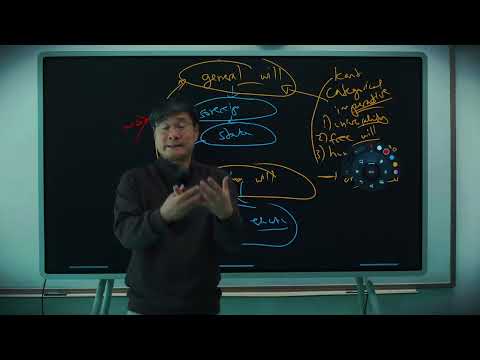
Immanuel Kant, Categorical Imperative
Summarized in three principles (universality, free will, humans as ends) to explain Rousseau's 'general will' and how it produces sovereign law. The summary is a reasonable lay paraphrase, though it conflates Rousseau and Kant rather more tightly than scholars would.
scholar
✓ Accurate
Johann Gottlieb Fichte
Cited as the 'father of German nationalism' for the argument that language binds people, contrasting with Rousseau's liberty. Generally accurate placement, though no specific text (e.g. 'Addresses to the German Nation') is named.
primary_document
✓ Accurate
Otto von Bismarck, 'Iron and Blood' speech
Read aloud to establish that Prussian/German nation-state legitimacy rested on power and war, not liberalism or majority votes. The 1862 speech is correctly identified and accurately quoted.
primary_document
✓ Accurate
Otto von Bismarck on worker insecurity (1880s social-insurance speech)
Read aloud to argue Bismarck's welfare reforms (health insurance, accident insurance, pensions) were instrumental for war-readiness rather than humanitarian. Quote appears genuine, framing is one of several plausible historiographic readings.
primary_document
✓ Accurate
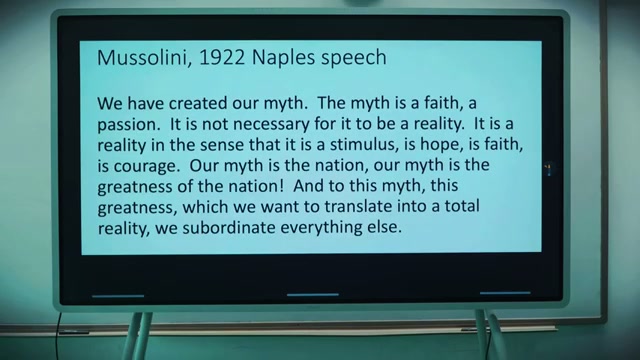
Benito Mussolini, Naples speech (October 24, 1922)
Quoted: 'We have created our myth. The myth is a faith... Our myth is the nation.' Used to argue that nation-states explicitly construct mythologies that motivate citizens to die in war. Quote is accurately attributed.
primary_document
✓ Accurate
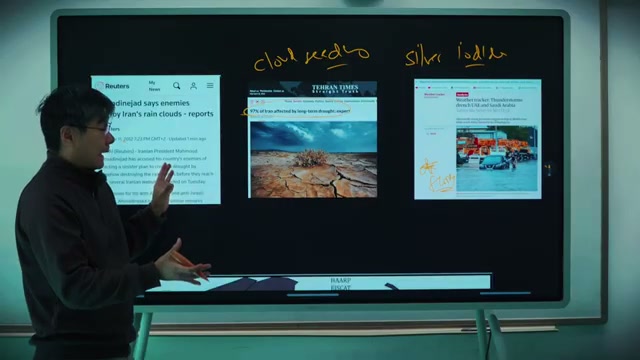
Operation Popeye (US cloud-seeding in Vietnam, 1967-72)
Cited to establish that the US has operational weather-modification military doctrine. Operation Popeye is documented historical fact; the program did seed clouds to extend monsoon and disrupt the Ho Chi Minh Trail. Accurate.
primary_document
✗ Inaccurate
Lyndon Johnson, 'He who controls the weather will control the world'
Attributed to a 1962 speech 'when he became president.' Anachronism: LBJ was Vice President in 1962; he became President in November 1963. The quote is associated with a 1962 speech at Southwest Texas State College, where he was speaking as VP, not President.
media
✓ Accurate
Mahmoud Ahmadinejad weather-warfare accusation (2012)
Cited as evidence the US has been waging weather warfare against Iran via cloud-seeding to cause droughts. Ahmadinejad did make this accusation; mainstream meteorologists rejected the claim as scientifically baseless. Speaker correctly hedges with 'this is all rumors.'
data
✗ Inaccurate
HAARP (High-frequency Active Auroral Research Program)
Presented as possible weather-warfare technology capable of creating hurricanes, cyclones, floods, droughts. HAARP is a real ionospheric research facility (now operated by University of Alaska Fairbanks); it has no demonstrated capability to create extreme weather and the claim is a long-debunked conspiracy theory.
primary_document
✗ Inaccurate
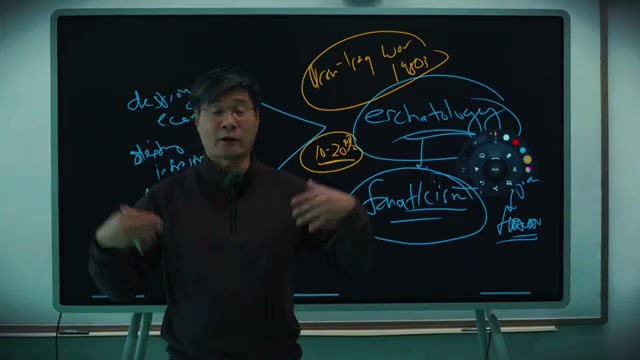
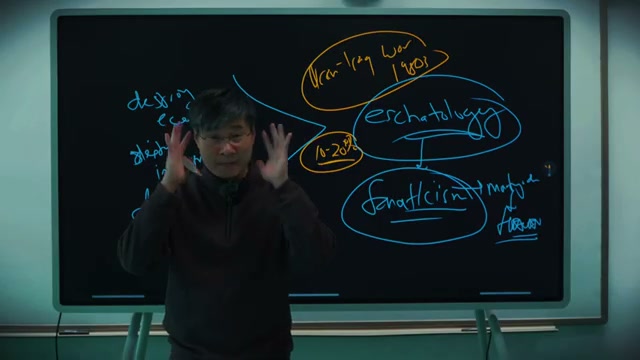
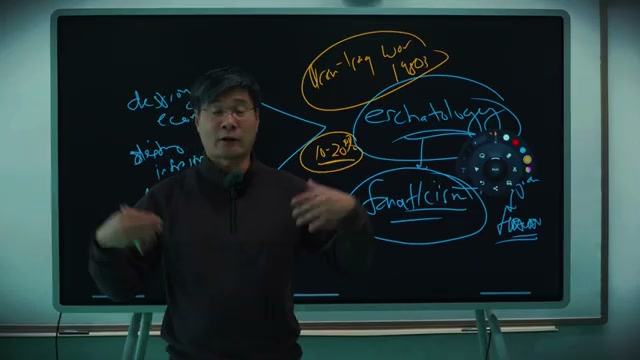
Iran-Iraq War (1980-88)
Cited as historical proof that eschatological martyrdom culture defeats technologically superior conventional armies. The basic facts (Iraqi material superiority, Iranian human-wave tactics, child soldiers, basij martyrdom mobilization) are correct, but the speaker incorrectly attributes Iraqi chemical weapons use to 'the Americans' — Iraq used chemical weapons (with US/Soviet acquiescence and intelligence-sharing on Iranian positions, but the weapons were Iraqi).
media
✗ Inaccurate
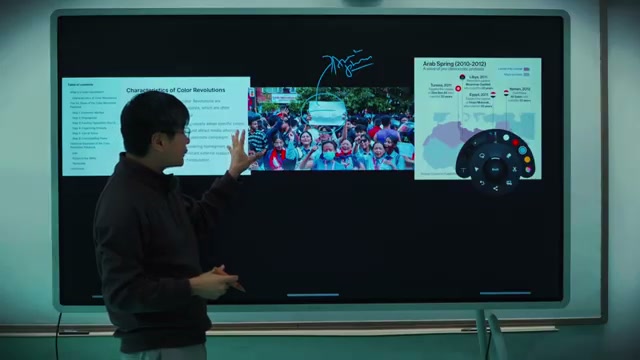
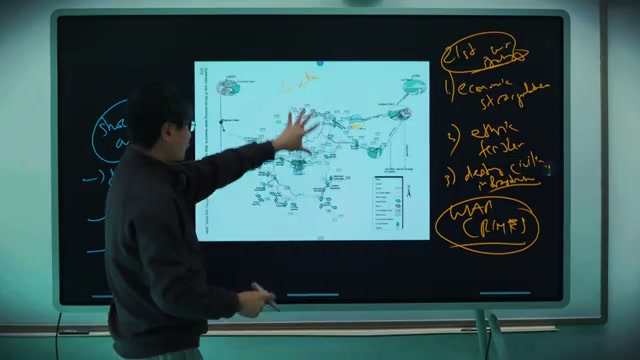
Nepal 'OK Boomer / Times Up' protests
Cited as Washington-orchestrated color revolution because protest signs were in English. The Sept 2025 Nepal Gen Z protests had documented domestic grievances (corruption, social media ban). English signage is a near-universal feature of contemporary protest aimed at international media; Nepal also has high English literacy in urban youth. Treating English signs as proof of foreign funding is a non sequitur.
media
✗ Inaccurate
Arab Spring (2010-12)
Asserted as another color revolution orchestrated by Washington via Twitter and Facebook. Mainstream scholarship treats Arab Spring as primarily indigenous, multi-causal (food prices, demographics, authoritarian fatigue, social media as accelerant). The Washington-orchestration claim is a contested and largely fringe position.
Vague Appeals to Authority
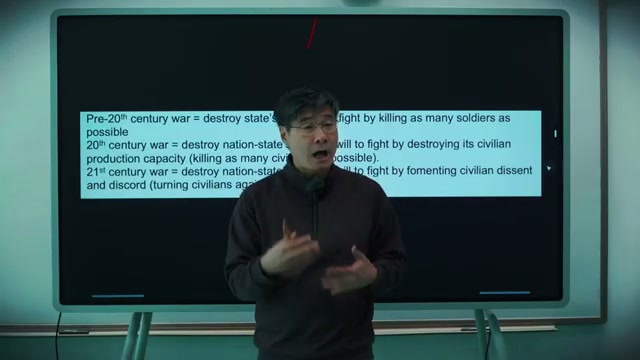
- 'Most analysts expect that this war will resume in a week, two weeks, a month' — no analysts named.
- 'Scientists will tell you it's because of the revolution. It's because of this revolution in technology and understanding... That's not true.' — uses 'scientists' as a strawman without naming any.
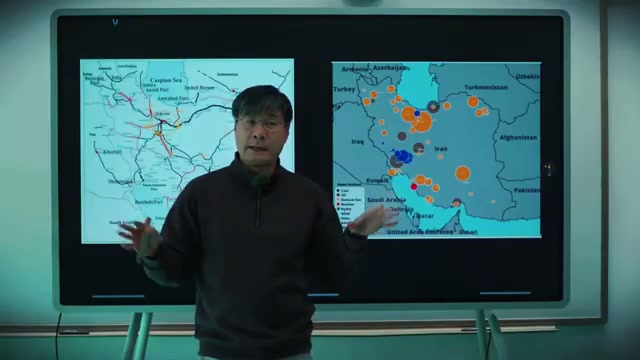
- '90% of Iran's oil exports goes to China' — figure roughly correct (China is Iran's overwhelming oil customer, ~90% per most estimates) but cited without source.
- 'These professional armies were losing to the citizen armies' — oversimplifies the military history of the French Revolutionary Wars; ignores Carnot's reorganization and the levée en masse mass-conscription system.
- 'It is wars that give people meaning in their lives' — attributed to Mussolini as a paraphrase, but presented as established truth without context.
- 'Most people [in Nepal] don't speak English' — contradicted by Nepal's actual English literacy rate, especially in urban Gen Z.
- 'A lot of people believe that what America really wants to do is just destroy China' — appeal to unnamed believers.
- 'According to game theory, there's only one response' [to 21st-century warfare: eschatology] — no game-theoretic argument is actually presented.
Notable Omissions
- No mention of demographic transition theory or actual demographic-historian explanations for population growth (sanitation, vaccines, Haber-Bosch, antibiotics, child mortality decline).
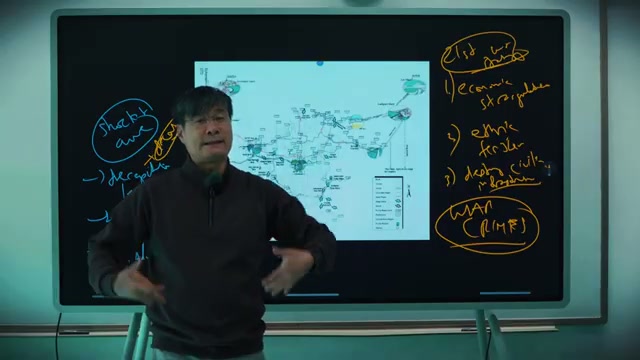
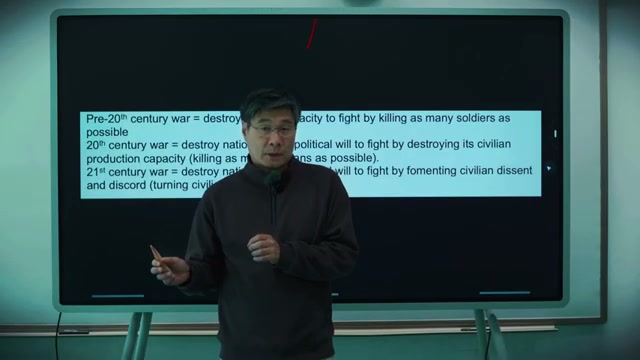
- No engagement with mainstream international-relations scholarship on the 'Revolution in Military Affairs,' fourth-generation warfare (Lind, Hammes), or hybrid warfare doctrine (Hoffman) — the actual academic literature on what the speaker is calling '21st-century warfare.'
- No discussion of Russian doctrine (Gerasimov) which is the most theorized version of the integrated strangulation/destabilization warfare the speaker attributes solely to America.
- No mention that Iraq, not the US, used chemical weapons against Iran in the 1980s.
- Color-revolution framing presented without engagement with Sharp/Otpor literature on civil resistance, or critiques of NED/USAID democracy promotion (Carothers, Diamond) that distinguish funding from causation.
- HAARP weather-warfare claim presented without any reference to actual atmospheric science or to the consensus that the technology cannot do what conspiracy theorists claim.
- Bismarckian welfare state presented purely as war preparation, omitting the labor-pacification/anti-socialist motivation extensively documented by historians (Bismarck explicitly wanted to undercut the SPD).
- American 'game' framing of capitalism presented without engagement with the actual historical scholarship on US state-formation (Skowronek, Bensel, Hacker), the New Deal, or Bretton Woods.
- No mention of Chinese state internet controls, Great Firewall, or social-credit system in the discussion of 'AI surveillance state' — only the US (and implicitly the regimes the US would target) are named.
- No engagement with the literature on civilian targeting and the ethics of strategic bombing (Walzer, Pape, Downes) when arguing 21st-century warfare requires civilian-infrastructure attack.