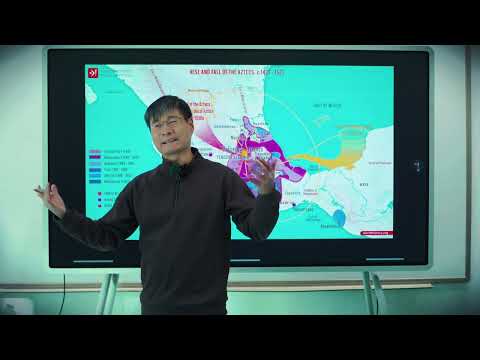
Throughout history, marginalized peripheral groups with high energy, openness, and cohesion consistently conquer wealthy but corrupt, insular, and divided empires, and this pattern can be used to predict future geopolitical shifts.
- Conventional metrics like population, resources, and technology fail to predict which state will dominate a region; instead, the qualities of energy, openness, and cohesion determine outcomes.
- Ibn Khaldun's concept of asabiyyah (group solidarity) explains why poor peripheral groups conquer wealthy centers: poverty forces creativity, solidarity, and adaptability.
- Empires inevitably decline through a process of elite overproduction, factional struggle via secret societies, corruption, insularity, and division.
- The warring states period in any civilization represents its peak of creativity due to open cooperative competition.
- Mercenaries from the periphery are invited in by competing factions within empires, learn the empire's technology and methods, and eventually take over.
- Once an empire falls, it never recovers; new peoples may adopt the empire's name but the original group does not regain dominance.
- Germany, Japan, and Israel -- as historically defeated or persecuted peoples who never achieved lasting empire -- will become the next great powers.
- The United States and China are 'done' as rising powers.
- International development organizations and NGOs function to prevent the emergence of unifying leaders in Africa, keeping the continent in a perpetual state of dependency.
- Japan and Germany, despite post-WWII wealth, remain 'vassal states' of America because America controls the game and extracts their wealth through mechanisms like the Plaza Accord and forced treasury bond purchases.
CHINA
China is declared 'done' in a one-word dismissal. Its 5,000-year history is acknowledged but used only to illustrate the warring states period's creativity. Modern China is characterized as a declining power that will be surpassed by North Korea. The speaker does not engage with China's actual economic trajectory, institutional reforms, or technological development.
UNITED STATES
The United States is described as the current 'game master' that extracts wealth from vassal states (Japan, Germany) and controls the world through the dollar system and military dominance. It is simultaneously the most resource-rich player (in the world game analogy) and declared 'done' as a great power. The US is characterized as using NGOs and international organizations to suppress potential rivals in Africa.
RUSSIA
Russia is mentioned only in passing in the context of invading Ukraine and the Nord Stream pipeline. No analysis of Russia's position in the energy-openness-cohesion framework is offered.
THE WEST
'The West' as a concept is not explicitly analyzed, though Western civilization is traced to Greek origins. The speaker's framework implicitly positions current Western powers (US, UK) as declining empires that will be overtaken by more energetic peripheral groups.
False authority / Borrowed prestige
00:14:18

The entire lecture is framed as 'game theory' despite containing no game-theoretic analysis. The speaker repeatedly says 'according to game theory' when presenting his own speculative historical framework.
Lends scientific credibility to what is essentially a speculative cyclical theory of history by associating it with a rigorous mathematical discipline.
Cherry-picking / Confirmation bias
00:02:34

The speaker selects Qin/China, Macedon/Greece, Aztecs/Mesoamerica, and Akkadians/Sumer as examples -- all cases where a peripheral group conquered a center -- while ignoring the many cases where established powers dominated for centuries or recovered from decline.
Creates the impression of an 'iron law' by presenting only confirming cases while omitting disconfirming ones.

Groups that succeeded are retroactively labeled as having 'energy, openness, and cohesion' while groups that failed are labeled 'insular, corrupt, and divided.' There is no independent way to measure these qualities before outcomes are known.
Makes the theory unfalsifiable -- any historical outcome can be explained after the fact by assigning the appropriate labels.

The classroom 'world game' exercise is presented as evidence that resource-poor groups outperform resource-rich ones. A controlled classroom exercise with fixed rules is treated as equivalent to the complex dynamics of geopolitical competition.
Makes the abstract theory feel concrete and relatable while obscuring the enormous differences between a classroom game and actual international relations.

International development organizations, NGOs, and the United Nations are characterized as tools to prevent unifying leaders from emerging in Africa: 'The goal guys is to identify the possibility of a leader emerging and make sure he does not emerge.'
Transforms mainstream international institutions into villains in a grand conspiracy narrative, discouraging critical engagement with development economics.

When asked about China's future: 'Done. Okay.' When asked about America: 'The Americans are done.' Complex geopolitical realities reduced to single-word dismissals.
Projects confidence and authority while avoiding the complexity that would undermine the simple narrative.
Appeal to common sense / populist epistemology
00:40:24

'It's actually common sense if you think about it, right? If you're the best student in the school, you never have to reflect.'
Bypasses the need for evidence by suggesting the theory is self-evident to anyone with basic life experience.
Hedging followed by strong claims
00:47:04

'Look, look guys, guys. I mean like like this is all just a theory, okay?' immediately followed by 'Germany and Japan and Israel will be the three great nations.'
The nominal caveat ('just a theory') provides plausible deniability while the confident predictions create the lasting impression. Allows the speaker to present speculative claims while deflecting criticism.
Socratic-style audience leading
00:06:45

The speaker repeatedly asks 'Does that make sense?' and 'Does that make sense, guys?' after presenting claims, creating social pressure to agree rather than critically evaluate.
Converts a lecture into a pseudo-dialogue that discourages dissent and manufactures consensus in the classroom.
Projection of emotions onto nations
00:46:29

'Japan was destroyed. It's something that forced them to reflect as a people and now they want vengeance basically.'
Anthropomorphizes an entire nation, attributing a single emotional motivation to 126 million people, making geopolitical analysis feel intuitive but obscuring actual policy dynamics.
prediction
Germany will one day 'come to rule the world or at least Europe and Asia'
partially confirmed
Germany approved 108B EUR defense budget (2026), 650B EUR over 5 years, 3.5% GDP target, 260K soldiers. Building strongest conventional army in Europe. But rearmament is defensive/NATO-oriented, not imperial. No Asia evidence. UK hosted 41-nation Hormuz conference (Apr 2) — allies taking regional ownership.
prediction
Japan will come to dominate East Asia
partially confirmed
Japan's FY2026 defense budget hit 9.04T yen (~$58B), part of 43T yen 5-year buildup. Pursuing long-range counterstrike missiles, national intelligence agency, lethal weapons exports. Largest defense export deal ever (Australian frigates). But far from 'dominating' — China's military vastly larger.
prediction
Israel will become one of three great future empires
partially confirmed
2025 record year for settlement expansion. FOUR IDF divisions in Lebanon near Litani; 1,200+ killed in Lebanon. Smotrich called for annexation to Litani River. Territorial expansion accelerating. But internationally more isolated: ICC warrants for Netanyahu, ICJ genocide case. 'Empire' characterization debatable — military expansion does not equal empire-building.
prediction
The United States is 'done' as a dominant power
partially confirmed
US still #1 military and economic power. But GDP growth slowed to 2.2% (2025), largest decline in Asia Power Index, Air Force at 2/3 needed fighters, Navy shrinking, tariffs imposed largest tax increase since 1993. Trend directionally correct; 'done' is overstated.
prediction
China is 'done' as a rising power
partially confirmed
Real GDP growth ~2.5-3% (half of official figure). Four consecutive years of deflation. Population declining for four straight years. Newborn population lowest since 1949. Fixed-asset investment declined 3.8%. But still world's #2 economy and dominant manufacturer. 'Done' is overstated.
prediction
North Korea has a better future than China based on historical patterns
partially confirmed
DPRK GDP grew 3.1% (2023) and 3.7% (2024) — fastest since 2016. Arms sales to Russia returned $20B+. Cybercrime $2B+. Solid-fuel engine test (2,500 kN, 26% increase); Kim demands nuclear recognition. But DPRK remains one of world's poorest countries. Claim remains extraordinary.
BUILDS ON
- Game Theory #1-4 (referenced implicitly as prior lectures in the series)
- A prior semester lecture on Zoroastrianism is explicitly mentioned ('Zorah which who we studied last semester')
The lecture follows what appears to be a consistent pattern in this series of framing heterodox historical theories under the prestige label of 'game theory' without employing any formal game-theoretic methodology. The speaker uses a cyclical theory of history (rise, peak, decline, conquest by periphery) that closely resembles Ibn Khaldun's framework but extends it with modern conspiratorial elements (secret societies, NGOs as tools of empire, vassal state dynamics). The classroom setting with student Q&A reveals the pedagogical context -- this appears to be an actual course being taught, which raises questions about the educational standards being applied. The next lecture is previewed as covering 'how the American Empire controls the world,' suggesting the series progressively builds toward a conspiratorial geopolitical framework.