Predictive History Audit / Systematic Content Analysis
Geo-Strategy
Episode 1 · Posted 2024-04-24

Iran's Strategy Matrix

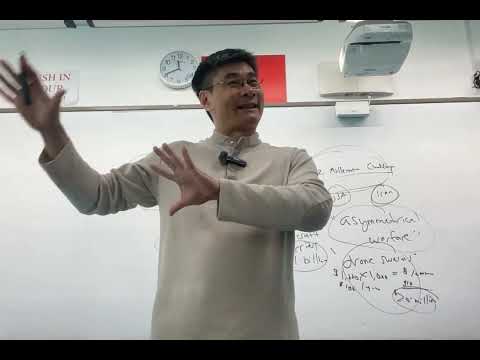
This lecture, the first in the Geo-Strategy series, analyzes the April 2024 Israeli strike on the Iranian embassy in Damascus and Iran's retaliatory Operation True Promise. The speaker introduces the concept of asymmetrical warfare, arguing that despite overwhelming US-Israeli military dominance, Iran could prevail in a conflict by employing creative, flexible tactics against a hubristic empire. The lecture presents a four-part 'Iran Strategy Matrix' -- unite the population, build alliances (with Russia and China), win global opinion (via Gaza), and weaken the enemy (by creating internal dissent in the US-led coalition) -- and argues that Operation True Promise was designed to accomplish all four goals simultaneously. The speaker predicts that if Trump wins the presidency, he will likely initiate a war against Iran within approximately two years.

Video thumbnail
youtube.com/watch?v=xEEpOxqdU5E ↗ Analyzed 2026-03-14 by claude-opus-4-6

Viewer Advisory

  • The lecture assumes US-Iran conflict must take the form of a ground invasion, which proved incorrect -- actual US-Israeli military action against Iran in 2025-2026 was entirely air/missile-based.
  • The Iranian narrative about Operation True Promise (intentionally harmless) is presented as more credible than the Israeli narrative (99% interception) without sufficient evidence for this preference.
  • The claim that 'Russia is about to win the war in Ukraine' is stated as background fact but was and remains inaccurate as of March 2026.
  • The strategy matrix framework is analytically elegant but essentially unfalsifiable -- it can explain any Iranian action after the fact.
  • The lecture is delivered in a high school classroom setting, which means complex topics are necessarily simplified, but this also means significant nuance is lost.
  • The speaker's prediction about Trump initiating war with Iran proved directionally correct, which may lend unwarranted credibility to the specific invasion scenario described.
  • No scholarly sources are cited; the analysis rests entirely on the speaker's own framework and publicly known events.
Central Thesis

Iran's strategic response to US-Israeli military dominance follows a coherent four-part matrix -- uniting its population, building alliances with Russia and China, winning global opinion, and weakening the enemy coalition -- and Operation True Promise was a successful execution of this asymmetrical warfare strategy despite appearing to be a military failure.

  • The US and Israel possess clear military and intelligence dominance over Iran, as demonstrated by the precision strike on the Iranian embassy in Damascus and the assassination of Qasem Soleimani.
  • The 2002 Millennium Challenge war game proved that Iran could defeat the US through asymmetrical warfare, but the US military refused to accept the result, revealing imperial hubris and inflexibility.
  • Asymmetrical warfare allows a weaker power to prevail by defining the terms of engagement, using cost-effective tactics (e.g., drone swarms costing $20 million to sink a $1 billion aircraft carrier).
  • Iran's population would resist a foreign invasion due to historical memory of the 1953 CIA/MI6 coup, the Shah's police state, and the 1979 revolution.
  • Russia would support Iran by limiting US military options (particularly nuclear weapons use), while China would provide limited material assistance to protect its Middle Eastern oil supply.
  • Israel's war in Gaza is helping Iran win global opinion, making the world more sympathetic to Iran's position.
  • Operation True Promise was intentionally designed to cause minimal damage, accomplishing all four strategic matrix goals: uniting Iran's population, demonstrating willingness to fight (for Russia/China), maintaining global sympathy, and creating friction between Israel and the United States.
  • Empires collapse due to three factors -- overextension, debt, and civil unrest -- all of which are currently present in the United States.
  • If America withdraws from global commitments, regional powers (Germany in Europe, Japan in East Asia, Israel in the Middle East) would become dominant.
Qualitative Scorecard 2.6 / 5.0 average across 7 axes
Historical Accuracy ▸ Expand
The lecture gets several key facts right: the Damascus embassy strike, Soleimani assassination, the Millennium Challenge exercise (though oversimplified), the 1953 coup history, and the basic facts of Operation True Promise. The claim that Iran received 16% of oil profits is accurate for the earlier period. However, some claims are misleading or imprecise: the speaker says the embassy strike was carried out by 'a jet from Israel' when it was likely an F-35 strike but specific details remain classified; the claim that 'Russia is about to win the war in Ukraine' was premature and remains inaccurate as of March 2026; the $1 billion defense cost figure was widely reported but is an estimate. The characterization of the Millennium Challenge as proving Iran 'would win' oversimplifies a complex exercise with significant methodological debates.
3
Argumentative Rigor ▸ Expand
The four-part strategy matrix is a useful analytical framework, but the argument suffers from several logical problems. The leap from 'Iran has a strategy matrix' to 'Iran will win a war' is not rigorously supported. The Millennium Challenge is treated as definitive proof that Iran would win, ignoring that it was a single exercise from 2002 with contested methodology. The asymmetric warfare argument, while valid in general, is applied too broadly -- the speaker assumes any US-Iran conflict must take the form of a ground invasion where asymmetric tactics can be employed, ignoring the possibility of air strikes, naval blockades, or cyber warfare. The claim that Operation True Promise was 'intentionally designed to cause no damage' is presented as fact when it remains one of two competing narratives. The argument that Russia would serve as nuclear guarantor rests on assertion rather than evidence of Russian willingness to risk nuclear war for Iran.
2
Framing & Selectivity ▸ Expand
The lecture is highly selective in its evidence. Iran is consistently presented as the strategic, rational actor while the US and Israel are characterized by hubris and inflexibility. The Millennium Challenge is cited only for the result that supports the thesis (Iran won), without engaging with the complex debates about what it actually proved. Operation True Promise is analyzed exclusively through the Iranian government's preferred narrative (intentionally designed to cause no damage) rather than the alternative explanation (Iran's weapons were largely intercepted). The dark forest analogy for asymmetric warfare is evocative but misleading -- it implies Iran has home-field advantage in every scenario, when the actual conflict forms (air/missile strikes from outside Iranian territory) do not fit this model. Cases where technologically superior powers successfully projected force are not discussed.
2
Perspective Diversity ▸ Expand
The lecture presents primarily one perspective: that Iran is strategically rational and will prevail against a hubristic American empire. While the speaker briefly acknowledges uncertainty ('this is all theory and conjecture,' 'I'm just a high school teacher'), the analysis consistently arrives at the same conclusion from every angle. Student questions are used to reinforce the thesis rather than genuinely challenge it. The Israeli perspective on Operation True Promise is mentioned (99% interception, Iron Dome success) but immediately dismissed in favor of the Iranian narrative. No voices arguing that the US could successfully manage Iran through means short of invasion are presented. The claim that America is 'constraining' Israel is briefly acknowledged as arguable from both sides, which represents a rare moment of genuine perspective diversity.
2
Normative Loading ▸ Expand
The lecture is moderately normatively loaded but somewhat less so than later episodes in the series. The speaker uses descriptive language more often than evaluative language, explaining concepts like asymmetric warfare and the strategy matrix in relatively neutral terms. However, the US military is characterized through loaded concepts like 'hubris' and 'inflexibility,' the Millennium Challenge anecdote carries implicit judgment ('this is cheating'), and the framing of Israeli actions in Gaza as 'basically genocide' carries significant normative weight. The characterization of the US as an empire that 'doesn't really need a reason to fight a war' and 'can just make them up' is normatively loaded. The speaker does hedge with disclaimers ('I'm just a high school teacher'), which partially mitigates the normative force.
3
Determinism vs. Contingency ▸ Expand
The lecture shows more acknowledgment of contingency than later episodes in the series. The speaker uses conditional language ('it's possible that in two years' time'), explicitly states 'this is all theory and conjecture,' and notes 'I don't know it's going to happen.' The decline of the American Empire is described as taking 'decades, possibly centuries.' However, the strategy matrix is presented as a deterministic framework where Iran's actions inevitably accomplish all four goals, and the hubris concept implies empires are structurally incapable of adapting. The prediction that Trump will start a war is presented with fairly high confidence. The overall framing -- empires fall due to overextension, debt, and civil unrest -- presents a fairly deterministic historical pattern.
3
Civilizational Framing ▸ Expand
The lecture employs civilizational categories but with somewhat less loading than later episodes. Iran is characterized as having historical grievances that justify resistance, with references to its ancient identity as 'Persia.' The US is characterized as an empire suffering from hubris, which is a civilizational judgment though presented in strategic terms. Israel is acknowledged as militarily powerful and potentially the regional hegemon if the US withdraws. The multipolar world prediction (Germany/Europe, Japan/East Asia, Israel/Middle East) implicitly characterizes these as natural civilizational blocs.
3
Overall Average
2.6
Civilizational Treatment
CHINA

China is mentioned primarily as an energy-dependent power that needs Middle Eastern oil and would therefore have strategic interest in supporting Iran. China is described as maintaining 'strategic ambiguity' and providing limited, acceptable assistance. The treatment is brief and relatively neutral -- China is presented as a rational, self-interested actor.

UNITED STATES

The US is consistently characterized as an empire afflicted by hubris and inflexibility. The Millennium Challenge anecdote frames the US military as unable to accept defeat or adapt its doctrine. The US is described as an empire heading for trouble due to overextension, debt, and civil unrest. However, the speaker also acknowledges US military power as historically unprecedented and notes that 'chances are it will win the war' if it invades Iran, providing some balance.

RUSSIA

Russia receives relatively favorable treatment. Russia is described as 'about to win the war in Ukraine' (stated as fact), positioned as a strategic actor that would limit US military options by threatening nuclear retaliation, and presented as a rational player pursuing its interests. No criticism of Russian actions or policies is offered.

THE WEST

The West is implicitly characterized through the colonial lens of the 1953 coup narrative -- Britain exploiting Iranian oil, the US and UK jointly overthrowing a democratic government. NATO is described as unlikely to support a US invasion of Iran, implying it is a reluctant follower of American imperial projects rather than an independent strategic actor.

Named Sources

data
2002 Millennium Challenge war game
Presented as proof that Iran could defeat the US military through asymmetrical warfare. The speaker describes how Iran (Red Team) won the first simulation but the US military declared asymmetrical tactics 'cheating' and restarted the exercise with restrictions.
✓ Accurate
primary_document
Operation True Promise (April 2024)
Used as the central case study to demonstrate Iran's strategy matrix in action. The speaker analyzes the strike package of 300 drones and missiles, the $10-30M cost versus $1B Israeli defense cost, and Iran's claim that the attack was intentionally designed to cause minimal damage.
? Unverified
primary_document
1953 Iranian coup (Operation Ajax)
Referenced to explain why the Iranian population would resist a Western invasion. The speaker describes the British discovery of oil in 1909, the 16% profit-sharing deal, Mossadegh's attempt to renegotiate to 50/50, and the CIA/MI6 coup installing the Shah.
✓ Accurate
other
Anglo-Iranian Oil Company / British Petroleum
Referenced as the vehicle for British exploitation of Iranian oil resources, with Iran receiving only 16% of profits.
✓ Accurate
primary_document
Israeli embassy strike on Iranian embassy in Damascus (April 1, 2024)
Used as the opening event framing the lecture, demonstrating US-Israeli military and intelligence dominance over Iran.
✓ Accurate
primary_document
Qasem Soleimani assassination (January 2020)
Referenced alongside the Damascus embassy strike to demonstrate US-Israeli military dominance and intelligence superiority over Iran.
✓ Accurate

Vague Appeals to Authority

  • 'As you know from your research' -- repeatedly used to reference student research assignments as if they constitute established facts, without specifying what sources students consulted.
  • 'Iran would win a war' presented as a conclusion from the Millennium Challenge without discussing the significant criticisms and debates surrounding that exercise's methodology and applicability.
  • 'Most people think that Iran's response showed restraint and it was a measured response' -- presented as global consensus without citing polls or specific international reactions.
  • 'We know that America doesn't really need a reason to fight a war... it can just make them up' -- presented as established fact without specific examples or qualification.
  • 'Russia is about to win the war in Ukraine' -- stated as fact at ~00:21:03 without supporting evidence or sourcing.

Notable Omissions

  • No discussion of the Millennium Challenge's well-documented controversies and the Red Team commander (Paul Van Riper) who resigned in protest, which would add important nuance to the narrative.
  • No engagement with mainstream IR scholarship on US-Iran relations (Trita Parsi, Kenneth Pollack, Ray Takeyh) or asymmetric warfare theory (Andrew Mack, Ivan Arreguin-Toft).
  • No discussion of Iran's actual military capabilities, force structure, or defensive doctrine in concrete terms beyond the abstract asymmetry concept.
  • No consideration that the US might choose limited strikes or covert action rather than a ground invasion -- the only scenario considered is full-scale invasion.
  • No mention of domestic US political constraints on war (Congressional authorization, war-weariness after Iraq/Afghanistan, military leadership opposition to ground war in Iran).
  • No discussion of the JCPOA or diplomatic track with Iran beyond brief historical context.
  • No engagement with the complexity of Iran's internal politics -- reformists vs. hardliners, IRGC vs. elected government tensions.
  • No mention of Israel's actual relationship with the US beyond a brief reference to the 'Israel Lobby' being deferred to a future class.
  • China's role as Iran's oil customer is mentioned but its complex strategic calculus (competing interests in maintaining US relations vs. supporting Iran) is oversimplified.
Pedagogical analogy (Dark Forest) 00:06:05
Frame at 00:06:05
The speaker creates an extended analogy where Jack has armor and a machine gun but enters a dark forest where his unarmed opponent has lived for decades, illustrating asymmetric warfare.
Makes abstract strategic concepts accessible to a high school audience while framing Iran as the clever underdog and the US as the arrogant invader. The analogy implicitly assumes a ground invasion scenario, which shapes the audience's expectations about what conflict form is likely.
Loaded rhetorical question 00:11:31
Frame at 00:11:31
'What is the Fatal flaw?' asked about empires, followed by leading the students toward 'hubris' as the answer.
Creates the appearance of Socratic discovery while guiding students to a predetermined conclusion. The word 'fatal' implies inevitability of imperial failure.
Narrative reframing 00:27:35
Frame at 00:27:35
The speaker reframes Operation True Promise from a military failure (99% intercepted) to a strategic success by introducing the four-part strategy matrix, arguing it accomplished all four goals.
Transforms what appears to be an Iranian military embarrassment into evidence of Iranian strategic genius. The reframing is intellectually interesting but relies on accepting Iran's preferred narrative about intentional restraint.
False equivalence via Millennium Challenge 00:12:10
Frame at 00:12:10
The speaker presents the US military's response to losing the Millennium Challenge ('this is cheating') as proof of imperial hubris and inflexibility, equating a war game dispute with actual strategic incapacity.
A legitimate critique of military institutional culture is presented as definitive proof that the US cannot adapt to asymmetric warfare, ignoring two decades of counterinsurgency adaptation since 2002.
Strategic matrix as analytical framework 00:14:50
Frame at 00:14:50
The four-part Iran Strategy Matrix (unite population, build alliances, win global opinion, weaken enemy) is presented as a comprehensive analytical tool through which all Iranian actions can be understood.
Provides an elegant framework that makes Iranian behavior appear coherent and rational while implying that Iran's leadership is operating according to a deliberate strategic plan. The framework's explanatory power may exceed its predictive power.
Cost asymmetry argument 00:08:37
Frame at 00:08:37
The speaker contrasts the cost of drone swarms ($20 million) against a $1 billion aircraft carrier, and Iran's $10-30 million strike package against Israel's $1 billion defense cost.
Uses concrete dollar figures to make the asymmetric warfare thesis tangible and compelling. The numbers are approximately correct and this is one of the lecture's stronger analytical points.
Epistemic humility as rhetorical device 00:35:22
Frame at 00:35:22
'I'm just a high school teacher. I'm not making the decisions. I'm just teaching you how to think about geopolitics.'
Deflects potential criticism of the lecture's strong predictions by positioning the speaker as a humble educator rather than a strategic analyst. This self-deprecation paradoxically increases credibility by making the speaker appear modest while still delivering confident predictions.
Assertion presented as established fact 00:21:03
Frame at 00:21:03
'Russia is about to win the war in Ukraine' -- stated in passing as background context, not argued or supported.
Embeds a highly contested geopolitical claim within a discussion of a different topic, normalizing it as background knowledge rather than a claim requiring evidence.
Historical grievance narrative 00:16:43
Frame at 00:16:43
The extended narrative of British oil exploitation (1909), the 16% profit deal, the 50/50 renegotiation attempt, and the 1953 coup is used to explain why Iranians would resist invasion.
Creates an emotionally compelling narrative of Western injustice that frames any Iranian resistance as morally justified, while implicitly delegitimizing any Western military action against Iran.
Previewing future lectures as authority signal 00:43:53
Frame at 00:43:53
The speaker repeatedly defers complex questions to future classes ('we need to spend an entire class on the Israel Lobby,' 'we'll talk about this in future class'), positioning himself as possessing knowledge too deep for a single session.
Creates anticipation and implies the speaker has comprehensive knowledge that will be revealed systematically. Also conveniently avoids addressing difficult counter-arguments in the moment by promising to address them later.
Frame at 00:04:05 ⏵ 00:04:05
Just because you have military dominance does not mean you'll win the war.
The central thesis of the lecture in a single sentence. This sets up the entire asymmetric warfare framework and becomes the lens through which all subsequent analysis is conducted.
Frame at 00:12:13 ⏵ 00:12:13
What the Americans said is nope, this is cheating. Asymmetrical warfare is cheating. You cannot cheat.
Encapsulates the speaker's characterization of American military hubris. The word 'cheating' is used to mock the US military's institutional resistance to asymmetric warfare concepts, though the actual Millennium Challenge controversy was more nuanced.
Frame at 00:27:53 ⏵ 00:27:53
Iran needed to show its population that Iran can strike back against Israel.
Reveals the analytical framework: Iranian military actions are interpreted primarily through a domestic political lens rather than a military effectiveness lens, which is the key insight of the strategy matrix.
Frame at 00:31:27 ⏵ 00:31:27
From a military dominance perspective, Operation True Promise accomplished nothing. But from an asymmetrical warfare perspective, you accomplished all your four major goals.
The clearest statement of the lecture's analytical method: conventional military metrics are dismissed in favor of a strategic communications framework. This reframing is intellectually interesting but also unfalsifiable.
Frame at 00:21:03 ⏵ 00:21:03
Russia is about to win the war in Ukraine.
Stated as an uncontested fact in passing. As of March 2026, Russia occupies ~20% of Ukraine but the war continues as a grinding attritional conflict. This reveals the speaker's tendency to present contested geopolitical claims as established facts.
Frame at 00:40:20 ⏵ 00:40:20
Listen, this is all theory and conjecture. America has not expressed any intent of invading Iran.
A rare moment of epistemic honesty that contradicts the confident tone of the rest of the lecture. Noteworthy because the speaker explicitly acknowledges the speculative nature of his analysis, though this caveat is quickly followed by renewed confident predictions.
Frame at 00:43:05 ⏵ 00:43:05
We know that America doesn't really need a reason to fight a war. It can just make them up a reason. It doesn't care.
Reveals the speaker's deep skepticism about US foreign policy legitimacy. While historically supported by examples like the Gulf of Tonkin or WMD claims, the blanket assertion dismisses any possible legitimate US security concern.
Frame at 00:43:16 ⏵ 00:43:16
If Trump wins a presidency then it's most likely that he will start a war against Iran... I think it will be Trump who initiates the war and I think that it will happen maybe two years from now.
The lecture's most specific and falsifiable prediction. Trump did win and did initiate military action against Iran, though as air strikes rather than the ground invasion discussed throughout the lecture. The prediction was directionally correct.
Frame at 00:05:17 ⏵ 00:05:17
If the entire world were to get together and said let's go fight the United States, the world would lose.
Establishes the enormity of US military power as a baseline, which makes the asymmetric warfare thesis more striking by contrast. Also reveals the speaker's tendency toward hyperbole.
Frame at 00:39:33 ⏵ 00:39:33
If America left Europe who would become the dominant power? Germany. And if America left East Asia? Japan.
Presents a realist power-vacuum theory of international relations. Germany's massive 2025-2026 rearmament and Japan's record defense budgets partially validate this directional analysis, though full regional dominance by these powers remains far from established.
prediction Iran and Israel are committed to a war, and it is possible that in two years' time there will be a ground invasion of Iran.
00:04:15 · Falsifiable
partially confirmed
US-Israeli military campaigns struck Iran in June 2025 (Operation Midnight Hammer, Twelve-Day War) and Feb 2026 (full-scale air campaign, 900+ strikes). However, no ground invasion occurred -- the conflict took the form of air/missile strikes, not the ground invasion predicted. The timeline was roughly correct (~1.5 years).
prediction If Trump wins the presidency, he will most likely start a war against Iran, possibly two years from now.
00:43:16 · Falsifiable
confirmed
Trump won in November 2024. The US launched Operation Midnight Hammer against Iran in June 2025 (~7 months into his term) and a full-scale campaign in February 2026. The prediction of Trump initiating war with Iran was accurate, though it came sooner than the predicted two-year timeframe.
prediction Russia would tell the United States it is not allowed to use tactical nuclear weapons against Iran, threatening nuclear retaliation.
00:21:26 · Falsifiable
disconfirmed
Russia-Iran treaty (Jan 2025) notably lacks mutual defense clause. Russia did not prevent US-Israeli strikes on Iran in June 2025 or Feb 2026 and did not serve as a nuclear guarantor. Russia delivered some military equipment but did not threaten nuclear retaliation.
prediction China would provide limited assistance to Iran in the event of war, maintaining strategic ambiguity rather than openly supporting Iran.
00:34:25 · Falsifiable
confirmed
China maintained strategic ambiguity during the 2026 Iran war, providing diplomatic support but not openly intervening militarily — exactly as predicted.
prediction Russia and China would not sign a mutual defense treaty with Iran, maintaining strategic ambiguity.
00:34:47 · Falsifiable
partially confirmed
Russia signed a treaty with Iran in January 2025, but it notably lacks a mutual defense clause, consistent with the prediction of avoiding binding commitments. China has not signed any such treaty.
prediction NATO would not involve itself in a US war against Iran, and Middle Eastern countries like Saudi Arabia, UAE, and Jordan would also not participate.
00:31:00 · Falsifiable
partially confirmed
Saudi Arabia refused airspace and condemned strikes on Iran. Most NATO and Middle Eastern states did not participate. However, the UK provided some support, and Israel was a full partner -- so the prediction was broadly correct about Saudi Arabia and wider non-participation.
prediction The American Empire is heading to a lot of trouble over the next 10 years due to overextension, debt, and civil unrest happening simultaneously.
00:41:25 · Falsifiable
untested
The 10-year timeframe extends to ~2034. While US political polarization and debt are real, 'end of empire' remains a long-term prediction that cannot yet be assessed.
prediction The decline of the American Empire will lead to a multipolar world where Germany controls Europe, Japan controls East Asia, and Israel controls the Middle East.
00:41:57 · Falsifiable
untested
Germany's massive rearmament (650B EUR over 5 years) and Japan's record defense budgets are consistent with the direction predicted, but full regional dominance by these powers has not materialized.
prediction Iran's Operation True Promise strike package cost $10-30 million while Israel spent at least $1 billion defending against it, demonstrating asymmetric cost advantage.
00:09:43 · Falsifiable
untested
The $1 billion Israeli defense cost was widely reported in media. The $10-30 million Iranian cost is plausible but hard to independently verify. The asymmetric cost ratio is broadly supported by available reporting.
Verdict

Strengths

The lecture introduces a genuinely useful analytical framework (the Iran Strategy Matrix) that provides a coherent way to understand Iranian strategic behavior. The asymmetric warfare concept is well-explained and pedagogically effective for a high school audience. The Millennium Challenge reference, while oversimplified, introduces students to an important real-world case. The historical context of the 1953 coup is accurate and relevant. The cost-asymmetry argument ($20M drone swarms vs. $1B aircraft carrier) is a strong analytical point. The speaker demonstrates legitimate predictive insight in identifying Trump as likely to initiate conflict with Iran. The analysis of Operation True Promise through the strategy matrix lens is intellectually creative, even if one-sided. The speaker's willingness to explicitly acknowledge uncertainty ('this is all theory and conjecture') provides some intellectual honesty.

Weaknesses

The lecture consistently assumes the only form US-Iran conflict could take is a ground invasion, ignoring the far more likely scenarios of air strikes, cyber warfare, or naval operations -- which is indeed what actually happened. The Millennium Challenge is presented as definitive proof without engaging with its well-documented controversies. The claim that 'Russia is about to win the war in Ukraine' is stated as fact and remains inaccurate. The lecture accepts the Iranian government's narrative about Operation True Promise (intentionally designed to cause no damage) without critical examination. The strategy matrix, while elegant, is unfalsifiable -- any Iranian action can be retroactively interpreted as serving all four goals. The Russia-as-nuclear-guarantor prediction proved wrong. The lecture lacks engagement with any scholarly literature on asymmetric warfare, US-Iran relations, or Middle Eastern geopolitics.

Cross-References

BUILDS ON

  • Student research assignments on the April 2024 Damascus embassy strike and the Axis of Resistance, referenced as prerequisite knowledge.
  • The speaker references future classes that became later Geo-Strategy episodes: the Israel Lobby, the US-Israel relationship, what a US-Iran war would look like, the rise of Japan and Germany, and what happens to America if it loses.
As the first episode in the Geo-Strategy series, this lecture establishes the foundational framework (asymmetric warfare, imperial hubris, strategy matrix) that subsequent lectures build upon. The speaker explicitly previews at least four future lecture topics that correspond to later episodes in the series. The lecture format is clearly a high school classroom with named students (Jack, Peter, David, Seline) asking questions, which distinguishes it from a university setting. The core analytical framework -- weaker powers can defeat empires through strategic creativity while empires are doomed by their own hubris -- becomes a recurring theme throughout the series. The prediction of Trump starting a war with Iran is stated here as a possibility and becomes more confident in later episodes.