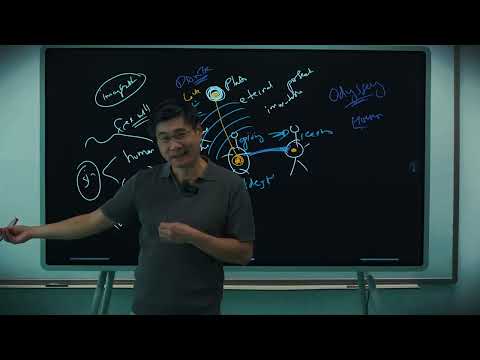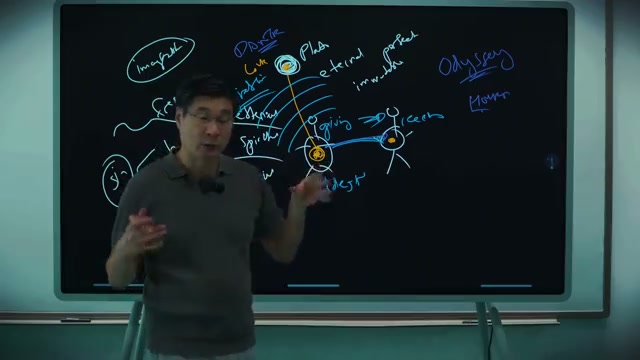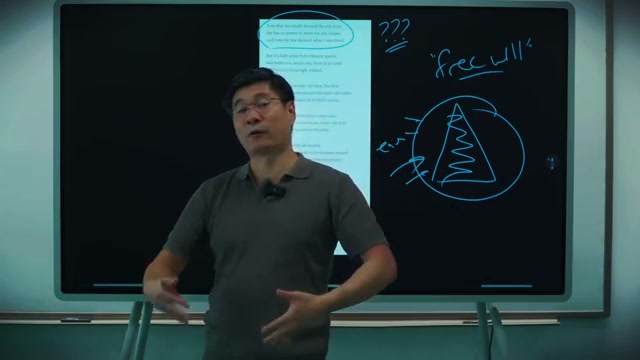
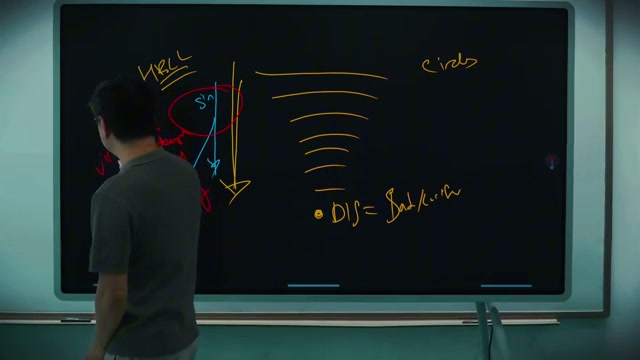
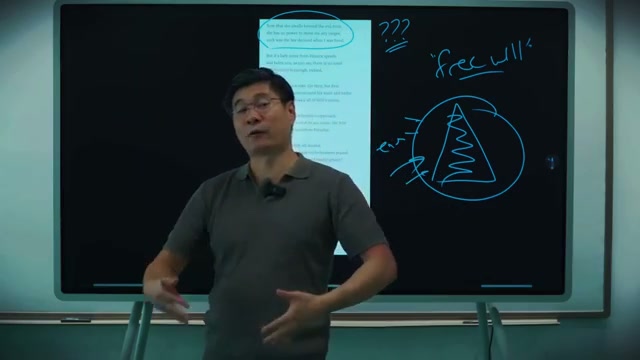
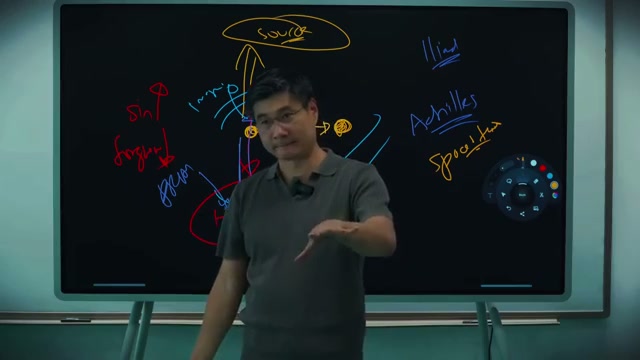
The lecture opens with a hand-drawn diagram of God as the monad, the human soul as a spark, and love as the line connecting them — establishing the entire metaphysical scheme as a chalkboard geometry before any text is read.
Visual abstraction makes a contestable Neoplatonic reading look like a self-evident schema. Once the diagram is accepted, the textual evidence is fitted into it rather than tested against it.
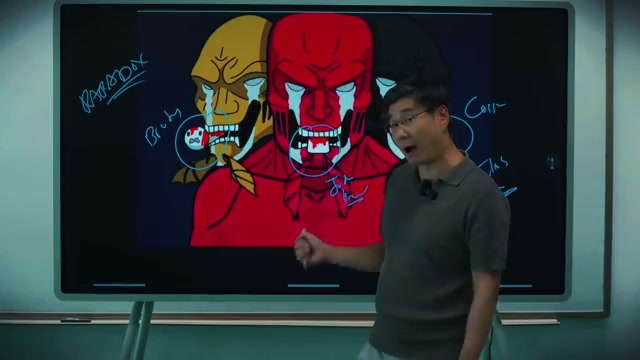
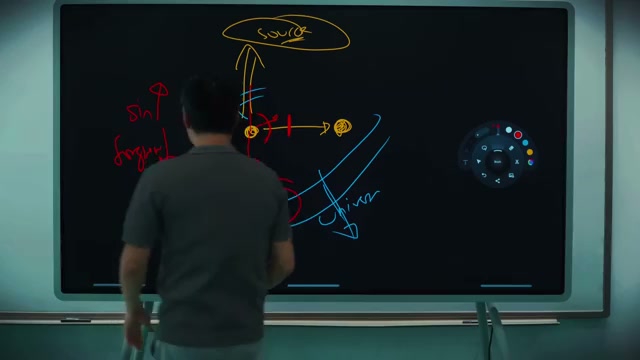
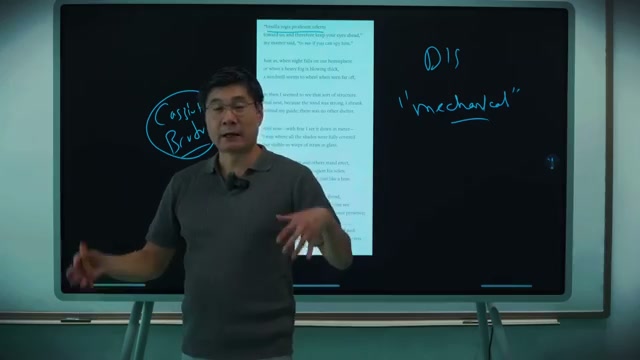
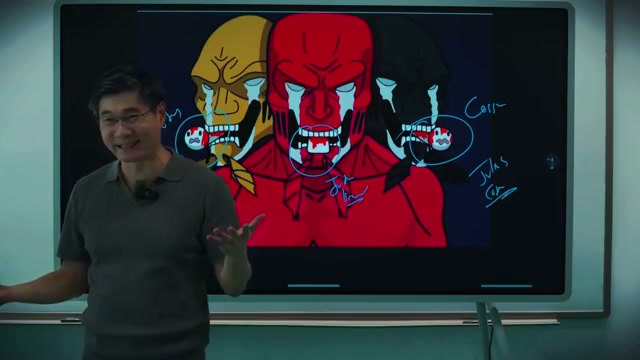
Repeated framing 'this makes no sense' followed by a reveal — Brutus/Cassius beside Judas only makes sense if Caesar is divine; Cato as Purgatory's guardian violates Dante's own three rules; Lucifer is a machine.
Trains the audience to read the Comedy as a deliberately self-undermining text whose surface contradictions point to a hidden author (Virgil). It is a productive technique, but it also licenses interpretive leaps under the cover of 'the text wants us to notice this.'
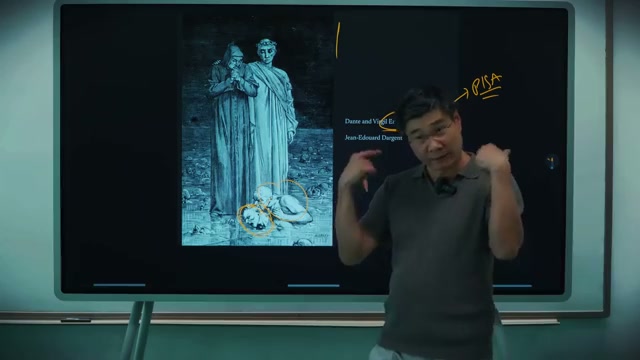
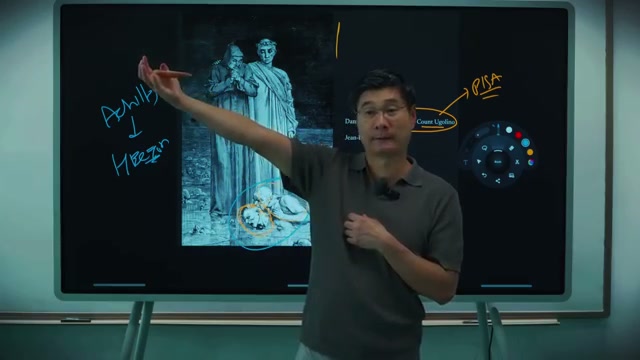
Achilles mutilating Hector → Ugolino biting the archbishop; Odysseus's love for Penelope → Dante's love for Beatrice; Achilles's guilt over Patroclus → Ugolino's self-hatred displaced onto Ruggieri.
Creates a sense of universal moral grammar shared between Homer and Dante. The mirroring is genuinely illuminating but also smooths over differences (Homer is not a Christian moralist; Achilles's wrath is heroic, not penitential).
Mechanistic reduction of the antagonist
00:31:25
'He's a machine. He doesn't have ideas. He doesn't have words. He doesn't have free will... almost like an air conditioner.'
Strips Lucifer of menace and converts him into a thermodynamic appliance. The deflation is rhetorically vivid and clears narrative space for the speaker's preferred candidate (Virgil) as the real organizing intelligence of Hell.
'When you cheat others, others are going to want to cheat others as well. It's almost like a virus.'
Translates a Dantean theological claim about treachery into a quasi-epidemiological metaphor that feels modern and intuitive, lending Aquinas's hierarchy the air of contemporary social theory.
'If you want to understand, you first have to misunderstand. If you want to be virtuous, you must first sin.'
Closes the lecture with paired chiasmus that sounds profound and quotable. The pithiness conceals the philosophical leap from 'sin can be redeemed' to 'sin is required.'
Ascription of authorial intent through paradox
00:33:06
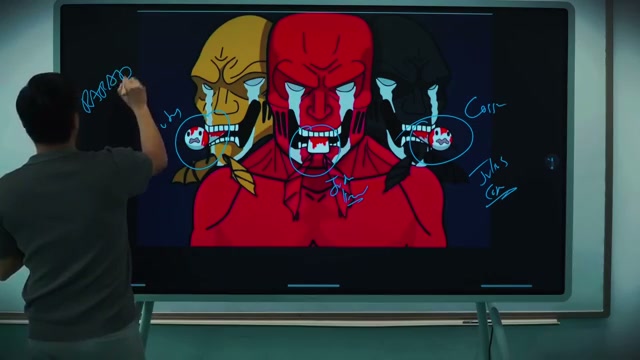
'Maybe this reality, it's being created for me by a stronger power, okay? So the question then is, who would think of putting Brutus and Cassius into hell? Now that person, of course, would be Virgil.'
Reads the poem as a metafictional construction with Virgil as in-text author. This is a striking and engaging move that licenses the speaker to attribute every awkward placement to Virgilian editorializing rather than to Dante's own theology.
Confirmatory rhetorical questions
00:13:26
'Does that make sense, guys?' / 'Does that make sense?' — repeated dozens of times throughout the lecture as transitional punctuation.
Maintains classroom rhythm and signals 'we have established this; moving on.' The pattern discourages dissent and converts each interpretive claim into a checkpoint passed rather than a hypothesis tested.
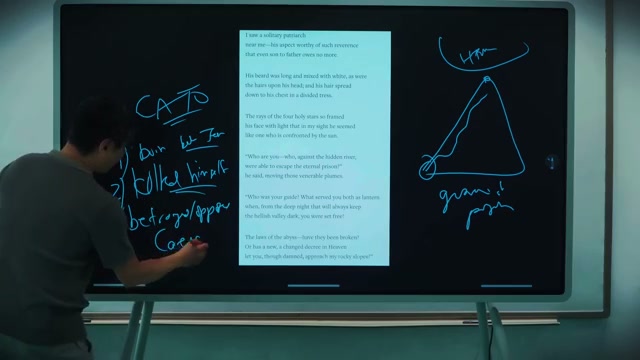
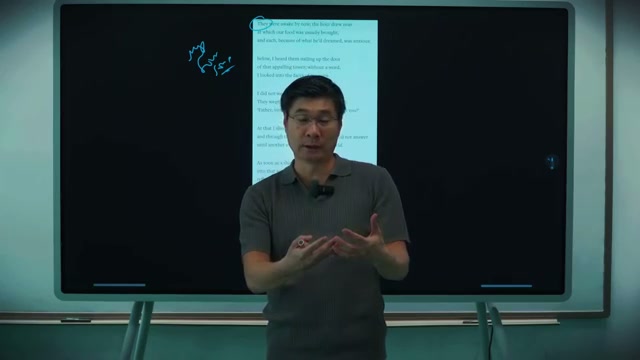
Long verbatim readings from the Mandelbaum translation are interspersed with paraphrase, then followed by 'so what he's saying is...' — the speaker's gloss arrives wrapped in the authority of the read passage.
The audience hears Dante's actual words and then hears the gloss as if it followed by entailment. The paraphrase often introduces material (e.g., 'I no longer love her, but I respect her') that the text does not state.
Universalization of personal narrative
00:04:45
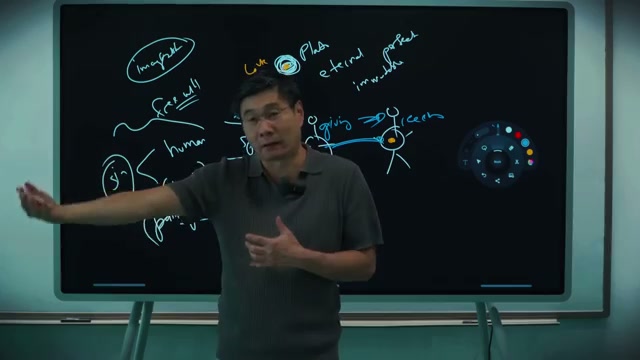
'When a mother loves a child, it doesn't matter the child loves her back. All that matters is that she loves him or her unconditionally.'
Anchors the abstract metaphysical scheme in a stock emotional image (mother-child love), making the otherwise speculative cosmology feel intuitively obvious.
claim
Dante's God is Plato's monad: eternal, perfect, and immutable — and therefore unable to be creative or imaginative.
disconfirmed
Mainstream Dante scholarship (Auerbach, Singleton, Hollander, Barolini) traces Dante's God primarily to Christian Aristotelianism via Aquinas and to Augustinian Neoplatonism, not directly to Plato. Plato's Republic and Timaeus do not call God 'the monad'; that term is Pythagorean and Neoplatonic (Plotinus, Iamblichus). The medieval Latin West also did not have direct access to most of Plato's dialogues — only the Timaeus (in part) and a few others. Furthermore, classical theology explicitly attributes creativity and 'understanding all things by knowing himself' to God; the claim that perfection precludes imagination is the speaker's own philosophical move, not Dante's or Plato's.
claim
Dante never read Homer because he could read Latin but not Greek, and therefore did not have direct access to the Iliad or Odyssey.
partially confirmed
True that Dante did not read Greek and had no full Latin translation of Homer (the first complete Latin Iliad post-dates him). However, he had indirect access through the Ilias Latina (a 1st-century Latin verse epitome of the Iliad widely read in medieval schools), through Virgil's Aeneid, Statius, Ovid, and through Servius's commentaries. Dante explicitly names Homer in Inferno IV ('quel signor de l'altissimo canto') and discusses Homeric figures throughout. The strong claim that Dante and Homer arrived at 'the same framework working independently' overstates this — Dante worked from a long Roman/medieval reception chain that was already saturated with Homeric material.
claim
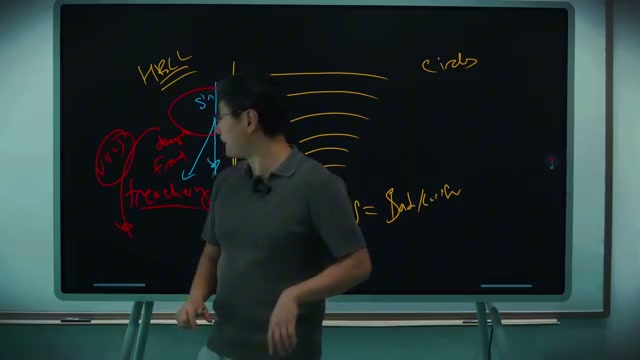
Treachery is the worst sin in Dante's Hell, occupying the lowest circle, because it destroys others' capacity to trust and therefore to love.
confirmed
Accurate description of Inferno's structure. The ninth circle (Cocytus) is reserved for traitors, subdivided into Caina (kin), Antenora (country), Ptolomea (guests), and Judecca (benefactors/lords). Dante's reasoning ties to Aristotle's Ethics via Aquinas — fraud and treachery are uniquely human (not animal) sins that pervert reason itself, the faculty most distinctively human.
claim
Count Ugolino della Gherardesca was a real historical figure who was head of Pisa, was overthrown and imprisoned by Archbishop Ruggieri, and starved to death with his sons in the Tower of Hunger.
confirmed
Historically accurate. Ugolino (c. 1220–1289) was de facto ruler of Pisa, captured in 1288 by Ruggieri degli Ubaldini and imprisoned in the Torre della Muda (later 'Torre della Fame') with his two sons and two grandsons; they died of starvation in early 1289. Dante's framing of Ugolino as paradigmatic traitor matches contemporary Florentine perception.
claim
It is implied in Inferno XXXIII that Count Ugolino actually ate his own children in the tower.
contested unresolved
This is the famous crux of the canto: 'Poscia, più che 'l dolor, poté 'l digiuno' ('then fasting did what sorrow could not'). Some readers (including some medieval commentators and later critics like Borges) have argued cannibalism is hinted at; mainstream Dantists (Singleton, Hollander, Barolini) read it as Ugolino dying of hunger after his sorrow could no longer kill him. The lecture presents the cannibalistic reading as settled, which is one defensible interpretation but not consensus. Documented facts: Dante leaves the line famously ambiguous; medieval commentators were divided; the metaphor of 'cannibalizing the soul' that the speaker draws is his own gloss, not Dante's text.
claim
Lucifer at the center of Hell is a mindless machine without agency, ideas, words, or free will — essentially an air-conditioner cooling Hell with his wings.
partially confirmed
Dante's Lucifer in Inferno XXXIV is indeed mute, weeping, and mechanically flapping six wings to freeze Cocytus — a deliberate parody of the Trinity and a reduction of evil to brute, sterile repetition. The lecture's reading is in line with mainstream interpretations (e.g., John Freccero's 'mechanical' Satan). The 'air conditioner' framing is the speaker's idiom, not Dante's, but not inaccurate to the imagery. The further claim that this proves Virgil is the 'true master of Hell' is an interpretive flourish, not a textually established Dantean position.
claim
Brutus and Cassius are placed in Lucifer's mouths alongside Judas because Virgil — Augustus's court poet — wanted them there, since Augustus deified Julius Caesar; the placement only makes logical sense if Caesar is treated as divine, and Caesar is in Limbo, so the placement is paradoxical.
partially confirmed
Factually: Augustus did formally deify Julius Caesar (lex Rufrena, 42 BC) and Virgil was Augustus's poet. Mainstream Dante scholarship reads Brutus/Cassius placement as reflecting Dante's medieval imperial ideology — the Empire is divinely ordained (De Monarchia), so betraying its founder is parallel to betraying Christ. The speaker's twist that Virgil is 'editorializing' the Comedy is a creative reading, not the standard interpretation, but it is plausible as a metafictional layer. The 'paradox' is real and frequently discussed by Dantists.
claim
Cato of Utica is the guardian of Purgatory in Dante's poem, despite being a pre-Christian Roman suicide who opposed Caesar — a triple paradox by Dante's own stated rules (limbo for pre-Christians, Hell for suicides and traitors).
confirmed
Accurate. Cato Uticensis appears in Purgatorio I as warden of the mountain. Dantists have long noted this as a deliberate exception, usually explained as Cato emblematizing libertas (political and spiritual freedom) — Dante valorized Cato in Convivio IV.v and De Monarchia II.v as the ideal Roman. The speaker's three paradoxes are correctly stated.
claim
Cato chose suicide at Utica rather than submit to Julius Caesar.
confirmed
Historically accurate. Cato killed himself in April 46 BC at Utica after the Battle of Thapsus, refusing to receive clemency from Caesar. Plutarch's Life of Cato the Younger and Appian both record the suicide.
claim
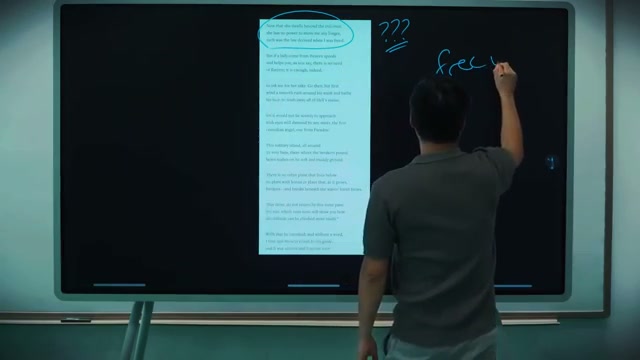
Heaven and Hell are constructions of our imagination — consequences of our emotional state and refusal to forgive ourselves — rather than externally imposed places of reward and punishment.
unfalsifiable
A theological/metaphysical claim that is also a defensible Dantean reading (souls in Inferno are described as having chosen their condition) but goes well beyond Dante. The lecture frames it as both Dante's view and as objectively true; only the descriptive claim about Dante is partially evaluable, and Dante's actual position is more orthodox: divine justice ratifies the soul's settled disposition at death.
claim
Space and time are constructs of human imagination, and our souls live simultaneously in eternity even as we speak — so the moment we sin, we are already imagining ourselves into a place in Hell.
unfalsifiable
claim
True love respects the beloved's free will and never coerces; therefore Cato's refusal to advocate for Marcia's removal from Limbo is itself an act of higher love rather than indifference.
unfalsifiable
claim
To understand we must first misunderstand; to be virtuous we must first sin — error and sin are pedagogical preconditions for growth.
unfalsifiable
A philosophical/aphoristic claim. It echoes Augustinian felix culpa ('happy fault') and Hegelian dialectics, but the lecture asserts it as Dante's settled doctrine without textual citation. Dante's actual position in the Commedia is more cautious — sin is permitted in the economy of free will, but the lecture's stronger 'must sin' framing risks making evil a positive good.