Predictive History Audit / Systematic Content Analysis
Great Books
Episode 2 · Posted 2026-01-14

Homer and the Invention of the Human

This classroom lecture analyzes Homer's Iliad through the lens of Harold Bloom's literary criticism, arguing that great books create characters who can 'hear themselves speak' — i.e., possess full consciousness. The speaker examines the Agamemnon-Achilles quarrel in Book 1 to demonstrate how Homer's characters operate simultaneously on three levels: responding to interlocutors, managing audience perception, and maintaining internal narrative coherence. The lecture then pivots to a speculative theory of consciousness, proposing that the brain is not a storage facility but an 'antenna' for universal consciousness, invoking Carl Jung's concept of archetypes to explain how Homer could create such psychologically real characters. The speaker equates poets, prophets, and teachers as figures who access universal truth, and credits the Iliad with creating 'the greatest civilization on earth in history.'

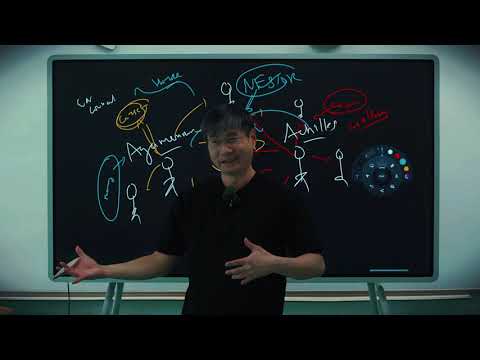
Video thumbnail
youtube.com/watch?v=Ft2CuowGuYc ↗ Analyzed 2026-03-14 by claude-opus-4-6

Viewer Advisory

  • The lecture's claims about neuroscience are inaccurate — we know substantially more about memory storage, personality formation, and empathy than the speaker suggests. The 'brain as antenna' theory has no scientific support and is unfalsifiable.
  • The lecture title and framework appear to derive from Harold Bloom's 'Shakespeare: The Invention of the Human,' but Bloom attributed the invention of human interiority to Shakespeare, not Homer — this is a significant misattribution.
  • The endorsement of physiognomy (reading character from faces) draws on a discredited pseudoscience with a troubling historical legacy.
  • The oral-formulaic theory of Milman Parry and Albert Lord — which provides a well-evidenced, non-mystical explanation for how Homer created complex characters through centuries of bardic tradition — is entirely absent from the discussion.
  • This lecture provides the epistemological foundation for the 'Predictive History' channel's approach to geopolitical analysis: the belief that truth, prediction, and moral judgment are identical. Understanding this framework helps explain the confident determinism of the channel's geopolitical lectures.
Central Thesis

Homer's Iliad invented modern human consciousness by creating characters with full psychological interiority — characters who can hear themselves speak — and this achievement is best explained by understanding the brain as an antenna for universal consciousness rather than a self-contained organ.

  • Great books, as Harold Bloom argued, are works that help us 'become human' by creating characters who can hear themselves speak — who possess consciousness.
  • Agamemnon and Achilles in Book 1 of the Iliad demonstrate three simultaneous levels of consciousness: responding to each other, managing audience perception among the other generals, and maintaining internal narrative coherence.
  • The Iliad's characters are so psychologically real that readers across time and cultures can identify with them, imagining their childhoods and transplanting them into modern contexts.
  • Modern psychology cannot explain three things: the origin of personality, where memories are stored in the brain, and how empathy works.
  • The brain is an 'antenna for the vibrations of the universe' rather than a storage facility, and consciousness comes from interaction with a universal consciousness.
  • Carl Jung's archetypes represent personality patterns that access the same dimensions of universal consciousness, explaining how Homer could create universally recognizable characters.
  • Prophets, poets, and teachers perform the same function: accessing truth from the universal consciousness and transmitting it through language that enables civilization.
  • The Iliad created Greek civilization — 'the greatest civilization on earth in history' — and all subsequent Greek thinkers (Plato, Thucydides, Aeschylus) are derivative of Homer.
  • Truth, prediction, and moral judgment are the same thing: speaking truth means speaking what is eternal, encompassing past, present, and future.
Qualitative Scorecard 2.0 / 5.0 average across 7 axes
Historical Accuracy ▸ Expand
Several factual claims are inaccurate or misleading. The claim that 'we don't know where in the brain memories are stored' is false — neuroscience has identified the hippocampus as critical for memory formation, the amygdala for emotional memory encoding, and has mapped distributed storage across cortical areas. The claim that 'we know Homer was a real person' presents as settled fact what is one of the most contested questions in classical scholarship. The Iliad was composed approximately 2,700-2,800 years ago, not '2,500 years ago' as stated. The lecture title appears to borrow from Harold Bloom's 'Shakespeare: The Invention of the Human,' but Bloom's actual thesis attributes the invention of human interiority to Shakespeare, not Homer — a significant misattribution. The broad retelling of the Agamemnon-Achilles quarrel in Book 1 is reasonably accurate, though modernized and simplified.
2
Argumentative Rigor ▸ Expand
The lecture builds toward a pseudoscientific conclusion through a series of logical leaps. The argument proceeds: (1) Homer created psychologically real characters, (2) modern psychology cannot explain personality origin, memory storage, or empathy, (3) therefore the brain must be an 'antenna for the vibrations of the universe.' Step 2 contains factual errors (neuroscience has made substantial progress on all three problems), and the leap to step 3 is a textbook argument from ignorance — 'we don't know X, therefore my unfalsifiable theory Y must be true.' The oral-formulaic tradition provides a well-evidenced, mundane explanation for Homer's achievement that is never considered. The equation of 'truth = beauty = prediction = moral judgment' is asserted without argumentation. The claim that 'evil people have a certain look to their face' is physiognomy — a discredited pseudoscience.
2
Framing & Selectivity ▸ Expand
The lecture is highly selective in its presentation. Neuroscientific knowledge about memory and empathy is dismissed as nonexistent to create an explanatory vacuum that the 'universal consciousness' theory can fill. The Homeric Question — directly relevant to the lecture's central inquiry — is mentioned only in passing and then bypassed in favor of mystical speculation. Bloom's actual thesis (about Shakespeare, not Homer) is silently transferred. Alternative explanations for Homer's achievement — oral tradition, bardic training, centuries of iterative composition — are not considered. The classroom format, where students cannot easily challenge claims, amplifies this selectivity.
2
Perspective Diversity ▸ Expand
The lecture presents a single interpretive framework throughout — a mystical-idealist view of consciousness and literary creation. No alternative perspectives are considered: no materialist/neuroscientific accounts of consciousness, no oral-formulaic theory for Homer's composition, no competing literary-critical frameworks (structuralism, historicism, reception theory), no challenge to the 'universal consciousness' claim from philosophy of mind. Student questions are accommodated but do not introduce genuinely alternative viewpoints. The one student who pushes back on the definition of 'prophet' is redirected to support the speaker's thesis.
1
Normative Loading ▸ Expand
Compared to the geopolitical lectures, this literary lecture is relatively less ideologically loaded. The analysis of the Iliad itself is presented with genuine pedagogical enthusiasm rather than polemical intent. However, normative claims are embedded throughout: Greek civilization is 'the greatest civilization on earth in history' (a deeply contestable evaluative claim presented as fact), the 'universal consciousness' theory is presented as explanatory truth rather than speculation, and the equation of beauty with truth and moral judgment carries heavy normative freight. The physiognomy claim ('evil people have a certain look to their face') is normatively loaded pseudoscience presented casually.
3
Determinism vs. Contingency ▸ Expand
The lecture is structured around a deeply deterministic metaphysics. The universe is conscious, archetypes are fixed patterns within it, truth encompasses past, present, and future simultaneously, and moral causation is presented as an iron law ('if you do evil onto others, evil will come onto you'). Homer didn't create his characters through craft, training, or cultural inheritance — he accessed pre-existing universal archetypes. There is no room for contingency, individual variation, or historical accident in this framework. The determinism is metaphysical rather than geopolitical, but equally rigid.
2
Civilizational Framing ▸ Expand
Greek civilization is explicitly called 'the greatest civilization on earth in history' — a sweeping evaluative claim that dismisses all other civilizations without argument. All subsequent Greek intellectual achievement is attributed to Homer alone, ignoring the complex social, economic, and political conditions that produced classical Greek culture. The lecture is delivered to Chinese students, creating an implicit hierarchy where students must study the 'greatest' (Western/Greek) civilization to develop consciousness and imagination. No Chinese literary tradition is mentioned for comparison, despite rich parallels (e.g., the psychological complexity of characters in the Zuo Zhuan or the Romance of the Three Kingdoms).
2
Overall Average
2.0
Civilizational Treatment
CHINA

China is not discussed as a civilization, but Chinese students are the audience. The implicit framing is that Chinese students need Homer and Western literary traditions to develop imagination and consciousness. The speaker mentions 'your identity when you go to America' as a context-switching example, implicitly positioning America/the West as a destination that requires different identity formation.

UNITED STATES

Not discussed substantively. The speaker mentions studying English literature at Yale and sitting in on Harold Bloom's class, using American academic credentials to establish authority.

THE WEST

Western civilization is implicitly elevated through the claim that Greek civilization — its foundational tradition — is 'the greatest civilization on earth in history.' The Western literary and philosophical canon (Homer, Plato, Thucydides, Aeschylus) is presented as the pinnacle of human intellectual achievement, with all these figures derivative of the single genius of Homer.

Named Sources

scholar
Harold Bloom
Cited as 'the most famous American literary critic' who taught at Yale. His concept that great books help us 'become human' and that literary characters are distinguished by their ability to 'hear themselves speak' forms the lecture's analytical framework. The speaker mentions sitting in on one of Bloom's classes at Yale, establishing personal authority.
? Unverified
primary_document
Homer / The Iliad
The primary text under analysis. The quarrel between Agamemnon and Achilles in Book 1 is examined in detail as evidence of Homer's creation of psychologically complex, conscious characters. The speaker's retelling is broadly accurate but simplified — treating Chryseis/Briseis as 'girlfriends' and modernizing the language considerably.
✓ Accurate
scholar
Carl Jung
Described as 'a Swiss psychologist' whose concept of archetypes is invoked to explain how Homer could create universally recognizable character types. Jung's archetypes are reinterpreted through the speaker's 'universal consciousness' framework, going well beyond Jung's actual theoretical claims.
? Unverified
scholar
Thucydides
Mentioned briefly as a Greek thinker who is 'derivative of Homer' and who writes 'in a very Homeric way' with characters giving speeches, but who writes about real people and events rather than fictional ones.
? Unverified
scholar
Plato
Mentioned in passing as one of the greatest Greek thinkers who is derivative of Homer, operating within Homer's intellectual universe.
? Unverified
scholar
Aeschylus
Mentioned (as 'iselist' in the auto-transcription) as one of the great Greek thinkers derivative of Homer.
? Unverified

Vague Appeals to Authority

  • 'This is a great mystery that has confused scholars for centuries' — regarding how Homer created such psychologically complex characters, no specific scholars or debates named.
  • 'There are some who speculated that Homer were many people' — references the Homeric Question without naming any scholars (e.g., Friedrich August Wolf, the Analyst school).
  • 'We all know the Iliad is one of the greatest books ever composed' — presented as universal consensus.
  • 'We think this is true' — regarding the universal consciousness theory, no scientific or philosophical sources cited.
  • 'We know that Homer was a real person' — stated as fact despite being one of the most contested questions in classical scholarship.

Notable Omissions

  • No engagement with the extensive scholarly debate on the Homeric Question (single author vs. oral tradition compilation) — Wolf, Parry, Lord, and the oral-formulaic theory are absent despite being directly relevant to the lecture's central question of 'how did Homer do this.'
  • Milman Parry and Albert Lord's oral-formulaic composition theory, which provides a well-evidenced explanation for how Homer created complex characters through centuries of bardic tradition, is completely absent — despite directly answering the question the speaker poses.
  • Harold Bloom's book 'Shakespeare: The Invention of the Human' (1998), from which the lecture title appears to derive, actually attributes the invention of human interiority to Shakespeare, not Homer — the speaker appears to have transferred Bloom's thesis about Shakespeare onto Homer without acknowledgment.
  • No engagement with cognitive science or neuroscience on memory — the claim that 'we don't know where memories are stored in the brain' is misleading given extensive research on the hippocampus, amygdala, and distributed neural networks.
  • No mention of mirror neurons, which provide a neuroscientific framework for empathy that the speaker claims science cannot explain.
  • No engagement with other ancient literary traditions (Mesopotamian, Egyptian, Chinese, Indian) that also produced psychologically complex characters, which would complicate the claim that Homer uniquely 'invented the human.'
  • Bloom's actual argument about 'overhearing' — that characters change by overhearing themselves — is simplified into a general claim about consciousness without engaging its literary-critical specificity.
  • No discussion of the oral tradition context that shaped the Iliad's composition, which is essential to understanding how its characters were constructed.
Argument from ignorance 00:26:22
The speaker identifies three 'problems' modern psychology allegedly cannot solve (personality origin, memory storage, empathy), then uses these alleged gaps to justify a 'universal consciousness' theory: 'if you just use the human brain and assume everything comes from the human brain, nothing makes sense.'
Creates an artificial explanatory vacuum by misrepresenting the state of neuroscience, then fills it with an unfalsifiable metaphysical claim. The audience, likely unfamiliar with neuroscience, accepts the premise that science has failed and the mystical alternative is needed.
Appeal to personal authority 00:04:24
The speaker establishes credentials by mentioning he 'studied English literature at Yale' and 'sat in on a class of' Harold Bloom's, positioning himself as having direct access to the greatest American literary critic.
Transfers Bloom's scholarly authority to the speaker, making subsequent claims (including those that depart significantly from Bloom's actual positions) seem more credible.
Socratic leading questions 00:04:08
Throughout the lecture, the speaker asks questions like 'What are the mechanisms behind all this?' and 'How did Homer do this?' then provides his own answers, creating an appearance of collaborative discovery while guiding students toward predetermined conclusions.
Creates the illusion of student-driven inquiry while maintaining tight control over the argument's direction. Students feel they are reasoning independently when they are being led.
Analogical reasoning (computer/cloud) 00:26:03
The speaker compares the brain to a computer and universal consciousness to the cloud/internet: 'some memory is stored on the laptop but most of it is actually stored in the cloud' — to make the 'brain as antenna' theory seem intuitive.
The familiar metaphor of cloud computing makes an extraordinary metaphysical claim feel like common sense. But the analogy is false — we designed the internet and know how cloud storage works; no mechanism for 'universal consciousness' has been demonstrated.
Categorical conflation 00:28:40
The speaker equates prophets, poets, and teachers as performing 'the same function' — all are 'accessing the truth of the universe' and spreading it through words 'that enable the construction of civilization.'
By collapsing distinct categories (religious prophecy, artistic creation, pedagogy), the speaker elevates his own role as a teacher to quasi-prophetic status while making his speculative claims about consciousness seem like revealed truth.
Escalating claims via momentum 00:25:04
The lecture begins with a modest, defensible claim (the Iliad creates psychologically real characters), builds through literary analysis (Bloom's 'hearing yourself speak'), then escalates rapidly to metaphysical claims (universal consciousness, brain as antenna, archetypes as cosmic patterns) without flagging the escalation.
By the time the speaker reaches his most extraordinary claims, the audience has been carried along by the momentum of earlier, reasonable observations. The shift from literary analysis to pseudoscientific metaphysics occurs gradually enough that it may not register as a category change.
Physiognomy claim presented casually 00:27:32
'If you're an evil person, you have a certain look to your face. If you're a good person, you have a certain look to your face. If you're clever, you have a certain look.'
A discredited pseudoscientific claim (that character is legible from facial features) is presented as self-evident common sense in support of the archetypes argument. Its casual delivery prevents students from recognizing it as a contestable and ethically problematic claim.
False trilemma 00:24:25
The speaker presents three 'unsolved problems' of psychology — personality origin, memory location, empathy — and implies that because modern science cannot answer them (a misrepresentation), only his universal consciousness theory can.
By presenting only two options — materialist neuroscience (which he claims has failed) and universal consciousness (his preferred theory) — the speaker eliminates from consideration the many other frameworks that address these questions (developmental psychology, evolutionary psychology, embodied cognition, etc.).
Superlative framing 00:17:19
Greek civilization is called 'the greatest civilization on earth in history' without qualification, comparison, or argument.
Presents a deeply contestable value judgment as though it were self-evident historical fact. The superlative framing discourages the audience from asking 'greater than what, by what measure?' and reinforces the lecture's implicit hierarchy of civilizations.
Moral determinism as prediction 00:32:35
'If you do evil onto others, evil will come onto you' is presented as both moral truth and predictive law — 'the way you test his words is see if it happens.'
Conflates moral aspiration with empirical prediction, making an unfalsifiable moral claim appear testable. This also positions the speaker's channel (named 'Predictive History') as engaged in prophetic truth-telling rather than merely analysis.
⏵ 00:04:40
A great book is something that helps us become human.
Attributed to Harold Bloom, this serves as the lecture's foundational premise. While Bloom did argue something similar, his actual book 'The Invention of the Human' was about Shakespeare, not Homer — a distinction the lecture elides.
⏵ 00:04:57
The characters are able to hear themselves speak.
Bloom's concept of literary self-overhearing is the lecture's key analytical tool. The speaker uses it productively to analyze Agamemnon and Achilles, though he simplifies Bloom's more nuanced formulation about characters who change through self-overhearing.
⏵ 00:11:56
Through their speeches, they're trying to control reality... they're trying to impose the reality on others.
This is the lecture's most insightful observation about the Iliad — that the Agamemnon-Achilles quarrel is fundamentally a battle over narrative control. Ironically, this is precisely what the speaker himself does throughout the lecture: imposing a reality (universal consciousness theory) on his students through rhetorically skilled speech.
The speaker describes Homer's characters trying to 'control reality' and 'impose reality on others' through speech — which is an apt description of what the speaker himself does when presenting pseudoscientific claims as established truth to students who lack the knowledge to challenge them.
⏵ 00:17:17
This is how the Iliad created the greatest civilization on earth in history, the Greek civilization.
A sweeping civilizational value judgment presented as fact. Reduces the complex origins of Greek civilization to a single literary work and implicitly ranks all other civilizations — including that of his Chinese students — as lesser.
Calling Greek civilization 'the greatest on earth in history' while lecturing to Chinese students whose own civilization produced the world's longest continuous literary tradition, invented paper and printing, and sustained a complex bureaucratic state for millennia, reflects an uncritical absorption of Western civilizational hierarchy that a Chinese educator might be expected to interrogate rather than amplify.
⏵ 00:25:33
Our brain, it's not a storage facility. It's an antenna for the vibrations of the universe.
The lecture's most extraordinary claim — a statement of metaphysical idealism presented as explanatory theory. This is pseudoscience dressed in poetic language, offered to students without any scientific evidence or philosophical argumentation.
⏵ 00:23:21
We don't know in the brain where memories are formed and stored and accessed. We don't know. That's really weird, guys.
This is factually incorrect. Neuroscience has extensively studied memory formation (hippocampus), emotional memory encoding (amygdala), and distributed cortical storage. The speaker's claim creates an artificial knowledge gap to justify his universal consciousness theory.
⏵ 00:27:32
If you're an evil person, you have a certain look to your face. If you're a good person, you have a certain look to your face.
A casual endorsement of physiognomy — the pseudoscientific belief that character can be read from facial features. This has a deeply problematic history, having been used to justify racial discrimination and eugenic programs. Its casual presentation to students as common sense is concerning.
⏵ 00:36:13
In literature, prediction and truth are the same thing. If you're going to speak truth, you can predict the future.
This statement reveals the epistemological framework underlying the entire 'Predictive History' channel — the speaker positions his geopolitical predictions not as probabilistic analysis but as truth-telling in a quasi-prophetic sense. This explains the channel's confident, deterministic tone across all its series.
⏵ 00:03:15
Achilles is honestly a fictional character. He never existed, but he's real to you.
One of the lecture's more genuinely insightful moments — acknowledging the paradox of fictional characters feeling more real than actual people. This is the kind of literary observation that works effectively as pedagogy before the lecture veers into pseudoscience.
⏵ 00:28:20
A word we have for these people are prophets. What are prophets? Prophets are those who bring the truth of the universe onto our world.
Reveals the speaker's self-conception and the channel's brand identity. By equating poets, prophets, and teachers, and by naming his channel 'Predictive History,' the speaker positions himself in this prophetic lineage — one who speaks eternal truth rather than offering contingent analysis.
claim If you do evil onto others, evil will come onto you — presented as a universal law of moral causation.
00:32:44 · Not falsifiable
unfalsifiable
Verdict

Strengths

The lecture's literary analysis of the Agamemnon-Achilles quarrel in Iliad Book 1 is genuinely insightful and pedagogically effective. The observation that both characters operate simultaneously on three levels (interpersonal response, audience management, internal coherence) demonstrates real literary sensitivity. The opening exercise — asking students to imagine themselves as Achilles, imagine his childhood, and imagine him in the modern world — is creative and engaging pedagogy that effectively demonstrates how great literature activates imagination. The speaker communicates genuine enthusiasm for Homer that is likely to inspire students to engage deeply with the text. The discussion of narrative control as the central conflict of the Iliad is a sophisticated literary observation.

Weaknesses

The lecture suffers from three major problems. First, it contains outright factual errors: the claim that neuroscience cannot explain where memories are stored is false; the hippocampus, amygdala, and distributed cortical networks are well-studied. Second, the 'brain as antenna for universal consciousness' theory is pseudoscience — unfalsifiable, unsupported by evidence, and presented as explanatory truth rather than speculation. This is particularly concerning in a classroom setting where students trust the teacher's authority. Third, the lecture appears to misattribute Harold Bloom's thesis: Bloom's 'The Invention of the Human' is about Shakespeare, not Homer, yet the lecture title and framework transfer Bloom's argument onto Homer without acknowledgment. The endorsement of physiognomy ('evil people have a certain look') introduces a discredited and ethically problematic pseudoscience. The claim that Greek civilization is 'the greatest on earth in history' is an unargued value judgment that implicitly diminishes the civilizational achievements of the speaker's own students' culture.

Cross-References

BUILDS ON

  • Great Books #1 (referenced as 'last class' where they discussed universal consciousness and infinite dimensions of consciousness)
  • Civilization series lectures on Greek civilization (the speaker's treatment of Greek culture as the greatest civilization connects to the broader Civilization series framework)
  • The 'Predictive History' channel brand itself — this lecture provides the epistemological foundation for why the speaker believes predictions and truth are identical
This lecture reveals the philosophical underpinning of the entire Predictive History project. By arguing that truth, prediction, and moral judgment are identical, and that prophets/poets/teachers access universal truth, the speaker provides a metaphysical justification for his geopolitical prediction enterprise. The confident, deterministic tone of lectures like Geo-Strategy #8 ('The Iran Trap') is not merely analytical overconfidence — it reflects a worldview in which speaking truth necessarily includes predicting the future. This also explains why the speaker's predictions carry such moral weight: in his framework, predicting that 'evil will come onto' those who do evil is not speculation but truth-telling. The Great Books series thus functions as the epistemological foundation for the geopolitical series.