Predictive History Audit / Systematic Content Analysis
Great Books
Episode 3 · Posted 2026-01-21

Poets and Prophets

This lecture argues that poets are prophets who create civilization itself through language. Beginning with Homer's Iliad, the speaker examines how speech-making and war-fighting serve the same purpose in Greek culture — imposing one's reality on others. Drawing on a simplified version of Kant's epistemology (noumena vs. phenomena, time and space as mental filters), the lecture claims that language controls reality and that poets, through a divine connection to the universe, create the language that shapes collective understanding. The speaker then reads extensively from Percy Bysshe Shelley's 'A Defence of Poetry' to argue that Greek tragedy produces epiphany and catharsis, that poetry is a 'portal to the divine,' and that Homer created Greek civilization because 'God willed it.' The lecture presents a thoroughly mystical framework in which the universe functions as a 'divine psychic internet,' consciousness survives death, reincarnation is real, and poetry reawakens memories of past lives.

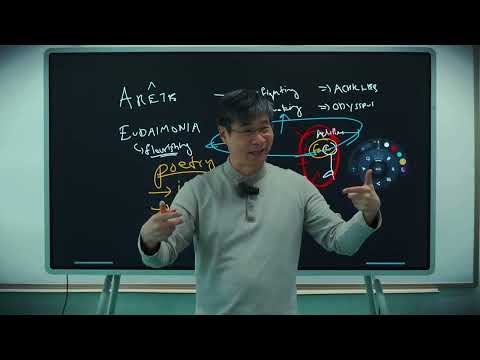
Video thumbnail
youtube.com/watch?v=XRP407WsA0w ↗ Analyzed 2026-03-14 by claude-opus-4-6

Viewer Advisory

  • The treatment of Kant, Hegel, Jung, and Plato is significantly oversimplified and in places outright inaccurate — viewers should not take these summaries as reliable introductions to these thinkers.
  • Plato's well-known hostility to poets is suppressed, creating a misleading impression that he supported the lecture's thesis.
  • Aristotle's Poetics, the most relevant text on Greek tragedy and catharsis, is entirely absent.
  • Claims about reincarnation, cosmic consciousness, communication with the dead, and the 'divine psychic internet' are metaphysical beliefs presented as established knowledge — they are not supported by any philosophical tradition cited in the lecture and would be contested by most scholars in the fields referenced.
  • The lecture's claim that Greek civilization is 'the greatest civilization in human history' is a normative assertion, not a factual statement.
  • The internal contradiction between Homer as conscious craftsman (first half) and Homer as unconscious divine vessel (second half) is never acknowledged or resolved.
Central Thesis

Poets are prophets with a divine connection to the universe who create civilization itself through language, as demonstrated by Homer's Iliad giving birth to Greek civilization.

  • Greek civilization is 'the greatest civilization in human history' and was founded on a single epic poem, the Iliad.
  • In Greek culture, war-fighting and speech-making are equivalent activities — both attempt to impose one's reality onto others, differing only in means (force vs. beauty/truth).
  • Kant's epistemology shows that time and space are mental filters we impose on reality, and whoever controls language controls these filters and therefore controls reality itself.
  • Poets have a divine connection to the universe (variously called Geist, collective unconscious, realm of Forms, or heaven) and channel divine truth through their words.
  • The universe functions as a 'divine psychic internet' where all memories and consciousnesses are stored eternally, and poets can access this repository.
  • Greek tragedy produces epiphany (recognizing hubris leads to downfall) and catharsis (purging negative emotions), which together create moral, wise citizens.
  • Poetry activates the imagination, allowing humans to perceive beyond time and space and connect to the eternal and divine.
  • Reincarnation is real, and poetry reawakens buried memories of past lives by touching the soul.
  • Poets are 'the unacknowledged legislators of the world' (Shelley) because their language creates the reality everyone inhabits.
Qualitative Scorecard 1.9 / 5.0 average across 7 axes
Historical Accuracy ▸ Expand
The broad literary-historical facts are largely correct: the Iliad's central role in Greek education, the Embassy scene in Book 9, the structure of Greek tragedy involving hubris and catharsis, and the basic plot of Oedipus Rex. However, several claims are inaccurate or significantly distorted: (1) Kant's epistemology is oversimplified to the point of distortion — Kant did not argue that 'everything outside of us is just pure energy' or that controlling language means controlling reality; (2) Hegel's Geist is reduced to an etymological game with 'ghost, gist, geyser' that misrepresents a complex philosophical concept; (3) Jung's 'collective unconscious' is misnamed as 'eclectic unconscious'; (4) Plato is cited as supporting the divine role of poets when he is actually their most famous ancient critic; (5) The claim that Greek education consisted solely of memorizing the Iliad oversimplifies a complex educational system; (6) Aeschylus is omitted from the 'three big' tragedians.
3
Argumentative Rigor ▸ Expand
The lecture's argument relies entirely on assertion, mystical claims, and equivocation rather than logical demonstration. The central claim — that poets create civilization through divine channeling — is unfalsifiable and presented without evidence. The logical chain is: (1) Kant showed perception shapes reality → (2) language shapes perception → (3) poets create language → (4) therefore poets create reality. Each step involves a significant logical leap. Step 1 distorts Kant. Step 2 conflates linguistic determinism (a debated hypothesis) with certainty. Step 3 ignores that language is a collective, evolving phenomenon not created by individual poets. Step 4 is a non sequitur. The mystical framework (divine psychic internet, reincarnation, consciousness surviving death) is presented as fact without any argument or evidence. Multiple philosophical traditions (Kant, Hegel, Plato, Jung, Shelley) are collapsed into a single mystical framework as though they all said the same thing, when they fundamentally disagree.
1
Framing & Selectivity ▸ Expand
The lecture is highly selective in its use of sources and ideas. Plato is cited in support of poetry's divine role while his explicit critique of poetry (Republic Book X) is omitted. Aristotle's Poetics — the most directly relevant ancient text on the topics discussed — is entirely absent. Kant is selectively presented to support linguistic idealism while his actual project (establishing the conditions for objective knowledge) is ignored. Shelley's essay is quoted at length but interpreted through a mystical lens that goes beyond Shelley's Romantic idealism into claims about reincarnation and cosmic consciousness that Shelley did not make. The lecture presents only evidence that supports the thesis of poets as divine prophets, with no counterarguments or alternative interpretations considered.
2
Perspective Diversity ▸ Expand
The lecture presents a single mystical-Romantic perspective on poetry and civilization with no engagement with alternative viewpoints. No materialist, historicist, structuralist, Marxist, postmodern, or empirical perspectives on literature are mentioned. The Platonic critique of poetry is suppressed. Aristotle's naturalistic account of catharsis (as a psychological rather than divine phenomenon) is absent. Modern cognitive science and psychology of narrative are not referenced. Non-Western traditions of poetry and civilization-building are entirely absent. The classroom format involves occasional student interactions but no substantive dialogue or pushback on the mystical claims.
1
Normative Loading ▸ Expand
The lecture is heavily normatively loaded, presenting metaphysical and spiritual claims as established facts. Poetry is 'a portal to the divine'; poets are 'prophets'; Homer was 'channeling God'; the universe is a 'divine psychic internet'; reading the Iliad 'allows us to connect and talk to God itself.' These are not presented as one philosophical perspective among many but as the truth that the speaker is revealing to students. The language is consistently reverential and absolute: 'the greatest civilization in human history,' 'the most creative,' 'eternal and immortal.' The Socratic pedagogical style ('Does that make sense guys?') creates an atmosphere where agreement is expected, not critical engagement.
2
Determinism vs. Contingency ▸ Expand
The lecture presents a thoroughly deterministic view of cultural creation. Homer created Greek civilization because 'God willed it.' Poets speak truth because 'they have no choice' — there is 'a fire burning in you' that must come out. The spread of Greek civilization through Homer's poetry was 'all by design.' There is no room for contingency, historical accident, social conditions, economic factors, or human agency in this account. The Iliad's cultural dominance is attributed to divine will rather than to any combination of historical circumstances (colonization, trade networks, political competition among city-states, educational institutions).
2
Civilizational Framing ▸ Expand
Greek civilization is explicitly and without qualification called 'the greatest civilization in human history, the most creative,' presented as the foundation of Western civilization. This is stated as self-evident fact in the opening seconds of the lecture. No other civilization is discussed or compared. The implicit hierarchy places Greek civilization at the pinnacle of human achievement, with its greatness attributed to a single divinely-inspired poet. No criteria for 'greatest' are offered, no other candidates are considered, and no cultural relativism is acknowledged.
2
Overall Average
1.9
Civilizational Treatment
THE WEST

Western civilization is mentioned briefly as being founded on Greek civilization. The framing implies that the West's cultural achievement derives from its Greek roots and specifically from Homer's poetry. No critical examination of Western civilization is offered.

Named Sources

primary_document
Homer / The Iliad
Central text of the lecture. The exchange between Odysseus and Achilles in Book 9 (the Embassy) is analyzed as an example of competing speech-realities. Achilles' choice between a long life at home and a short glorious life at Troy is cited. The Iliad as a whole is presented as the foundational text that created Greek civilization.
✓ Accurate
book
Immanuel Kant / Critique of Pure Reason
Kant's distinction between noumena (things-in-themselves) and phenomena (things as perceived) is cited to argue that time and space are mental constructs, and that controlling language means controlling reality. The speaker uses this to support the claim that poets create reality through language.
✗ Inaccurate
book
Percy Bysshe Shelley / A Defence of Poetry
Extensively quoted (multiple long passages read aloud) to support the claims that poetry is the foundation of civilization, that poets are prophets and 'unacknowledged legislators of the world,' and that Greek drama creates moral citizens through catharsis. This is the most heavily cited source in the lecture.
? Unverified
scholar
G.W.F. Hegel (Geist)
Hegel's concept of Geist is briefly mentioned and etymologically linked to the English words 'ghost,' 'gist,' and 'geyser' to explain the universal spirit. Used as one of several labels for the divine/universal consciousness.
✗ Inaccurate
scholar
Carl Jung (collective unconscious)
Jung's 'collective unconscious' (mispronounced as 'eclectic unconscious' in the transcript) is cited as another name for the universal consciousness that poets access.
✗ Inaccurate
scholar
Plato (realm of Forms)
Plato's realm of Forms and ideals is cited as another name for the divine universe that poets access. Notably, this contradicts Plato's actual view, as Plato in Republic Book X famously banished poets from the ideal city as purveyors of imitation twice removed from truth.
✗ Inaccurate
primary_document
Sophocles / Oedipus Rex
Cited as the classic example of Greek tragedy where the protagonist's downfall teaches the audience humility and produces catharsis. The speaker argues Oedipus 'did nothing wrong' and his fate was just an accident.
? Unverified
scholar
Torquato Tasso
Quoted (via Shelley) as saying 'None but God and the poet deserve the name of creator.' Used to support the elevation of poets to divine status.
✓ Accurate

Vague Appeals to Authority

  • 'Remember how we said before our memories are stored in the universe' — presented as previously established fact without any evidence or sourcing.
  • 'We are always in a process of reincarnation' — stated as a known truth with no philosophical or religious tradition specified or argued for.
  • 'Greek civilization is the greatest civilization in human history. The most creative.' — stated as self-evident without criteria or comparative analysis.
  • 'All they had to do was memorize the Iliad' regarding Greek education — an oversimplification presented without sourcing.
  • 'The entire world is sound vibrations, frequencies' — a vague appeal to physics presented without context or accuracy.

Notable Omissions

  • Plato's Republic Book X, where Plato banishes poets from the ideal city as harmful imitators — directly contradicts the lecture's use of Plato as supporting the divine role of poets.
  • Aristotle's Poetics, the foundational text on Greek tragedy, catharsis, and mimesis — the lecture discusses these concepts without referencing Aristotle at all.
  • Any critical scholarship on Homer (Milman Parry, Albert Lord on oral-formulaic composition), which would complicate the mystical 'divine channeling' interpretation.
  • The Homeric Question — no mention that 'Homer' may not be a single author, which is relevant to claims about his divine inspiration.
  • Nietzsche's The Birth of Tragedy, which offers an alternative (Apollonian/Dionysian) framework for understanding Greek drama that would complicate the lecture's account.
  • Any non-Western poetic traditions (Chinese poetry, Sanskrit epics, Arabic poetry) that could test the universality of the claims about poetry and civilization.
  • Aeschylus, the third of the three great Athenian tragedians — the speaker mentions 'three big players' but only names Sophocles and Euripides.
  • Any engagement with modern cognitive science or psychology of narrative and empathy, which could ground the claims about poetry's effects in evidence rather than mysticism.
Appeal to the mystical/unfalsifiable 00:19:45
The speaker describes the universe as a 'divine psychic internet' where 'every single memory is stored' and claims poets can 'access this universe' and 'summon the memories of the universe.'
Elevates the argument beyond the reach of rational critique. If one accepts the metaphysical premises, the conclusions follow — but the premises themselves are unfalsifiable and presented as established fact rather than belief.
Equivocation across philosophical traditions 00:18:23
The speaker lists Hegel's Geist, Jung's collective unconscious, Plato's Forms, and Christian heaven as different names for the same thing, saying 'these are the universe.'
Creates an illusion of broad intellectual consensus by treating fundamentally different and often incompatible philosophical concepts as synonymous. Hegel, Jung, Plato, and Christianity have radically different ontologies, but collapsing them makes the speaker's position seem universally supported.
Rhetorical scaffolding through Socratic questioning 00:26:00
The speaker repeatedly asks 'Does that make sense guys?' and 'Are we clear?' after presenting mystical claims as explanations, creating the expectation of agreement rather than critique.
Positions metaphysical assertions as explanations that should make sense, implying that a student who doesn't agree simply doesn't understand. Discourages critical questioning by framing agreement as comprehension.
Modern analogy for ancient concept 00:05:35
Speech-making is compared to 'projecting a movie onto the world,' and the universe/Geist is compared to an 'internet' with 'download speed.'
Makes abstract and potentially obscure concepts feel familiar and intuitive. However, the modern analogies smuggle in assumptions (e.g., that consciousness works like data download) that the original concepts do not support.
Selective quotation from authority 00:27:05
Shelley's 'A Defence of Poetry' is quoted at great length — multiple long passages read aloud — to lend the weight of a canonical Romantic poet to the speaker's mystical framework.
The extensive quotation from a recognized literary figure creates the impression that the speaker's mystical interpretation is identical to Shelley's argument. The audience hears prestigious language and attributes the speaker's glosses to Shelley's authority.
Assertion by escalation 00:43:07
The speaker builds from 'poets create language' to 'poets create reality' to 'poets are prophets' to 'Homer was channeling God' to 'it's all by design,' each step presented as following naturally from the last.
Each claim is slightly more extraordinary than the last, but by the time the audience reaches 'God willed it,' they have implicitly accepted the chain of reasoning. The escalation normalizes increasingly extraordinary claims.
False etymology as argument 00:18:43
Hegel's Geist is 'explained' through three English cognates: ghost, gist, and geyser. 'Ghost is the underlying thing, gist is the essence, geyser is an eruption.'
Substitutes etymological play for philosophical analysis. The audience feels they understand Geist through familiar English words, when in fact they have received neither an accurate translation nor a substantive explanation of Hegel's concept.
Suppression of counterevidence 00:19:20
Plato is cited for his 'realm of Forms and ideals' as another name for the divine universe poets access. No mention is made of Plato's famous hostility to poets in Republic Book X, where he argues poets are dangerous imitators who should be banished.
Creates a false impression of philosophical consensus. A student hearing this would believe Plato championed poets as divine connectors, when Plato is arguably the most prominent ancient critic of poetry. This omission is particularly significant because Plato's critique directly undermines the lecture's thesis.
Declarative certainty on contested claims 00:00:00
'Greek civilization is the greatest civilization in human history. The most creative.' Stated as fact in the opening line with no qualification, criteria, or acknowledgment of alternative views.
Establishes the lecture's normative framework before any argument is made. By asserting Greek supremacy as self-evident, the speaker frames the entire discussion as explaining an established fact rather than defending a contestable claim.
Collapsing the distinction between metaphor and literal truth 00:35:01
The speaker moves seamlessly from Shelley's metaphorical language about poetry ('mirrors,' 'portals,' 'flames') to literal claims about reincarnation, consciousness surviving death, and cosmic memory storage.
Shelley's Romantic metaphors are treated as literal descriptions of reality. The beauty and persuasive power of Shelley's prose lends aesthetic force to claims that go far beyond what Shelley argued, but the audience may not notice where metaphor ends and literal assertion begins.
⏵ 00:00:00
Greek civilization is the greatest civilization in human history. The most creative.
Opening declaration that frames the entire lecture. Presents a highly contestable civilizational ranking as self-evident truth. Reveals the speaker's Hellenocentric framework and willingness to make sweeping normative claims without argument.
This unqualified civilizational superlative mirrors the kind of ethnocentric ranking the speaker might criticize if applied to other cultures. The claim that one civilization is objectively 'the greatest' and 'most creative' in all of human history presupposes universal criteria that are themselves culturally contingent. Chinese civilization, with its independent inventions of printing, gunpowder, compass, paper, civil service examination, and continuous literary tradition spanning over 3,000 years, represents an equally strong or stronger candidate by many measures — but is not even mentioned.
⏵ 00:19:45
The universe is almost like a divine psychic internet. Every single memory is stored inside the universe.
Reveals the lecture's fully mystical ontology. The 'divine psychic internet' metaphor transforms an unfalsifiable metaphysical claim into something that sounds modern and technological, making it appear more plausible to a young audience.
⏵ 00:17:46
Poets are really prophets. If you look at all these great religious figures of the past including Jesus, including Zoroaster, they weren't religious figures. They were really poets.
A remarkable claim that reduces major religious figures to poets, while simultaneously elevating poets to prophetic status. This move allows the speaker to claim divine authority for all poetry, including his own interpretive framework.
⏵ 00:21:12
It's possible through intense meditation to actually connect with Homer, Dante, Shakespeare, whoever. They're all there.
Presents the ability to communicate with dead authors through meditation as fact ('they're all there'), not as belief, speculation, or metaphor. This is the clearest statement of the lecture's departure from any empirical or philosophical framework into pure mysticism.
⏵ 00:39:29
None but God and the poet deserve the name of creator. The poet is the creator of our world.
Quoting Tasso via Shelley, the speaker equates poets with God as the only true creators. This reveals the lecture's ultimate claim: poetry is not merely important or influential but is literally the act of divine creation.
⏵ 00:43:20
Homer created civilization because God willed it that Homer speak truth and willed that this truth will spread across the world through his poetry. It's all by design.
The lecture's conclusion reduces all historical contingency to divine design. This is the most explicitly deterministic and theistic statement in the lecture, attributing civilization itself to God's will channeled through a single poet.
⏵ 00:42:00
When Homer is speaking, he doesn't know what he's speaking. He's just channeling God.
Denies Homer any conscious craft or artistic agency, reducing him to a passive vessel. This contradicts the lecture's own earlier analysis of Odysseus's sophisticated rhetorical techniques, which implied deliberate craft in Homer's composition.
⏵ 00:35:01
We are always in a process of reincarnation... When we reincarnate into this world, our memories of our former selves and of the spiritual world are lost to us.
Presents reincarnation as an established fact in a lecture ostensibly about literature and philosophy. The claim is introduced casually ('remember how we said') as though it were a previously established premise, normalizing a major metaphysical assertion.
⏵ 00:39:52
Poetry is a portal to the divine.
Concise statement of the lecture's central thesis. Notably, this is presented not as Shelley's Romantic metaphor but as literal truth. The word 'portal' — used repeatedly — frames poetry as a technology for accessing a real spiritual dimension.
⏵ 00:43:04
Poets are the unacknowledged legislators of the world.
Shelley's famous closing line from 'A Defence of Poetry,' used here as the capstone of the lecture's argument. While Shelley meant this partly as a claim about imagination shaping political and moral reality, the speaker interprets it through his mystical framework as literal divine legislation.
claim Through intense meditation, one can connect with the consciousnesses of Homer, Dante, Shakespeare, and other deceased figures whose consciousness persists in the universe.
00:21:08 · Not falsifiable
unfalsifiable
Metaphysical claim about consciousness surviving death and being contactable through meditation. Cannot be empirically tested.
Verdict

Strengths

The lecture contains a genuinely interesting analysis of the Embassy scene in Iliad Book 9, showing how Odysseus and Achilles create competing realities through speech — Odysseus expanding outward (past, present, future, communal) while Achilles contracts inward (I, me, self). The connection between speech-making and war-fighting as parallel forms of imposing one's will is a legitimate and insightful reading of Greek culture. The discussion of epiphany and catharsis in Greek tragedy, while simplified, captures real elements of how Athenian drama functioned. The extensive use of Shelley's 'A Defence of Poetry' exposes students to a canonical Romantic text. The lecture is engaging and clearly delivered with genuine passion for the material.

Weaknesses

The lecture's most serious flaw is presenting unfalsifiable mystical claims as established fact in what appears to be an educational setting. Reincarnation, cosmic consciousness, the 'divine psychic internet,' and communication with the dead through meditation are stated as truths rather than beliefs or philosophical positions. The treatment of Kant is significantly distorted — Kant did not argue that 'everything outside of us is just pure energy' or that controlling language means controlling reality. Jung's 'collective unconscious' is misnamed as 'eclectic unconscious.' Plato is cited in support of poetry's divine role while his famous critique of poetry (Republic Book X) is suppressed — a significant misrepresentation. Aristotle's Poetics, the foundational text on the very topics discussed (tragedy, catharsis, mimesis), is entirely absent. Hegel's Geist is reduced to etymological wordplay. The lecture contains an internal contradiction: it first analyzes Homer's deliberate rhetorical craftsmanship and then claims Homer 'doesn't know what he's speaking' and is 'just channeling God.' The claim that Greek civilization is 'the greatest civilization in human history' is asserted without criteria, evidence, or acknowledgment that this is a normative judgment.

Cross-References

BUILDS ON

  • Great Books series lectures 1-2 (referenced as 'remember how we said before' regarding stored memories and the universe; students have apparently been reading the Iliad in previous classes)
  • A previous semester's Civilization series on Greek civilization (the speaker references having previously discussed Greek concepts of arete and eudaimonia)
  • Geo-Strategy #8 'The Iran Trap' — shares the Greek hubris framework; in that lecture, hubris was applied to American military overreach, here it is discussed as a theme of Greek tragedy

CONTRADICTS

  • The lecture's claim that Homer was 'just channeling God' and 'doesn't know what he's speaking' contradicts its own earlier analysis of Odysseus's deliberate rhetorical techniques (imagery, metaphor, diction, syntax), which implies Homer was a conscious craftsman who understood rhetorical strategy.
The Great Books series appears to be a parallel track to the Geo-Strategy series, focused on literary and philosophical analysis rather than geopolitics. However, shared themes emerge: the concept of hubris as the downfall of great powers (applied to the US in Geo-Strategy, to tragic heroes here), the idea that narrative/speech creates reality (applied to propaganda in Geo-Strategy, to poetry here), and a broadly Romantic/anti-materialist worldview. The mystical framework presented here — poets as prophets channeling divine truth — provides the epistemological foundation for the speaker's confidence in his own geopolitical predictions in other series: if the analyst is himself a kind of prophet with access to deeper truths, his predictions carry quasi-divine authority.