Predictive History Audit / Systematic Content Analysis
Great Books
Episode 6 · Posted 2026-03-11

The Intimacy of Love

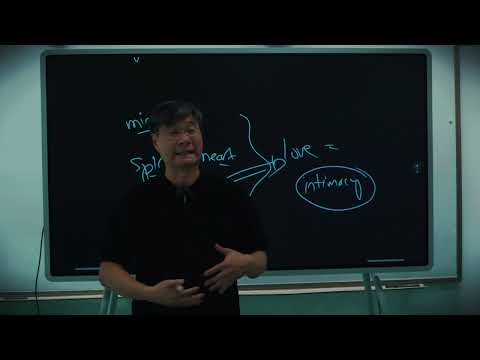
This lecture concludes the speaker's analysis of Homer's Odyssey, focusing on the theme of love as intimacy. The speaker frames love through a metaphysical lens of three planes of consciousness — mind, spirit, and soul — arguing that true love requires alignment across all three. The lecture contrasts the loveless marriage of Helen and Menelaus (who talk past each other) with the deep intimate connection between Odysseus and Penelope, demonstrated through coded language (the golden brooch) and shared secrets (the immovable bed). Extended passages from the Odyssey are read aloud by students, covering the bow-stringing scene, the bed test, and Achilles's regret in the underworld. The lecture concludes that the Odyssey's ultimate moral is that love and family give life meaning, surpassing glory and empire — and that this story became the foundation of Greek civilization, which the speaker calls 'humanity's greatest civilization.'

Video thumbnail
youtube.com/watch?v=aS-NfPSPMu8 ↗ Analyzed 2026-03-14 by claude-opus-4-6

Viewer Advisory

  • The metaphysical framework of mind/spirit/soul and 'the monad' is the speaker's own interpretive apparatus, not a standard tool of literary analysis or Homeric scholarship.
  • The brooch interpretation, while creative, is one of several scholarly readings of the Book 19 recognition scene — the academic debate over whether Penelope recognizes Odysseus before the bed test is extensive and unresolved.
  • The lecture's romanticized portrait of Odysseus and Penelope's marriage omits troubling aspects of the text: Odysseus slept with Circe and Calypso during his journey, and he orders the execution of the maidservants who slept with the suitors — episodes that complicate a pure 'love story' reading.
  • The claim that Greek civilization is 'humanity's greatest' is a subjective judgment that the speaker does not argue for, and it sits in tension with the Sinocentric framing of his geopolitical lectures.
  • The gatekeeper pedagogy ('you can't find it yourself') should prompt skepticism rather than deference — good literary analysis empowers readers to find meaning independently.
Central Thesis

True love is defined by intimacy — the ability to communicate through shared secrets and coded language across the planes of mind, spirit, and soul — and the Odyssey teaches that building a loving family is more purposeful than pursuing glory or empire.

  • Consciousness exists on three planes — mind, spirit, and soul — and depression/trauma results from misalignment between these planes.
  • Love is the force that compels individuals back toward unity (the 'monad'), and true love is demonstrated through intimate knowledge and secret communication between partners.
  • Helen and Menelaus represent a loveless marriage: they talk past each other, telling competing stories without hearing one another.
  • Odysseus and Penelope demonstrate true love through coded language (the golden brooch, the immovable bed) that only they can understand.
  • Odysseus's bow-stringing represents a metaphorical resurrection — the alignment of mind, spirit, and soul — made possible by the love of his wife and son.
  • Achilles, speaking from the underworld, reverses his life's choice by declaring he would rather be a poor farmer alive than rule over the dead, revealing that family and love matter more than glory.
  • The Odyssey's moral — that love and family trump glory and empire — became the foundation of Greek civilization, which is 'humanity's greatest civilization.'
Qualitative Scorecard 3.0 / 5.0 average across 7 axes
Historical Accuracy ▸ Expand
The Homeric content is broadly accurate: the scenes from the Odyssey are real and correctly placed in the narrative. Odysseus does disguise himself as a beggar, describe his clothing to Penelope (Book 19), string the bow and kill the suitors (Books 21-22), and Achilles does express regret in the underworld (Book 11). Minor inaccuracies in the transcript appear to be auto-captioning errors rather than the speaker's mistakes (e.g., 'Penaltz,' 'Tamakz,' 'children horse' for 'Trojan horse'). The claim that Helen 'helps the Greeks implement their plan' after Odysseus's infiltration is a reasonable paraphrase of Book 4. The score is reduced from 5 because the metaphysical framework (consciousness as monad, three planes of mind/spirit/soul) is presented as fact rather than philosophical interpretation, and the claim that the Odyssey is the foundation of 'humanity's greatest civilization' is asserted without qualification.
4
Argumentative Rigor ▸ Expand
The literary analysis follows a coherent internal logic: the contrast between Helen-Menelaus (loveless) and Odysseus-Penelope (intimate) is well-structured, and the three scenes (brooch, bow, bed) build effectively toward the thesis. However, the argument rests on an undefended metaphysical framework — the three planes of consciousness — that is asserted rather than argued for. The brooch interpretation is presented as the definitive reading when it is actually one of several scholarly interpretations. The leap from 'the Odyssey teaches that love matters more than glory' to 'this is the foundation of Greek civilization, humanity's greatest' is a massive logical jump made without argumentation. The lecture works well as pedagogy but would not withstand scholarly scrutiny.
3
Framing & Selectivity ▸ Expand
The lecture presents one interpretation of the Odyssey as the correct reading without acknowledging alternatives. The romanticized view of Odysseus and Penelope's relationship selectively omits complicating elements: Odysseus spent seven years with Calypso and one year with Circe; Penelope's 'choice' is constrained by patriarchal norms; the mass execution of the maidservants who slept with suitors (which Odysseus orders) sits uncomfortably alongside the 'love conquers all' thesis. The Helen-Menelaus contrast is effective but one-sided — some scholars read their exchange as a complex negotiation between two people who have genuinely reconciled. The score is moderate because literary lectures inherently advocate for an interpretation, and the speaker does effectively support his reading with textual evidence.
3
Perspective Diversity ▸ Expand
The lecture presents a single interpretive lens — a Neoplatonic/mystical framework of consciousness and love — without acknowledging any competing scholarly perspectives. No alternative readings of the recognition scenes are mentioned. No feminist, structuralist, oral-tradition, or historicist perspectives are introduced. The classroom format involves students reading passages aloud but not offering competing interpretations. The speaker's authority as the sole interpreter is reinforced by statements like 'you can't actually find it yourself, but I'll tell you what it is.'
2
Normative Loading ▸ Expand
The lecture is moderately normatively loaded. The metaphysical framework (monad, ego as hallucination, three planes of consciousness) carries heavy normative weight but is presented as neutral description. The characterization of love as 'the burning of the soul' and the assertion that building a family 'will give you much more happiness than building an empire' are normative claims presented as the text's self-evident meaning rather than one interpretive frame. However, the normative loading serves a pedagogical purpose — the speaker is teaching students to find meaning in literature — and the emotional language is less politically charged than in the Geo-Strategy lectures. The claim about 'humanity's greatest civilization' is the most loaded statement, ranking Greek civilization above all others without argument.
3
Determinism vs. Contingency ▸ Expand
This dimension is less applicable to a literary analysis lecture, but the speaker does present a somewhat deterministic reading: Odysseus and Penelope's reunion is presented as cosmically inevitable because their love is 'imprinted in the monad.' The metaphysical framework suggests that love is a force that compels reunion regardless of circumstance, which is a deterministic account of human relationships. The characters' agency is preserved within the narrative analysis (Penelope tests Odysseus, Odysseus must choose to return), but the overarching metaphysical claim is that love operates as a quasi-gravitational force drawing separated lovers back together.
3
Civilizational Framing ▸ Expand
The lecture culminates in a sweeping civilizational claim: that the Odyssey's moral about love over glory 'became the foundation of Greek civilization, which is humanity's greatest civilization.' This is stated as a matter of fact with no qualification, argument, or engagement with the obvious objections (greatest by what metric? What about Chinese, Indian, Egyptian, or Islamic civilizations?). The claim is particularly notable given that the speaker's other lecture series (Civilization, Geo-Strategy) typically foreground Chinese civilizational perspectives. In this lecture, Greek civilization receives uncritical exaltation.
3
Overall Average
3.0
Civilizational Treatment
THE WEST

Greek civilization is characterized as 'humanity's greatest civilization' without qualification. The implicit framing positions Western/Greek cultural origins as the apex of human achievement, which contrasts with the speaker's typically more critical treatment of the West in geopolitical lectures.

Named Sources

primary_document
Homer, The Odyssey (Robert Fagles translation)
The primary text under analysis. Extended passages are read aloud by students: Odysseus's description of his clothing to Penelope (Book 19), the bow-stringing and slaughter of the suitors (Book 21), the bed test and reunion (Book 23), and Achilles's speech in the underworld (Book 11). The translation appears to be Robert Fagles's based on diction.
✓ Accurate
primary_document
Homer, The Iliad
Referenced for background on Achilles's choice between a long obscure life and a short glorious one, and on the Trojan War context. Discussed in previous lectures in the series.
✓ Accurate

Vague Appeals to Authority

  • 'Remember that consciousness is the universe' — presented as established fact without attribution to any philosophical tradition (idealism, panpsychism, etc.).
  • 'We hallucinate time and space' — draws on cognitive science/neuroscience language but without citing any specific research (e.g., Donald Hoffman's interface theory or similar frameworks).
  • 'Love is the monad, god, or love that burns in us and compels us to return to the monad' — draws on Neoplatonic and possibly Leibnizian concepts without attribution.
  • 'You can't actually find it yourself' regarding the brooch's significance — the speaker presents his interpretation as a hidden truth that requires his authority to reveal, without engaging with Homeric scholarship.

Notable Omissions

  • No engagement with Homeric scholarship on the recognition scenes — scholars like Sheila Murnaghan ('Disguise and Recognition in the Odyssey'), Pietro Pucci, or the extensive anagnorisis literature.
  • No discussion of competing interpretations of Penelope's awareness — a major scholarly debate is whether Penelope recognizes Odysseus before the bed test, and the speaker presents one view as definitive.
  • No mention of the Greek concept of 'nostos' (homecoming) as a literary and cultural category, despite the lecture being about homecoming.
  • No engagement with feminist readings of the Odyssey that complicate the romanticized view of Odysseus and Penelope's marriage (e.g., Penelope's lack of choice, the execution of the maidservants).
  • The metaphysical framework of mind/spirit/soul is presented without acknowledging its roots in Neoplatonism, Christian theology, or any specific philosophical tradition.
  • No discussion of oral tradition and how these stories were composed, transmitted, and their relationship to historical Greek society.
  • The claim that this story is the 'foundation of Greek civilization' ignores the many other foundational elements (polis, democracy, philosophy, athletics, etc.).
Metaphysical framework as analytical tool 00:03:44
The speaker introduces three 'planes' of consciousness — mind, spirit, and soul — and uses this framework to analyze every scene in the Odyssey, declaring that depression results from their misalignment and love from their alignment.
Creates an appearance of systematic, almost scientific analysis of literary characters, when in reality the framework is an unfounded metaphysical assertion. Students are taught to apply this framework as though it were an established analytical method.
Gatekeeper authority 00:15:04
'You can't actually find it yourself. But I'll tell you what it is and it's the word brooch. Golden brooch.' — The speaker positions himself as the sole possessor of interpretive keys.
Reinforces the speaker's authority as an interpreter while discouraging independent textual analysis. Students are primed to accept his readings as revelations rather than debatable interpretations.
Close reading as proof 00:12:23
The detailed analysis of the brooch passage, the bow-stringing scene, and the bed test are presented as conclusive evidence for the metaphysical framework, when they actually demonstrate skilled close reading within one interpretive tradition.
The genuine textual detail lends credibility to the broader metaphysical claims, creating a halo effect where good literary analysis makes the unfounded philosophical framework seem equally well-supported.
Contrast pair 00:08:57
The Helen-Menelaus relationship ('they are together because they're stuck together') is juxtaposed with the Odysseus-Penelope relationship ('they understand each other intimately') as negative and positive exemplars.
Creates a clear binary that makes the thesis emotionally compelling. The audience sees what love is by first seeing what it is not, making the positive example feel more powerful by contrast.
Narrative escalation through three scenes 00:15:07
The brooch scene (spirit recognition), the bow scene (resurrection/alignment), and the bed scene (full mind-spirit-soul reunion) are structured as a three-act climax.
The tripartite structure mirrors the three-plane metaphysical framework, creating a sense of elegant completion that reinforces the framework's validity through structural resonance rather than argument.
Emotional anchoring through student reading 00:18:12
Having students read extended Homeric passages aloud — including Penelope's tears, the bed revelation, and Achilles's anguished regret — before the speaker provides interpretation.
The beauty and emotional power of Homer's poetry does the persuasive work before the speaker's interpretive framework is applied. By the time the metaphysical explanation arrives, students are already emotionally invested in the text.
Rhetorical question with predetermined answer 00:06:08
'How do you know if you love someone?' — followed immediately by the speaker defining love as intimate understanding, excluding other possible definitions (passion, commitment, sacrifice, etc.).
Narrows the conceptual space to the speaker's definition while appearing to invite open inquiry. Students are steered toward a specific understanding of love before engaging with the text.
Sweeping civilizational claim as conclusion 00:32:00
'This story, this legacy is what will become the foundation of Greek civilization, which is humanity's greatest civilization.'
Elevates a literary analysis into a civilizational thesis in a single sentence, without argument or qualification. The claim arrives at the emotional peak of the lecture (after Achilles's regret) when critical resistance is lowest.
Secret knowledge framing 00:15:01
The repeated use of 'secret' language — 'there is a code,' 'there is a great secret that only Odysseus and Penelope know,' 'our secret sign' — frames the text as containing hidden knowledge.
Flatters the audience by making them feel they are being initiated into secret knowledge, increasing engagement and reducing critical scrutiny of the interpretation.
Philosophical assertion as recap 00:01:38
'Remember that consciousness is the universe' — the speaker presents a contested metaphysical position as something previously established and agreed upon.
By framing a radical philosophical claim as a reminder rather than an argument, the speaker bypasses the need to defend it. Students who don't recall agreeing to this premise may assume they simply missed it.
⏵ 00:01:38
Consciousness is the universe. And our consciousness is infinite. But we don't know that because in order to navigate our reality, we hallucinate time and space.
Reveals the speaker's metaphysical framework, which underpins the entire lecture. This is presented as established fact ('remember that...') rather than one philosophical position among many. The claim draws on idealist philosophy and possibly Donald Hoffman's interface theory but without attribution.
⏵ 00:02:24
Love is the monad, god, or love that burns in us and compels us to return to the monad.
Conflates love, God, and the Neoplatonic monad into a single concept, revealing the syncretic metaphysical framework underlying the literary analysis. This is characteristic of the speaker's approach: using ancient texts to teach contemporary spiritual/philosophical positions.
⏵ 00:06:08
You love this person... you know you love this person if you understand this person intimately. So in other words, you're able to communicate and understand each other in an intimate language with code words and secrets.
The speaker's definition of love as intimate mutual understanding through shared secret language. This is a specific and somewhat narrow definition that excludes other dimensions of love (sacrifice, commitment, forgiveness, desire), but it is tailored to support the reading of the Odyssey passages that follow.
⏵ 00:08:57
They are together because they're stuck together.
The speaker's summary of Helen and Menelaus's marriage. This pithy formulation serves as the negative exemplar against which Odysseus and Penelope's 'true love' will be measured. It is a defensible reading of Book 4 but ignores scholarly arguments that their relationship is more complex than mere cohabitation.
⏵ 00:15:04
You can't actually find it yourself. But I'll tell you what it is and it's the word brooch. Golden brooch.
Reveals the speaker's pedagogical stance — he positions himself as the sole interpreter who can unlock the text's hidden meanings. This gatekeeper role is pedagogically effective but intellectually problematic, as it discourages independent analysis.
⏵ 00:27:08
This bed is my heart. This bed is something that I worked really hard to create with loving care for years and years and years. And this is where my heart is. The bed is my love for you and it cannot be moved.
The speaker's interpretation of what Odysseus really means in the bed scene — reading the physical bed as a metaphor for his immovable commitment. This is one of the lecture's strongest moments of close reading, connecting the physical construction of the bed to the emotional architecture of their marriage.
⏵ 00:29:53
No winning words about death to me, shining Odysseus. By God, I'd rather slave on earth for another man, some dirt poor tenant farmer who scrapes to keep alive, than rule down here over all the breathless dead.
One of the most famous passages in all of Western literature (Odyssey 11.488-491). The speaker uses it to clinch the argument that love/family surpass glory/empire. The passage genuinely supports this reading, though Achilles's concern is more broadly about being alive than specifically about family.
⏵ 00:31:14
What makes me happy are the memories of my father, the memories of my son. That's what I care about. That's the purpose of life. That is what gives life meaning.
The speaker's paraphrase of Achilles's sentiment, extrapolated into a universal claim about the purpose of life. While Achilles does ask about his father and son, the speaker's paraphrase adds an emphatic universality ('that's the purpose of life') that goes beyond what the text strictly says.
⏵ 00:31:44
To construct a family, to build a family that you can love is much more important. It will give you much more happiness than building an empire, than being the most famous person in the world.
The lecture's moral thesis stated plainly. While this is a valid reading of the Odyssey's themes, it is notable that the speaker presents this as the definitive moral of the text rather than one interpretive lens. It also carries implicit geopolitical resonance given the speaker's other lectures about empires and their decline.
The speaker's other lecture series consistently celebrates Chinese civilization's longevity and cultural achievements — effectively a form of civilizational fame-seeking — while here arguing that family matters more than empire. China's own history of imperial conquest and the current state's emphasis on national greatness over individual family life (e.g., the human cost of the one-child policy, the 996 work culture) complicates this universal moral.
⏵ 00:32:00
This story, this legacy is what will become the foundation of Greek civilization, which is humanity's greatest civilization.
The lecture's most sweeping and controversial claim, delivered as a casual aside in the final sentence. Declaring Greek civilization 'humanity's greatest' without qualification is a remarkable normative judgment, especially from a speaker whose Geo-Strategy and Civilization lectures typically position Chinese civilization as the world's most enduring and significant.
In the speaker's Civilization series, Chinese civilization is typically presented as uniquely continuous, sophisticated, and foundational. The unqualified claim that Greek civilization is 'humanity's greatest' directly contradicts the implicit Sinocentrism of those lectures. The inconsistency suggests the 'greatest civilization' label is deployed situationally to serve whichever argument is being made.
claim Greek civilization's story of love over glory became the foundation for what is 'humanity's greatest civilization.'
00:32:00 · Not falsifiable
unfalsifiable
Normative value judgment about civilizational ranking that cannot be empirically tested.
claim Consciousness is infinite and unified ('the monad'), and our perception of separation through time and space is a hallucination created by the ego.
00:01:46 · Not falsifiable
unfalsifiable
Metaphysical claim presented as established fact, drawn from idealist/mystical philosophy but not empirically testable.
claim Love is a force that compels individuals back toward cosmic unity, and when two people truly love each other, their love is 'imprinted' in the monad.
00:02:40 · Not falsifiable
unfalsifiable
Metaphysical/spiritual claim about the nature of love with no empirical test.
claim Penelope's mention of the golden brooch is a coded message proving the stranger is Odysseus, because only the two of them knew about this farewell gift.
00:15:07 · Not falsifiable
unfalsifiable
Literary interpretation. The brooch scene is in the Odyssey, but the specific interpretation that Penelope recognizes Odysseus through this coded reference is one of several scholarly readings of the passage.
Verdict

Strengths

The lecture demonstrates genuine literary sensitivity and effective close reading of Homer's Odyssey. The contrast between Helen-Menelaus and Odysseus-Penelope is well-constructed and textually supported. The analysis of the brooch scene, the bow-stringing, and the bed test as progressive moments of recognition across different 'levels' of consciousness is creative and pedagogically engaging. The use of student readings from the Fagles translation brings the text alive. The connection between Achilles's regret in the underworld and the Odyssey's broader theme of love over glory is a genuine literary insight. The lecture successfully conveys why the Odyssey remains emotionally powerful after nearly three millennia.

Weaknesses

The lecture rests on an elaborate metaphysical framework (consciousness as monad, three planes of mind/spirit/soul, ego as hallucination) that is asserted without argument or attribution. This framework is presented as fact rather than as one interpretive lens among many, which is intellectually dishonest in an educational setting. The speaker positions himself as the sole possessor of the text's secrets ('you can't actually find it yourself'), discouraging independent critical engagement. No competing scholarly interpretations are acknowledged, despite the Odyssey's recognition scenes being among the most debated passages in classical scholarship. The romanticized reading of Odysseus and Penelope ignores significant complicating elements (Odysseus's infidelities, the murder of the maidservants, Penelope's constrained agency). The final claim that Greek civilization is 'humanity's greatest civilization' is an extraordinary normative judgment offered without a shred of argumentation.

Cross-References

BUILDS ON

  • Great Books #5 (previous lecture) — referenced explicitly as covering the first part of the Odyssey analysis, including Telemachus's visit to Sparta, Helen and Menelaus, and the depression of the three family members.
  • Earlier Great Books lectures on the Iliad — Achilles's choice between glory and long life, the Trojan War context, and the concept of PTSD from war are referenced as previously discussed material.
  • The metaphysical framework (consciousness, monad, ego, three planes) appears to have been introduced in earlier lectures in the Great Books series, as the speaker says 'remember that consciousness is the universe.'

CONTRADICTS

  • The claim that Greek civilization is 'humanity's greatest civilization' stands in tension with the Civilization series lectures, which typically position Chinese civilization as the world's most significant and enduring. The speaker appears to switch civilizational allegiance depending on which text is being discussed.
The Great Books series reveals a different dimension of the speaker compared to the Geo-Strategy and Civilization lectures. Here, the focus is on literature, philosophy, and metaphysics rather than geopolitics. The speaker demonstrates genuine literary passion and close-reading skill. However, the same rhetorical patterns persist: assertions of exclusive interpretive authority, unfalsifiable metaphysical frameworks presented as fact, sweeping civilizational generalizations offered without qualification, and a pedagogical style that guides students toward predetermined conclusions rather than fostering independent critical engagement. The tension between this lecture's valorization of Greek civilization and the Geo-Strategy series' critique of Western/American civilization suggests the speaker's civilizational judgments are more strategic than consistent.