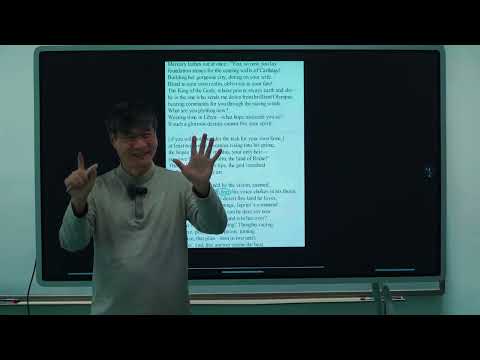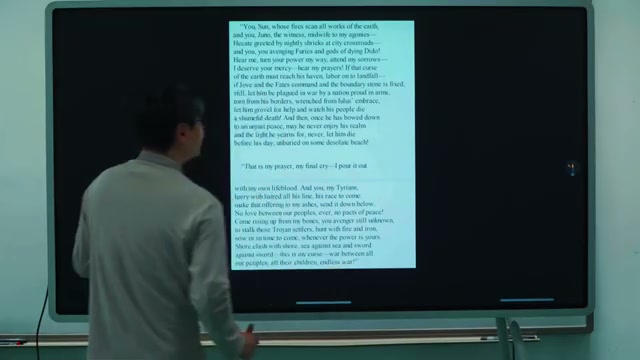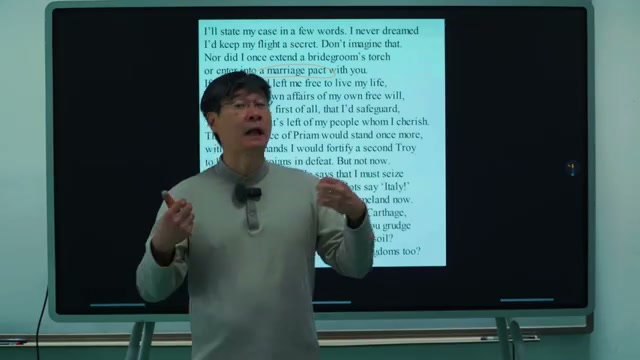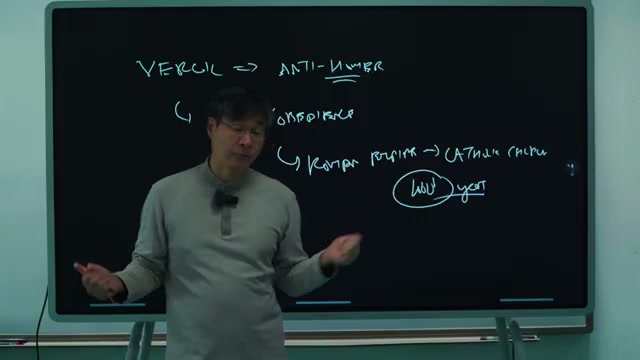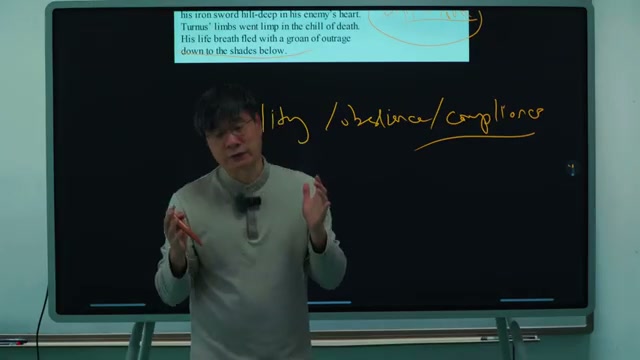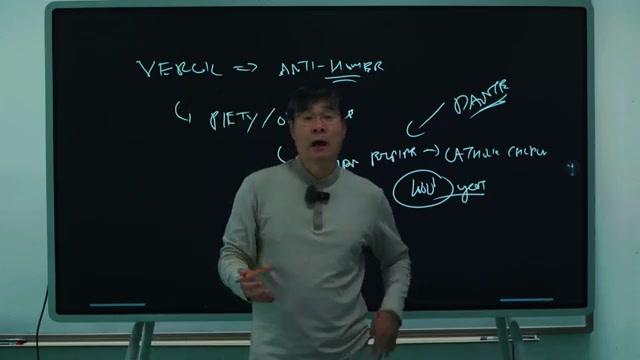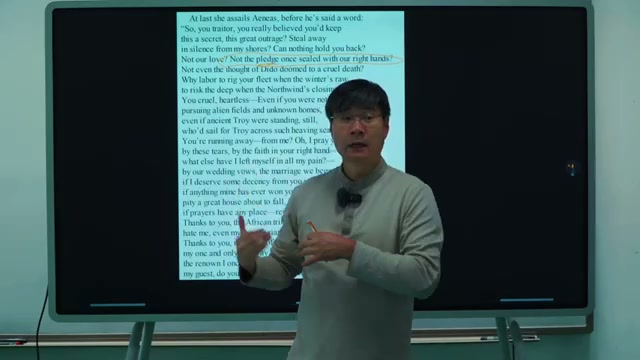
The entire lecture is structured around a stark Homer vs. Virgil binary: 'Homer believes that love is the unifying force of the universe... For Virgil, what matters is the idea of piety or obedience.' Love and piety are presented as mutually exclusive competing forces.
Creates a clean moral framework (love = good, duty = bad) that makes the Aeneid easy to condemn but oversimplifies both poets. Homer contains plenty of duty and violence; Virgil contains genuine emotional depth.
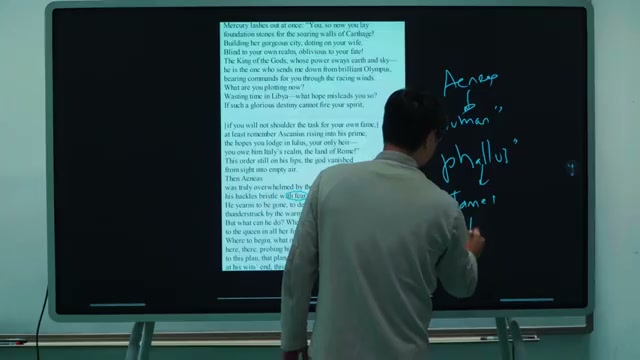
Aeneas is compared to James Bond: 'He's like James Bond man, you know? He goes around, does his mission, sleeps with a lot of girls and then runs off.'
Makes the ancient text relatable to students but trivializes Virgil's characterization of Aeneas. The comparison reduces a complex literary figure to a pop culture caricature, priming students to dismiss him.
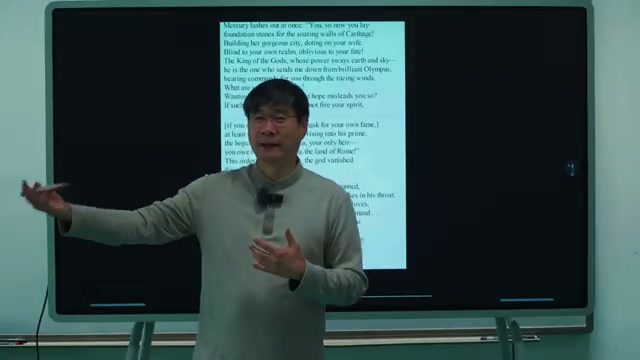
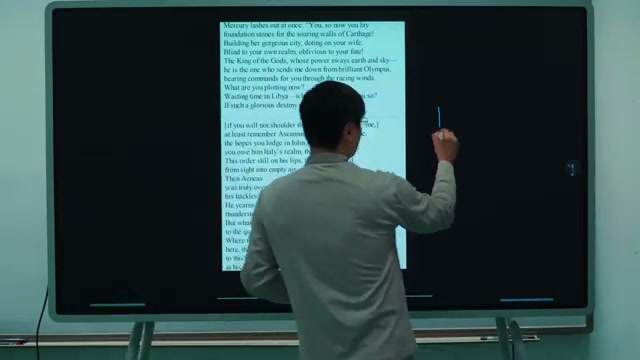
Aeneas's emotional conflict about leaving Dido is paraphrased as: 'How do I get out of here without her bitching at me?'
Uses crude modern language to strip Aeneas's dilemma of dignity, reinforcing the speaker's thesis that Aeneas is emotionally shallow. The actual text describes genuine anguish ('thunderstruck by the warnings'), which the paraphrase erases.
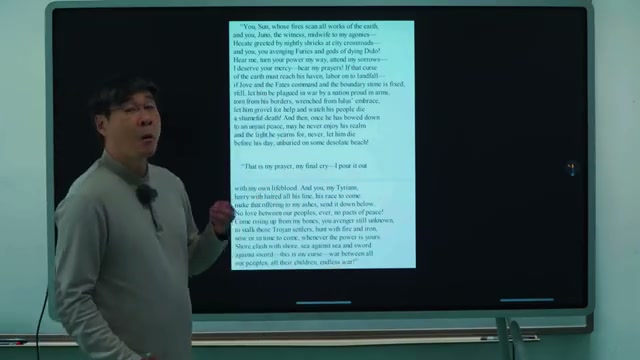
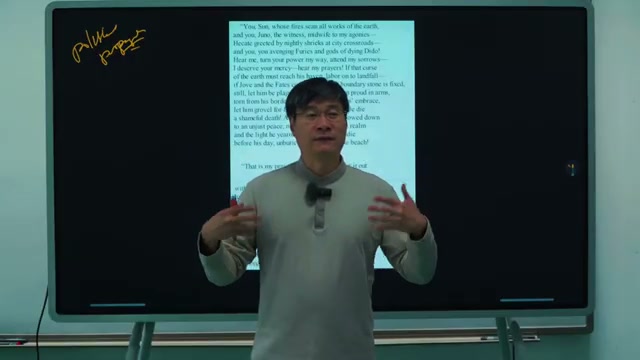
The Aeneid is repeatedly labeled 'political propaganda,' 'brainwashing,' and 'indoctrination' — terms that carry strongly negative connotations and preclude sympathetic reading.
Forecloses the possibility of reading the Aeneid on its own terms or finding genuine literary merit in it. Once labeled 'propaganda,' any beauty or insight in the text can be dismissed as manipulation.
Dismissal of student counterargument
00:50:08
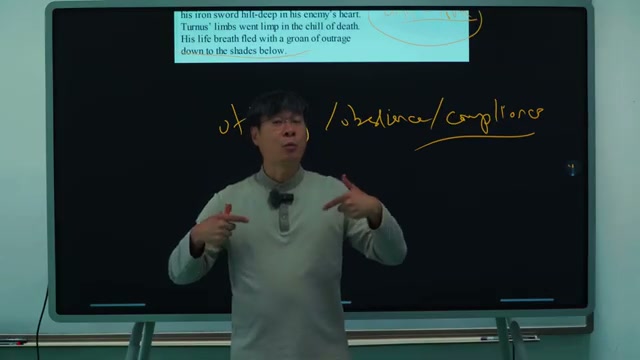
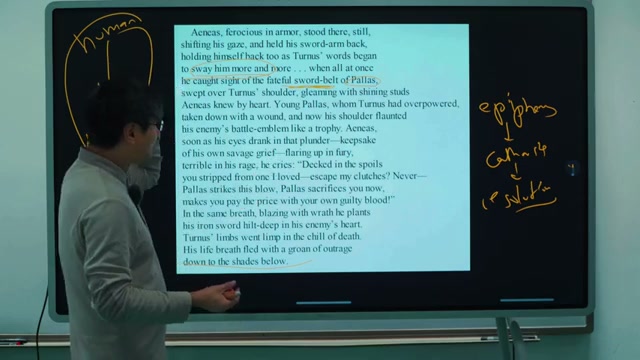
When a student raises a thoughtful point — that Aeneas killing Turnus is driven by love for Pallas, not pure robotic duty — the speaker responds: 'By asking this question, what you're really doing is revealing the sort of education you've received' and 'you've been brainwashed.'
Shuts down legitimate intellectual inquiry by pathologizing the questioner rather than engaging the argument. The student's point is actually a strong one that many scholars have made, but it is dismissed as evidence of ideological contamination.
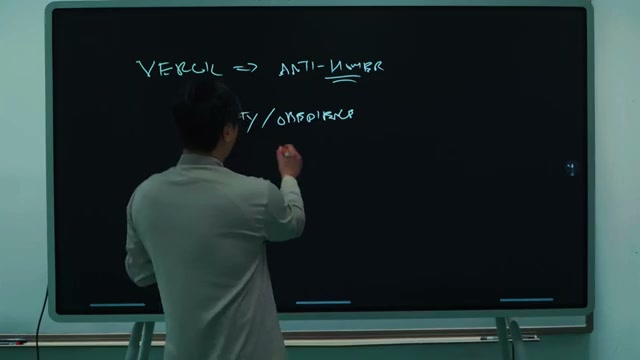
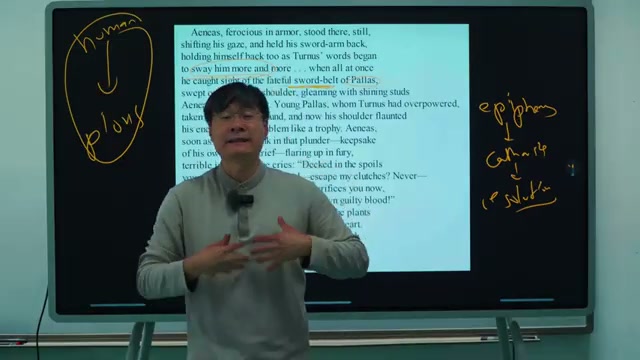
The speaker traces a sweeping arc from the Aeneid to the Roman Empire to the Catholic Church to a 'thousand years of stagnation' to Dante's liberation of the imagination — presented in under two minutes as established fact.
Creates a compelling teleological narrative that makes the speaker's interpretive framework seem like historical inevitability. The speed and confidence of delivery discourages questioning of any individual link in the chain.
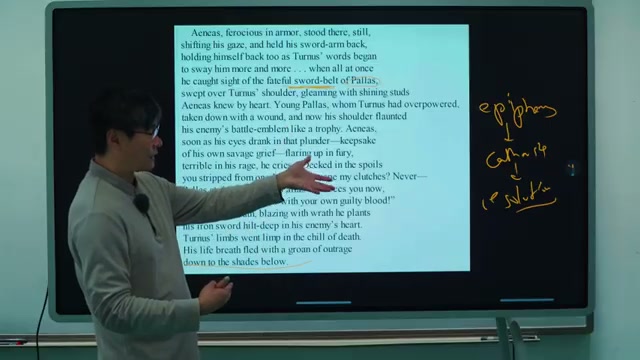
'Scholars are confused by this ending... the answer is because you're misreading the Aeniad. First and foremost, it is a work of political propaganda.'
Positions the speaker as possessing superior insight that eluded professional scholars. The implication that generations of classicists simply 'misread' the text flatters the students (they'll get the 'right' reading) while asserting the speaker's authority over the scholarly mainstream.
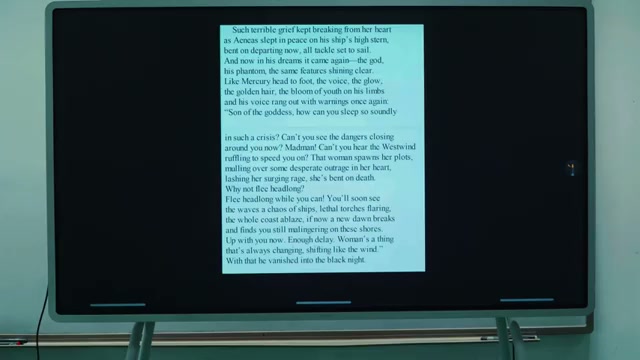
The speaker interprets 'Aenias slept in peace on his ship's high stern' as proof that 'he doesn't care... he was never in love with her. She was just a plaything.'
Extracts a single line and gives it maximum negative interpretation to support the thesis. The passage could equally be read as showing Aeneas's hard-won resolution after emotional torment, or as Virgil's ironic juxtaposition of his calm against Dido's agony.
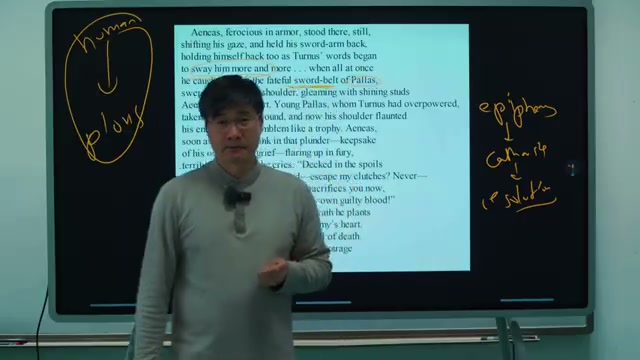
Throughout the lecture, the speaker asks questions ('Does that make sense?', 'Okay?', 'Do you understand?') that function not as genuine inquiries but as rhetorical checks that assume agreement.
Creates the appearance of dialogic teaching while actually reinforcing a single interpretation. The constant 'Okay?' functions as a conversational pressure to agree rather than an invitation to disagree.
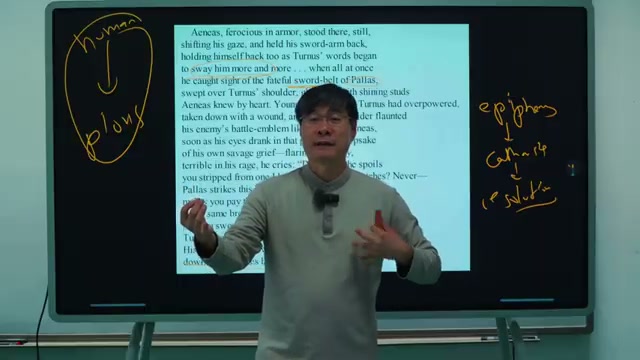
'If you truly love someone, love means that you cannot do something evil. Love is pure good. If you do something evil, it means you actually don't love that person.'
Presents a specific philosophical position on the nature of love as self-evident truth, foreclosing debate. This is actually a contested theological and philosophical claim, but it is stated as axiom to support the reading that Aeneas's killing of Turnus proves his lovelessness.
claim
Dante's Divine Comedy destroyed the Roman Empire and the Catholic Church by liberating the human imagination.
unfalsifiable
This is a literary-philosophical interpretation, not a factual historical claim. The fall of the Western Roman Empire preceded Dante by nearly 800 years. The Catholic Church continues to exist. The claim that the Divine Comedy 'destroyed' these institutions is metaphorical.
claim
The Catholic Church ruled for over a thousand years during a time of conformity and stagnation (the Dark Ages), with Virgil as its central organizing intellectual force.
partially confirmed
The Aeneid was indeed central to medieval education and Virgil was revered (Dante himself placed Virgil as his guide). However, characterizing the entire medieval period as 'conformity and stagnation' (the 'Dark Ages') is rejected by modern medievalists, who recognize significant intellectual, technological, and cultural developments throughout the period.
claim
Every elite child in the medieval period memorized the Aeneid, making Virgil the 'god of the Catholic Church.'
partially confirmed
Virgil was indeed the most widely read classical author in medieval education and was central to the curriculum. However, calling him 'the god of the Catholic Church' is hyperbolic — the Bible, Church Fathers, and theological works were primary. Virgil's prominence was real but not singular.
claim
In the Carthaginian understanding, Dido killed herself to avoid submission to local warlords, and this sacrifice emboldened her people and won the respect of neighboring tribes.
partially confirmed
Ancient sources (Justin's Epitome of Pompeius Trogus) do record a version where Dido chose death rather than marriage to the Libyan king Iarbas, and this was understood as an act of fidelity and pride. The speaker's account broadly aligns with this tradition, though the details are simplified.
claim
Students have been 'brainwashed' by an education system that teaches utility and compliance rather than love, which prevents them from understanding Homer and Dante.
unfalsifiable
This is a normative philosophical claim about education that cannot be empirically tested.
BUILDS ON
- Great Books #1-7 (implied): Previous lectures covering Homer's Iliad and Odyssey, which are constantly referenced as the baseline against which Virgil is measured.
- The speaker references 'as we discussed' regarding Virgil as the 'anti-Homer' and the love vs. piety conflict — material from a previous Great Books lecture.
- The Achilles-Patroclus-Priam narrative from earlier Iliad lectures is assumed as background knowledge.
- The Odysseus-Penelope reunion and the bow of Odysseus from earlier Odyssey lectures are referenced as known material.
This lecture is part of the 'Great Books' series, which operates differently from the geopolitical series (Geo-Strategy, Game Theory, Civilization). It is a genuine university literature class focused on close reading of canonical texts. However, the speaker's interpretive framework — that great literature is primarily a tool of political power, that empires use narrative to control populations, that 'brainwashing' is the default mode of education — aligns closely with the ideological framework of the geopolitical lectures. The Great Books series appears to provide the philosophical foundation for claims made in other series about how civilizations use narrative, education, and ideology to maintain power. The anti-Virgilian stance (Virgil as imperial propagandist) connects to the broader channel thesis that Western empires use propaganda to justify their expansion.