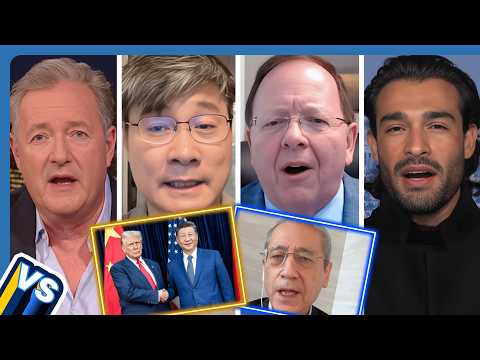
Framing the US strike on Iranian nuclear sites as ‘an act of war’ while declining to apply the same label to Iranian missile strikes on Gulf targets.
Asymmetric moral weight: American action becomes legally and normatively charged, while comparable Iranian action is framed as retaliation or defense.
Motive-attribution / hidden-hand framing
00:31:20
‘The real goal is to strangle China by making Europe and Asia depend on North American energy.’
Shifts debate from observable US actions to inferred hidden intent, which is unfalsifiable and forces opponents to prove a negative.
Invoking Vietnam as a template for any US ground commitment in Iran.
Transfers the emotional and political weight of Vietnam's failure onto a scenario that has not yet occurred, bypassing analysis of the disanalogies (Iran's terrain, population density, insurgency structure, US force posture).
When Chang cites US intelligence on Iranian enrichment, Jiang responds by characterizing American media as propaganda-saturated.
Discounts the source wholesale rather than engaging the specific evidentiary claim; it is cheap when applied to rivals but Jiang does not extend the analysis to Chinese state media.
Credential-adjacent positioning
00:14:20
Accepting the ‘Professor’ honorific in framing while elsewhere acknowledging that he is actually a high school teacher and that the title is internet convention.
Borrows the authority of an academic framing for a commentator position; the occasional disclosure provides plausible deniability without removing the ambient credibility boost.
Presenting the JCPOA as a functioning deal that Trump threw away, without engaging the post-2019 Iranian enrichment record.
Creates a clean ‘peace was available and you chose war’ narrative and avoids the harder question of whether the JCPOA would have held absent US renewal.
Speaking for ‘the Chinese people’ and ‘the Iranian people’ as unitary actors with discernible collective preferences opposed to US policy.
Occludes internal dissent in both societies and treats regime positions as if they were organically popular.
Emphasizing that he is willing to debate Chang on camera as proof of Chinese intellectual openness relative to American elite discourse.
Uses a specific diaspora-friendly venue (an English-language podcast) to stand in for the Chinese information environment, which does not permit equivalent debate on Tiananmen, Xinjiang, Tibet, or Xi.
Minimizing Iranian or Chinese regime repression by comparing it to what he frames as American imperial violence abroad.
Whataboutism shifts the axis of evaluation from the specific behavior under discussion to a global ledger where the US almost always loses.
Urging a long-horizon view (‘five to ten years’, ‘civilizations measure in centuries’) against Chang's near-term metrics.
Makes near-term disconfirming evidence look impatient and lets long-horizon predictions remain comfortably untested within the debate.
prediction
The United States will be compelled to send ground troops into Iran to actually end the nuclear program, because air power alone cannot do it.
untested
As of May 1, 2026, no US ground troops in Iran — war remains air/missile + maritime blockade (extended indefinitely Apr 22). Apr 30 Cooper/Caine briefing was the FIRST cabinet-level formal presentation of military options including Hormuz seizure that 'could include ground forces' and special-forces uranium recovery — first material upward shift since war began (LOW-BUT-NON-ZERO). However, Trump has not ordered ground action; USS Ford leaving theatre after 309-day record; only 192nd MP Battalion (~150 NG, logistics) mobilized. The prediction remains live and the Apr 30 escalation modestly increases its probability, but execution has not occurred. [June 1, 2026 update] The prediction remains live, but the near-term trajectory is de-escalation toward a 60-day ceasefire MOU, not ground commitment. As of June 1, 2026 (Day 95) there are still ZERO US ground troops in Iran. Since the Apr 30 Cooper/Caine cabinet briefing that first put ground-inclusive options on the table, the trajectory reversed toward de-escalation: through late May US and Iranian negotiators reached a tentative 60-day ceasefire MOU (Iran pledging never to develop or purchase a nuclear weapon; a negotiated Hormuz reopening with no tolls + Iranian mine-clearing + proportional blockade lift), pending final approval by Trump and Mojtaba Khamenei -- not signed as of June 1 (Trump requested edits May 31 rather than signing). The principal US instrument remains the naval blockade (CENTCOM: ~118 vessels redirected + 5 disabled). The named deal-failure alternative is an air/strike package ('end it a different way'; Hegseth at the Shangri-La Dialogue: 'more than capable' of resuming strikes), not a ground order. No new ground-deployment order, no third ARG, no draft. Israel's capture of Beaufort Castle in Lebanon (May 31) is an Israeli ground operation in Lebanon, NOT US ground troops in Iran.
prediction
If ground troops are sent, the United States will be stuck in Iran for ten years in a Vietnam-style quagmire.
untested
Conditional on ground deployment, which has not occurred. Cannot be evaluated until the antecedent obtains. [June 1, 2026 update] The prediction remains live, but the near-term trajectory is de-escalation toward a 60-day ceasefire MOU, not ground commitment. As of June 1, 2026 (Day 95) there are still ZERO US ground troops in Iran. Since the Apr 30 Cooper/Caine cabinet briefing that first put ground-inclusive options on the table, the trajectory reversed toward de-escalation: through late May US and Iranian negotiators reached a tentative 60-day ceasefire MOU (Iran pledging never to develop or purchase a nuclear weapon; a negotiated Hormuz reopening with no tolls + Iranian mine-clearing + proportional blockade lift), pending final approval by Trump and Mojtaba Khamenei -- not signed as of June 1 (Trump requested edits May 31 rather than signing). The principal US instrument remains the naval blockade (CENTCOM: ~118 vessels redirected + 5 disabled). The named deal-failure alternative is an air/strike package ('end it a different way'; Hegseth at the Shangri-La Dialogue: 'more than capable' of resuming strikes), not a ground order. No new ground-deployment order, no third ARG, no draft. Israel's capture of Beaufort Castle in Lebanon (May 31) is an Israeli ground operation in Lebanon, NOT US ground troops in Iran.
prediction
The Gulf Cooperation Council (GCC) may not survive this war as a functioning bloc.
untested
GCC remains formally intact as of 2026-04-19. Saudi-UAE tensions over Iran policy are reported but no dissolution or major withdrawal has occurred. Calibration reference notes GCC strain but not collapse.
claim
America's grand strategy is to strangle China economically by making Europe and East Asia energy-dependent on North America.
unfalsifiable
An attribution-of-motive claim about hidden US strategic intent. Not directly falsifiable from open sources; some observable consequences (LNG flows, Gulf instability) are consistent with but do not uniquely confirm this intent.
prediction
China will not invade Taiwan in the next five to ten years.
untested
No Taiwan invasion has occurred as of 2026-04-19. Prediction window extends to 2031-2036; remains open.
prediction
Japan would militarily intervene to prevent any Chinese move on Taiwan.
untested
Conditional on a Chinese move on Taiwan, which has not occurred. Japan's 2022 National Security Strategy signals commitment to regional defense; actual combat intervention is untested.
prediction
The Iranian regime will emerge from this war strengthened rather than weakened because foreign bombing produces rally-around-the-flag effects.
partially confirmed
The claim that bombing produces rally effects is supported by open-source reporting of Iranian demonstrations pivoting from anti-regime to anti-invasion framing after June 2025 strikes (noted by Talabani and Ahmari in this same episode). However, with Khamenei assassinated (per calibration reference) and succession unresolved, 'strengthened' is only partially supported; the regime is cohering militarily while losing elite leadership.
claim
The Obama-era JCPOA was working and containing Iran's nuclear program successfully.
contested unresolved
IAEA verification during JCPOA years (2016-2018) did show Iran was within stockpile and enrichment limits. Whether this constituted 'working' depends on whether one scopes success to enrichment caps (supportive) or to regional behavior and sunset clauses (critical). Non-fringe actors argue both sides; open-source evidence does not cleanly resolve the normative claim.