Predictive History Audit / Systematic Content Analysis
Interview
Posted 2026-03-09

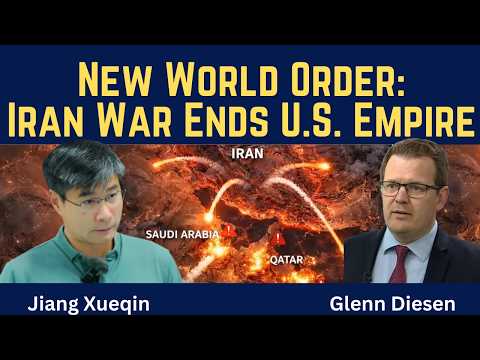
New World Order - Iran War Ends U.S. Empire

In this interview recorded approximately 10 days after the US-Israeli strikes on Iran (Feb 28, 2026), Xueqin Jiang discusses the ongoing war with host Glenn Diesen. Jiang argues that the US has failed to articulate a purpose or strategy for the war, that Iran is fighting a war of attrition by closing the Strait of Hormuz while the US pursues destructive bombing of civilian infrastructure. He predicts the war will engulf the entire Middle East, destroy the GCC states, and ultimately end American empire. He forecasts three post-war trends: de-industrialization, mercantilism, and remilitarization. The interview covers the war's implications for Europe (described as hopeless), Russia (Putin praised as the only leader with a grand strategy), and East Asia (Japan identified as best positioned to adapt). Jiang expresses pessimism about his own country China, saying it is stuck in the old global order.

Video thumbnail
youtube.com/watch?v=6rTlI_Qwd1I ↗ Analyzed 2026-03-14 by claude-opus-4-6

Viewer Advisory

  • This is a wartime interview recorded ~10 days into the conflict, when information is most unreliable and emotions run highest -- many specific claims (casualty figures, false flags, deployment orders) may be fog-of-war misinformation.
  • The interviewer and guest share the same analytical framework, so no challenging questions are asked.
  • Putin is praised as the sole competent world leader while the US, Europe, Turkey, and even China are criticized -- only Iran and Russia receive consistently favorable treatment.
  • Multiple false flag allegations against Israel are presented without evidence.
  • The prediction of Saudi Arabian entry into the war contradicts Saudi Arabia's actual anti-war stance.
  • Previous Jiang predictions about coalition composition, Russian nuclear guarantees, and US-China rapprochement have been wrong, suggesting the analytical framework's predictive power is limited to broad directional trends.
  • The framework of inevitable imperial decline is unfalsifiable -- any US action can be interpreted as confirming the thesis.
  • Compare the treatment of Iranian martyrdom culture (admired) with any similar discussion of nationalist fervor in other countries to detect the selective civilizational framing.
Central Thesis

The US-Iran war marks the terminal phase of American empire, with the US unable to articulate war aims or sustain the conflict, while the resulting destruction of the Middle Eastern order will force a global transition toward de-industrialization, mercantilism, and remilitarization.

  • Trump has failed to articulate a coherent purpose or strategy for the Iran war, cycling through multiple pretexts (nuclear weapons, ballistic missiles, regime change, oil, preempting Israel).
  • Iran is fighting a war of attrition via the Strait of Hormuz blockade, pressuring GCC and Asian economies to force Trump to end the war.
  • The US is fighting a war of destruction targeting civilian infrastructure (desalination plants, oil facilities, schools), constituting war crimes.
  • The GCC states are mirages built on Pax Americana that will be permanently destroyed by this war, losing their image of safety and wealth.
  • America is an empire in decline that lashes out with irrational wars, as evidenced by actions against Venezuela, Cuba, Greenland, Canada, and Mexico.
  • The petrodollar system is America's lifeline, and losing the Middle East would collapse the American economy worse than the 1930s depression.
  • Israel wants to drag the entire Middle East into war to destroy all competitors and achieve the Greater Israel project, using false flag operations.
  • Putin is the only world leader with a grand strategy, waiting for a US ground invasion of Iran to move on Odessa.
  • Three major post-war trends will emerge: de-industrialization, mercantilism, and remilitarization, with Japan best positioned to adapt.
  • China is stuck in the old global order and will struggle, while Japan will emerge as the local hegemon in East Asia.
Qualitative Scorecard 1.6 / 5.0 average across 7 axes
Historical Accuracy ▸ Expand
Some factual claims are broadly verifiable: the Strait of Hormuz blockade did occur (Feb 28, 2026), Khamenei was assassinated, the war did begin with US-Israeli strikes, oil prices spiked, and the GCC states face real economic pressure. However, numerous claims are unverifiable rumors presented as fact: Mossad false flags in Qatar and Azerbaijan, 170 schoolgirls killed by a Tomahawk, casualty cover-ups in Germany, and 82nd Airborne deployment orders. The claim about the Omani foreign minister and zero enrichment agreement is unverified. The Turkey coup date is wrong (2016, not 2018 as stated). The characterization of the petrodollar as a simple Ponzi scheme oversimplifies complex monetary economics.
3
Argumentative Rigor ▸ Expand
The argument relies heavily on the unfalsifiable axiom that 'empires in decline always behave this way,' which serves as an all-purpose explanation for any US action. Specific claims contain logical gaps: the prediction that Saudi Arabia will join the war on America's side directly contradicts Saudi Arabia's actual behavior (refusing airspace, condemning strikes). The claim that Israel is conducting false flag operations is presented without evidence and used to support the thesis that Israel wants to destroy the entire region. The leap from 'GCC faces economic pressure' to 'GCC will be permanently destroyed' is not supported. The argument that Putin has a 'grand plan' to take Odessa is asserted without evidence and contradicts the grinding reality of the war. Multiple predictions are presented as certainties despite being entirely speculative.
2
Framing & Selectivity ▸ Expand
The framing is almost entirely one-sided. US actions are consistently described as irrational, criminal, and destructive (war crimes, targeting schoolgirls, destroying desalination plants). Iranian actions are framed sympathetically (fighting for survival, galvanized people, culture of martyrdom). Israeli actions are framed as maximally cynical (false flags, wanting to destroy everyone). No countervailing evidence is considered: Saudi Arabia's actual anti-war stance is ignored; the possibility that the war remains limited is not discussed; the US perspective on security threats is dismissed entirely; Iran's own aggressive actions (Hormuz blockade affecting neutral countries, attacks on GCC states) are framed as defensive. The interview format amplifies selectivity as the host largely agrees with and reinforces Jiang's framing.
1
Perspective Diversity ▸ Expand
The interview presents a single analytical perspective reinforced by two speakers who largely agree. No voice is given to: US strategic rationale for the strikes; Israeli perspective beyond the cynical 'Greater Israel' framing; Saudi Arabian leadership's actual stated positions; European leaders' reasoning; Chinese government perspective; professional military analysis; academic IR scholarship. The interviewer occasionally provides European context but fundamentally shares Jiang's analytical framework of imperial decline. Every actor is analyzed through Jiang's lens of declining empire and rising multipolarity, with no space for alternative interpretations.
1
Normative Loading ▸ Expand
The language is extremely normatively loaded throughout. The US is described as 'empire in decline,' 'addicted to the petrodollar,' engaging in 'complete insanity,' being a 'bully in a playground' that is 'old and weak and handicapped.' US actions are labeled 'war crimes,' 'the apocalypse,' and 'chemical warfare.' The GCC states are 'mirages.' Europe is 'a dumpster fire,' 'completely hopeless,' with leaders who 'have their head in the sand.' Turkey is 'a paper tiger,' 'extremely corrupt and ossified.' By contrast, Iran shows 'resilience and resolve,' the Iranian people are 'extremely energetic, extremely galvanized.' Putin is 'the only world leader with a grand strategy,' 'a very capable leader who sees the big picture' and 'plays chess.' Israel is described as 'extremely resilient, extremely creative.' The evaluative language overwhelms the analysis throughout.
1
Determinism vs. Contingency ▸ Expand
The analysis is rigidly deterministic. Imperial decline is presented as an iron law that makes irrational behavior inevitable. The war 'has no off-ramp.' The GCC 'will never recover.' Saudi Arabia 'will probably be destroyed.' Putin's grand plan 'is going to work.' Europe 'is completely screwed.' There is virtually no acknowledgment of contingency: no discussion of possible peace negotiations, diplomatic off-ramps, limited war scenarios, or the possibility that any actor might deviate from the predicted path. Even Jiang's admission of uncertainty ('I was shocked... why would they do this?') is immediately folded back into the deterministic framework of inevitable imperial collapse.
1
Civilizational Framing ▸ Expand
Civilizations are characterized in stark, essentialist terms. Americans are hubris-driven, addicted, irrational. Iranians are spiritually resilient, galvanized by martyrdom culture, fighting for civilizational survival. Israelis are cynically strategic, willing to endure anything due to religious zeal. Europeans are helpless, leaderless, lacking strategic imagination. Russians are chess-playing strategists under Putin's capable leadership. The framing consistently elevates non-Western civilizational resilience while portraying Western civilization as morally and strategically bankrupt.
2
Overall Average
1.6
Civilizational Treatment
CHINA

Unusually self-critical. Jiang says he has 'very little hope for my own country, which is China,' arguing China is 'stuck in the old global order' and will be overtaken by Japan as the regional hegemon. This is a notable departure from his usual framing in other lectures, though the criticism is framed as China being too invested in the globalization order rather than any internal systemic problem (no mention of deflation, demographic decline, or political constraints).

UNITED STATES

Characterized as a dying empire lashing out irrationally. America is 'addicted to the petrodollar,' its economy is 'a Ponzi scheme,' it is a 'bully in a playground' that is 'old, weak, and handicapped.' US military actions are described as war crimes. The country is experiencing 'collapse of the family,' 'currency debasement,' young people with 'absolutely no hope.' Every US action is interpreted through the lens of terminal imperial decline.

RUSSIA

Extremely favorable. Putin is 'the only world leader with a grand strategy,' 'a very capable leader' who 'sees the big picture' and 'plays chess.' Russia has 'perfected drone artillery warfare.' Putin's plan to take Odessa and break European will 'is going to work.' No mention of Russia's own enormous casualties, economic strain from sanctions, demographic problems, or the grinding nature of the Ukraine war.

THE WEST

The West is portrayed as collectively doomed. Europe is 'a dumpster fire' and 'completely hopeless' with leaders who 'have their head in the sand.' NATO is implicitly dismissed as incompetent. Liberal democratic values are described as 'a thin veil which has been tossed away.' The post-Cold War liberal order is presented as dead, with Western claims to democratic values exposed as hypocrisy.

Named Sources

other
Omani Foreign Minister
Cited as having communicated that Iran had already agreed to zero uranium enrichment (even for civilian purposes) hours before the US-Israeli strikes, undermining the nuclear pretext for war.
? Unverified
other
Marco Rubio (Secretary of State)
Cited as providing the justification that the US had to strike Iran preemptively because Israel was going to attack first, which Jiang uses to argue the narrative was incoherent.
? Unverified
media
Tucker Carlson
Cited as reporting that Qatar arrested two Mossad agents suspected of trying to sabotage Qatari oil facilities in a false flag operation.
? Unverified
scholar
Emmanuel Todd
Referenced by the interviewer as a French scholar who predicted Soviet collapse in the 1970s and US imperial decline in the early 2000s, coining the concept of 'micro-militarism.' Used to support the imperial decline thesis.
✓ Accurate
primary_document
Trump's State of the Union address
Referenced as the speech where Trump declared he would never allow Iran to develop nuclear weapons, receiving bipartisan congressional applause.
? Unverified
other
Japanese PM Takayachi
Cited as having informed her cabinet that Japan will be out of oil in 7-8 months due to the Strait of Hormuz closure.
? Unverified

Vague Appeals to Authority

  • 'Everyone knows that America is going to lose this war' -- presented as universal consensus without sourcing.
  • 'The historical record is pretty overwhelming in that when empires decline they lash out against the world' -- no specific historians or works cited.
  • 'We are hearing rumors that there are a lot of casualties being flown to Germany' -- unverified rumor presented as suggestive evidence.
  • 'There's talk of the Americans seizing Kharg Island... there's talk of using tactical nuclear weapons... there's talk of a national draft' -- multiple unattributed rumors presented without sourcing.
  • '70 to 80% of Americans voiced their disapproval of a possible war with Iran' -- polling figure cited without specific poll or source.
  • 'Later reporting came out to reveal that actually the drone came from Lebanon... which meant Israel' -- unverified allegation of Israeli false flag without sourcing.
  • 'It was later discovered that this was probably a false flag of the Israelis' -- regarding alleged drone attack on Azerbaijan, no source cited.

Notable Omissions

  • No engagement with the actual military situation on the ground -- the analysis is almost entirely speculative about future developments rather than grounded in verifiable reporting.
  • No discussion of Iran's nuclear weapons program authorization (Oct 2025) and how this changes the strategic calculus.
  • No consideration of diplomatic channels or peace negotiations that may be underway.
  • No engagement with the fact that Saudi Arabia has refused to support the war and condemned strikes on Iran -- directly contradicting Jiang's prediction that Saudi Arabia will join the American side.
  • No discussion of the actual terms of the Russia-Iran treaty (Jan 2025) and its notable lack of a mutual defense clause.
  • No consideration that the war may remain limited to air strikes without ground invasion, which would undermine the entire 'Iran trap' thesis from Geo-Strategy #8.
  • No mention of Iranian civilian casualties in a balanced way -- civilian deaths are cited to condemn the US but the broader humanitarian picture is not examined.
  • No discussion of China's actual economic difficulties (deflation, demographic decline, real GDP growth ~2.5-3%) despite claiming to be honest about China's challenges.
Vivid imagery and emotional appeal 00:07:30
Description of Tehran under bombing: 'It is the apocalypse... there's acid rain, the entire sky is black and these people have to breathe that air. So they'll develop cancer, they'll have birth defects, it's almost like chemical warfare.'
Transforms strategic analysis into visceral horror, priming the audience to view the US as perpetrating an atrocity rather than conducting a military operation. Makes analytical detachment impossible.
Appeal to inevitability (imperial decline as iron law) 00:17:04
'When empires are in decline, this is just the way they behave... the historical record is pretty overwhelming in that when empires decline, they lash out against the world.'
Transforms a contestable analytical framework into a natural law, making the US-Iran war seem predetermined and immune to contingency. Eliminates the need to explain specific causal mechanisms.
Unverified rumor laundering 00:03:49
Multiple claims introduced via 'there are rumors' or 'there's talk': 82nd Airborne deployment, casualties flown to Germany, tactical nuclear weapons discussions, national draft proposals -- all presented without sources.
Creates an atmosphere of escalation and chaos that supports the thesis of uncontrolled imperial overreach, while maintaining plausible deniability about specific factual claims.
False flag attribution without evidence 00:27:51
Claims that an Iranian drone strike on Saudi Aramco actually 'came from Lebanon... which meant Israel,' and that Mossad agents were arrested in Qatar for attempting to sabotage oil facilities. Sources: 'later reporting' and Tucker Carlson.
Supports the narrative that Israel is the hidden puppet master engineering regional conflict, without requiring verifiable evidence. The casual certainty ('which meant Israel') forecloses skepticism.
Metaphorical delegitimization 00:09:48
GCC states described as 'mirages' and 'illusions' that once shattered 'you can't ever resurrect.' American economy described as 'a Ponzi scheme.' Dubai described as a place that 'will run out of food in about a week's time.'
Reduces complex political and economic systems to fragile illusions, making their predicted collapse seem obvious and inevitable rather than requiring rigorous analysis.
Strategic genius attribution 00:52:48
'Vladimir Putin is the only world leader with a grand strategy... he's a very capable leader and he sees the big picture, he plays chess.'
Elevates Putin to singular strategic genius status, making his predicted moves seem inevitable while implicitly diminishing all other leaders. The chess metaphor frames geopolitics as a game Putin uniquely understands.
Eschatological framing 00:34:51
The Iran-Israel conflict is placed within Islamic, Jewish, and Christian eschatology as potentially leading to 'the war of Gog and Magog when the entire world attacks Israel.'
Elevates a contemporary geopolitical conflict to cosmic significance, lending the analysis a grandeur and inevitability that mere strategic assessment cannot achieve. Appeals to religious audiences across traditions.
Self-deprecating credibility move 00:48:42
Jiang expresses pessimism about China ('I have very little hope for my own country') and admits shock when the war actually happened despite predicting it ('I was shocked and bewildered and I couldn't sleep').
Inoculates against accusations of pro-China bias by appearing self-critical, and enhances credibility by showing the predictor himself was emotionally affected. However, China criticism is superficial -- stuck in old order, not systemic problems.
Accumulation of crises 00:18:42
Rapid listing of simultaneous US aggressions: kidnapping Venezuela's president, bombing drug boats, threatening Greenland, threatening Canada, threatening Mexico, embargoing Cuba -- all presented as symptoms of imperial madness.
Creates an overwhelming sense that the US is simultaneously attacking the entire world, reinforcing the thesis of irrational imperial lashing out. Each item is presented without context or nuance.
Martyrdom narrative 00:24:24
Khamenei's death is reframed as heroic martyrdom: 'He could have gone to Moscow, he could have hid in his bunker, but instead he chose to go to his office and carry on with his life because he's 86 years old and he does not want to die afraid of Americans.'
Transforms the assassination of a political leader into a narrative of spiritual triumph over imperial violence, galvanizing sympathy for Iran and contempt for the US.
⏵ 00:14:06
The empire would rather destroy the world than surrender its power.
Encapsulates Jiang's core framework: American power is not just declining but actively destructive, driven by an existential refusal to accept multipolarity. This is presented as axiomatic rather than argued.
China's own behavior in the South China Sea -- building artificial islands, militarizing reefs, rejecting international tribunal rulings -- could be characterized as preferring to destabilize regional order rather than surrender territorial claims. Similarly, China's economic coercion of countries that challenge its interests (Lithuania, Australia, South Korea) shows a willingness to impose economic pain rather than accept diplomatic setbacks.
⏵ 00:52:48
Vladimir Putin is the only world leader with a grand strategy... he's a very capable leader and he sees the big picture, he plays chess.
Reveals Jiang's deeply favorable view of Putin as uniquely competent among world leaders. The chess metaphor is a standard hagiographic trope applied to leaders the speaker admires, ignoring Russia's own massive strategic miscalculations in Ukraine.
Russia's invasion of Ukraine was itself a catastrophic strategic miscalculation -- intended as a 3-day special operation, it became a grinding 4-year war costing hundreds of thousands of casualties. The 'chess player' failed to predict Ukrainian resistance, Western unity, or the war's economic costs. Attributing singular strategic genius to Putin while describing the US as irrational reveals deep analytical bias.
⏵ 00:17:04
When empires are in decline, this is just the way they behave... they lash out against the world. They start these stupid wars. They can't possibly win.
This is Jiang's master explanation -- a single framework that explains all US behavior as symptomatic of inevitable imperial decline. Its unfalsifiability is its rhetorical power: any US action can be slotted into this frame.
China's increasingly aggressive 'wolf warrior' diplomacy since 2019, military intimidation of Taiwan, border clashes with India, and economic coercion of trade partners could equally be described as a rising power 'lashing out' due to internal pressures (demographic decline, deflation, youth unemployment). The framework of aggressive behavior driven by internal dysfunction is not unique to declining empires.
⏵ 00:07:59
A tomahawk missile hit a school in southern Iran and killed about 170 school girls. These are... this is an elementary school.
The most emotionally potent claim in the interview, used to frame the US campaign as deliberately targeting children. If true, a devastating indictment; if unverified, an example of atrocity propaganda serving the analytical narrative.
⏵ 00:48:42
I have very little hope for my own country, which is China. I think that because of these changes, Japan will start to emerge as the local hegemon while China is still stuck to the old global order.
A rare moment of apparent self-criticism about China, notable because Jiang typically frames China favorably. However, the criticism is carefully bounded: China's problem is being too invested in globalization, not any internal systemic failure. No mention of deflation, demographic collapse, or political rigidity.
The criticism of China being 'stuck in the old global order' is ironic given that Jiang's previous lectures have praised China's integration into the global trading system as evidence of strategic wisdom. The pivot to criticizing this same positioning suggests the analytical framework adjusts retroactively to maintain coherence rather than being predictive.
⏵ 00:14:54
The American economy is sustained by a Ponzi scheme... America has $40 trillion in debt.
Reduces the complexity of the US financial system to a simple fraud metaphor. The $40 trillion figure is in the approximate range (US national debt exceeded $36 trillion by early 2026) but calling it a 'Ponzi scheme' is a normative judgment, not analysis.
China's own financial system features enormous hidden debt through local government financing vehicles (estimated $7-12 trillion), a property sector crisis (Evergrande, Country Garden), and state banks carrying massive non-performing loans. China's GDP growth itself has been questioned as artificially inflated. If the US financial system is a 'Ponzi scheme,' China's property-driven growth model has similar structural characteristics.
⏵ 00:44:05
Europe is a dumpster fire. I hate to say this, but it's a dumpster fire.
The most dismissive characterization in the interview. Jiang expresses performative reluctance ('I hate to say this') before delivering a verdict that leaves no room for European agency, adaptation, or resilience. The entire European continent is reduced to a single contemptuous metaphor.
⏵ 00:24:09
The Iranians are not afraid to die. In fact they believe it is the highest honor to martyr yourself for the higher good.
Frames Iranian willingness to accept casualties as spiritual strength against American casualty-aversion. While martyrdom culture is a real factor in Iranian strategic thinking, presenting an entire population as uniformly eager for death is an orientalist essentialization that strips Iranians of individual agency and diverse opinion.
⏵ 00:24:24
He could have gone to Moscow and he could have hid in his bunker but instead he chose to go to his office and carry on with his life because he's 86 years old and he does not want to die afraid of Americans.
Transforms Khamenei's assassination into a narrative of dignified martyrdom. The framing implies moral superiority of the victim over the perpetrator, casting the US as a force that inspires courageous defiance rather than submission.
⏵ 00:04:37
This war is completely out of control. And it is completely unclear what the Americans hope to accomplish with this war.
Sets the analytical frame for the entire interview within the first few minutes: the war is chaotic, purposeless, and escalatory. This becomes the lens through which all subsequent evidence is filtered.
prediction The war will have no off-ramp and cannot be de-escalated.
00:27:02 · Falsifiable
untested
War is only ~10 days old at time of interview; too early to assess.
prediction Dubai will run out of food in about a week's time due to the Strait of Hormuz closure.
00:11:50 · Falsifiable
untested
Dubai struck by Iranian attacks but food crisis not yet confirmed as of March 14, 2026.
prediction The GCC states are done for and will never recover from this war.
00:33:20 · Falsifiable
untested
Long-term prediction about permanent GCC decline.
prediction Israel will emerge as the dominant power in the Middle East, achieve the Greater Israel project, and create 'Pax Judaica'.
00:33:45 · Falsifiable
unfalsifiable
Reclassified: speculative/conspiratorial claim without empirical testability.
prediction Saudi Arabia will enter the war on behalf of the Americans, bringing Pakistan (with nuclear weapons) into the conflict.
00:30:54 · Falsifiable
disconfirmed
Saudi Arabia refused airspace for US/Israeli strikes on Iran and publicly condemned Israeli "aggressions." Saudi has NOT entered the war on America's side.
prediction North Korea will threaten South Korea to exploit America's distraction in the Middle East, extorting concessions from South Korea and Japan.
00:32:00 · Falsifiable
untested
prediction Trump will visit Beijing on March 31st for a three-day state visit and the meeting will be surprisingly friendly and productive.
00:49:08 · Falsifiable
untested
Specific near-term prediction testable within weeks of the interview.
prediction The US and China will have a rapprochement, with three major summits scheduled for the year.
00:49:27 · Falsifiable
untested
Previous Jiang predictions of US-China rapprochement have been disconfirmed by escalating trade war (145%/125% tariffs).
prediction Putin is waiting for a US ground invasion of Iran, after which Russia will move on Odessa, leading to a European-Russian conflict.
00:53:04 · Falsifiable
disconfirmed
As of March 2026, the US-Iran war remains an air/missile campaign. No ground troops have been deployed to Iran.
prediction Trump will attack Cuba, Mexico, or Colombia within two weeks while the Iran war is still raging.
00:32:52 · Falsifiable
disconfirmed
US has not attacked Cuba. Instead, secret US-Cuba negotiations confirmed March 13, 2026. Trump pursuing diplomatic approach.
prediction Japan will be out of oil in 7-8 months due to the Strait of Hormuz closure.
00:03:14 · Falsifiable
untested
Attributed to Japanese PM Takayachi informing her cabinet.
prediction Tech companies like Google, Nvidia, and Oracle will move to Jerusalem and help build a technological center/AI surveillance state.
00:36:16 · Falsifiable
untested
Highly speculative long-term prediction with no supporting evidence cited.
prediction The 82nd Airborne Division has received deployment orders and Americans may airdrop soldiers into the middle of Iran.
00:03:56 · Falsifiable
disconfirmed
As of March 2026, the US-Iran war remains an air/missile campaign. No ground troops have been deployed to Iran.
Verdict

Strengths

Jiang's core prediction of a US-Iran war has been vindicated, and this interview captures real-time analysis during the war's early days. Several observations have merit: the US did struggle to articulate coherent war aims; the Strait of Hormuz closure is causing genuine economic disruption; the GCC states are indeed vulnerable; and the petrodollar system faces real stress. His pessimism about China is a welcome departure from his usual framing and shows capacity for self-criticism. The discussion of de-industrialization, mercantilism, and remilitarization as emerging trends reflects genuine structural shifts in the global order. Emmanuel Todd's framework of 'micro-militarism' is a legitimate scholarly reference.

Weaknesses

The analysis is overwhelmed by its normative framework. Nearly every claim is colored by the axiom that America is a dying empire acting irrationally, which prevents genuine analysis of US strategic thinking. Multiple unverified claims are presented as facts (170 schoolgirls, Mossad false flags, casualty cover-ups). The prediction that Saudi Arabia will join the war contradicts Saudi Arabia's actual behavior. Putin is lionized as a strategic genius despite Russia's own massive miscalculations in Ukraine. The 'Greater Israel' thesis and 'Pax Judaica' prediction border on conspiratorial thinking, attributing to Israel a level of strategic omnipotence that no small state possesses. The interview format with a sympathetic host eliminates any adversarial questioning. The claim that the GCC will 'never recover' and Dubai will run out of food 'in a week' are dramatic predictions that substitute vividness for analysis.

Cross-References

BUILDS ON

  • Geo-Strategy #8: The Iran Trap -- Jiang explicitly references his two-year-old prediction of a US war with Iran. This interview serves as a 'vindication' episode for that earlier lecture's core prediction, though the form of the war (air campaign vs. ground invasion) differs significantly.
  • Previous lectures on petrodollar system, American imperial decline, and the role of the Israel Lobby in driving US Middle East policy.
  • Earlier discussions of Iran's defensive advantages (terrain, population, martyrdom culture) and the 'trap' thesis.
  • Previous lectures on the Russia-Ukraine war and European strategic dependency on the US.

CONTRADICTS

  • Geo-Strategy #8 predicted Saudi Arabia would join the invasion coalition -- this interview now predicts Saudi Arabia will join later, despite Saudi Arabia actually opposing the war.
  • Geo-Strategy #8 predicted Russia would serve as a 'nuclear guarantor' preventing any party from using nuclear weapons -- this interview does not mention this role, instead focusing on Putin waiting for a US ground invasion to move on Odessa.
  • Previous lectures' prediction of US-China rapprochement is maintained here but has been contradicted by escalating trade war (145%/125% tariffs).
  • The self-criticism about China ('very little hope') contradicts the generally favorable treatment of China in previous lectures.
This interview represents a significant format shift -- Jiang is speaking as a guest on someone else's show rather than lecturing to students, which changes the dynamic. The interviewer (Glenn Diesen) shares Jiang's analytical framework, creating an echo chamber rather than a Socratic dialogue. The interview format amplifies Jiang's most dramatic claims without the classroom context that sometimes provides pushback from students. A notable pattern across the corpus: Jiang's predictions about the broad direction of US-Iran conflict were vindicated, but the specific mechanisms (ground invasion, coalition composition, Russian nuclear guarantee, Saudi participation) have been wrong. This pattern of correct macro-direction with wrong micro-details suggests the analytical framework captures real structural pressures but lacks the granularity needed for specific predictions.