Predictive History Audit / Systematic Content Analysis
Interview
Posted 2026-04-13

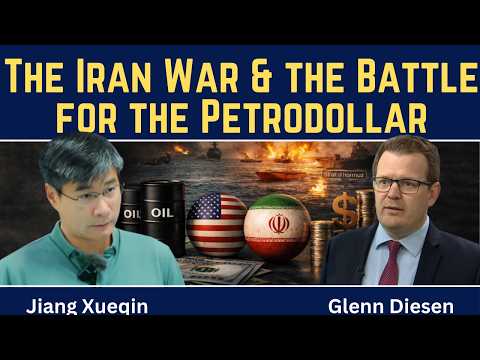
Jiang Xueqin: The Iran War & the Battle for the Petrodollar

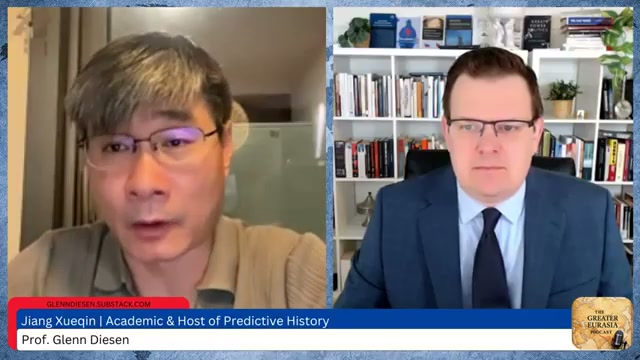
In this interview, Jiang Xueqin argues that the ongoing US-Iran war is fundamentally about maintaining the petrodollar system. He contends that the United States is deliberately destroying Middle Eastern energy infrastructure to force the world — especially China, Europe, and East Asia — to depend on North American energy, thereby sustaining demand for US treasuries and the dollar's reserve status. The discussion covers the failed Islamabad negotiations, the US naval blockade of Iran, Trump's strategy of converting the American military from a 'police force' into a 'pirate force' that extracts tolls from global trade, the globalist-versus-nationalist struggle within American politics, and the prediction that Russia will emerge as the primary challenger to American maritime supremacy. Jiang frames this as a long-term transition from a US-led 'rules-based order' to a 'Greater North America' continental fortress strategy.

Video thumbnail
youtube.com/watch?v=P_DHMUdOVdo ↗ Read time: ~11 min
Analyzed 2026-04-16 by claude-opus-4-6

Viewer Advisory

  • The petrodollar thesis is presented as self-evident but is actually a contested claim among energy economists — many argue the petrodollar's importance has been declining for decades through natural market evolution.
  • The claim that the US naval blockade is really about the Strait of Malacca has zero evidence and contradicts CENTCOM's stated operational scope.
  • Iran's own strategic choices — rejecting ceasefire offers, attacking neutral Gulf states, IRGC toll-collection through Hormuz — are omitted or downplayed.
  • Russia receives remarkably favorable treatment ('biblical will,' 'great salvation') despite its failing Ukraine invasion and its own imperial behavior.
  • The globalists-vs-nationalists framework is deployed as an unfalsifiable explanation that absorbs all contradictory evidence.
  • Specific factual claims (40% of Russian oil taken off market, US removed Russia/Iran sanctions, CIA infiltration of Malaysia/Indonesia) lack sourcing and should be independently verified.
  • The interview was recorded immediately after the Islamabad talks collapsed (around Apr 13), reflecting a moment of maximum pessimism that may not represent the trajectory of events.
Central Thesis

The US-Iran war is primarily a war to maintain the petrodollar system by destroying Middle Eastern energy capacity and forcing the world to depend on North American energy, with the long-term goal of transitioning the US from a global empire into a continental 'technate' fortress.

  • The petrodollar is the very basis and objective of the American empire, and the US will fight tooth and nail to protect it.
  • The US strategy is to knock Middle East oil and energy off the global market, forcing Europe and East Asia to pivot to North American energy supplies.
  • China pressured Iran into attending the Islamabad negotiations because China's economy is under severe strain from the Hormuz closure, as it receives 50-60% of its oil from the Middle East.
  • The US naval blockade of Iran is impractical near the Strait of Hormuz due to Iranian ballistic missile range, so its real purpose is a pretext to choke the Strait of Malacca and cut off East Asian access to Middle Eastern energy.
  • After the Supreme Court struck down IEEPA tariffs, Trump pivoted to using military force to extract 'tolls' from global trade as an alternative revenue mechanism for the empire.
  • Trump is transforming the American military from a 'police force' guaranteeing international trade into a 'pirate force' that extracts tolls from the world.
  • Trump's grand vision is to transition America from a global empire into a 'Greater North America' technate — a continental fortress that sells resources to a world at war.
  • The real war is not between the US and Iran but between globalists (Wall Street, City of London, deep state) and nationalists (MAGA/America First), with both sides supporting the Iran war for different reasons.
  • Russia, not China, is America's main adversary because only Russia has the resources, will, and territorial integrity to challenge American hegemony.
  • Russia will begin challenging American maritime supremacy by arming its shadow fleet, degrading the US Navy through attrition over time.
  • A US ground invasion of Iran is the next step, aimed not at conquering Iran but at provoking Iran into attacking GCC energy infrastructure, furthering the destruction of Middle Eastern energy capacity.
  • The Biden administration's policies were continuations of Trump's first-term strategies, and any future Democratic administration will similarly institutionalize Trump's extractive approach.
Qualitative Scorecard 2.0 / 5.0 average across 7 axes
Historical Accuracy ▸ Expand
Several factual claims are broadly correct: SCOTUS did strike down IEEPA tariffs (Feb 20, 2026); Trump did shift to Section 122 tariffs; the Islamabad talks did collapse; Israel and the US have targeted Iranian railways and bridges; the Hormuz blockade is real; China does import a large share of oil from the Middle East. However, specific claims are inaccurate or unverifiable: the '40% of Russian oil taken off the global market' by a Ukrainian drone strike is unconfirmed; the claim that the US 'removed sanctions on both Russian and Iranian oil' is not clearly documented; the frozen Russian assets figure switches between $200 billion and $20 billion within the interview; the characterization of Indonesia and Malaysia as 'heavily infiltrated by the CIA' is unsubstantiated assertion. The Mackinder reference is substantively correct despite the name being garbled as 'McKenna' in the transcript.
3
Argumentative Rigor ▸ Expand
The core argument — that the Iran war is about the petrodollar — relies on a chain of unsubstantiated causal claims. The leap from 'Middle Eastern energy is disrupted' to 'this was the deliberate US objective all along' is never demonstrated, only asserted. The Strait of Malacca claim (that the naval blockade is really about choking East Asian trade routes) has zero supporting evidence. The 'technate' thesis attributes a coherent grand strategy to Trump that synthesizes territorial expansion, energy dominance, and imperial withdrawal — an extraordinary claim supported only by pattern-matching Trump's public statements. The argument that China has 'absolutely no choice' but to buy American LNG ignores China's strategic petroleum reserves, Russian pipeline gas (Power of Siberia), and alternative supply options. The globalists-vs-nationalists framework is deployed as an unfalsifiable explanatory mechanism that absorbs all evidence.
2
Framing & Selectivity ▸ Expand
The interview is highly selective in its evidence. Facts supporting the petrodollar thesis are emphasized while contradicting evidence is ignored. The 41-nation UK-led Hormuz conference — which explicitly worked against US unilateralism — is not mentioned. The fact that US allies (UK, France, Spain, Turkey) refused to support the US blockade is omitted despite directly contradicting the thesis that the US controls global energy flows at will. The humanitarian cost of the war is entirely absent. The interview presents the US as having near-total strategic control while simultaneously arguing it is a declining empire — a tension never resolved. Iran is portrayed purely as a victim-defender with no agency, ignoring Iran's own rejection of ceasefire offers and its attacks on neutral Gulf state infrastructure.
2
Perspective Diversity ▸ Expand
The interview presents a single analytical perspective throughout. The interviewer and Jiang are largely in agreement, with the interviewer occasionally offering mild challenges that Jiang incorporates into his thesis. No alternative explanations for the war are considered (Israeli security concerns, nuclear nonproliferation, Iranian expansionism, Gulf state perspectives). No energy economists challenge the petrodollar thesis. No military analysts assess the feasibility of the Strait of Malacca claim. No Chinese policy perspective is offered beyond the assertion that China has 'no choice.' The interview functions as a dialogue between two people who share the same analytical framework rather than a genuine examination of competing hypotheses.
1
Normative Loading ▸ Expand
The language is heavily loaded throughout. The US is consistently described through negative moral framing: 'pirate,' 'piracy,' 'hubris,' 'stealing,' 'thuggy,' 'bully.' American strategy is characterized as 'destroying a civilization' and 'starving populations.' The empire is described as having 'flailed against the wind' and trying to 'destroy the world as they decline.' Trump is called an 'agent of empire' and a 'useful idiot.' Biden is characterized as 'comatose.' Democrats are called 'a bunch of' [expletive implied]. By contrast, Iran is described as 'protecting its sovereignty' with 'the right approach,' and Russia is positioned as having 'biblical will.' The normative loading consistently favors the Russia-Iran-China axis while demonizing the US.
2
Determinism vs. Contingency ▸ Expand
The analysis is highly deterministic. China has 'absolutely no choice' (repeated four times). The war 'cannot stop.' Russia 'has absolutely no choice but to start to challenge America.' Imperial decline follows an iron law: 'empires have never gone quietly into the night.' The petrodollar strategy will 'definitely' create long-term animosity. The Peloponnesian War analogy is used to make alignment against the US seem historically inevitable. The only contingency acknowledged is whether Trump's strategy works in the short term versus the long term, but even this is framed deterministically — short-term success, long-term failure, with no alternative paths. Diplomatic solutions, domestic political change, technological shifts in energy, or changes in Chinese strategic calculus are not considered.
2
Civilizational Framing ▸ Expand
The framing consistently positions the US as an aggressive, declining empire engaging in piracy and civilizational destruction, while Russia, China, and Iran are portrayed as rational actors responding defensively to aggression. The interview explicitly uses the term 'kill off a civilization' to describe US intentions toward Iran. The Peloponnesian War analogy casts the US as Athens (hubristic aggressor) and Russia as the alternative around which the world will rally.
2
Overall Average
2.0
Civilizational Treatment
CHINA

China is treated sympathetically as a victim of US energy coercion — 'in a lot of trouble' due to limitations of Chinese strategic thinking (a rare critical note) but fundamentally trapped by American naval power. China's investments in the Middle East ($200 billion) and dependency on Gulf oil (50-60%) are cited to generate sympathy. The criticism of Chinese strategic myopia is notable but mild, framed as naivety about American intentions rather than a fundamental flaw.

UNITED STATES

The United States receives the harshest treatment in the interview. It is characterized as a pirate, a bully, and an empire in terminal decline that is trying to 'destroy the world' as it falls. Trump is an 'agent of empire' and 'useful idiot.' The military has been transformed from 'police force' to 'pirate force.' American strategy is described as deliberately starving civilian populations, destroying civilizations, and stealing from global trade. No legitimate US security concerns are acknowledged.

RUSSIA

Russia is treated with notable deference. It is described as having 'biblical will,' 'resources,' and 'territorial integrity' to challenge American hegemony. The world will turn to Russia as 'the great salvation.' Russia's challenge to American maritime power is presented as inevitable and justified. No mention of Russia's own imperial history, its invasion of Ukraine, its authoritarian governance, or its role in the current energy crisis through its own aggression.

THE WEST

Europe and NATO are characterized as weak, obedient, and lacking political imagination. The Europeans are described as so dependent on the US that 'they will do anything' if they believe America will protect them. NATO is framed as part of the globalist deep state that Trump wants to destroy. The UK-led Hormuz conference is not mentioned despite being a significant example of European independent action.

Named Sources

other
Scott Bessent (Treasury Secretary)
Cited as explaining that the US removed sanctions on Russian and Iranian oil to maintain global stability and prevent oil from reaching $200/barrel.
? Unverified
scholar
Romano Prodi (former Italian PM / European Commission President)
Referenced as predicting that European energy from Russia will resume once Americans control the Russia-Europe energy infrastructure (i.e., Nordstream), supporting the thesis that the US seeks to control all global energy flows.
? Unverified
scholar
Samuel Huntington, 'Dead Souls' (2004)
The interviewer (not Jiang) cites Huntington's article predicting the globalist-versus-nationalist divide, which Jiang's framework mirrors. Used to lend academic legitimacy to the globalists-vs-nationalists framing.
✓ Accurate
scholar
Halford Mackinder / Heartland thesis
Referenced (as 'McKenna') to frame the US-Russia rivalry as a contest between maritime powers and heartland powers, arguing that American strategy aims to prevent Eurasian land integration. The core concept is used correctly, though the name is misstated in the transcript.
✓ Accurate
primary_document
Thucydides / Peloponnesian War
Athens in the Peloponnesian War is used as an analogy for the United States — the aggressor whose behavior causes the world to align against it. Used to predict that global alignment will shift toward Russia.
✓ Accurate
other
Pentagon Papers / Biden era policies
Referenced to argue Biden's administration was ineffective, blew up Nordstream, sanctioned Russian energy, froze $200 billion in Russian assets, and removed Russia from SWIFT — but 'none of these things were actually useful.'
? Unverified

Vague Appeals to Authority

  • 'What we know from history is that this sort of hubris will lead to a backlash' — no specific historical examples cited for this particular claim.
  • 'We know that China and Iran are very strong allies' — presented as common knowledge without citing the specific 25-year cooperation agreement or other documentation.
  • 'Malaysia and Indonesia have been heavily infiltrated by the CIA' — serious accusation presented without any sourcing or evidence.
  • 'These past few days there was a Ukrainian drone strike on Russia's main export hub which basically took off 40% of Russian oil from the global market' — specific claim presented without source or verification.
  • 'China buys about 90% of all Iranian oil' — plausible figure but presented without sourcing; actual estimates vary (70-90% depending on period).
  • 'The No Kings protests — you were allowed to say no kings but you were not allowed to say no war' — presented as fact about protest organization without evidence that anti-war speech was systematically suppressed.

Notable Omissions

  • No discussion of the actual terms of the Islamabad negotiations beyond Iran's 10-point plan — the US 15-point plan and the specific sticking points (20-year vs 3-5 year enrichment suspension) are not mentioned.
  • No engagement with the fact that the 41-nation UK-led Hormuz conference explicitly worked against US unilateral action, complicating the 'world vs. America' narrative.
  • No mention of domestic Iranian politics, the IRGC's own agency in prolonging the conflict, or Iran's rejection of temporary ceasefire offers.
  • No discussion of the humanitarian cost of the war in Iran (3,597+ killed per HRANA) or Lebanon (2,124+ killed) — civilian casualties are entirely absent from the analysis.
  • No consideration of US domestic anti-war sentiment beyond a brief mention of the No Kings protests, despite the war's clear unpopularity.
  • No engagement with energy economics — the claim that North America can replace Middle Eastern energy for the entire world ignores capacity constraints, LNG infrastructure limitations, and the sheer volume of Gulf production.
  • No mention of SPR drawdowns, the IEA's warnings about supply shortfalls, or the actual economic damage the energy disruption is causing to the US itself (gas at $4.12/gallon).
  • No discussion of the ceasefire that began Apr 8, its terms, or the diplomatic track — the interview seems recorded just after the Islamabad talks collapsed (Apr 12-13).
  • No engagement with professional military or energy analysts on the feasibility of the petrodollar thesis.
  • No acknowledgment that the petrodollar system has been declining for decades through natural market evolution, not just geopolitical manipulation.
Policeman-to-pirate metaphor 00:20:48
Frame at 00:20:48
Jiang describes the transformation of the American military 'from a police force into a pirate force in order to extract tolls from the world,' explicitly comparing US naval operations to piracy.
Delegitimizes US military operations by recasting them in the most unfavorable light possible. The metaphor equates the world's largest navy with criminal enterprise, priming the audience to view all subsequent US naval actions (blockade, boarding operations) as illegitimate.
False dilemma with deterministic framing 00:27:28
Frame at 00:27:28
'China has absolutely no choice at all but to agree to Trump's demands which is that China will become a major purchaser of American LNG. China has absolutely no choice in the matter. Absolutely no choice.' — repeated four times.
The quadruple repetition of 'no choice' eliminates from the audience's mind any alternative Chinese responses (strategic petroleum reserves, Russian pipeline gas, energy conservation, diplomatic countermeasures). Creates an impression of inevitability that serves the petrodollar thesis.
Conspiracy framing as structural analysis 00:19:08
Frame at 00:19:08
The claim that 'the Empire decided' to 'reinstate Trump in 2024' because he would act forcefully where Biden did not, and that 'Trump is an agent of empire. He is doing what the empire requires.'
Transforms a democratic election outcome into the result of elite coordination, removing voter agency from the analysis. The passive construction ('the decision was made') creates an impression of coordinated conspiracy while technically avoiding naming specific conspirators.
Escalation ladder presented as certainty 00:15:36
Frame at 00:15:36
The progression from air strikes → naval blockade → Strait of Malacca chokepoint → ground invasion → siege of Tehran → starvation of population is presented as a sequence of inevitable next steps.
Each step is presented as the logical and inevitable consequence of the previous one, creating a rhetorical momentum that makes the most extreme outcome (civilizational destruction) seem like the natural endpoint. The audience is carried along the escalation ladder without pausing to evaluate the probability of each step.
Historical analogy as predictive law 00:41:58
Frame at 00:41:58
The Peloponnesian War analogy: 'the main aggressor was Athens. And what happened ultimately was that the entire world ultimately aligned against Athens... So right now the great aggressor is America and we can see that the world... turning to Russia as the great salvation.'
Collapses 2,400 years of historical difference to suggest that international alignment follows iron laws. The analogy presupposes its conclusion — by labeling the US as 'Athens' and Russia as the alternative, the outcome (global alignment against the US) is built into the framing rather than argued.
Insider knowledge claims 00:10:47
Frame at 00:10:47
Jiang presents speculative theories ('So we can only speculate here') but immediately transitions to confident assertions about Trump's specific thinking: 'He's trying to figure out... can I propose to Beijing, hey man, let's have a grand alliance where you start to buy energy from North America.'
The brief disclaimer of speculation is immediately overwhelmed by the specificity and confidence of the scenario that follows. The audience is left with the impression of insider knowledge rather than speculation.
Motive attribution without evidence 00:38:58
Frame at 00:38:58
The Democrats 'have not stopped him... they think that Trump will be the scapegoat... the Republicans will be wiped out in the midterms and then Democrats can steamroll back in office in 2028.'
Attributes a specific cynical calculation to the entire Democratic Party without any sourcing. The effect is to make all political actors appear as cynical strategists playing a game at the expense of Iranian and American lives, reinforcing the 'empire' narrative.
Selective evidence accumulation 00:21:47
Frame at 00:21:47
Jiang lists US aggressive actions (Venezuela operation, Iran war, boarding Russian shadow fleet tankers, Caribbean naval deployment) as evidence of a coherent piracy strategy, omitting all defensive or humanitarian dimensions of these actions.
By selectively stacking examples that fit the 'pirate empire' thesis while omitting context (Venezuela's Maduro was indicted for narco-terrorism; the Hormuz blockade is a response to Iran's own blockade), the evidence appears overwhelming and the thesis seems self-evident.
Strategic empathy asymmetry 00:09:42
Frame at 00:09:42
Jiang explains Iranian strategic thinking with sympathy ('This is the attitude you must take against bullies') while characterizing American strategic thinking purely through cynicism and greed ('His main objective is to maintain American imperial supremacy').
The audience is guided to empathize with Iran's perspective while viewing the US purely through a lens of predation. Iran 'protects sovereignty' while the US 'extracts tolls' — the same action (using military force to control trade routes) receives opposite moral framing depending on the actor.
Unfalsifiable meta-narrative 00:36:09
Frame at 00:36:09
The globalists-vs-nationalists framework explains everything: Trump fights the war (nationalists want Greater North America), Democrats don't stop it (globalists want empire extended), both parties agree (structural imperial interest). Any political outcome confirms the thesis.
Creates an analytical framework that cannot be falsified because it absorbs contradictory evidence. If Democrats oppose the war, they're fighting nationalists. If they support it, they're using Trump as a useful idiot. The framework explains everything, which means it predicts nothing.
Frame at 00:03:33 ⏵ 00:03:33
America used to be the policeman of the world and that's become the pirate of the world.
Encapsulates the lecture's central metaphor and moral framing. The policeman-to-pirate transition is the organizing principle for Jiang's entire analysis of post-2026 US strategy.
Russia's own use of energy as a coercive tool — cutting gas supplies to Europe, weaponizing pipeline politics with Ukraine and Belarus, and using its shadow fleet to evade sanctions — could equally be characterized as 'piracy.' China's island-building in the South China Sea to control maritime chokepoints mirrors the very behavior Jiang attributes exclusively to the US.
Frame at 00:27:28 ⏵ 00:27:28
China has absolutely no choice at all but to agree to Trump's demands... Absolutely no choice. There's no, there's China can do nothing.
Reveals the deterministic core of Jiang's analysis. The quadruple repetition of 'no choice' for China — the world's second-largest economy with the world's largest shipbuilding capacity — is striking for someone who normally emphasizes Chinese strength.
In other Predictive History lectures, China is presented as an ascendant civilization with strategic depth and manufacturing dominance (232:1 shipbuilding ratio). The sudden reversal to 'absolutely no choice' when confronted with US energy leverage reveals an unacknowledged vulnerability that contradicts the series' usual narrative of inevitable Chinese rise.
Frame at 00:19:13 ⏵ 00:19:13
Trump is an agent of empire. He is doing what the empire requires.
Reveals Jiang's structural determinism — individual leaders are instruments of systemic forces. This framework removes accountability from any specific actor and makes the war appear as an inevitable expression of imperial logic rather than a contingent political choice.
Frame at 00:15:45 ⏵ 00:15:45
The entire goal is to destroy the Middle East which will force the world to pivot to North America.
The most extreme version of Jiang's thesis, stated plainly. The claim that the US is deliberately destroying an entire region's infrastructure as part of an energy dominance strategy goes far beyond standard geopolitical analysis.
China's own Belt and Road Initiative explicitly aims to create economic dependencies that serve Chinese strategic interests — building infrastructure in developing nations with Chinese loans and Chinese labor, creating what critics call 'debt trap diplomacy.' The strategic use of economic infrastructure to create dependency is not uniquely American.
Frame at 00:26:29 ⏵ 00:26:29
It never occurred to Chinese policymakers that one day America could be like, why don't we steal the cargo?
One of the interview's more analytically honest moments — a genuine criticism of Chinese strategic planning that acknowledges the vulnerability of Chinese supply lines to US naval power. Unusual in Jiang's typically pro-China framing.
Frame at 00:40:58 ⏵ 00:40:58
Russia is the only country that has the resources, biblical will, and territorial integrity to challenge American hegemony.
Reveals an almost reverential view of Russia as the indispensable challenger to American power. The phrase 'biblical will' is particularly loaded, elevating Russia's geopolitical role to a quasi-religious mission. This is notably at odds with Russia's actual military performance in Ukraine, where its offensive has gained only 17 square miles in a month.
Russia has been unable to conquer Ukraine — a country a fraction of its size — in over four years of war, with total losses exceeding 1.3 million. Describing a nation that cannot subdue its neighbor as having 'biblical will' and the 'territorial integrity' to challenge global American hegemony is aspirational rather than analytical.
Frame at 00:25:32 ⏵ 00:25:32
Empires have never gone quietly into the night. They have flailed against the wind and they have tried to destroy the world as they decline.
Articulates the lecture's macro-historical thesis in evocative language. The characterization of imperial decline as inevitably destructive serves both as historical analysis and moral condemnation of current US policy.
The Soviet Union — Russia's imperial predecessor — provides a notable counterexample. The USSR's dissolution was remarkably peaceful compared to most imperial collapses, achieved through negotiation rather than civilizational destruction. Jiang's generalization that empires always 'destroy the world' as they decline is historically selective.
Frame at 00:41:19 ⏵ 00:41:19
The war against Iran is really seen as a way to counter Russia's aggression in Ukraine. Basically once Russia went to Ukraine, America has actually no choice but to attack Iran.
Links the Iran war to the Ukraine conflict through Mackinder's heartland thesis, creating a grand strategic narrative. The claim that the US 'had no choice' parallels the determinism applied to China, suggesting that all actors are trapped in structural roles.
Characterizing Russia's full-scale invasion of Ukraine as 'Russia's aggression in Ukraine' while simultaneously portraying Russia as the victim of American imperial machinations reveals an unresolved tension. The same speaker who frames Russia as having 'biblical will' also implicitly acknowledges that Russia committed 'aggression' — but treats this aggression as a rational response to US provocation rather than an imperial act in its own right.
Frame at 00:21:17 ⏵ 00:21:17
If Congress won't let me enforce tariffs, then I'll just enforce tolls. I'll make the world pay tolls in order to have trade around the world.
Jiang constructs dialogue he attributes to Trump's inner reasoning. The tariff-to-toll thesis is the most novel analytical contribution of the interview, connecting the SCOTUS IEEPA ruling to the subsequent military escalation as a strategic pivot.
The IRGC itself has been charging tolls of up to $2M per tanker in cryptocurrency and yuan for Hormuz transit — the very 'piracy' behavior Jiang attributes exclusively to the US. Iran's selective opening of the strait to allied nations (China, Russia, India, Iraq, Pakistan) while blocking others is structurally identical to the 'toll' system Jiang condemns.
Frame at 00:36:37 ⏵ 00:36:37
He wants to transition America from an empire into something called a technate... greater North America... taking over Canada, taking over Greenland, taking over Mexico, taking over Cuba, Venezuela, Colombia.
The 'technate' concept is the interview's most distinctive analytical contribution — a framework for understanding Trump's seemingly contradictory moves (weakening NATO while expanding in the Western Hemisphere) as parts of a coherent strategy of imperial consolidation rather than withdrawal.
China's own strategy in the South China Sea, Central Asia, and along the Belt and Road corridor could equally be described as creating a continental/regional 'technate' — consolidating a sphere of influence through economic dependency and military pressure while weakening rival alliance structures.
prediction The US will send ground troops into Iran to secure the coastline and maintain the war.
00:15:36 · Falsifiable
disconfirmed
As of Apr 15, 2026 (Day 48 of the war, Day 8 of ceasefire), zero US ground troops have been deployed IN Iran. The war has been conducted entirely through air/missile/naval operations. Pentagon plans for Kharg Island ground raids (reported Mar 29) were never executed. The US imposed a naval blockade (Apr 13) rather than ground operations. Calibration reference states 'GROUND OPS PROBABILITY ABSOLUTE ZERO.'
prediction The US naval blockade is a pretext to choke off the Strait of Malacca and cut East Asia off from Middle Eastern energy.
00:12:56 · Falsifiable
untested
No evidence as of Apr 15 that the US has moved to blockade or restrict traffic through the Strait of Malacca. The naval blockade announced Apr 12-13 explicitly targets Iranian ports only, with CENTCOM confirming non-Iran-bound ships may transit Hormuz freely.
prediction China has absolutely no choice but to become a major purchaser of American LNG due to the Middle East energy disruption.
00:27:37 · Falsifiable
untested
Trump-Xi summit scheduled for May 14-15 in Beijing. No public reports yet of a US-China energy deal involving LNG purchases. China tariffs remain at 47% and trade tensions continue. China's energy stress from Hormuz closure is real but whether it translates to accepting US LNG terms is untested.
prediction The world will ultimately align with Russia against the United States as the 'great aggressor,' analogous to the world aligning against Athens in the Peloponnesian War.
00:42:10 · Falsifiable
untested
Mixed evidence: 22-nation Hormuz coalition condemned Iran's blockade (Mar 19); UK-led 41-nation conference sought to reopen Hormuz (Apr 2); China and Russia vetoed UN Hormuz resolution (Apr 7); UK and allies refused to support US blockade (Apr 13). Global alignment is fractured rather than clearly pro- or anti-US.
prediction Russia will start to challenge American maritime/naval supremacy by arming its shadow fleet.
00:27:48 · Falsifiable
untested
No evidence of Russia arming its shadow fleet as of Apr 15. Russia sent oil tankers to Cuba (Mar 30, Apr 2) but these were humanitarian/commercial, not military challenges to US naval supremacy.
claim Trump's strategy is to destroy the Middle East (energy infrastructure) to force the world to pivot to North America for energy.
00:07:56 · Not falsifiable
unfalsifiable
This attributes a specific hidden motive to US strategy that cannot be confirmed or denied from open sources. The factual premises are partially supported: Middle Eastern energy infrastructure has been severely damaged (Saudi capacity cut 600K bpd; Iran's petrochemical exports ~85% disrupted; multiple GCC facilities struck), and oil markets have been destabilized. But the claim that this destruction is the deliberate objective rather than a byproduct of the Iran conflict is unfalsifiable.
claim Iran agreed to Islamabad negotiations only because China pressured Iran to do so, due to China's economic strain from the Hormuz closure.
00:09:03 · Falsifiable
untested
China FM Wang Yi visited Pyongyang (Apr 9) but no public reports of Chinese pressure on Iran to negotiate. Iran's motivation for attending Islamabad talks is unconfirmed. Pakistan, Egypt, and Turkey were the public mediators. China's role, if any, in pushing Iran to the table is not documented in open sources.
claim The Americans used the Islamabad ceasefire negotiations as a bad-faith tactic — JD Vance, Jared Kushner, and Witkoff were never serious about peace.
00:06:54 · Falsifiable
contested unresolved
Documented facts: Talks collapsed after 21 hours (Apr 12); Vance departed saying 'They have chosen not to accept our terms'; key sticking points were nuclear commitment (US demanded 20-year enrichment suspension vs Iran's 3-5 year offer), Hormuz, Lebanon, and sanctions. Iran blamed US for 'failing to gain trust.' Trump immediately ordered a naval blockade (Apr 12-13) after talks collapsed. Both sides blame the other for the failure. Whether the US entered in bad faith (as Jiang claims) or Iran's terms were genuinely unacceptable cannot be resolved from public sources. Iran, Pakistani mediators, and some analysts assert US bad faith; US officials assert Iran was intransigent.
prediction The Americans and Israelis plan to besiege Tehran by cutting off railways, roads, and supply lines to starve the population.
00:05:25 · Falsifiable
partially confirmed
Israel bombed 8 bridges and railways in Tehran, Karaj, Tabriz, Kashan, and Qom (Apr 7). B1 bridge between Tehran and Karaj collapsed (Apr 2-3). Iran's transport infrastructure has been significantly damaged. However, a systematic siege of Tehran specifically has not materialized — the infrastructure strikes appear to be broader strategic targeting rather than a focused siege of the capital.
claim Trump is an 'agent of empire' who was reinstated in 2024 by the deep state/neocons because Biden was ineffective and they needed someone forceful.
00:19:08 · Not falsifiable
unfalsifiable
This is a conspiratorial framing of Trump's 2024 electoral victory that attributes it to elite coordination rather than democratic processes. Unfalsifiable because it interprets any outcome as consistent with the thesis.
claim Trump wants to transition America from an empire into a 'technate' — a Greater North America continental fortress including Canada, Greenland, Mexico, Cuba, Venezuela, Colombia, Honduras, and Nicaragua.
00:36:37 · Falsifiable
partially confirmed
Trump has publicly discussed acquiring Greenland, expressed interest in Canada as a '51st state,' launched Operation Absolute Resolve against Venezuela (Jan 2026), and pursued aggressive policies toward Cuba and other Western Hemisphere nations. However, the specific 'technate' framework and the claim that this represents a coherent grand strategy to abandon global empire for continental consolidation is Jiang's interpretive overlay, not a stated US policy.
claim The Democrats have not stopped the Iran war because they view Trump as a useful idiot who will take the blame, allowing them to sweep back into power in 2028.
00:38:58 · Not falsifiable
unfalsifiable
Attributes hidden motives to the Democratic Party that cannot be confirmed or denied. The factual observation that Democratic opposition to the war has been muted is partially supported by the 'No Kings' protest framing, but the causal explanation is speculative.
claim After the SCOTUS struck down IEEPA tariffs, Trump pivoted to using military force ('tolls') as an alternative revenue extraction mechanism.
00:21:07 · Falsifiable
partially confirmed
SCOTUS did strike down IEEPA tariffs (Feb 20, 2026); Trump shifted to 10% global tariff under Section 122. The Iran war began Feb 28, 2026, 8 days later. The IRGC has been charging tolls of up to $2M/tanker in crypto/yuan for Hormuz transit. However, the causal connection — that tariff defeat caused military escalation as an alternative extraction mechanism — is Jiang's interpretive claim, not an established fact.
claim A Ukrainian drone strike recently took 40% of Russian oil off the global market.
00:02:46 · Falsifiable
untested
Unable to verify this specific claim from the calibration reference. Ukraine has conducted strikes on Russian energy infrastructure, but the 40% figure for Russian oil taken off the global market requires independent verification.
claim The US removed sanctions on both Russian and Iranian oil in response to the Hormuz closure.
00:04:43 · Falsifiable
untested
The calibration reference does not confirm wholesale removal of sanctions on Russian and Iranian oil. Some sanctions relief or non-enforcement may have occurred to stabilize markets, but the claim as stated requires verification.
Verdict

Strengths

The interview contains several genuine analytical insights: the connection between the SCOTUS IEEPA tariff ruling and subsequent military escalation is a novel and thought-provoking linkage worth investigating; the observation about Chinese energy vulnerability and supply-chain dependence on US naval protection is strategically sound and supported by actual events (Hormuz closure has caused real economic pain for China); the Mackinder heartland thesis application to the current conflict is a legitimate geopolitical framework; the 'policeman-to-pirate' metaphor, while loaded, captures a real shift in how US military power is perceived globally; and the recognition that US policy has bipartisan structural drivers (Biden institutionalized Trump's first-term policies) reflects genuine understanding of American political dynamics.

Weaknesses

The interview suffers from fundamental analytical weaknesses. The central claim — that the US deliberately started a war to destroy Middle Eastern energy and protect the petrodollar — is unfalsifiable and presented without evidence beyond post-hoc pattern matching. The Strait of Malacca claim (that the blockade is really about choking East Asia) has zero supporting evidence. The characterization of China as having 'absolutely no choice' ignores multiple alternative responses available to the world's second-largest economy. The deterministic framing eliminates agency from all actors, making the analysis unfalsifiable. The massive asymmetry in moral judgment — Iran 'defends sovereignty' while the US commits 'piracy' — undermines analytical credibility. Humanitarian costs of the war are entirely absent. The 'technate' concept, while creative, attributes a level of strategic coherence to Trump that contradicts the interview's own characterization of him as a 'useful idiot.' Most critically, the interview's predictive track record is poor: the ground invasion prediction from Geo-Strategy #8 hasn't materialized, and this interview's prediction of imminent ground troops is already contradicted by events.

Steelman — the strongest honest reading of the underlying concern, even where the specific argument fails

The petrodollar thesis, in its strongest form, identifies a genuine structural dynamic: the US does benefit enormously from dollar-denominated energy trade, and the Hormuz crisis has revealed how dependent the global economy remains on energy chokepoints that the US military can influence. Mainstream energy analysts (including at the IEA and Goldman Sachs) have noted that the war has fundamentally reshuffled global energy trade flows toward North American suppliers. The observation that empires in decline tend to weaponize their remaining structural advantages (financial systems, military assets, technology controls) is supported by historical scholarship from Paul Kennedy, Charles Kindleberger, and others. A viewer sensing something real in Jiang's analysis should look to these mainstream scholars rather than the conspiratorial framing offered here. The genuine insight — that the US faces a structural incentive to maintain energy-market control even at enormous cost — is better explored through the work of energy security analysts like Daniel Yergin, or geopolitical scholars like Hal Brands, who examine these dynamics without the deterministic and conspiratorial overlay that weakens Jiang's version.

Cross-References

BUILDS ON

  • geo-strategy-08 (The Iran Trap) — The ground invasion prediction from that lecture is directly relevant; this interview continues the thesis but shifts from predicting ground invasion to predicting energy infrastructure destruction as the primary strategy.
  • Previous Predictive History lectures on the petrodollar, Belt and Road Initiative, and Mackinder's heartland thesis — all core concepts deployed here.
  • Lectures covering the globalist-vs-nationalist framework and Trump as an 'agent of empire.'
  • Earlier interviews discussing the Hormuz blockade, ceasefire dynamics, and the Islamabad negotiations.

CONTRADICTS

  • geo-strategy-08 — That lecture predicted Russia would serve as a 'nuclear guarantor' preventing strikes on Iran (disconfirmed). This interview quietly abandons that prediction in favor of Russia challenging US maritime power.
  • geo-strategy-08 — That lecture's core prediction was a US ground invasion of Iran with 200,000+ troops becoming trapped. This interview downgrades ground forces to 'securing the coastline' rather than conquest, implicitly acknowledging the original scenario hasn't materialized.
This interview represents an evolution in Jiang's analytical framework. The original Geo-Strategy #8 thesis (May 2024) predicted a full-scale ground invasion of Iran; this interview (April 2026) has been forced to adapt to a war that has remained aerial and naval. The petrodollar thesis and 'Greater North America technate' concept represent new additions to the framework, while the ground invasion prediction has been quietly downsized. The Russia-as-savior narrative persists but has shifted from 'nuclear guarantor' to 'maritime challenger.' The pattern across interviews is one of thesis persistence — the core prediction (US-Iran war benefits Russia/China at America's expense) survives, but the specific mechanisms keep changing to accommodate events that don't match the original scenario.