When challenged on the Haley VP prediction, Jiang retreats from 'I predicted this' to 'I also said JD Vance had a good opportunity' and reframes it as an analytical branching point rather than a failed prediction.
Allows him to maintain the appearance of predictive accuracy by retroactively expanding the claim to include the actual outcome.
Anti-intellectualism disguised as epistemological innovation
00:22:02

Jiang claims 'the problem with education is that it focuses too much on facts, too much on rigor, and not enough on truth' and defends 'speculative analysis' as a valid methodology.
Pre-emptively deflects evidence-based criticism by positioning his lack of evidence as a feature rather than a bug, creating an unfalsifiable framework.
Appeal to authority (Yale credentials)
00:19:31

Jiang emphasizes 'I went to Yale and I received a very rigorous classical education' while simultaneously arguing that such education 'doesn't really apply to real life.'
Invokes institutional prestige to establish credibility while simultaneously dismissing the very standards that institution upholds.
Jiang admits 'it is possible I'm a useful idiot' and says multiple governments may be amplifying his message, including China, Russia, and even 'some aspects of the American government.'
By appearing transparent and self-aware, he disarms the criticism while distributing blame across so many actors that no specific accusation sticks.
Parroting official state rhetoric
00:11:54
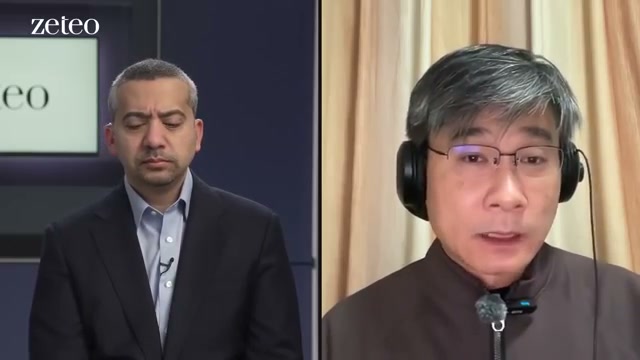
On China's role: 'The official Chinese Communist Party line is that China is committed to global peace and to global trade that benefits all... China wants a win-win globalized system.'
Presents CCP talking points as neutral analysis without critical evaluation, despite his own 2017 writings recognizing CCP propaganda. The 'win-win' language is verbatim CCP diplomatic terminology.

Claims Iran 'clearly has the strategic advantage' and the next step 'will be' ground forces, but when asked about outcomes, hedges with 'we still have to remember that America is the world's greatest empire. It has a lot of resources.'
Creates a no-lose rhetorical position: if the US escalates, he predicted it; if the US doesn't, he acknowledged America's strength.
False equivalence through deflection
00:21:38

When Hasan presses on calling himself 'Professor Jiang,' Jiang deflects: 'There's a guy on the internet who calls himself the god. Have you interviewed him yet?'
Deflects legitimate credibility concerns by comparing his misleading title to an obviously tongue-in-cheek internet persona, trivializing the distinction.

Jiang describes his conspiracy theory content about Illuminati, Freemasons, and Jesuits as 'a new approach to pedagogy and scholarship which is speculative analysis.'
Elevates conspiracy theorizing to the level of academic methodology by using scholarly language, lending it unearned legitimacy.

Claims 'America and Iran should have gone to war' after the Soleimani assassination and 'we prevented World War II' — presumably meaning WWIII — through de-escalation.
Presents war as inevitable and structural rather than contingent on specific decisions, reinforcing his deterministic framework while making a factual error (WWII vs WWIII).
Grandiose prediction as authority signal
00:27:52

Predicts the Al-Aqsa Mosque will be destroyed during this war — an extraordinary claim delivered as the final dramatic statement of the interview.
The sheer audacity of the prediction functions as a credibility signal for followers (if correct, genius; if wrong, forgotten), while the emotional weight of Al-Aqsa destruction drives engagement and virality.
prediction
Trump would win the 2024 election.
confirmed
Trump won the November 2024 presidential election.
prediction
Trump would start a war with Iran.
confirmed
Operation Midnight Hammer (June 2025) and full-scale US-Israeli campaign (Feb 28, 2026).
prediction
The US would lose the war with Iran.
untested
War is ongoing as of March 30, 2026 (Day 31). No definitive outcome yet, though Iran's Hormuz blockade has inflicted significant economic damage.
prediction
Trump would pick Nikki Haley as his VP running mate.
disconfirmed
Trump chose JD Vance, not Nikki Haley. Jiang acknowledges this error in the interview.
prediction
The United States will deploy ground troops, and this will become a quagmire requiring a national draft.
untested
As of May 1, 2026: zero US ground troops in Iran and no draft legislation. The Apr 30 CENTCOM Cooper / Joint Chiefs Caine briefing was the FIRST cabinet-level formal presentation to Trump of military options that explicitly included ground forces (Hormuz seizure 'could include ground forces'), and the 192nd MP Battalion (~150 Connecticut NG, logistics support) was the first NG unit mobilized for this war. Presentation is not execution: Trump has not ordered ground action; USS Gerald R. Ford is leaving theatre after a 309-day deployment. Ground probability has nudged from near-zero to low-but-non-zero — the first material upward shift — but a quagmire-plus-draft scenario is still not the dominant trajectory. War trajectory: air → ceasefire → failed Islamabad talks → naval blockade → indefinitely-extended ceasefire-with-blockade. Resolves further as ceasefire holds or collapses. [June 1, 2026 update] The prediction remains live, but the near-term trajectory is de-escalation toward a 60-day ceasefire MOU, not ground commitment. As of June 1, 2026 (Day 95) there are still ZERO US ground troops in Iran. Since the Apr 30 Cooper/Caine cabinet briefing that first put ground-inclusive options on the table, the trajectory reversed toward de-escalation: through late May US and Iranian negotiators reached a tentative 60-day ceasefire MOU (Iran pledging never to develop or purchase a nuclear weapon; a negotiated Hormuz reopening with no tolls + Iranian mine-clearing + proportional blockade lift), pending final approval by Trump and Mojtaba Khamenei -- not signed as of June 1 (Trump requested edits May 31 rather than signing). The principal US instrument remains the naval blockade (CENTCOM: ~118 vessels redirected + 5 disabled). The named deal-failure alternative is an air/strike package ('end it a different way'; Hegseth at the Shangri-La Dialogue: 'more than capable' of resuming strikes), not a ground order. No new ground-deployment order, no third ARG, no draft. Israel's capture of Beaufort Castle in Lebanon (May 31) is an Israeli ground operation in Lebanon, NOT US ground troops in Iran. [August 1, 2026 monthly update — Day 156] Still ZERO US ground troops in Iran; the war remains air, naval and maritime-interdiction only. Since the June 1 scoring the record has moved substantially — and net downward on the ground rung. A thirteen-night US air campaign (July 12-25) ended in a pause on July 25-26; strikes resumed July 30 with a 'heavy wave' against dozens of IRGC targets along the Gulf littoral (Bandar Abbas, Qeshm, Kish, Abu Musa, Bushehr, Kazerun, Farashband, Abadan, Ahvaz) — but NOT Kharg. On July 31 four outlets (WSJ, CBS, CNN, Axios) reported a multi-day campaign against power plants, refineries, Tehran's electricity grid and dual-use bridges, framed as forcing capitulation ('At some point, they're going to say, We just can't take it anymore'). NO ground element and NO Kharg operation appears in any version of that reporting. The amphibious rung actually FELL: on July 26 the Tripoli ARG offloaded ~2,500 Marines of the 31st MEU at Okinawa with no relief ARG announced, leaving USS Boxer the sole deployed ARG fleet-wide. Foreign Policy's survey of former commanders (July 27) found the US 'does not appear to be moving toward a major ground operation in Iran,' and Trump said on July 22 'we have other people that will do the ground campaign for us.' Countervailing signals exist and are logged: the Pentagon was reported on July 24 readying options for weeks of limited ground operations (Kharg plus coastal raids) pending approval, and July 30 produced the war's first ambiguous shaping signal — but every EXECUTION indicator remains at zero: no landing, no embarkation, no MEU tasking, no airborne insertion, no draft. Independent confirmation this cycle: CFR's Global Conflict Tracker records that 'no significant US ground force commitment is documented' and that operations have 'remained primarily aerial and naval.' The Kharg seizure requirement is still assessed at ~1,200+ troops against anti-personnel and anti-armour mines emplaced on the landing shoreline itself plus added MANPADS, with experts calling holding the island the harder problem. US theatre strength is above 50,000 — roughly 10,000 above baseline — and none of it is inside Iran. US casualties stand at 18 KIA / 685 wounded; CFR records ~1,701 documented Iranian civilian deaths, up to 3.2 million displaced, and a ~$37.5B war cost.
prediction
Israel and the United States will not use nuclear weapons in this war.
untested
No nuclear weapons have been used as of March 30, 2026. War is ongoing.
prediction
The Al-Aqsa Mosque will be destroyed during the course of this war.
untested
No reports of damage to Al-Aqsa Mosque as of March 30, 2026.
prediction
Trump and China will sign a landmark deal where China agrees to buy energy from North America.
partially confirmed
At the May 14-15 Beijing summit Trump said Xi agreed to buy US oil, LNG and energy ('China wants to buy US oil to feed its insatiable appetite,' Fox News May 15), and Xi reportedly committed to 200 Boeing jets. The energy-purchase direction is confirmed at the level of Trump's public claims, but no formal 'landmark deal' was signed, China did not confirm the commitments, and the two readouts diverged (Al Jazeera, May 15). Partially confirmed: the summit and verbal energy commitments occurred; a binding signed energy deal did not.
claim
Iran has the strategic advantage in this war.
unfalsifiable
Depends on definition of 'strategic advantage.' Iran's Hormuz blockade has caused massive economic disruption (2,000+ ships stranded, Brent ~$109/bbl), but Iran has suffered 2,076+ killed, 26,500+ wounded, 9+ senior officials assassinated, and significant infrastructure damage. Houthis entered war Mar 28.
claim
The war was started in part to economically strangle China by disrupting its GCC energy imports.
unfalsifiable
Attribution of motive is not empirically verifiable. China's energy imports have been disrupted, but Iran allowed China through Hormuz blockade (one of 5 nations).
claim
Most military analysts expect Americans to launch an amphibious assault to control the Strait of Hormuz.
disconfirmed
Pentagon drew up limited ground ops plans (WashPost Mar 29) but as of Apr 3, Trump's rhetoric has shifted toward ending the war within 2-3 weeks via air strikes only. Ground ops probability at lowest point. WSJ reports Trump willing to end war without reopening Hormuz. Amphibious assault increasingly unlikely. [June 1, 2026 update] The prediction remains live, but the near-term trajectory is de-escalation toward a 60-day ceasefire MOU, not ground commitment. As of June 1, 2026 (Day 95) there are still ZERO US ground troops in Iran. Since the Apr 30 Cooper/Caine cabinet briefing that first put ground-inclusive options on the table, the trajectory reversed toward de-escalation: through late May US and Iranian negotiators reached a tentative 60-day ceasefire MOU (Iran pledging never to develop or purchase a nuclear weapon; a negotiated Hormuz reopening with no tolls + Iranian mine-clearing + proportional blockade lift), pending final approval by Trump and Mojtaba Khamenei -- not signed as of June 1 (Trump requested edits May 31 rather than signing). The principal US instrument remains the naval blockade (CENTCOM: ~118 vessels redirected + 5 disabled). The named deal-failure alternative is an air/strike package ('end it a different way'; Hegseth at the Shangri-La Dialogue: 'more than capable' of resuming strikes), not a ground order. No new ground-deployment order, no third ARG, no draft. Israel's capture of Beaufort Castle in Lebanon (May 31) is an Israeli ground operation in Lebanon, NOT US ground troops in Iran. [August 1, 2026 monthly update — Day 156] DISCONFIRMED. The claim is about the state of expert opinion, and expert opinion has now been surveyed and points the other way. Foreign Policy's July 27, 2026 survey of former commanders found that the US 'does not appear to be moving toward a major ground operation in Iran.' The specialist literature on Kharg emphasises the difficulty rather than the expectation: seizure is assessed at ~1,200+ troops against anti-personnel and anti-armour mines emplaced on the landing shoreline itself plus added MANPADS, and analysts identify **holding** the island — not taking it — as the binding problem. The CFR Global Conflict Tracker records 'no significant US ground force commitment' and operations 'primarily aerial and naval.' Material posture moved the same way: the Tripoli ARG offloaded ~2,500 Marines of the 31st MEU at Okinawa on July 26 with no relief ARG announced, leaving USS Boxer the sole deployed ARG fleet-wide. At Day 156 no amphibious assault has been launched and the analyst consensus the claim asserted does not exist. Status changed from untested to disconfirmed.