Predictive History Audit / Systematic Content Analysis
Interview
Posted 2026-04-13

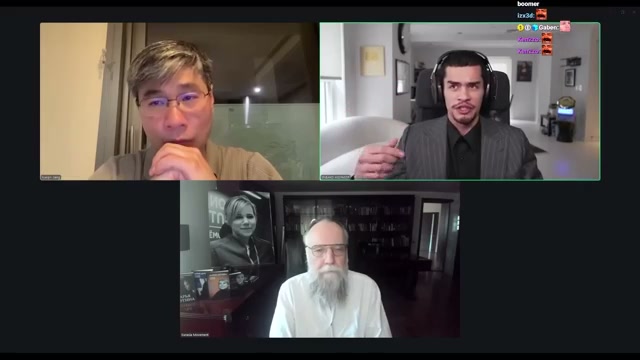
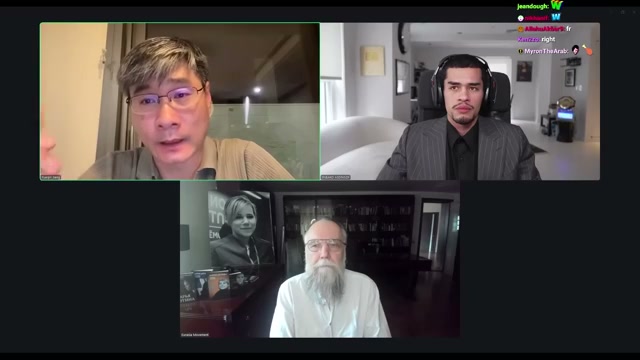
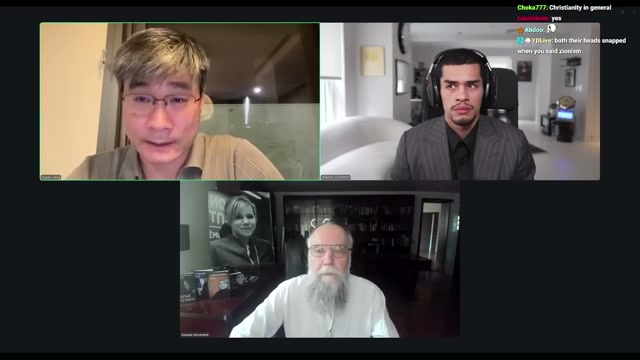
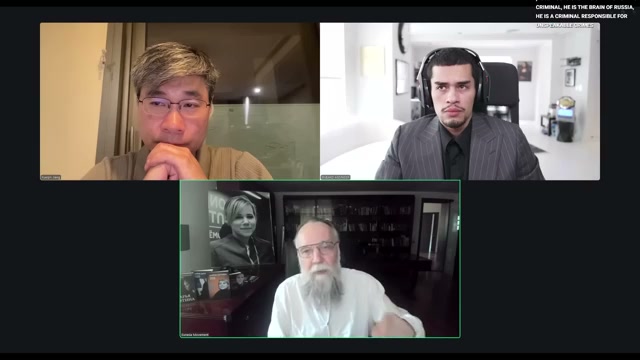
SNEAKO X Professor Jiang X Aleksandr Dugin | Full Interview

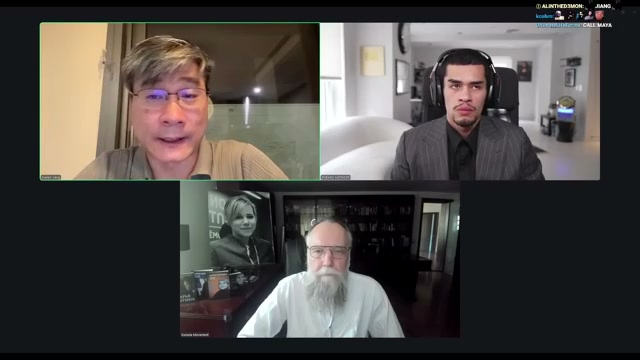
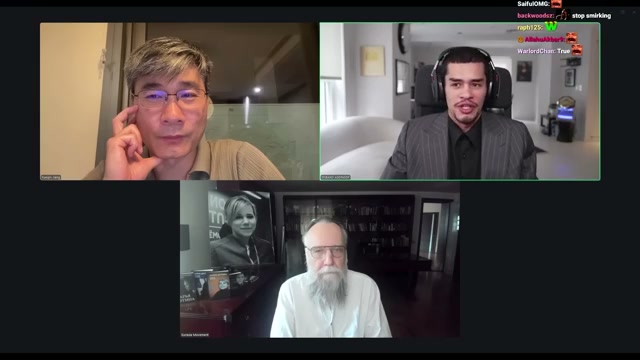
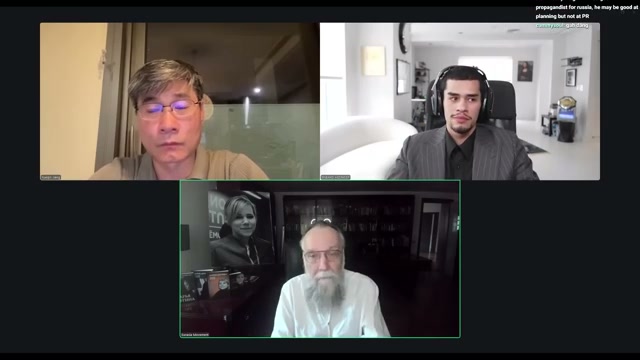
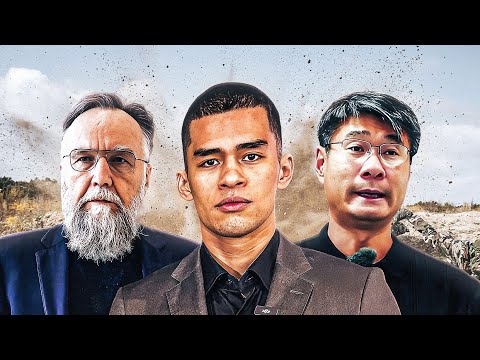
This is a three-way livestream interview between SNEAKO (a Filipino-American Muslim YouTuber), Professor Xueqin Jiang (a Chinese geopolitics lecturer), and Aleksandr Dugin (a Russian philosopher and political theorist). The conversation spans approximately 1 hour 52 minutes, covering eschatology across religious traditions (Protestant dispensationalism, Zionism, Shia Islam, Russian Orthodoxy), the philosophical roots of Western civilization traced back to the Bank of England (1694) and Calvinism, the Russian Orthodox concept of the Katechon (the force that restrains the Antichrist), Eurasian unity as an alternative to American hegemony, and the geopolitics of the current US-Iran war. All three participants broadly converge on a critique of Western/American civilization as spiritually and morally bankrupt, with Dugin characterizing the modern West as the Antichrist system and Jiang framing Western philosophy from Locke through Bentham as the root of societal decay.

Video thumbnail
youtube.com/watch?v=n44OF1Y7zgo ↗ Read time: ~9 min
Analyzed 2026-04-15 by claude-opus-4-6 · Views updated 2026-04-15

Viewer Advisory

  • This interview features no dissenting voice — all three participants share fundamentally anti-Western orientations and reinforce each other's conclusions.
  • Dugin is not merely a scholar but an active political figure who advocated for Russia's actions in Ukraine and whose daughter was killed in a 2022 car bombing — he has personal and political stakes in the narrative he presents.
  • The Sabbatean-Frankist conspiracy theory presented as historical fact (Sabbatai Zevi → Freemasonry → Christian Zionism → modern America) lacks mainstream scholarly support and has been criticized as antisemitic.
  • Russia's own human rights record, imperial history, and current military aggression in Ukraine are completely omitted — Dugin claims Russia is 'not imperialist' while Russia occupies Ukrainian territory.
  • China receives uniformly positive treatment with no mention of Uyghur persecution, Tibet, Tiananmen, the Cultural Revolution, or the Great Firewall — viewers should apply the same critical lens to China that the speakers apply to the West.
  • The theological framing (Katechon vs. Antichrist) makes the analysis unfalsifiable — any Western action confirms the Antichrist thesis, any Russian action confirms the Katechonic mission.
  • Jiang's arguments about US debt and the Iran war overlap with his Geo-Strategy #8 lecture, where several key predictions (Haley VP, ground invasion, Russia as nuclear guarantor, Saudi in coalition) were disconfirmed.
Central Thesis

Western modernity — rooted in Calvinism, British Enlightenment philosophy, and transnational finance — constitutes a spiritually corrupt system identifiable with the Antichrist, while a Eurasian civilizational bloc (Russia, China, Iran) represents the authentic alternative and, in the Russian Orthodox framework, the Katechon that restrains ultimate evil.

  • The Bank of England (1694) created the framework of infinite state financing through transnational capital, which spawned British Enlightenment philosophy (Locke, Hume, Bentham, Mill) as ideological justification for a debt-based consumer society.
  • Calvinism — which equates wealth with divine chosenness — is the spiritual root of American capitalism and the underlying cause of American fear, anxiety, and social dysfunction.
  • Christian Zionism originated in 17th-century Dutch Protestant circles through fifth monarchism and Sabbatean-Frankist influence on Freemasonry, and was transmitted to America through the Scofield Bible (1909).
  • Russia's Katechonic mission — inherited from the Byzantine Empire via the Third Rome doctrine — compels it to resist the Antichrist (identified with the modern West) until the last breath.
  • America is a 'financial Ponzi scheme' with $39 trillion in debt, and the Iran war is fundamentally about preventing a Eurasian trade bloc that would make US treasuries worthless.
  • Trump is being used by a 'deeper state' — not just liberal globalists but technocratic hyper-globalists — who will eventually scapegoat him and his movement after he has served their purpose.
  • The Epstein files are not merely a sex scandal but an eschatological sign confirming Russian Orthodox elders' centuries-old warnings about the demonic nature of the Western ruling elite.
  • A Eurasian unity built around Russia, China, and Iran through BRICS could create an alternative gold-based financial system that would bankrupt America.
  • Putin is a genuine Christian Orthodox believer fulfilling a Katechonic function, not manipulated by Chabad Lubavitch or any Jewish faction.
  • China's absorption of Western materialism, while producing impressive technological and economic results, may eventually exact a spiritual and cultural price.
Qualitative Scorecard 1.6 / 5.0 average across 7 axes
Historical Accuracy ▸ Expand
While some references are broadly accurate (Bank of England 1694, Weber on Calvinism, Scofield Bible 1909, Carl Schmitt on the Katechon), the interview is plagued by errors, distortions, and unsourced claims. Jiang incorrectly dates Herzl's book to 1899 (actually 1896), his claim that 'Britain lost six of seven wars against Napoleon' is a gross oversimplification of the Coalition Wars, and the Sabbatean-Frankist conspiracy chain (Sabbatai Zevi → Jacob Frank → Freemasonry → Christian Zionism → America) lacks scholarly support. Dugin's characterization of Calvinism as teaching 'there is no afterlife' is a serious misrepresentation of Reformed theology. The claim that a Ukrainian drone strike took '40% of Russian oil exports offline' is unsubstantiated. Historical claims are deployed instrumentally to support predetermined conclusions rather than presented with scholarly care.
2
Argumentative Rigor ▸ Expand
The conversation proceeds almost entirely through assertion, association, and conspiratorial reasoning. Causal chains are constructed through temporal proximity (Bank of England → Locke → Bentham → consumer society → Antichrist) without establishing actual causal mechanisms. The leap from 'Sabbatai Zevi existed' to 'Sabbatean-Frankists infiltrated Freemasonry which created Christian Zionism which conquered America' is presented as a straightforward historical narrative rather than the highly contested conspiracy theory it is. Dugin's invocation of Hegel's 'cunning of reason' is used to immunize his thesis from empirical challenge — if people don't see the spiritual reality, it's because the logic of ideas operates above human consciousness. The interview format encourages mutual reinforcement rather than rigorous testing of claims — no participant seriously challenges another.
1
Framing & Selectivity ▸ Expand
The interview presents an almost perfectly one-sided view. Western civilization is systematically characterized as spiritually corrupt, financially parasitic, and demonic, while Russia is portrayed as a holy civilization fulfilling a sacred mission and China is treated as an admirable synthesis of tradition and modernity. Counterexamples are never considered: Russia's own imperialism, colonialism, and religious persecution are omitted; China's suppression of Uyghur Muslims and Tibetan Buddhists is never mentioned despite extensive discussion of religious freedom; America's genuine religious vitality, charitable traditions, and democratic accountability are never acknowledged. The selection of evidence is purely confirmatory — everything from the Epstein files to Trump's social media posts to the Bank of England is slotted into a predetermined narrative of Western civilizational evil.
1
Perspective Diversity ▸ Expand
Despite having three participants from different civilizational backgrounds (American Muslim, Chinese atheist/gnostic, Russian Orthodox), the conversation displays remarkable ideological homogeneity. All three converge on anti-Western critique, anti-Zionism, and sympathy for a Russia-China-Iran axis. SNEAKO occasionally pushes back (asking about Putin's Epstein connections, questioning whether American tradition is truly 'rotten to the core'), but these are gentle probes quickly absorbed into the consensus. Jiang raises a genuine difference — that Chinese materialism makes the anti-Antichrist framework less compelling — but it's presented as a friendly qualification rather than a substantive disagreement. No voice representing Western liberal thought, mainstream Christianity, academic political science, or pro-Israel perspectives is present.
2
Normative Loading ▸ Expand
The interview is saturated with evaluative and theological language that replaces analysis. The modern West is 'the Antichrist,' 'demonic,' 'satanic,' 'pure evil,' exhibiting 'signs of the beast.' Western philosophy from Bentham onward is 'capitalist satanism.' The Epstein network is an 'Epstein class' of 'terrible terrible' psychology. Russia is fulfilling a 'sacred duty,' Putin is a 'catechonic' figure with 'very balanced and very positive' relations. Chinese civilization is 'amazing' and a 'miracle.' The normative loading is not occasional rhetorical flourish but the fundamental mode of analysis — geopolitical events are interpreted through a Manichaean lens of absolute good versus absolute evil.
1
Determinism vs. Contingency ▸ Expand
This is one area where the interview shows genuine complexity. Dugin explicitly affirms free will and rejects predestination — 'the human soul human being is always free totally and absolutely free.' He argues Americans can choose to reject the Antichrist, and that Russia's own eschatological analysis could be 'postponed or delayed' based on human choices. However, structural determinism pervades the rest of the conversation: the Bank of England made Western corruption inevitable, Calvinism determined American society's character, America 'has no choice but to fight this war in Iran,' the Sabbatean-Frankist infiltration predetermined Western political structures. The explicit theology allows contingency but the practical analysis is highly deterministic.
3
Civilizational Framing ▸ Expand
The interview employs the most extreme form of civilizational essentialism. Each civilization is assigned a fixed spiritual character: Russia is the Katechon, the holy restrainer of the Antichrist, whose sacred mission is inherited from Byzantium; the West is the Antichrist, spiritually corrupt from its Calvinist foundations; China is a harmonious Confucian civilization that 'lacks the radical feeling of the end,' admirably balanced but potentially vulnerable to Western toxicity; Islam is a legitimate traditional faith allied with the Katechon. These are not analytical categories but theological absolutes. No internal diversity within any civilization is acknowledged — there are no corrupt Russians, no holy Westerners, no aggressive Chinese policies worth discussing.
1
Overall Average
1.6
Civilizational Treatment
CHINA

China is treated with consistent admiration and gentle paternalism. Dugin calls Chinese civilization 'very balanced' with 'harmony that prevails,' praises its ability to combine 'traditional values with material technological prosperity' as 'amazing' and a 'miracle,' but warns that absorbing too much 'western materialist and capitalist poison' may eventually exact a price. Jiang represents China as a materially successful society where billions were 'lifted out of poverty' but acknowledges its atheist foundation makes eschatological frameworks less compelling. China is never criticized — not for its treatment of religious minorities, its own imperialism, its surveillance state, or its territorial claims. It is the one civilization that escapes both Western corruption and Russian apocalypticism.

UNITED STATES

America is characterized as a civilization rotten from its roots. Jiang traces its corruption to the Bank of England (1694) and British Enlightenment philosophy. Dugin identifies American tradition itself as heretical — Calvinist, Masonic, and lacking 'sacred roots.' The American founding is described in terms of 'Calvinist heretic groups,' 'mercenary radicalism,' and 'extremist sects.' Contemporary America is a 'financial Ponzi scheme,' its people are 'hostages,' and its elite belongs to a 'satanic anti-Christian' 'Epstein class.' Trump is either 'mad' or a tool of 'deeper state' forces. However, both Dugin and Jiang distinguish between the corrupt elite and 'normal American people' who they express solidarity with.

RUSSIA

Russia receives the most favorable treatment of any civilization. Dugin presents Russia as inheritor of the Byzantine Empire's sacred mission, fulfilling the Katechon function of restraining the Antichrist. Putin is described as a genuine Christian Orthodox believer with 'very balanced and very positive, very respectful relations to all kinds of other traditional religions.' Russia's intelligence services are portrayed as purely 'defensive.' The Ukraine war is presented as having helped Russia achieve 'resurrection of Russian technological sovereignty.' Russia's relationship with Islam is described as exemplary — Muslim citizens are 'loyal patriots' who 'fight better than anybody else.' Russia's own imperialism, the Chechen wars, Novichok poisonings, press suppression, and oligarchic corruption are completely absent.

THE WEST

The West as a collective is characterized as the Antichrist system. Dugin states this is no longer 'just presumption' but visible reality confirmed by the Epstein files. Western philosophy from the Enlightenment onward is described as the 'ideology of capitalist satanism.' Western values — individuality, rationality, consumerism — are labeled 'antihuman.' NATO is discussed only in terms of aggression. The Statue of Liberty is identified with Hecate, 'the great goddess of hell.' Both left-liberal and right-wing Western politics are identified as part of the same 'Epstein network.' No positive contribution of Western civilization — democratic governance, human rights, scientific progress, religious freedom — is acknowledged as genuine.

Named Sources

book
Aleksandr Dugin / The Foundations of Geopolitics
Jiang cites this as 'the most important geopolitical book in our modern era' and credits it with his interest in geopolitics and eschatology. Not critically discussed but treated as foundational authority.
? Unverified
scholar
René Guénon
Dugin identifies as a follower of Guénon's traditionalist philosophy, which views modernity as decline rather than progress. Used to frame the anti-modernist position as philosophically rigorous.
✓ Accurate
scholar
Max Weber
Referenced by Dugin to support the connection between Calvinism and capitalism — 'Max Weber has shown that in his sociological framework.' Standard scholarly reference used correctly.
✓ Accurate
scholar
John Locke
Jiang cites Locke as creating the 'sanctification of private property as the highest good' in service of the Bank of England's debt-finance system. Dugin adds that Locke drew inspiration from Dutch Protestant circles. The causal chain is oversimplified.
? Unverified
scholar
Jeremy Bentham / Utilitarianism
Jiang presents Bentham's utilitarianism as reducing morality to pleasure/pain, creating the philosophical basis for consumer society. This is a recognizable critique but strips Bentham's thought of nuance.
? Unverified
scholar
Carl Schmitt
Dugin credits Schmitt with introducing the concept of Katechon into political science. This is accurate — Schmitt developed the concept in 'The Nomos of the Earth.'
✓ Accurate
scholar
Giorgio Agamben
Named alongside Schmitt and Taubes as having engaged with the Katechon concept. Accurate reference.
✓ Accurate
scholar
Jacob Taubes
Dugin references Taubes as a 'Jewish author about Western eschatology' who raised the question of why not accelerate the Antichrist's arrival. Broadly accurate.
✓ Accurate
scholar
Peter Zeihan
Jiang references Zeihan's 'Greater North America' thesis where the US consolidates control over the Western Hemisphere as a continental fortress.
? Unverified
primary_document
Theodor Herzl / Der Judenstaat (1897)
Jiang dates it to 1899 (actually 1896) and claims Herzl was an obscure journalist with access to British royalty, implying top-down sponsorship of Zionism by Christian Zionist elites.
✗ Inaccurate
primary_document
Scofield Reference Bible (1909)
Both Jiang and Dugin describe it as embedding dispensationalist commentary within Biblical text to promote Christian Zionist eschatology. The description of how it works — commentary indistinguishable from scripture — is a recognized criticism.
? Unverified
other
Sabbatai Zevi / Jacob Frank
Referenced by both Dugin and Jiang as pseudo-messiahs whose cabalistic tradition infiltrated Freemasonry and created Christian Zionism. This Sabbatean-Frankist conspiracy theory is a staple of anti-Zionist discourse but lacks mainstream scholarly support for the claimed causal chain.
? Unverified
scholar
Hegel
Dugin invokes Hegel's 'cunning of reason' (List der Vernunft) to argue that ideas drive history regardless of whether individuals understand them — used to justify why a spiritual elite's understanding of the Katechon matters more than popular materialism.
✓ Accurate

Vague Appeals to Authority

  • 'Our elders, Christian Orthodox authorities, wrote during all last decades about the real nature of the West' — no specific texts or elders named beyond a reference to an unnamed young bishop.
  • 'We know from the Epstein files' and 'some text, some coding words in Epstein files' — referenced as confirming satanic behavior without citing specific documents.
  • 'It's an open secret' and 'people are saying' used by SNEAKO throughout to present conspiratorial claims as common knowledge.
  • 'There are some cases already investigated in Russian' regarding Russian oligarch connections to 'Epstein class' — no specifics provided.
  • Jiang's claim that 'British lost six of seven wars' against Napoleon — presented without citation and significantly oversimplifies the Napoleonic Wars.
  • 'What the Pentagon says' about Russian shadow fleet targeting — no specific Pentagon statement cited.

Notable Omissions

  • No engagement with any critical scholarship on Dugin's own work (e.g., Marlene Laruelle, Andreas Umland), which has documented significant gaps and contradictions in his geopolitical theories.
  • No mention of Russia's own history of religious persecution — suppression of Old Believers, Soviet-era anti-religious campaigns, or current restrictions on Jehovah's Witnesses and other groups that complicate the 'Russia as defender of tradition' narrative.
  • No discussion of China's treatment of Uyghur Muslims, which directly contradicts the framing of the Russia-China-Iran axis as defenders of religious tradition and Muslim rights.
  • No acknowledgment of the Chechen wars and Russia's devastating military campaigns against Muslim populations, despite Dugin's claim that Russia has 'no reason to hate Islam.'
  • No engagement with mainstream scholars of eschatology (e.g., N.T. Wright, Bart Ehrman) or academic historians of Zionism (e.g., Walter Laqueur, Benny Morris).
  • No discussion of Russia's own oligarchic capitalism, corruption, or income inequality — the critique of Western capitalism proceeds as though Russia represents an alternative model.
  • No mention of Dugin's documented connections to European far-right movements and his advocacy for Russian imperialism in Ukraine prior to 2022.
  • No engagement with the substantial body of scholarship questioning the Sabbatean-Frankist conspiracy theory's historical basis.
  • No consideration that American evangelical support for Israel has multiple motivations beyond eschatology, including shared democratic values, Cold War alliance structures, and genuine theological conviction.
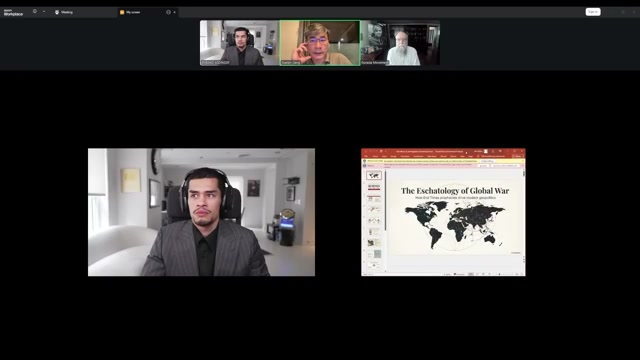
Mutual credentialing 00:04:00
Frame at 00:04:00
Dugin describes Jiang as 'the unique Chinese scholar' who shows 'such deep engagement' in eschatology, while Jiang calls Dugin's book 'the most important geopolitical book in our modern era.' SNEAKO frames the conversation as bringing together exceptional thinkers the mainstream won't engage with.
Creates an aura of intellectual authority through reciprocal praise, positioning the conversation as a meeting of rare minds rather than a discussion that should be evaluated on its merits. Inoculates participants against criticism by framing detractors as intellectually inferior.
Persecutor framing / persecution bonding 00:17:44
Frame at 00:17:44
SNEAKO opens by noting critics called this a meeting of 'a CCP propagandist and a KGB propagandist' and 'Chinese and Russian spies,' then pivots to argue this proves the very point they'll make about Western censorship and foreign influence double standards.
Transforms criticism into evidence for the thesis. By framing themselves as persecuted truth-tellers, they create in-group solidarity with the audience against a hostile mainstream, making the audience more receptive to the anti-establishment narrative that follows.
Historical chain construction 00:19:34
Frame at 00:19:34
Jiang constructs a continuous causal chain: Bank of England (1694) → Locke → Hume → Bentham → Mill → Darwin → Marx → modern Western civilization, presenting each thinker as a logical derivative of the Bank of England's need for philosophical justification.
Creates an impression of inevitable causation where contingent historical developments become a single narrative of civilizational corruption. The listener absorbs the conclusion (Western thought is merchant-class ideology) before questioning whether 300 years of philosophy can be reduced to one institution's PR needs.
Conspiratorial chain construction 00:39:20
Frame at 00:39:20
Jiang traces: Sabbatai Zevi → Jacob Frank → infiltration of Freemasonry → creation of Christian Zionism → Herzl → Scofield Bible → Balfour Declaration → modern Israel → AIPAC → Trump's Iran policy, presenting it as a single historical narrative.
Links a 17th-century messianic movement to 21st-century geopolitics through a chain of asserted connections. Each link is individually plausible enough to avoid immediate rejection, but the cumulative chain requires accepting a conspiratorial view of 400 years of history as a single coordinated project.
Theological absolutism deployed as geopolitical analysis 01:18:07
Frame at 01:18:07
Dugin frames the Russia-West confrontation in explicitly theological terms: Russia is the Katechon, the West is the Antichrist, and current events are the unfolding of eschatological prophecy. He then states 'we could describe what is going on in Middle East in the same time by two different layers of reality — normal geopolitics and the geography of prophecy — and they now coincide almost perfectly.'
Elevates geopolitical analysis to the plane of sacred narrative, making disagreement tantamount to spiritual blindness. If current events 'perfectly coincide' with prophecy, then the Katechon thesis becomes self-confirming rather than falsifiable.
Enemy distinction with audience solidarity 00:31:52
Frame at 00:31:52
Both Dugin and Jiang carefully distinguish between the American 'demonic elite' / 'Epstein class' and 'normal American people' whom they express solidarity with. Dugin: 'We feel the great contempt for American people because they became a kind of hostages.'
Allows the speakers to deliver maximally harsh critiques of American civilization while retaining the American audience's sympathy. The listener can agree that their own elite is evil without feeling personally attacked, making them more receptive to the broader anti-Western thesis.
Escalating theological conclusion 01:24:14
Frame at 01:24:14
The conversation gradually escalates from philosophical critique (Enlightenment was flawed) to political critique (American politics is corrupt) to conspiracy (Epstein network controls the elite) to theological absolute (the West IS the Antichrist). Each step normalizes the next.
The boiling-frog structure means the audience has accepted many premises before reaching the radical conclusion. By the time Dugin declares the West is 'pure Antichrist,' the audience has been primed through two hours of progressively more extreme framing.
Appeal to free will as escape valve 01:28:46
Frame at 01:28:46
After declaring the West the Antichrist, Dugin immediately pivots to affirm human freedom: 'The human soul human being is always free totally and absolutely free. So if you follow if you choose to be Antichrist you are. If you continue to go this this way it is up to you to decide.'
The free-will escape valve serves multiple functions: it softens the deterministic despair of the Antichrist thesis, provides the audience with agency (they can choose differently), and implicitly positions choosing the Western path as a deliberate embrace of evil rather than a reasonable disagreement.
Whataboutism preemption 01:33:07
Frame at 01:33:07
When SNEAKO asks about Putin's connection to Epstein, Dugin admits 'some Russian oligarchs' had connections but immediately deflects to 'the measure of Russian involvement is relatively small' and argues Russia was 'totally incapable' of managing something like the 'Epstein class.'
By acknowledging a minor version of the criticism before dismissing it, Dugin appears transparent and fair-minded while ensuring Russia escapes the moral indictment applied to the West. The audience's legitimate question is answered technically while the asymmetric moral framework is preserved.
Paternalistic civilizational concern 01:49:41
Frame at 01:49:41
Dugin says of China: 'I have the great hope in Chinese culture and Chinese future... how you could combine the traditional values with material technological prosperity. It is amazing, that is something that is miracle. So I admire that. But I can see that maybe it will be a moment to pay for that. So if you take too much poison, it will affect you sooner or later.'
Positions Dugin as a wise elder with concern for China, maintaining the framework where Russia possesses superior spiritual insight while China excels materially. Allows gentle criticism of Chinese materialism while preserving the alliance framing.
Frame at 00:19:34 ⏵ 00:19:34
The root of the problem is 1694 because that is when the Bank of England was first chartered... and this was a revolution in European affairs because now England basically had infinite financing.
Encapsulates Jiang's reductive historical methodology — tracing all of Western civilization's ills to a single financial innovation. This framing allows him to characterize all subsequent Western philosophy (Locke through Marx) as ideological superstructure for debt-based capitalism.
China's own modern rise was fueled by massive state-directed lending, currency manipulation, and integration into the global financial system Jiang condemns. The People's Bank of China's balance sheet and China's own debt-to-GDP ratio (over 300%) make it as much a product of the financial revolution Jiang traces to 1694 as any Western nation.
Frame at 00:28:34 ⏵ 00:28:34
When you want when you try to get back to your roots to your sources — welcome to the Calvinist heretic group of the founding fathers.
Dugin's most devastating critique of American traditionalism — that America's roots are themselves heretical, making authentic conservatism impossible without abandoning American identity entirely. This is the argument that resonates most with SNEAKO's audience of disillusioned young Americans.
Frame at 01:25:22 ⏵ 01:25:22
Before our eyes the whale is taken off and we see... three millions — it's enough. Maybe there are more three millions of Epstein files. But we need — we see now the real reality, real face of Western ruling elite.
Reveals how the Epstein scandal functions in Dugin's framework — not as a criminal case but as eschatological confirmation of Russian Orthodox prophecy about the demonic nature of the West. The 'veil being taken off' is apocalyptic language applied to a news event.
Russia's own ruling elite faces comparable accusations — Putin's palace, oligarchic corruption, the Panama Papers revelations involving Putin's inner circle, and systematic state-sponsored poisonings — yet these are never treated as revelatory of Russia's 'true face.' The selective application of elite corruption as civilizational indictment applies only westward.
Frame at 01:10:50 ⏵ 01:10:50
Putin is motivated by interests of Russia. He is Christian Orthodox... he himself is practicizing Christian Orthodox. So he is a member of the Christian Orthodox faith and church.
Dugin's defense of Putin as a genuine believer reveals the interview's double standard: Western leaders' religious expressions are dismissed as heretical or cynical, while Putin's faith is presented as authentic and politically determinative.
Trump also claims to be a practicing Christian and is supported by millions of sincere evangelical believers, yet his religiosity is dismissed as 'sacrilegious' and evidence of Antichrist. The same evidentiary standard — a leader's public religious practice — is read favorably for Putin and negatively for Trump.
Frame at 01:02:22 ⏵ 01:02:22
We are not anymore imperialist. We don't want to occupy neither Europe nor Asia. We are satisfied with our own zone of influence in Eurasia.
Dugin claims Russia has renounced imperialism while simultaneously asserting Russia's 'zone of influence in Eurasia' — which, given Russia's invasion of Ukraine in 2022, amounts to defining imperialism as something only others do.
This statement was made while Russia was actively occupying ~20% of Ukrainian territory and waging a war of territorial expansion. Dugin himself was one of the most vocal advocates for Russian action in Ukraine. The claim to be 'not imperialist' while maintaining a 'zone of influence' enforced by military invasion is the interview's most striking instance of cognitive dissonance.
Frame at 01:18:07 ⏵ 01:18:07
We could not prevent to see behind these events the very alternative scenario... when the everyday reality start to intermingle with the metaphysical eschatological alliance — that is very very special.
Dugin's key methodological claim — that geopolitical reality and eschatological prophecy now 'coincide almost perfectly.' This makes his framework unfalsifiable: geopolitical events confirm prophecy, while prophecy explains geopolitical events.
Frame at 01:47:35 ⏵ 01:47:35
If you prefer to be on the side of God, you will decide with your demonic elite and you will yourself will deal with this satanic anti-Christian elite.
The interview's climactic exhortation — framing the choice for American viewers as binary: side with God (and implicitly with Russia's Katechonic mission) or accept your demonic elite. This is evangelistic recruitment disguised as geopolitical analysis.
Frame at 00:51:08 ⏵ 00:51:08
America is a financial Ponzi scheme. It's $39 trillion in debt and if people stop buying US treasuries then America would collapse.
Jiang's characterization of US fiscal structure as a Ponzi scheme. While US debt levels are genuinely concerning, characterizing the world's reserve currency and largest economy as a simple fraud scheme is reductive analysis designed to delegitimize rather than understand.
China's total debt-to-GDP ratio exceeds 300%, with local government financing vehicles carrying trillions in hidden debt, a property sector in prolonged crisis (Evergrande, Country Garden), and an economy propped up by massive state lending. If the US is a 'Ponzi scheme,' China's debt structure warrants comparable scrutiny — but receives none in this interview.
Frame at 00:18:22 ⏵ 00:18:22
Our entire political lobby has been infiltrated by Zionists. Very clearly, everybody it seems like has dual allegiance to Israel, first off.
SNEAKO's framing of Zionist influence on American politics. While AIPAC's influence is documented, the claim that the 'entire political lobby' has been 'infiltrated' and that 'everybody' has 'dual allegiance' deploys classic dual-loyalty tropes that have historically been used to scapegoat Jewish communities.
Frame at 01:49:41 ⏵ 01:49:41
I have the great hope in Chinese culture and Chinese future — that is amazing, amazing how you could combine the traditional values with material technological prosperity. It is amazing, that is something that is miracle.
Dugin's praise for China reveals the civilizational hierarchy in his framework: Russia is spiritually supreme, China is admirably balanced, the West is demonic. This paternalistic admiration gives China a special protected status where its own contradictions (surveillance state, religious persecution, environmental destruction) need not be examined.
The 'traditional values' Dugin admires in China were devastated by the Cultural Revolution (1966-76), which destroyed temples, persecuted religious practitioners, and killed millions. China's current 'traditional values' are a CPC-curated reconstruction, not an unbroken inheritance — much like the American tradition Dugin dismisses as 'rotten from the very beginning.'
claim America has no choice but to fight the war in Iran to prevent a Eurasian movement from arising.
00:51:31 · Not falsifiable
unfalsifiable
This frames the US-Iran conflict as existential for American hegemony. The US did attack Iran (Operation Midnight Hammer June 2025, Feb 2026 campaign), but the causal claim that it was specifically to prevent Eurasian integration is unfalsifiable.
claim America is a financial Ponzi scheme and would collapse if people stopped buying US treasuries.
00:51:08 · Falsifiable
untested
US debt approximately $39 trillion at time of interview. Treasury market has faced stress but not collapse. Dollar remains reserve currency despite geopolitical tensions.
prediction Trump is being used by a 'deeper state' and will eventually be scapegoated along with his movement.
00:56:30 · Falsifiable
untested
As of April 2026, Trump remains in office and in control. No signs of being discarded by any deeper power structure. Prediction is speculative.
prediction Eurasian trade bloc (Russia, China, Iran via BRICS) will create a gold-based financial system displacing the dollar.
00:50:47 · Falsifiable
untested
BRICS has expanded but no gold-based alternative financial system has materialized. De-dollarization discussions continue but dollar remains dominant.
claim America is transitioning from a financial empire to a resource empire through 'Greater North America' (controlling Greenland, Canada, Mexico, Venezuela, Colombia, Cuba, etc.).
00:52:55 · Falsifiable
partially confirmed
Trump has pursued Greenland acquisition and Panama Canal rhetoric. Venezuela's Maduro was arrested. Cuba faces massive blackouts amid US pressure. But a formal 'Greater North America' bloc has not materialized. The direction is correct but the comprehensive scope is unachieved.
claim The Ukraine war has been beneficial for Russia — it helped restructure the economy and achieve technological sovereignty.
01:01:11 · Falsifiable
partially confirmed
Russia's economy has shown resilience; oil revenues nearly doubled ($19B March 2026); defense industrial base has expanded. However, total Russian losses ~1,312,960; war continues as grinding attritional conflict. 'Beneficial' is a strong characterization given enormous human and material costs.
claim The American Navy has been targeting Russian shadow fleet tankers — committing acts of piracy.
00:54:04 · Falsifiable
untested
There have been reports of Western pressure on Russian shadow fleet operations, but the characterization as 'piracy' by the American Navy specifically is not confirmed by available calibration data.
claim A Ukrainian drone strike took about 40% of Russian oil exports offline.
00:54:08 · Falsifiable
untested
Ukraine has conducted drone strikes on Russian oil infrastructure, but the 40% figure is likely an exaggeration. Russia's March 2026 oil revenues nearly doubled, suggesting export capacity was not catastrophically impaired.
claim The ceasefire talks failed in Islamabad because Israel wants to continue bombing Lebanon.
01:04:56 · Falsifiable
partially confirmed
Ceasefire talks in Pakistan are ongoing as of April 15, 2026. Israel-Lebanon historic talks occurred at State Dept (Apr 15). An IDF soldier was killed in Bint Jbeil and Hezbollah escalated fire during talks. The characterization is simplistic — multiple factors drive negotiations.
claim The modern West is the Antichrist system as prophesied by Russian Orthodox elders.
01:24:14 · Not falsifiable
unfalsifiable
This is a theological/metaphysical claim that cannot be empirically tested.
Verdict

Strengths

The interview succeeds as a rare cross-civilizational dialogue that surfaces perspectives genuinely underrepresented in Western media. Dugin's discussion of the Katechon concept draws on legitimate theological and philosophical sources (Schmitt, Agamben, Taubes). Jiang's tracing of Western political economy to the Bank of England, while oversimplified, touches on real historiography (echoing Braudel and Arrighi). The discussion of how eschatological beliefs shape geopolitical behavior is a genuinely important analytical lens rarely explored in mainstream foreign policy discourse. Dugin's affirmation of free will and human agency provides philosophical nuance absent from more deterministic frameworks. The interview format allows viewers to hear Russian and Chinese perspectives articulated by their own advocates rather than filtered through Western media.

Weaknesses

The interview's fundamental weakness is the complete absence of critical engagement between participants. Despite having three speakers from different civilizations, it functions as a collaborative anti-Western monologue rather than a genuine debate. No participant challenges another's factual claims, logical leaps, or moral blind spots. Historical accuracy is sacrificed to narrative — Calvinism, the Enlightenment, Zionism, and American founding history are all distorted to fit the anti-Western thesis. The Sabbatean-Frankist conspiracy theory is presented as established history. Russia's invasion of Ukraine — the most relevant test of Dugin's own anti-imperialist claims — is discussed only as an economic benefit to Russia. The asymmetric moral framework (Western elite corruption proves civilizational evil; Russian elite corruption is 'relatively small') is never interrogated. Dugin's theological absolutism (West = Antichrist) forecloses analytical nuance and reduces geopolitics to eschatological theater.

Cross-References

BUILDS ON

  • Geo-Strategy #8: The Iran Trap — Jiang's arguments about the US-Iran war, AIPAC's influence, and America's financial motivations for conflict directly echo and update the Iran Trap thesis.
  • Previous Predictive History lectures on eschatology — SNEAKO references Jiang's earlier detailed treatment of eschatological themes across religious traditions.
  • Previous Predictive History lectures on Christian Zionism and the Scofield Bible — referenced as established background by both SNEAKO and Jiang.
  • Jiang's previous appearance on Patrick Bet-David's podcast — referenced when discussing his evolving religious views.
  • Previous SNEAKO/Jiang stream — referenced directly when discussing information flooding as a censorship strategy.

CONTRADICTS

  • Geo-Strategy #8's prediction that Russia would serve as 'nuclear guarantor' preventing strikes on Iran — in this interview, Russia is presented as supportive of Iran but no nuclear guarantee is discussed, and the calibration reference confirms Russia did NOT prevent strikes.
  • Geo-Strategy #8's prediction of a US ground invasion of Iran — this interview discusses the Iran war as an ongoing air campaign, implicitly abandoning the ground invasion thesis.
This interview represents a significant format departure from Jiang's solo lectures. The presence of Dugin shifts the conversation from Jiang's characteristic game-theory analysis toward Dugin's theological-civilizational framework. Jiang appears to defer to Dugin's authority, adopting more metaphysical language than in his solo work. The interview reveals that Jiang's analytical framework — which appears secular in his solo lectures — is compatible with and sympathetic to Dugin's explicitly religious anti-Western theology. The conversation also reveals the Predictive History channel's role as a node in a broader alternative media network connecting Russian, Chinese, and American anti-establishment voices. SNEAKO's mention of upcoming interviews with 'Professor Morandi' (likely an Iranian academic) and Dave Smith suggests an expanding interview circuit.