Predictive History Audit / Systematic Content Analysis
Interview
Posted 2026-04-01

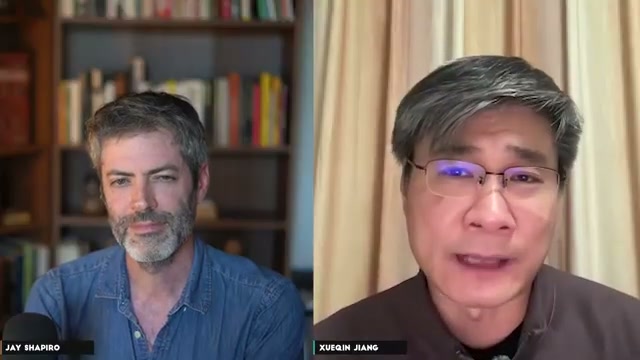
Professor Jiang on His Painful Personal Path | Truth and Myth | A Search for Reality | Internet Fame

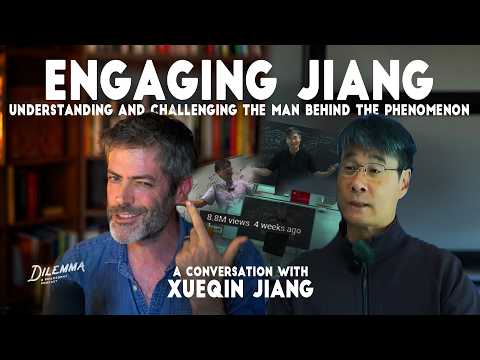
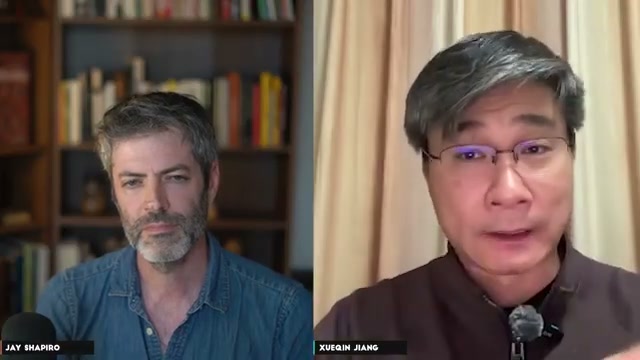
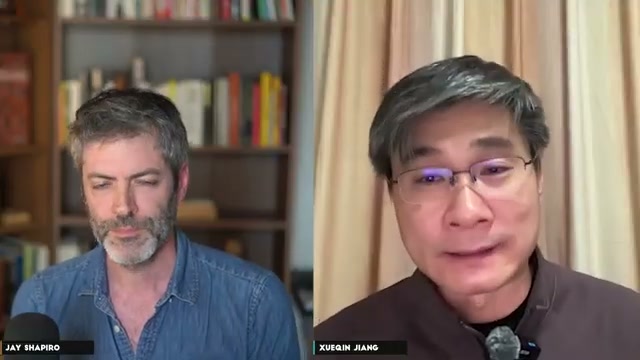
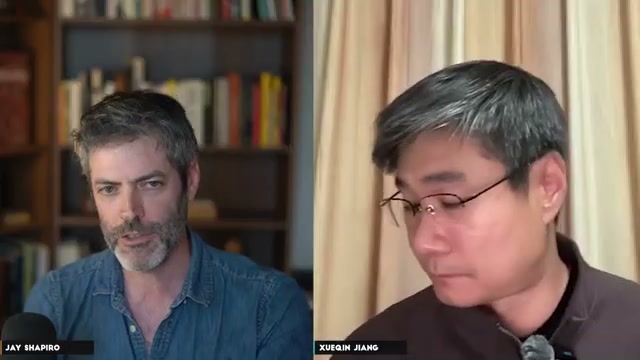
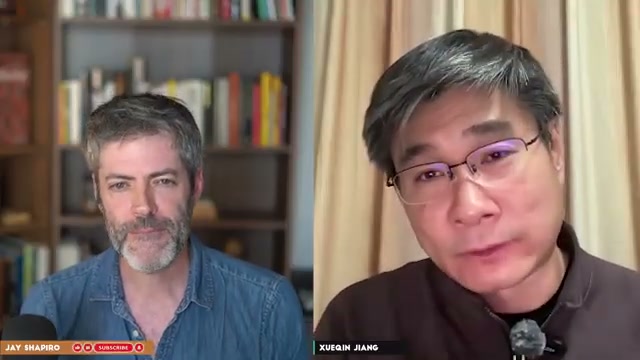
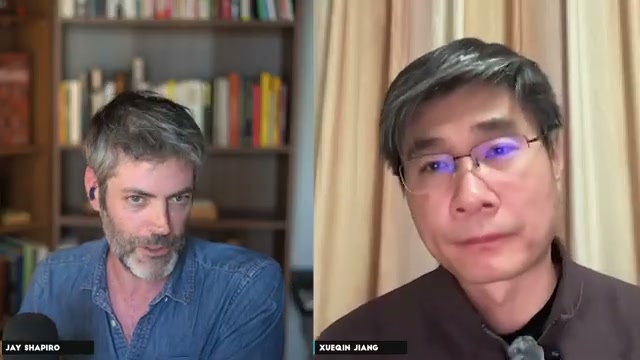
This is a long-form interview on the Lummit Podcast hosted by J. Shapiro, featuring Xueqin Jiang ('Professor Jiang'). The conversation covers Jiang's personal biography (born in rural China, immigrated to Canada at age 6, bullied childhood, Yale education, two decades in China), his methodology for geopolitical prediction (drawing on eschatology, secret societies, and pattern recognition), controversial claims about the Holocaust ('no direct evidence' for systematic extermination), the role of Kabbalah and Jewish theology in shaping Israeli politics, the Epstein files, the Masada myth, and a philosophical discussion about the value of truth-seeking versus maintaining useful societal myths. The host provides moderate pushback while also engaging sympathetically with the questioning of established narratives.

Video thumbnail
youtube.com/watch?v=oErKnj_uyPA ↗ Analyzed 2026-04-02 by claude-opus-4-6

Viewer Advisory

  • Jiang's claim about 'no direct evidence' for the Holocaust's systematic nature is factually false and reflects internet research rather than scholarly engagement -- the documentary record is one of the most extensive in human history.
  • Jiang explicitly admits his secret society framework has 'no evidence' and is 'all speculation,' yet this framework increasingly drives his public analysis.
  • The 'thought experiment' framing allows extraordinary claims to be advanced without evidence while deflecting criticism.
  • The interview applies intense skeptical scrutiny to Israeli and Western narratives while applying zero such scrutiny to Chinese national mythology, state propaganda, or authoritarian control -- a glaring asymmetry for someone who has lived in China for 25+ years.
  • The host, while providing some valuable pushback, also engages in problematic both-sides framing that positions truth as equidistant between the mainstream historical consensus and conspiracy theories.
  • The conspiratorial escalation pattern -- from Masada skepticism to Holocaust minimization to 9/11 trutherism to Freemasonic world control -- is a well-documented rhetorical technique that normalizes extreme claims through incremental steps.
  • Jiang's genuine personal story and emotional vulnerability should not be conflated with the accuracy of his analytical claims.
Central Thesis

The world is controlled by shadowy transnational elites operating through secret societies (Freemasons, Frankists, etc.), and understanding eschatology and religious mythology is essential for predicting geopolitical events, because powerful actors treat these religious scripts as operational plans rather than mere allegories.

  • Standard geopolitical theory and game theory do not fully explain persistent patterns in history; secret societies and eschatology fill the explanatory gap.
  • The Holocaust happened but there is 'no direct evidence' for systematic extermination that Jiang could find through internet research.
  • The Masada narrative is a fabricated national myth used to support Zionism, promoted by state archaeologist Yigael Yadin.
  • Jeffrey Epstein was not merely a Mossad agent but a member of a transnational elite that controls nation-states; 'Israel was working for him' rather than the reverse.
  • Eschatology functions as a 'generational script' allowing different generations to work toward a larger plan across centuries.
  • Kabbalah interprets Torah through Hermetic philosophy at a cosmic level, and understanding it is essential to understanding modern Israel.
  • The people who run the world believe in eschatology and attempt to fulfill it, making religious prophecy self-fulfilling.
  • Elite education 'educates you out of religion,' creating a blind spot for understanding how 80% of humanity actually operates.
  • The Iran war is impossible to understand without factoring in eschatology and secret societies.
  • The entire world has become bureaucratic, with elites using bureaucracy to maintain control, and people are seeking relief through alternative voices.
Qualitative Scorecard 1.7 / 5.0 average across 7 axes
Historical Accuracy ▸ Expand
The interview contains several significantly inaccurate claims. Most egregiously, Jiang claims he could find 'no direct evidence' for the systematic extermination of Jews in the Holocaust, which is flatly wrong -- the documentary record is one of the most extensively documented crimes in history (Wannsee minutes, Einsatzgruppen reports, Posen speeches, etc.). His claim reflects internet-based research rather than engagement with standard historical sources. The broad claims about Masada are partially supported by legitimate archaeological debate, but the characterization is oversimplified. The discussion of Kabbalah and Frankism contains some accurate elements mixed with speculative connections. Jiang accurately acknowledges his own prediction errors (Nikki Haley VP, timeline). The host's discussion of Dead Sea Scrolls discovery is accurate in outline but the conspiratorial framing ignores the extensive scholarly authentication.
2
Argumentative Rigor ▸ Expand
The interview operates almost entirely through assertion, speculation, and pattern-matching rather than rigorous argumentation. Jiang explicitly states his theory of transnational elite control through secret societies is 'without any evidence' and is 'all speculation.' The logical structure repeatedly commits the fallacy of inferring conspiracy from coincidence (the timing of the Dead Sea Scrolls discovery, Epstein's connections, eschatological dates and war timing). The claim that secret societies explain world events better than standard geopolitical theory is never demonstrated -- it is simply asserted. The 'thought experiment' framing is used to insulate extraordinary claims from scrutiny. The leap from 'eschatology exists' to 'people who run the world follow eschatological scripts' is unsupported.
1
Framing & Selectivity ▸ Expand
The interview is extremely selective in its evidence. The Holocaust discussion selectively ignores the vast documentary record while emphasizing the absence of evidence from internet searching. Israeli national mythology is subjected to intensive skeptical scrutiny (Masada, Dead Sea Scrolls), while no equivalent scrutiny is applied to Chinese, American, or any other national mythology -- despite Jiang living in China for 25+ years. The Epstein discussion selectively interprets limited evidence to support a maximal conspiracy theory. The discussion of religion selectively focuses on Judaism and Christianity as operative forces in geopolitics while barely mentioning other religions. The 'thought experiment' framing allows extraordinary claims to be advanced without the burden of proof.
1
Perspective Diversity ▸ Expand
The interview format provides some diversity through the host's pushback on certain claims (secret societies, the need for conspiratorial explanations, literal language about shadowy controllers). The host offers an alternative framework emphasizing normal human psychology, political incentives, and institutional dynamics as sufficient explanations. However, both participants share a fundamental orientation toward narrative skepticism directed exclusively at Western and Israeli institutions. No perspectives from mainstream historians, political scientists, archaeologists, or intelligence analysts are represented. No critical voice challenges the conspiracy theory framework head-on.
2
Normative Loading ▸ Expand
While the interview presents itself as a neutral 'truth-seeking' exercise, it is heavily normatively loaded. The framing consistently positions mainstream narratives as 'propaganda,' 'mythology,' and 'lies' while characterizing Jiang's alternative explanations as 'truth-seeking.' Language like 'the people who run this world,' 'puppets of people behind the curtain,' 'transnational elite' carries heavy normative weight. The characterization of Yale as focused on 'success' and 'Wall Street' vs. genuine intellectual curiosity embeds a moral judgment. The description of bureaucracy as a tool of elite control, and Jiang's self-presentation as a persecuted truth-seeker, frames the narrative in heroic moral terms.
2
Determinism vs. Contingency ▸ Expand
The interview's central framework is highly deterministic. Jiang argues that eschatology provides a 'generational script' that powerful actors follow across centuries. History is presented as containing discoverable patterns that enable prediction, inspired by Asimov's psychohistory. The claim that secret societies coordinate world events through hidden plans removes contingency from the analysis. The one moment of contingency acknowledgment is Jiang's admission that he is bad at specifics and timelines, but this is framed as a technical limitation rather than a recognition that history is genuinely contingent.
2
Civilizational Framing ▸ Expand
The interview applies intense civilizational scrutiny selectively. Jewish civilization and its theological traditions are subjected to detailed critical analysis -- Kabbalah, Frankism, the Jacob/Esau framework, Zionist archaeology, the Masada myth, the Holocaust narrative, and the Dead Sea Scrolls are all examined as potentially fabricated or politically motivated. Western civilization is characterized as controlled by shadowy elites through secret societies. Meanwhile, China -- where Jiang has lived for 25+ years -- receives virtually no critical civilizational analysis. This asymmetry is the interview's most significant framing bias.
2
Overall Average
1.7
Civilizational Treatment
CHINA

China is barely discussed as a civilization. Jiang mentions his village birth, his father's Cultural Revolution experience, and returning to China for education reform, but offers no critical analysis of Chinese national mythology, state propaganda, or civilizational framing. China serves only as a biographical setting, never as a subject of the critical scrutiny applied to Israel and the West.

UNITED STATES

The United States is characterized as a place of racism (Jiang's father's experience), elite credentialism (Yale focused on success over learning), and institutional lying (UN, study abroad scams). American foreign policy in Iran is characterized as planless and driven by eschatological beliefs rather than rational strategy. The American public is portrayed as disillusioned and seeking alternatives to mainstream narratives.

RUSSIA

Russia is mentioned only in passing as one of the 'puppets of people behind the curtain' alongside Israel and the United States. No substantive analysis of Russia's role in world events.

THE WEST

The West broadly is characterized as a civilization whose mythologies are crumbling -- from the Holocaust narrative to 1950s American exceptionalism to the MAGA movement. The 'storytellers of the West have gotten so ridiculous' that people no longer believe the myths that once kept them safe and comfortable.

Named Sources

book
Albert Pike, Morals and Dogma
Cited as the systematic articulation of Freemasonic belief systems, which Jiang claims can be applied as a 'schematic' for understanding 20th and 21st century politics.
? Unverified
primary_document
Jacob Frank, Sayings / Wisdom of Our Lord
Cited as revealing connections between Frankist theology and contemporary world events.
? Unverified
book
Hannah Arendt, The Origins of Totalitarianism
Jiang calls it 'really the best political science book of the 20th century' and says it helped him understand the Holocaust. Used to establish his intellectual bona fides.
✓ Accurate
book
Hannah Arendt, Eichmann in Jerusalem (Banality of Evil)
Referenced as informing his assumption that the Holocaust was a 'systematic and bureaucratic mission.'
✓ Accurate
book
Isaac Asimov, Foundation series
Cited as the original inspiration for Jiang's interest in whether historical patterns can be discerned and used for prediction (paralleling Asimov's 'psychohistory').
✓ Accurate
primary_document
Flavius Josephus
Referenced by the host as the sole ancient source for the Masada narrative, noting Josephus was a Jewish defector to Rome.
✓ Accurate
scholar
Yigael Yadin
Referenced by the host as Ben-Gurion's state archaeologist who popularized the Masada myth and whose father discovered the Dead Sea Scrolls. Used to argue the Masada narrative was fabricated national mythology.
? Unverified
scholar
Raul Hilberg (referenced as 'Roy Kasag')
Referenced by the host for the settled Holocaust death toll figure of 5.2-5.4 million.
? Unverified

Vague Appeals to Authority

  • 'All modern, most modern archaeologists think he basically exaggerated the story and made the whole story up' -- regarding Masada, no specific archaeologists named besides Yadin.
  • 'Hackers have released Ehud Barak's emails' -- no specific source or verification cited for this claim.
  • 'We only have about 50% of his emails and people say it's actually only 2% of his emails' -- regarding Epstein, completely unsourced.
  • 'If you go to Antarctica, if you go to Amazon, if you go to Gobekli Tepe, if you go to the Grand Canyon, you'll see a lot of evidence for lost civilizations' -- sweeping archaeological claim with no sources.
  • '80% of humans have practiced one religion' -- unsourced demographic claim.
  • 'The Dead Sea Scrolls apparently have been carbon dated to match that time' -- host acknowledges he is not an expert but presents suspicion as equivalent to evidence.

Notable Omissions

  • No engagement with the extensive documentary record of the Holocaust: Wannsee Conference protocol, Einsatzgruppen operational reports, Posen speeches, Korherr Report, Hoess autobiography, Auschwitz construction blueprints, transport records, or the massive post-war trial documentation from Nuremberg, Eichmann trial, and subsequent proceedings.
  • No mention of any professional historians of the Holocaust (Raul Hilberg, Christopher Browning, Saul Friedlander, Deborah Lipstadt) despite claiming to have searched for evidence.
  • No engagement with mainstream scholarship on secret societies (e.g., Margaret Jacob on Freemasonry showing it as a bourgeois social institution rather than a shadow government).
  • No discussion of China's own extensive use of national mythology, historical propaganda, and suppression of inconvenient history (Cultural Revolution, Tiananmen Square, Tibet, Uyghurs).
  • No critical examination of how Jiang's own framework could be applied to the CCP's 'Century of Humiliation' narrative as a political mythology equivalent to those he critiques.
  • No mention of academic literature on conspiracy thinking, motivated reasoning, or confirmation bias in pattern-recognition.
  • No engagement with actual IR scholarship on the Iran war, US foreign policy, or Israeli decision-making.
  • No discussion of the extensive peer-reviewed archaeological scholarship validating the Dead Sea Scrolls' authenticity.
Personal vulnerability as credibility 00:05:46
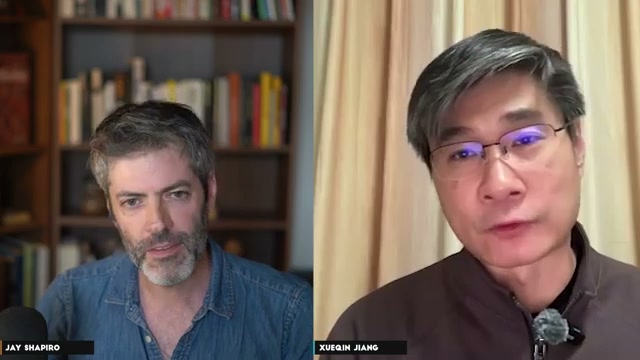
Frame at 00:05:46
Jiang shares an extensive personal narrative of childhood poverty, bullying, speech impediment, violence at home, depression, suicidal thoughts, and eventual salvation through his wife -- establishing emotional connection and positioning himself as an authentic truth-seeker rather than an establishment figure.
Creates sympathy and identification, making the audience more receptive to his unconventional claims. The 'outsider who overcame adversity' narrative frames his conspiracy theories as the courageous insights of someone who sees what comfortable elites cannot.
Thought experiment insulation 00:19:55
Frame at 00:19:55
'I'm doing everything as a thought experiment... let's try different possibilities and let's see what sticks as opposed to like this rigorous academic research.'
Pre-emptively deflects criticism by framing extraordinary claims as speculative exercises rather than assertions. This allows Jiang to advance conspiracy theories (Freemasons control geopolitics, 9/11 was an inside job) while maintaining plausible deniability about whether he actually believes them.
False equivalence between skepticism levels 01:10:02
Frame at 01:10:02
Questioning the Masada narrative (supported by legitimate archaeological debate) is presented as equivalent to questioning the Holocaust's documentary record, the Dead Sea Scrolls' authenticity, and the moon landing -- as if all are equally uncertain.
Normalizes extreme historical skepticism by embedding it within more defensible forms of questioning. The audience is led from reasonable skepticism about national myths to Holocaust minimization through seamless rhetorical escalation.
Epistemic learned helplessness 00:29:30
Frame at 00:29:30
Jiang describes searching the internet for Holocaust evidence and finding nothing, then concluding 'there's no direct evidence for it that I could find which I found really frustrating.'
Models a research methodology (internet searching) that is guaranteed to produce confusion, then presents the resulting confusion as evidence of an actual evidentiary gap. The audience is taught that standard historical knowledge is unreliable because a non-expert couldn't verify it through casual internet research.
Admitted ignorance as credential 00:48:38
Frame at 00:48:38
'This is my working theory of how the world works without any evidence, right? So, so, this is all speculation on my part.'
Paradoxically, the frank admission of having no evidence functions as a rhetorical asset -- it signals intellectual honesty and makes the audience more inclined to trust the framework. The audience perceives transparency where there is actually an absence of rigor.
Conspiratorial escalation ladder 00:16:58
Frame at 00:16:58
The conversation moves from reasonable questioning of national myths (Masada) to Holocaust minimization to 9/11 trutherism to moon landing skepticism to secret society control of world events, with each step normalized by the preceding one.
Each level of conspiracy theory serves as a stepping stone to the next. The host explicitly notes this ('at some point that paragraph shifted into like wait what why are we talking about the Freemasons now?') but continues the conversation rather than challenging the escalation.
Reversal of burden of proof 00:28:49
Frame at 00:28:49
Jiang claims there is no direct evidence for the Holocaust's systematic nature, placing the burden on the historical record to prove itself to him rather than on his extraordinary claim to demonstrate why the existing evidence is insufficient.
Shifts the standard of evidence so that the absence of easily googleable documentation is treated as equivalent to the absence of documentation itself, immunizing the claim against the vast archival record he never consulted.
Exotic knowledge appeal 01:02:42
Frame at 01:02:42
References to Kabbalah, Hermetic philosophy, Adam Kadmon, the will to bestow vs. the will to receive, Jacob Frank, and Albert Pike create an impression of deep esoteric learning that lends authority to the conspiracy framework.
The audience cannot easily evaluate these references and so defers to the speaker's apparent expertise. The exotic terminology creates an aura of hidden knowledge accessible only to those who have done the research.
Both-sides framing of asymmetric claims 00:23:02
Frame at 00:23:02
The host frames the conversation as 'somewhere between' his 14-year-old self being told Hitler was a monster and the claim that the Holocaust didn't happen, positioning truth as equidistant between these two poles.
Creates a false middle ground where the 'truth' appears to lie between the mainstream historical consensus and outright Holocaust denial, when in reality the evidentiary asymmetry is overwhelming.
Self-fulfilling prophecy framing 00:42:21
Frame at 00:42:21
Jiang argues that eschatology is important not because prophecies are supernaturally true but because powerful people believe them and work to fulfill them -- making the prophecies operationally real regardless of their metaphysical status.
This is the most intellectually sophisticated move in the interview. It allows the conspiracy framework to function without requiring evidence of supernatural causation -- the claim becomes unfalsifiable because any event can be interpreted as powerful actors following a script.
Frame at 00:29:30 ⏵ 00:29:30
I'm not saying the Holocaust didn't happen. It must have happened but there's no direct evidence for it that I could find which I found really frustrating.
This is the quote that generated the most controversy. It reveals both Jiang's methodology (internet research rather than archival or scholarly sources) and his willingness to advance claims that are factually wrong while framing them as honest intellectual inquiry. The Wannsee Conference minutes, Einsatzgruppen reports, Posen speeches, and Auschwitz blueprints constitute overwhelming 'direct evidence.'
Jiang's approach of 'I searched the internet and couldn't find evidence' mirrors exactly the kind of casual, uninformed inquiry that he criticizes when Western audiences accept mainstream narratives without investigation. His own research on the Holocaust is precisely as lazy and mythology-driven as the 'Hitler was a monster' education he criticizes.
Frame at 00:48:38 ⏵ 00:48:38
This is my working theory of how the world works without any evidence, right? So, so, this is all speculation on my part.
A remarkably candid admission that his entire framework of transnational elite control through secret societies is evidence-free speculation. This contradicts the confident assertions in his lecture series where these ideas are presented as analytical conclusions.
Frame at 00:19:47 ⏵ 00:19:47
Unless you factor in the eschatology and the secret societies I think it's very hard to explain what's going on.
Reveals the core methodological commitment: when standard explanations seem insufficient, the answer is secret societies rather than the possibility that the speaker's understanding of standard explanations is itself insufficient. This is a classic 'god of the gaps' argument applied to geopolitics.
China's own opaque decision-making process, where the CCP Politburo Standing Committee makes world-altering decisions in secret, is a far more documented example of secretive elite control than the Freemason conspiracy Jiang invokes -- yet he never applies this framework to China.
Frame at 00:48:01 ⏵ 00:48:01
Israel was working for him, right? So, it's almost like these nation states, Israel, United States, Russia, they're all puppets of people behind the curtain, this transnational elite.
The most explicit statement of Jiang's conspiracy framework: nation-states are not sovereign actors but puppets of a hidden transnational elite. This claim is presented 'without any evidence' by his own admission.
Frame at 00:54:00 ⏵ 00:54:00
What an elite education does is it educates you out of religion, right? And it teaches you to think in a certain way that is non-religious and the reality is that most of humans are religious.
One of the more intellectually interesting observations in the interview. It identifies a genuine blind spot in secular analytical frameworks that dismiss religious motivation as irrational. However, Jiang overcorrects by treating eschatology as the primary driver of geopolitics rather than one factor among many.
China's own elite education system under the CCP explicitly educates citizens out of religion and into materialist ideology, yet Jiang never applies this observation to explain why Chinese analysts might have blind spots about religious motivation in global affairs.
Frame at 01:16:24 ⏵ 01:16:24
I was fat, I was a drunk, I was really depressed, I was suicidal. And then I met her and she was like an angel who came to save me.
The most emotionally raw moment in the interview. This personal vulnerability narrative serves multiple rhetorical functions: humanizing the controversial figure, establishing authentic struggle credentials, and framing his subsequent truth-seeking as redemptive mission rather than intellectual hobby.
Frame at 00:19:20 ⏵ 00:19:20
Trump went in without a plan, without a strategy, without a purpose. And now he's just making stuff up as he goes along.
An interesting departure from Jiang's own earlier framework (Geo-Strategy #8) where the Iran war was presented as a carefully orchestrated trap by multiple interest groups. Here, he characterizes it as planless improvisation, which is more consistent with actual events but contradicts his deterministic predictions.
Frame at 00:29:51 ⏵ 00:29:51
The mythology kind of always outruns the truth and that leads to people then questioning if the truth is the truth at all.
Spoken by the host, this is the most insightful meta-observation in the interview. It identifies the mechanism by which legitimate mythologization (e.g., the '6 million' number, the 'monster' framing of Hitler) creates a backlash of over-skepticism that can lead to denialism.
Frame at 01:13:27 ⏵ 01:13:27
I've committed my entire life to truth seeking... being with her has really convinced me that truth seeking is the highest good in this world.
The moral self-framing that underlies the entire interview. Jiang presents himself as a gnostic truth-seeker for whom knowledge is salvation. This frames any criticism of his claims as opposition to truth itself, making it harder for audiences to disagree without feeling they are anti-truth.
Jiang's 'truth-seeking' notably never extends to seeking truth about China's own historical suppressions -- the Great Leap Forward famine (30-45 million dead), the Cultural Revolution, Tiananmen Square, or the Uyghur detention camps. His truth-seeking is selectively aimed at Western and Israeli narratives while the country he has lived in for 25+ years receives no such scrutiny.
Frame at 00:45:41 ⏵ 00:45:41
Everyone is sick and tired of being lied to. And so they're certainly excited about you offering, in my view, sometimes an overly confident description of what might be happening.
The host's most incisive observation about the Professor Jiang phenomenon. It correctly identifies that Jiang's popularity stems from audience frustration with institutional credibility, not from the accuracy of his alternative framework. The phrase 'overly confident description' is the sharpest critique in the interview.
prediction Jiang predicted Trump would win in 2024.
00:10:09 · Falsifiable
confirmed
Trump won the November 2024 presidential election.
prediction Jiang predicted Trump would pick Nikki Haley as VP.
00:13:23 · Falsifiable
disconfirmed
Trump chose JD Vance. Jiang acknowledges this error in the interview.
prediction Jiang predicted the US would attack Iran, originally expected around 2027.
00:13:29 · Falsifiable
confirmed
Operation Midnight Hammer (June 2025) and full-scale US-Israeli campaign (Feb 28, 2026) confirmed. Timeline was earlier than predicted.
prediction Israel will blow up Al-Aqsa Mosque.
00:53:37 · Falsifiable
untested
Made by the host (Shapiro), endorsed by Jiang. Has not occurred as of April 2026.
prediction Humanity is heading to a really rough time but it will cause a spiritual awakening among people.
01:27:55 · Not falsifiable
unfalsifiable
claim The Holocaust happened but there is no direct evidence for systematic extermination by Hitler.
00:29:30 · Falsifiable
disconfirmed
Extensively documented: the Wannsee Conference minutes (Jan 1942), Einsatzgruppen operational reports, Korherr Report, Posen speeches (Oct 1943), Auschwitz construction records, transport documents, and thousands of survivor testimonies. Jiang's claim reflects failure to consult standard historical sources, not an absence of evidence.
claim Jeffrey Epstein was part of a transnational elite controlling nation-states, not merely a Mossad agent.
00:47:54 · Not falsifiable
unfalsifiable
claim Secret societies (Freemasons, Frankists, Jesuits) are the mechanism through which transnational capital controls the world.
00:48:28 · Not falsifiable
unfalsifiable
claim Trump went into the Iran war without a plan, without a strategy, without a purpose.
00:19:20 · Falsifiable
partially confirmed
The war has lacked a clear exit strategy and Trump's stated goals have shifted repeatedly (from nuclear program to Hormuz reopening to 'take the oil'). However, Operation Midnight Hammer was a planned military operation, not entirely planless.
Verdict

Strengths

The interview provides genuine biographical insight into Jiang as a person -- his difficult childhood, immigrant experience, Yale education, struggles in China, and relationship with his wife humanize a controversial figure. His acknowledgment of specific prediction failures (Nikki Haley VP, 2027 timeline) demonstrates intellectual honesty rare among public predictors. The observation that elite secular education creates a blind spot for understanding religious motivation in geopolitics is genuinely insightful. The host provides valuable moderate pushback, particularly on the secret society framework and the difference between 'people running the world we don't know who they are' versus identifiable institutional power. The discussion of how national myths (Masada) are constructed and maintained as political tools contains legitimate historical observations supported by archaeological scholarship.

Weaknesses

The interview's most serious failing is the Holocaust discussion, where Jiang claims to have found 'no direct evidence' for systematic extermination. This is not a matter of interpretation but of factual error -- the evidence is voluminous, well-documented, and available in any university library or legitimate online archive. The claim reveals that Jiang's 'research' consists of internet browsing rather than engagement with primary sources or scholarly literature. The secret society framework is presented as evidence-free speculation by Jiang's own admission, yet it drives increasingly prominent elements of his analysis. The conspiratorial escalation -- from reasonable myth-questioning to 9/11 trutherism, moon landing skepticism, and Freemasonic world control -- demonstrates how the 'thought experiment' framing enables the normalization of unsupported claims. The complete absence of critical scrutiny toward China, where Jiang has lived for 25+ years, represents a massive analytical blind spot that undermines his credibility as a neutral truth-seeker.

Cross-References

BUILDS ON

  • Geo-Strategy series (referenced as 'my first series on geo-strategy where I made the prediction that the United States would attack Iran')
  • Civilization series ('60 lectures on the history of human civilization')
  • Game Theory series (referenced as 'standard geopolitical theory that I have, game theory')
  • Geo-Strategy #8: The Iran Trap (Jiang references his 2027 invasion prediction and Nikki Haley VP prediction as errors)

CONTRADICTS

  • Geo-Strategy #8: The Iran Trap -- In that lecture, the Iran war was presented as a carefully planned trap orchestrated by converging interest groups (AIPAC, Wall Street, Saudi Arabia). Here, Jiang says 'Trump went in without a plan, without a strategy, without a purpose.' The deterministic conspiracy framework has shifted to accommodate the messier reality.
  • Earlier Civilization and Geo-Strategy lectures where Jiang states he 'did not discuss secret societies at all' and 'did not discuss conspiracy theories at all' -- this interview reveals how his framework has shifted toward conspiracy in recent years.
This interview reveals a significant evolution in Jiang's analytical framework. His early work (Geo-Strategy, Civilization) relied on game theory, historical analogy, and structural analysis. His recent work increasingly incorporates Freemasonry, eschatology, Frankism, and secret society conspiracy theories. The interview exposes the methodological weakness underlying this shift: internet research rather than scholarly engagement, pattern-matching without falsification criteria, and the 'thought experiment' framing that insulates claims from critical evaluation. The host's moderate pushback highlights how the secret society framework is Jiang's weakest analytical contribution, contrasting with his stronger work on historical patterns and civilizational dynamics.