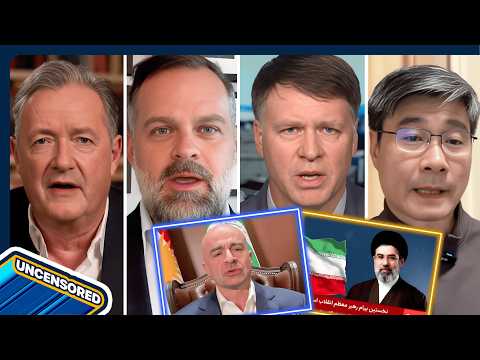
Jiang argues that because his predictions about Trump winning and the Iran war came true, his theories about secret societies driving events must have 'some legitimacy.'
Creates a false logical bridge between accurate predictions and unfounded conspiracy theories. Many different causal theories could yield the same predictions; correct outcomes do not validate the specific mechanism proposed.
Jiang moves from mainstream observations (Christian Zionist organizations exist, CUFI has 7 million members) to extraordinary claims (Freemasons, Sabbatean Frankists, and Jesuits have scripted the apocalypse) without evidentiary transitions.
Uses factual anchoring points to smuggle in unfounded conspiracy theories, making the extraordinary claims seem like natural extensions of verifiable facts.
Jiang lays out a complete eschatological script: Middle East war → defeat of American empire → Greater Israel → Pax Judaica → War of Gog and Magog → Third Temple → Jewish Messiah/Antichrist.
The completeness and specificity of the narrative creates a sense of inevitability and insider knowledge, while the apocalyptic framing triggers deep emotional engagement that bypasses critical analysis.
When discussing economic consequences, Jiang says 'these young men could not afford their OnlyFans anymore and this could lead to a revolution in the streets.'
The joke disarms the audience and creates rapport, while simultaneously trivializing serious economic analysis and embedding a contemptuous view of American society within a comedic frame that makes it harder to challenge.
Jiang presents only two options for Trump: send ground forces (leading to quagmire) or withdraw (leading to economic collapse as GCC pays 'ransom' to Iran). No middle ground of continued air operations, negotiation, or limited engagement is considered.
Forces the audience to accept one of two catastrophic outcomes, making American defeat seem inevitable regardless of the path chosen.
Calling the US economy a 'Ponzi scheme' dependent on GCC investment and the Strait of Hormuz closure a 'point of no return.'
The Ponzi scheme metaphor implies fundamental illegitimacy and inevitable collapse, while 'point of no return' creates urgency and fatalism that discourages consideration of recovery scenarios.
Appeal to eschatological authority
00:53:14
Jiang claims the 'real power base' is not Israel but 'a collection of secret societies that have an eschatological view of this war,' citing Freemasons, Rosicrucians, Knights Templar, Sabbatean Frankists, and Jesuits.
Invokes hidden knowledge that cannot be verified or falsified, positioning the speaker as someone with access to deeper truths while making the theory immune to empirical challenge.
The video is structured so that the Piers Morgan brand and the credibility of other panelists (Navy SEAL, Congressman, Haaretz journalist, Kurdish leader) precede Jiang's segment, lending him borrowed authority.
Jiang's appearance on a mainstream Western media program is used to legitimize his analysis, even though the host visibly pushes back on his conspiracy claims.
Jiang describes his work as 'predictive modeling' and 'speculative analysis' rather than historical analysis, saying 'I'm going to throw some theories out there and see what the predictions are.'
This framing allows Jiang to avoid the evidentiary standards of historical or political analysis while still claiming legitimacy when predictions prove correct. The word 'modeling' implies rigor, while 'speculative' provides an escape hatch.
Catastrophizing through supply chain analysis
00:48:32
Jiang connects the Strait of Hormuz closure to food production (via fertilizer), semiconductor production (via sulfuric acid), AI, global travel, and jet fuel, arguing all are dependent on GCC products.
By tracing interconnected supply chain dependencies, Jiang makes the consequences seem overwhelming and inescapable, though the analysis ignores alternative supply sources, strategic reserves, and the resilience of diversified economies.
prediction
The United States will be compelled to send ground forces into Iran.
untested
As of May 1, 2026 (Day 63), NO US ground troops are in Iran. War remains air/naval. HOWEVER, on Apr 30 CENTCOM Cmdr Cooper and Joint Chiefs Chair Caine made the FIRST CABINET-LEVEL formal presentation of military options to Trump including a Hormuz seizure that 'could include ground forces' and special-forces uranium-recovery — first material upward shift in ground-invasion probability since the war began. Trump has not ordered kinetic ground action; only the 192nd MP Battalion (~150 CT National Guard logistics-support) has mobilized; USS Ford is leaving theatre. Ground probability now LOW-BUT-NON-ZERO. Forward-looking prediction reverts from disconfirmed to untested given the formal option presentation. [June 1, 2026 update] The prediction remains live, but the near-term trajectory is de-escalation toward a 60-day ceasefire MOU, not ground commitment. As of June 1, 2026 (Day 95) there are still ZERO US ground troops in Iran. Since the Apr 30 Cooper/Caine cabinet briefing that first put ground-inclusive options on the table, the trajectory reversed toward de-escalation: through late May US and Iranian negotiators reached a tentative 60-day ceasefire MOU (Iran pledging never to develop or purchase a nuclear weapon; a negotiated Hormuz reopening with no tolls + Iranian mine-clearing + proportional blockade lift), pending final approval by Trump and Mojtaba Khamenei -- not signed as of June 1 (Trump requested edits May 31 rather than signing). The principal US instrument remains the naval blockade (CENTCOM: ~118 vessels redirected + 5 disabled). The named deal-failure alternative is an air/strike package ('end it a different way'; Hegseth at the Shangri-La Dialogue: 'more than capable' of resuming strikes), not a ground order. No new ground-deployment order, no third ARG, no draft. Israel's capture of Beaufort Castle in Lebanon (May 31) is an Israeli ground operation in Lebanon, NOT US ground troops in Iran.
prediction
Once ground forces are sent in, it will become another Vietnam for the US due to the sunk cost fallacy.
untested
As of May 1, 2026 (Day 63): No ground forces sent to Iran. War remains air/naval. Apr 30 CENTCOM presentation included ground-inclusive Hormuz-seizure option as first cabinet-level formal option, but Trump has not ordered ground action. Conditional prediction cannot be tested until/unless ground deployment occurs. [June 1, 2026 update] The prediction remains live, but the near-term trajectory is de-escalation toward a 60-day ceasefire MOU, not ground commitment. As of June 1, 2026 (Day 95) there are still ZERO US ground troops in Iran. Since the Apr 30 Cooper/Caine cabinet briefing that first put ground-inclusive options on the table, the trajectory reversed toward de-escalation: through late May US and Iranian negotiators reached a tentative 60-day ceasefire MOU (Iran pledging never to develop or purchase a nuclear weapon; a negotiated Hormuz reopening with no tolls + Iranian mine-clearing + proportional blockade lift), pending final approval by Trump and Mojtaba Khamenei -- not signed as of June 1 (Trump requested edits May 31 rather than signing). The principal US instrument remains the naval blockade (CENTCOM: ~118 vessels redirected + 5 disabled). The named deal-failure alternative is an air/strike package ('end it a different way'; Hegseth at the Shangri-La Dialogue: 'more than capable' of resuming strikes), not a ground order. No new ground-deployment order, no third ARG, no draft. Israel's capture of Beaufort Castle in Lebanon (May 31) is an Israeli ground operation in Lebanon, NOT US ground troops in Iran.
prediction
The global economy has reached a 'point of no return' due to the Strait of Hormuz closure and will require de-industrialization and mercantilism to survive future shocks.
untested
Hormuz blockade confirmed since March 2, 2026. Devastating impact on Gulf and global energy but too early to call permanent economic restructuring.
prediction
Iran wants to push oil prices to $200 a barrel by keeping the Strait of Hormuz closed for months.
untested
Oil peaked ~$126/bbl in March 2026 but crashed to $91-95/bbl range on Apr 15 as markets price in resumed talks. Iran's Hormuz blockade + IRGC tolling did push prices above $100 but the $200 target has not been reached. US naval blockade (Apr 13) has shifted the dynamics — Iran's ability to monetize Hormuz control is now contested.
prediction
If the US withdraws, GCC nations will be forced to pay ransom to Iran and the petrodollar system will shift to BRICS, gold, or an alternative financial system.
untested
prediction
The Greater Israel project will see Israel control the Middle East from the Nile to the Euphrates, transforming into a 'Pax Judaica' AI surveillance state.
unfalsifiable
Reclassified: speculative/conspiratorial claim without empirical testability.
prediction
Vietnam and Thailand have already ordered government workers to work from home to save fuel due to the oil crisis.
untested
Unable to verify this specific claim. If true, it supports the severity of the oil price shock; if false, it is fabricated supporting evidence.