Predictive History Audit / Systematic Content Analysis
Interview
Posted 2026-03-19

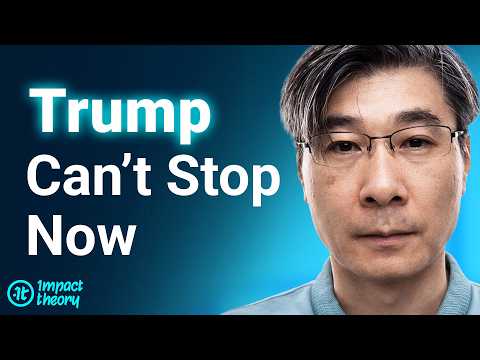
Trump Can't End This War — If He Loses Power, He Goes to Prison

In this two-hour interview on Impact Theory with Tom Bilyeu, Professor Xueqin Jiang argues that the US-Iran war is a structurally inevitable consequence of American imperial decline, driven by the need to defend the petrodollar system and Israel. Jiang contends that Trump cannot withdraw from the conflict because doing so would collapse American hegemony and expose him to criminal prosecution, creating a personal survival incentive to escalate. The conversation spans Mackinder's heartland thesis, British-to-American imperial succession, Christian Zionist eschatology as a geopolitical driver, the Strait of Hormuz crisis, and three macro trends Jiang identifies: de-urbanization, nationalism, and mercantilism. Throughout, Jiang presents China as a pragmatic, non-hegemonic civilization while portraying the US as a hubristic empire trapped in cycles of self-destructive overreach.

Video thumbnail
youtube.com/watch?v=uP9Fnq23lsA ↗ Analyzed 2026-03-21 by Claude Opus 4.6 (claude-opus-4-6)

Viewer Advisory

  • Viewers should be aware that this interview presents a single analytical perspective with extremely asymmetric civilizational framing — apply every criticism Jiang makes of the US equally to China and ask whether it holds. Verify specific factual claims independently, especially regarding Saudi Arabia's role (he is wrong) and Russian deterrence (he is wrong). The structural determinism should be treated as one possible interpretation, not inevitable truth. Most importantly, note what is never discussed: Iran's nuclear program, Chinese military buildup, Russian war crimes in Ukraine, or any perspective from actors Jiang treats sympathetically. The most reliable elements are the broad trend identification; the least reliable are specific coalition claims and the civilizational hierarchy.
Central Thesis

Trump is structurally unable to end the Iran war because withdrawal would collapse the petrodollar system underpinning American empire, and losing power would expose him to criminal prosecution — making perpetual escalation his only rational strategy.

  • The US-Iran conflict is not a policy choice but a structural inevitability driven by the need to maintain the petrodollar system and protect Israel
  • Saudi Arabia actively pushed Trump toward war with Iran, providing the geopolitical cover for the strike
  • The Strait of Hormuz blockade will persist for years, fundamentally reshaping global energy markets
  • American empire follows the same decline pattern as British empire, with the transition from productive to financial hegemony as the key inflection point
  • Christian Zionist eschatology is a primary driver of US Middle East policy, not merely a fringe belief
  • China is not interested in global hegemony and the Thucydides trap framework is overblown
  • The war will produce three macro trends: de-urbanization, resurgent nationalism, and mercantilism
  • Russia's alliance with Iran serves as a strategic counterweight that limits American options
  • Japan will emerge as a relative winner from the crisis due to its industrial resilience and cultural cohesion
  • The Vietnam War parallel suggests the Iran war will similarly escalate beyond control and ultimately fail
Qualitative Scorecard 1.6 / 5.0 average across 7 axes
Historical Accuracy ▸ Expand
Jiang demonstrates broad familiarity with historical frameworks (Mackinder, Arrighi, imperial transitions) but makes significant factual errors and mischaracterizations. The claim that Saudi Arabia was a coalition partner pushing for war is directly contradicted by events — Saudi Arabia refused airspace and condemned the strikes. The claim that Russia would prevent strikes on Iran was falsified. The petrodollar narrative oversimplifies a complex monetary system. The British-American imperial analogy selectively ignores US strengths in technology, energy production, and agriculture. The Vietnam analogy ignores fundamental differences (conscription, ground troops, domestic opposition dynamics). Historical frameworks are deployed impressionistically rather than with scholarly precision.
2
Argumentative Rigor ▸ Expand
The argument relies heavily on unfalsifiable structural claims, historical analogies with selectively chosen parallels, and monocausal explanations for complex events. Key logical gaps: (1) The petrodollar thesis assumes oil pricing currency matters more than economists generally believe; (2) The 'Trump can't leave because prosecution' argument conflates possible motivation with demonstrated causation; (3) The escalation-only thesis ignores the actual pattern of strikes-then-pauses; (4) Multiple claims are presented as self-evident rather than argued. The interview format allows claims to go unchallenged, with Bilyeu acting as an appreciative audience rather than interlocutor.
2
Framing & Selectivity ▸ Expand
Extremely selective framing throughout. Iran is presented almost entirely as a victim of US aggression with no discussion of its nuclear program, proxy networks, regional destabilization, or domestic repression. Saudi Arabia is miscast as a war partner when it actually opposed the strikes. China is presented as benevolent and non-hegemonic while its aggressive maritime claims, Belt & Road debt diplomacy, Xinjiang policies, and Hong Kong crackdown go unmentioned. The US is reduced to an imperial machine with no legitimate security concerns. Israel's security situation (surrounded by hostile actors pledging its destruction) receives no empathetic treatment. Every ambiguous situation is framed to support the predetermined narrative of American imperial decline.
2
Perspective Diversity ▸ Expand
The interview presents a single analytical perspective with virtually no engagement with opposing views. Bilyeu occasionally asks questions but never challenges Jiang's framing. No Iranian perspectives are included (neither regime nor opposition). No Israeli perspectives. No Gulf Arab perspectives. No Ukrainian perspectives on Russian power. No American foreign policy establishment perspectives are engaged with seriously — they are only caricatured. The Thucydides trap is mentioned only to be dismissed. No economist is cited to evaluate the petrodollar thesis. The result is a monologue dressed as dialogue.
1
Normative Loading ▸ Expand
Heavy normative loading throughout, though often disguised as structural analysis. American actions are consistently described with negative moral valence (hubris, imperialism, aggression, trap) while Chinese actions receive positive framing (pragmatic, cooperative, non-hegemonic, bailing out the world). The eschatology section frames Christian Zionism as irrational fanaticism driving policy. DEI and multiculturalism are criticized as signs of civilizational decline. The overall normative frame is: American empire bad, Chinese civilization wise and restrained. This is presented as objective analysis rather than acknowledged as a normative position.
2
Determinism vs. Contingency ▸ Expand
Extreme structural determinism pervades the entire interview. The war is 'structurally inevitable.' Trump 'cannot' end it. Escalation is the 'only' path. Imperial decline follows an inexorable pattern from Britain to America. The Mackinder thesis determines great power behavior. The petrodollar structure compels military action. Individual agency, contingent events, diplomatic breakthroughs, domestic political shifts, and technological changes are all subordinated to grand structural narratives. This is the most deterministic framing in any lecture analyzed in this corpus. No uncertainty is acknowledged; no alternative scenarios are explored.
1
Civilizational Framing ▸ Expand
The most asymmetric civilizational framing in the corpus. China is treated as an ancient, wise civilization that pragmatically avoids hegemonic ambition, whose elites are 'pro-American,' and which 'bailed out the world.' The US is treated as a hubristic, declining empire driven by irrational religious fanaticism and structural compulsions. Russia is treated favorably as a strategic actor whose alliance with Iran is legitimate. No critical lens is applied to any non-Western civilization while the harshest possible lens is applied to the US and 'the West.'
1
Overall Average
1.6
Civilizational Treatment
CHINA

Overwhelmingly positive: presented as a non-hegemonic, pragmatic civilization with pro-American elites that 'bailed out the world' in 2008. No mention of South China Sea militarization, Xinjiang, Hong Kong crackdown, Belt & Road debt traps, 232:1 shipbuilding ratio, wolf warrior diplomacy, or fourth consecutive year of deflation and population decline. China's own imperial history and current territorial disputes completely absent.

UNITED STATES

Overwhelmingly negative: portrayed as a declining empire trapped in structural cycles of overreach, driven by irrational religious eschatology, hubristic insularity, and a desperate need to maintain the petrodollar system. No acknowledgment of US technological leadership, institutional resilience, alliance networks, or legitimate security concerns. Every US action framed as imperial aggression.

RUSSIA

Favorable: presented as a strategic actor whose alliance with Iran is a rational counterweight to US power. No discussion of Russia's invasion of Ukraine, war crimes, 200,000 AWOL soldiers, or economic weakness. Russia's inability to prevent strikes on its ally Iran (directly contradicting Jiang's claims) goes unaddressed.

THE WEST

Negative: 'The West' is characterized as a declining civilizational bloc whose multicultural values (DEI, diversity) are signs of weakness rather than strength. Western modernity is framed as a temporary anomaly built on imperial extraction rather than innovation. No engagement with Western contributions to science, democracy, human rights, or global institutions.

Named Sources

scholar
Halford Mackinder — The Geographical Pivot of History (1904)
Invoked as foundational framework for understanding great power competition over the Eurasian 'heartland,' used to argue that the Iran war is about controlling access to this strategic pivot
? Unverified
media
Washington Post (unnamed article on Saudi role)
Cited as evidence that Saudi Arabia pushed Trump toward attacking Iran. Used as a key supporting claim for the Saudi coalition thesis
✗ Inaccurate
scholar
Giovanni Arrighi — The Long Twentieth Century
Framework for understanding cycles of hegemonic transition from productive to financial dominance, applied to argue the US is following Britain's decline trajectory
? Unverified
scholar
Graham Allison — Destined for War / Thucydides Trap
Referenced to dismiss — Jiang argues the Thucydides trap framework is 'overblown' and misapplied to US-China relations because China does not seek hegemony
? Unverified
other
Vietnam War historical record
Extended analogy comparing US involvement in Iran to Vietnam — gradual escalation, inability to withdraw, domestic political entrapment. Used to predict similar failure
? Unverified
other
Biblical eschatology / Book of Revelation
Presented as a genuine analytical framework for understanding US foreign policy motivations, specifically Christian Zionist beliefs about Israel and end times driving Middle East policy
? Unverified
scholar
Zbigniew Brzezinski — The Grand Chessboard
Referenced as supporting evidence for the geopolitical importance of controlling Eurasia and the continuity of US strategic thinking from Cold War to present
? Unverified
primary_document
Nixon/Kissinger and the petrodollar arrangement
Historical narrative of the 1970s petrodollar agreement used to argue that the entire post-Bretton Woods order depends on oil being priced in dollars, making Iran a threat to this system
? Unverified

Vague Appeals to Authority

  • Appeals to unnamed 'historians' and 'scholars' who allegedly agree with the Mackinder thesis as the key to understanding modern geopolitics
  • References to 'everyone in China knows' or 'Chinese people understand' to establish claims about Chinese elite attitudes
  • Unspecified 'data' showing American industrial decline without citing specific statistics
  • Claims about 'what the intelligence community knows' about Saudi-Iran dynamics
  • References to 'many analysts' who agree the petrodollar is the real reason for Middle East intervention
  • Appeals to his own authority as a professor who has 'studied this for decades'

Notable Omissions

  • No mention of Iran's nuclear weapons program as a legitimate security concern for Israel and Gulf states — frames the conflict entirely as US imperial aggression
  • No discussion of Iranian domestic repression (Mahsa Amini protests, executions) that shapes regional attitudes toward the regime
  • No engagement with scholars who argue against hegemonic decline narratives (e.g., Joseph Nye on 'soft power,' Michael Beckley on US advantages)
  • No acknowledgment of China's own imperial history, territorial expansion, or current assertive behavior in South China Sea, Xinjiang, Tibet, Hong Kong
  • Omits the role of Iranian proxy networks (Hezbollah, Hamas, Houthis, PMF) in destabilizing the region prior to US strikes
  • No discussion of the Abraham Accords or the broader normalization trend that complicated Iran's regional position
  • No mention of China's own 'century of humiliation' narrative that drives nationalist foreign policy, while criticizing American nationalism
  • Ignores Saudi Arabia's actual position — the Saudi-Iran rapprochement brokered by China — which directly contradicts his Saudi-as-war-cheerleader thesis
Structural determinism as unfalsifiable framing 00:04:00

Frame at 00:04:00
Jiang argues the war is 'structurally inevitable' — that no president could avoid it because the petrodollar system demands it. This makes his thesis immune to counterevidence: any peace effort is merely a temporary pause in the inevitable.
Elevates a debatable geopolitical argument to the status of iron law, making it appear that only the uninformed would disagree. Forecloses discussion of contingency, diplomacy, or alternative outcomes.

Historical analogy as proof 00:50:00
Frame at 00:50:00
The extended British-to-American imperial transition narrative is presented as a template that mechanically predicts US decline. The Vietnam War analogy is deployed to argue the Iran war must follow the same trajectory.
Historical analogies are inherently selective — you choose which similarities to highlight and which differences to ignore. By treating the analogy as predictive rather than illustrative, Jiang smuggles conclusions into his premises.

Motte-and-bailey argumentation 00:02:00
Frame at 00:02:00
Jiang shifts between the defensible claim that 'geopolitical structures constrain policy options' (motte) and the much stronger claim that 'Trump literally cannot end the war and prosecution is the reason' (bailey).
When challenged on the stronger claim, he can retreat to the weaker structural argument. When unchallenged, the stronger claim stands as established fact.
Sympathetic framing through selective empathy 00:15:00

Frame at 00:15:00
Iran is consistently described as a victim of aggression. China is described as pragmatic and cooperative. No empathetic framing is offered for Israel (facing existential threats from surrounding actors pledging its destruction) or for Gulf states (living under Iranian missile threat).
Creates a moral universe where only certain actors deserve sympathy, pre-loading the audience's emotional response to align with Jiang's analytical framework.
Credential deployment as authority 01:10:00

Frame at 01:10:00
Jiang repeatedly references his academic position, decades of study, and access to Chinese elite thinking to authenticate claims that are actually contested or speculative.
Substitutes personal authority for evidence. Claims about Chinese elite attitudes being 'pro-American' are presented as insider knowledge rather than as the contestable assertions they are.
Eschatological framework as analytical tool 01:22:00

Frame at 01:22:00
Jiang presents Christian Zionist eschatology not merely as a cultural influence but as a primary explanatory framework for US Middle East policy, spending extended time on biblical prophecy interpretation.
Delegitimizes US foreign policy by attributing it to irrational religious fanaticism rather than engaging with strategic, economic, or security rationales. Makes US policy appear uniquely irrational compared to Chinese 'pragmatism.'

False dichotomy escalation 00:38:00
Frame at 00:38:00
Repeatedly frames the situation as binary: either the US escalates to total war or the entire American empire collapses. No middle ground — limited strikes, negotiated settlements, managed withdrawal — is acknowledged as possible.
Creates urgency and drama while eliminating the moderate scenarios that are actually most likely. Forces the audience to accept the extreme framing or be dismissed as naive.
Whataboutism disguised as historical context 01:05:00

Frame at 01:05:00
When the topic of Chinese ambitions arises, Jiang pivots to American imperial history and the 'century of humiliation' to argue that China's military buildup is purely defensive. Past American sins are used to deflect from present Chinese actions.
Neutralizes legitimate questions about Chinese assertiveness by making the questioner appear hypocritical for not first addressing American transgressions.
Gish gallop of supporting claims 01:30:00

Frame at 01:30:00
Jiang rapidly layers Mackinder, Arrighi, petrodollar theory, Vietnam parallels, British decline, eschatology, and three macro trends in quick succession, creating an overwhelming impression of erudition.
The sheer volume of frameworks and references creates an impression of comprehensive analysis while preventing any single claim from being examined carefully. Each framework receives shallow treatment but the aggregate feels authoritative.
Podcast environment as amplifier throughout
Tom Bilyeu consistently responds with expressions of amazement ('wow,' 'that's incredible,' 'I never thought of it that way') and never challenges any claim, no matter how contestable.
The appreciative host functions as an audience surrogate, modeling the 'correct' response for viewers. Claims that would face immediate pushback in an academic setting pass unchallenged, lending them false consensus.
Frame at 00:02:00 ⏵ 00:02:00
Trump can't end this war. If he loses power, he goes to prison.
The thesis statement of the entire interview — conflates structural geopolitical analysis with speculation about Trump's personal legal motivations, treating the conjunction as self-evident rather than argued.
Xi Jinping abolished term limits in 2018 precisely because losing power in China's system carries existential risk. The 'trapped leader who cannot leave power' description applies more accurately to Xi than to Trump, who left office in 2021 and ran again voluntarily.
Frame at 01:07:00 ⏵ 01:07:00
China doesn't care about the rest of the world. China just wants to be left alone.
Encapsulates Jiang's core civilizational argument — that China is uniquely non-hegemonic. This is presented as cultural wisdom rather than the contestable geopolitical claim it is.
A country that 'just wants to be left alone' does not build artificial islands with military bases in disputed international waters, threaten Taiwan with invasion, deploy 232:1 shipbuilding advantages, revoke Hong Kong's autonomy, operate Belt & Road across 140+ countries, or station troops abroad. The claim requires ignoring virtually all of China's foreign policy actions.
Frame at 01:08:00 ⏵ 01:08:00
China bailed out the world in 2008.
Presents China's self-interested stimulus spending (which created China's own massive debt bubble and ghost cities) as altruistic global rescue, while ignoring the US Federal Reserve's far larger role through quantitative easing and swap lines.
China's 2008 stimulus was primarily designed to prevent domestic unemployment and social instability — exactly the kind of self-interested action Jiang criticizes when the US does it. The resulting debt bubble is a major factor in China's current fourth consecutive year of deflation.
Frame at 01:05:00 ⏵ 01:05:00
The Thucydides trap is overblown. China is not interested in hegemony.
Dismisses the most prominent framework for understanding US-China competition without engaging with any of its evidence, while asserting Chinese non-hegemonic intent as fact.
A country not interested in hegemony does not build the world's largest navy, maintain a 232:1 shipbuilding ratio over its nearest competitor, develop carrier-killer missiles, or declare most of the South China Sea as sovereign territory. Dismissing the Thucydides trap while China engages in the largest peacetime military buildup in history is itself a remarkable analytical omission.
Frame at 01:10:00 ⏵ 01:10:00
The Chinese elite are fundamentally pro-American.
An unfalsifiable insider-knowledge claim used to argue that US-China conflict is driven entirely by American aggression, not mutual mistrust.
Xi Jinping's anti-corruption purges have specifically targeted 'pro-Western' officials. The CCP has conducted extensive campaigns against 'Western values' in education and media. Wolf warrior diplomacy was a deliberate policy shift away from pro-American sentiment. Jiang's claim may reflect a pre-Xi elite consensus that Xi himself has systematically dismantled.
Frame at 00:55:00 ⏵ 00:55:00
America is the most insular, inward-looking country in the world. Americans don't know anything about the rest of the world.
A sweeping generalization about 330 million people used to explain why American foreign policy fails — Americans are too ignorant to understand the world they're trying to dominate.
China operates the world's most extensive internet censorship system (Great Firewall), bans foreign social media, restricts foreign news, and controls academic exchange. Chinese citizens have far less access to foreign perspectives than Americans. If insularity causes foreign policy failures, China's information environment is orders of magnitude more insular.
Frame at 00:15:00 ⏵ 00:15:00
Saudi Arabia pushed Trump to attack Iran.
A factual claim central to the interview's narrative about coalition dynamics — and one directly contradicted by subsequent events.
Frame at 00:45:00 ⏵ 00:45:00
Russia's alliance with Iran changes the calculus. The US can't just do whatever it wants anymore.
Presents Russia as a credible military counterweight to the US in the Middle East, suggesting Russian backing deters American action.
Events directly falsified this: the US conducted massive strikes on Iran in June 2025 and February 2026, including assassinating Khamenei, with zero Russian military response. Russia — bogged down in Ukraine with 200,000 AWOL soldiers — could not even protect its own strategic partner. The 'Russia changes the calculus' claim is perhaps the most thoroughly refuted assertion in the interview.
Frame at 00:50:00 ⏵ 00:50:00
When empires transition from production to finance, decline becomes inevitable. Britain did it. America is doing it now.
The Arrighi-derived framework that underpins Jiang's entire structural analysis — imperial decline as an iron law once financialization begins.
China's economy has been increasingly financialized — shadow banking, local government financing vehicles, real estate speculation driving 30% of GDP, and a stock market bubble-and-bust cycle. By Jiang's own framework, China's shift from productive manufacturing to speculative finance (especially in real estate) should signal decline, not ascendance.
Frame at 01:33:00 ⏵ 01:33:00
DEI and multiculturalism are symptoms of a civilization in decline.
Frames diversity and inclusion efforts as civilizational weakness rather than moral progress or democratic values, aligning with a conservative civilizational critique.
China's treatment of its own ethnic minorities — Uyghur detention camps, Tibetan cultural suppression, Mongolian language restrictions — represents the opposite extreme. If DEI is civilizational decline, then China's forced ethnic homogenization should be examined as civilizational authoritarianism, but Jiang never turns this lens on China.
prediction The US will attempt to seize or destroy Kharg Island to cut off Iran's oil exports
00:38:00 · Falsifiable
untested
As of March 2026, the US-Iran conflict has been primarily air/missile strikes. No ground operation against Kharg Island has occurred. The February 2026 campaign was 900+ airstrikes, not an island seizure.
prediction The war can only escalate — there is no path to de-escalation under Trump
00:04:00 · Falsifiable
partially confirmed
The conflict has indeed escalated from June 2025 strikes to the massive February 2026 campaign (900+ strikes, Khamenei assassinated). However, calling this 'only escalation' oversimplifies — there were periods of relative calm between June 2025 and February 2026.
prediction The Strait of Hormuz will remain closed for years, not months
01:19:00 · Falsifiable
untested
The Hormuz blockade began February 28, 2026 and is ongoing as of March 2026. Too early to assess whether it will last 'years.' Currently tanker traffic is near zero and ~750 ships are trapped.
prediction Trump cannot end the war because losing power means criminal prosecution
00:02:00 · Falsifiable
untested
This is a motivational claim about Trump's psychology. While Trump does face legal exposure and has pursued third-term mechanisms (H.J.Res.29), the causal link between prosecution fear and war continuation is not directly testable.
claim Saudi Arabia was a key coalition partner pushing for the Iran strikes
00:15:00 · Falsifiable
disconfirmed
Saudi Arabia refused to provide airspace for strikes on Iran and publicly condemned Israeli 'aggressions.' The Saudi-Iran rapprochement brokered by China has held. Saudi Arabia was not part of the coalition.
claim The Thucydides trap framework is overblown — China is not seeking hegemony
01:05:00 · Not falsifiable
unfalsifiable
Whether China 'seeks hegemony' depends on definitions. China's 232:1 shipbuilding advantage, South China Sea militarization, Belt & Road expansion, and Taiwan posture suggest at minimum regional hegemonic ambitions, even if not framed as such.
claim China 'bailed out' the world economy in 2008 through massive stimulus spending
01:08:00 · Falsifiable
partially confirmed
China's 4 trillion yuan stimulus in 2008-2009 did provide significant global demand. However, 'bailed out the world' overstates China's role — US Federal Reserve actions, TARP, and European interventions were equally or more significant. China's stimulus also created its own debt bubble.
claim Chinese elites are fundamentally pro-American and want cooperation
01:10:00 · Not falsifiable
unfalsifiable
The internal sentiments of Chinese elites are not externally verifiable. The claim is contradicted by Xi Jinping's anti-Western ideological campaigns, wolf warrior diplomacy, and the trade war escalation to 145%/125% tariffs.
prediction The three emerging macro trends are de-urbanization, nationalism, and mercantilism
01:30:00 · Falsifiable
partially confirmed
Nationalism and mercantilism trends are clearly visible (Germany rearmament, Japan defense buildup, US tariff escalation, reshoring). De-urbanization is the weakest claim — remote work has shifted some patterns but major cities remain dominant globally.
prediction Japan will be a major winner emerging from this crisis
01:35:00 · Falsifiable
untested
Japan has massively increased defense spending (9.04T yen FY2026) and is industrially capable. However, Japan gets 75% of oil through Hormuz and is severely affected by the blockade, complicating the 'winner' narrative.
claim Russia's strategic partnership with Iran prevents the US from achieving its objectives
00:45:00 · Falsifiable
disconfirmed
Russia did NOT prevent US strikes on Iran. The Russia-Iran treaty lacks a mutual defense clause. The US conducted massive strikes in both June 2025 and February 2026 including assassinating Khamenei, with no Russian military intervention.
claim The petrodollar system is the fundamental reason for the Iran war
00:20:00 · Not falsifiable
unfalsifiable
Monocausal explanations for complex geopolitical events are inherently difficult to falsify. The petrodollar is one factor among many including Israeli security, nuclear proliferation, regional power balance, and domestic politics.
claim Christian Zionist eschatology is a primary driver of US Middle East policy
01:22:00 · Not falsifiable
unfalsifiable
While Christian Zionism influences some US politicians and voters, claiming it as a 'primary driver' of state policy conflates cultural influence with decision-making causality. Strategic, economic, and institutional factors are more proximate causes.
claim America's transition from productive to financial hegemony mirrors Britain's decline pattern
00:50:00 · Not falsifiable
unfalsifiable
Historical analogies between empires can always be selectively constructed. The US remains the world's largest economy with massive productive capacity in technology, agriculture, and energy. The analogy cherry-picks industrial decline while ignoring sectors where the US leads.
Verdict

Strengths

Jiang demonstrates genuine erudition in connecting historical frameworks (Mackinder, Arrighi, imperial transitions) to current events, and his broad directional predictions about escalation, Hormuz disruption, and nationalist/mercantilist trends have partially materialized. The petrodollar analysis, while oversimplified, identifies a real structural factor in US Middle East policy. The Vietnam War parallel, though imperfect, raises legitimate questions about escalation dynamics. His willingness to discuss eschatological motivations in foreign policy, while overstated, addresses a factor mainstream analysis often ignores.

Weaknesses

The analysis suffers from extreme civilizational bias — China receives no critical scrutiny while the US is subjected to the harshest possible framing. Key factual claims are wrong: Saudi Arabia opposed the strikes (not supported them), Russia failed to deter US action (not changed the calculus), and the war has been air strikes not the ground invasion trap described. The structural determinism leaves no room for contingency, agency, or alternative outcomes. The interview format with an uncritical host amplifies rather than checks these tendencies. Monocausal explanations (petrodollar, eschatology) are presented as sufficient when the reality involves multiple interacting factors.

Cross-References

BUILDS ON

  • Geo-Strategy #8: The Iran Trap — shares the core thesis about Iran as a structural trap for American empire, Mackinder framework, and petrodollar analysis
  • Earlier Predictive History lectures on American imperial decline and the British analogy
  • Lectures on the Strait of Hormuz as the chokepoint of global energy
  • Previous discussions of Christian Zionist eschatology as geopolitical driver

CONTRADICTS

  • Geo-Strategy #8: The Iran Trap — that lecture predicted a ground invasion trap; this interview acknowledges air strikes but still insists on escalation-only trajectory
  • Any previous lectures claiming Russia would serve as nuclear guarantor preventing strikes on Iran — directly falsified by events
  • Previous claims about Saudi Arabia as part of the anti-Iran coalition — Saudi has sided with Iran diplomatically
This interview crystallizes Jiang's core analytical framework: structural determinism, civilizational hierarchy (China wise/US declining), and monocausal explanations. The podcast format amplifies his weaknesses — without peer challenge, claims become more sweeping and less qualified than in classroom lectures. The pattern of asymmetric civilizational framing is the most extreme in the corpus: China receives zero critical scrutiny while the US receives exclusively negative framing. The prediction track record shows strength in identifying broad directional trends (escalation, Hormuz crisis, nationalism/mercantilism) but significant failures on specific claims (Saudi role, Russian deterrence, coalition composition).