Predictive History Audit / Systematic Content Analysis
Secret History
Episode 11 · Posted 2025-10-21

Dawn of the Human Imagination

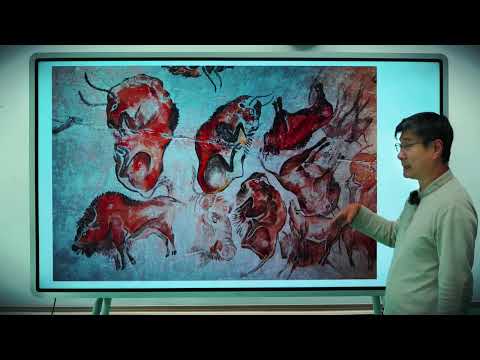
This lecture introduces a semester-long series on human history by challenging Darwinian evolutionary theory as the dominant framework for understanding human nature. The speaker argues that pre-literate Ice Age humans possessed superior imagination, empathy, and intuitive abilities compared to modern civilized humans, using evidence from cave paintings, Neanderthal burial sites, and geometric symbols found in European caves. Through examples ranging from Beethoven's deafness to Alzheimer's patients to psychedelic art, the speaker contends that humans are fundamentally spiritual-creative beings whose true nature has been suppressed by civilization, education, and modern society. The lecture concludes by debunking five 'myths' about human nature — materialism, patriarchy, survival of the fittest, civilizational superiority, and descent from apes — drawing on David Graeber and David Wengrow's 'The Dawn of Everything' to argue that early societies were compassionate, diverse, and deeply connected to the divine.

Video thumbnail
youtube.com/watch?v=LvHsg5qtDs8 ↗ Analyzed 2026-03-14 by claude-opus-4-6

Viewer Advisory

  • Presents a romantic-spiritualist worldview as historical and scientific fact, when it is actually a philosophical position with minimal empirical support.
  • Grossly mischaracterizes evolutionary theory — no evolutionary biologist claims humans are 'just monkeys' or that evolution is purely about competition; cooperation, altruism, and creativity are extensively studied within evolutionary frameworks.
  • Makes the historically false claim that racial categories did not exist before Darwin.
  • Romanticizes pre-literate societies by selectively presenting evidence of care while omitting extensive evidence of violence, warfare, and social hierarchy in prehistoric cultures.
  • Makes pseudoscientific claims about telepathy and divine connection that are presented alongside legitimate archaeological evidence, making it difficult for students to distinguish fact from speculation.
  • The romanticization of Alzheimer's as spiritual liberation is not only scientifically unjustifiable but potentially harmful.
  • The anti-institutional rhetoric ('schools exist to separate you from the divine') is delivered in a classroom to students, creating an ironic dynamic where the speaker uses institutional authority to undermine trust in institutions.
  • The lecture format — university classroom with student Q&A — lends unearned academic credibility to claims that would not survive peer review in any relevant discipline.
Central Thesis

Humans are fundamentally imaginative, spiritual, and empathic beings whose true nature has been progressively suppressed by civilization, education, and modern society, and pre-literate Ice Age peoples lived in a state of greater creative, emotional, and spiritual richness than modern humans.

  • Darwinian evolution is a 'theology' that justified imperialism, racism, and eugenics, and its materialistic worldview is a distortion of human nature.
  • Pre-literate humans were more intuitive, imaginative, and empathic than modern literate humans.
  • Cave paintings were not decorative but served as religious rituals completing cycles of life and death, painted in caves because caves were portals to the spirit world.
  • Early humans possessed a form of telepathy — deep emotional connection enabling nonverbal coordination and cooperation.
  • Writing was a technology humans consciously chose not to develop because it was seen as a corruption of divine speech and communal experience.
  • Language originated not for economic or hierarchical purposes but from singing and creative expression.
  • Modern mental illness epidemics (depression, anxiety) result from civilization severing humans' innate connection to the divine and to empathic relationships.
  • People with disabilities, Alzheimer's, or autism are closer to the 'divine self' because they have shed or cannot be subjected to society's dehumanizing socialization.
  • Schools and modern institutions exist to separate humans from the divine and to produce obedient workers rather than creative beings.
  • For most of human history, women controlled their own bodies and sexuality, and societies were matriarchal and egalitarian.
Qualitative Scorecard 1.6 / 5.0 average across 7 axes
Historical Accuracy ▸ Expand
The lecture contains several significant historical and scientific errors. The claim that 'before Darwinism, we didn't really have a concept of race' is factually wrong — racial classification systems (e.g., Bernier 1684, Linnaeus 1735, Blumenbach 1775) predated Darwin by a century. The characterization of evolutionary theory as purely 'survival of the fittest' ignores Darwin's own extensive work on cooperation, sexual selection, and moral instincts. The claim that early humans 'had the capacity to write but chose not to' based on geometric cave symbols conflates symbol use with writing systems — a distinction fundamental to archaeology. The claim that Beethoven 'saw the music' in dreams is romantic speculation, not historical fact. The description of Van Gogh as someone who 'shed away his socialization' ignores his formal artistic training and deliberate stylistic choices. The Romito 2 burial example and Graeber/Wengrow quotation are accurately used, but these accurate details are embedded in a framework of speculative claims about telepathy, divine connection, and the spiritual meaning of cave art that have no empirical support.
2
Argumentative Rigor ▸ Expand
The argument proceeds almost entirely through assertion, anecdote, and romantic speculation rather than evidence-based reasoning. The central logical structure is a series of non-sequiturs: cave paintings exist, therefore humans are divine spiritual beings; Beethoven was deaf, therefore music comes from dreams; Alzheimer's patients sometimes sing, therefore civilization suppresses our divine nature. The lecture repeatedly commits the naturalistic fallacy (what is 'natural' is better), the noble savage fallacy (pre-civilizational life was superior), and false dichotomy (either humans are materialistic apes or divine spiritual beings). The claim that early humans chose not to develop writing because they considered it 'corruption' is unfalsifiable speculation presented as fact. The treatment of telepathy conflates empathy/body language reading with supernatural ability, then uses this conflation to support spiritual claims. The argument that Alzheimer's patients 'return to the divine' by losing cognitive function is not only unsupported but potentially harmful pseudoscience.
1
Framing & Selectivity ▸ Expand
The lecture is extraordinarily selective in its evidence. Pre-literate societies are presented exclusively through evidence of care, creativity, and spirituality, while all evidence of violence, cruelty, infanticide, and warfare in these societies is omitted. Darwinian evolution is presented only through its worst social misapplications (Social Darwinism, eugenics) while ignoring its actual scientific content. Modern civilization is presented exclusively in negative terms (suppression, brainwashing, mundanity) while ignoring achievements in medicine, human rights, literacy, and poverty reduction. The examples chosen (Beethoven, Milton, Van Gogh) are cherry-picked to support the thesis while ignoring that all three operated within and were products of civilized society. The Alzheimer's example selects only behaviors that support the thesis (singing, spirituality) while ignoring the devastating cognitive decline, personality changes, and suffering the disease causes.
1
Perspective Diversity ▸ Expand
The lecture presents a single romantic-spiritualist perspective throughout without any acknowledgment of alternative viewpoints. No evolutionary biologist, cognitive scientist, or mainstream archaeologist is given voice. The interpretation of cave art as shamanic ritual is presented as the only possibility despite being one of several competing scholarly interpretations. The claim that pre-literate people were 'more intuitive and empathic' is presented without any counterargument. Student questions are answered in ways that reinforce the speaker's framework rather than opening genuine dialogue. The entire lecture operates from the premise that modern science, education, and society are forms of oppression, with no consideration of the perspective that these institutions have also expanded human knowledge and reduced suffering.
1
Normative Loading ▸ Expand
The lecture is overwhelmingly normatively loaded. Civilization is described as 'brainwashing,' 'socializing into mundanity,' creating 'robots and slaves.' Schools exist to 'separate you from the divine.' Evolution is a 'theology' that 'destroys' the correct worldview. Modern society creates 'zombies.' Social media creates a 'prison.' Writing is 'corruption.' Pre-literate life is characterized with exclusively positive language: 'divine,' 'beautiful,' 'amazing,' 'creative,' 'harmonious.' The speaker tells students 'you've been brainwashed,' 'don't believe people when they say,' and 'our true selves are divine.' This is not analysis but advocacy — the speaker is promoting a specific spiritual worldview while presenting it as historical fact.
1
Determinism vs. Contingency ▸ Expand
The lecture presents a highly deterministic narrative in which civilization inevitably and necessarily suppresses human spiritual nature. The trajectory from divine Ice Age harmony to modern alienation is presented as a linear decline with no room for contingency, counter-trends, or alternative outcomes. The framing implies that all civilizations follow the same path of spiritual suppression, with no acknowledgment that different societies have related to spirituality, creativity, and individual expression in vastly different ways. The slight acknowledgment of contingency comes in the suggestion that individuals can reclaim their 'divine self' through creative expression, but even this is framed deterministically — if you follow your imagination, you 'will always find a way.'
2
Civilizational Framing ▸ Expand
This lecture is less about comparative civilizations than about a general pre-civilization vs. civilization framework. The speaker treats all civilizations as essentially equivalent in their suppression of human spiritual nature. There is no explicit hierarchy among modern civilizations. However, the implicit framing positions Western/European civilization as particularly culpable due to Darwinism and imperialism, while indigenous and pre-literate cultures are uniformly romanticized.
3
Overall Average
1.6
Civilizational Treatment
CHINA

China is mentioned briefly and neutrally — as a location where the speaker has observed deaf people's emotional connections in restaurants, and as the setting for the CCTV/autistic boy anecdote. China is also mentioned alongside the US as experiencing a surge in mental illness. No civilizational characterization of China is offered; it is treated as part of the universal modern condition rather than singled out positively or negatively.

UNITED STATES

The United States is mentioned only in passing — as the location of the Clever Hans horse performance and The Telepathy Tapes podcast. No specific civilizational characterization of the US is offered in this lecture.

THE WEST

Western/European civilization is implicitly the primary target of critique. European imperialism is presented as the motivation for Darwinian theory. The Western scientific worldview (materialism, evolution) is characterized as a 'theology' that replaced Christianity and justified genocide. The Western educational system is presented as designed to suppress human creativity and produce obedient workers. However, the critique extends to all modern civilization, not just the West specifically.

Named Sources

book
Charles Darwin / The Origin of Species
Presented as the foundational text of evolutionary theory, which the speaker characterizes as a 'theology' that replaced Christianity and justified imperialism, racism, and eugenics. Darwin is called 'the most influential thinker of the past 200 years' (transcript says '20 years,' likely a misspeak).
✗ Inaccurate
scholar
Genevieve von Petzinger
Referenced as a Canadian archaeologist who spent decades cataloging geometric symbols found in European caves, used to support the claim that Ice Age humans had a proto-writing system they consciously chose not to develop.
? Unverified
book
David Graeber and David Wengrow / The Dawn of Everything
Quoted directly to support the claim that Paleolithic hunter-gatherer burials show high frequencies of health-related disabilities alongside 'surprising high levels of care' and 'remarkably lavish' funerals, arguing early humans were compassionate rather than practicing survival of the fittest.
✓ Accurate
media
The Telepathy Tapes (podcast)
Referenced as a popular American podcast about autistic children allegedly reading their parents' minds, which the speaker reframes as evidence of deep emotional empathy rather than literal telepathy.
? Unverified
media
CCTV documentary about autistic boy in China
An anecdote about a rural Chinese mother who devised a pitch-based signaling scheme with her autistic son to fake mind-reading on television, used to illustrate the power of maternal love and intuitive communication.
? Unverified
other
Clever Hans (performing horse)
The famous case of a horse that appeared to do math but was actually reading audience body language, used to illustrate animal empathy and 'reading the room' as a form of emotional intelligence.
✓ Accurate
other
Beethoven
Cited as a deaf composer who 'saw the music' in dreams and visions, used to support the claim that human imagination is resilient and finds alternative channels when one sense is lost.
? Unverified
book
John Milton / Paradise Lost
Cited as a blind poet who 'heard the songs' and dictated Paradise Lost to secretaries, used to support claims about the resilience of human creative expression.
✓ Accurate
other
Vincent van Gogh
Called 'the greatest painter who ever lived,' his Starry Night and Sunflowers presented as examples of an artist who 'shed away his socialization' to reveal divine truth in art.
? Unverified
other
Romito 2 (Paleolithic burial)
A dwarf from a 10,000-year-old Italian burial site who was given an elaborate funeral with jewelry, used to argue that early societies valued disabled individuals as divinely blessed rather than discarding them.
✓ Accurate

Vague Appeals to Authority

  • 'We believe that in early societies the shamans were the leaders because they had the most wisdom' — no specific archaeological or anthropological source cited for this claim.
  • 'Back then the bird signified mother earth' — no source given for this interpretation of cave art symbolism.
  • 'We know that homo sapiens spent a lot of time in these deep wet caves' — presented as established fact without citation.
  • 'It's very similar to alchemy' — comparing Ice Age geometric signs to alchemical symbols without scholarly support.
  • 'Throughout most of human history, humans cared for each other' — sweeping claim presented without qualification or evidence beyond one burial example.
  • 'For most of human history, it was women who had control of their bodies' — presented as established fact without anthropological sourcing.

Notable Omissions

  • No engagement with actual evolutionary biology or modern synthesis — Darwin's theory is presented in a caricatured 1859 form without acknowledging 165 years of scientific development, including kin selection, reciprocal altruism, and evolutionary psychology.
  • No mention of the extensive scholarly debate about cave art interpretation (Jean Clottes, David Lewis-Williams, Paul Bahn, etc.) — the speaker's shamanistic interpretation is presented as fact.
  • No acknowledgment of evidence for violence, warfare, and interpersonal conflict in pre-literate societies (e.g., Jebel Sahaba massacre site, Crow Creek massacre, Kennewick Man's injuries).
  • No engagement with cognitive science or neuroscience on how literacy affects the brain — the claim that pre-literate people were 'more intuitive' has no scientific basis as presented.
  • No discussion of the concept of 'noble savage' romanticism and its long history of critique in anthropology.
  • No mention of Steven Pinker's 'The Better Angels of Our Nature' or similar works arguing violence has decreased with civilization — a direct counter to the lecture's thesis.
  • Beethoven's deafness was progressive and he composed much of his greatest work while still partially hearing — the claim he was fully deaf while composing oversimplifies significantly.
  • No engagement with the substantial archaeological evidence for social hierarchy, slavery, and human sacrifice in pre-state societies.
  • Van Gogh's artistic style was not about 'shedding socialization' but reflected specific art movements (Post-Impressionism) and possibly mental illness — the romanticization erases his actual artistic context.
Romantic primitivism 00:11:41
The entire lecture constructs an idealized vision of pre-literate Ice Age society as spiritually harmonious, egalitarian, and creatively free — contrasted with modern civilization as alienating and soul-crushing.
Creates a powerful emotional narrative of decline and loss that primes the audience to reject modern frameworks (science, education, rationalism) in favor of the speaker's spiritual worldview.
False dichotomy 00:05:36
Humans are presented as either 'divine spiritual beings' with imagination and empathy, or 'just monkeys' driven by material desires — with no middle ground acknowledging that humans are biological beings with both material and imaginative capacities.
Forces the audience to choose between a reductive caricature of evolutionary theory and the speaker's spiritual framework, making the latter seem obviously preferable.
Straw man of evolutionary theory 00:05:38
Evolution is reduced to 'we're just monkeys' who 'like to have sex, like to eat, like to fart' — a caricature that ignores evolutionary psychology's extensive treatment of cooperation, altruism, creativity, and moral instincts.
Makes the scientific framework seem absurd and degrading, positioning the speaker's alternative as the only framework that respects human dignity.
Rhetorical questions with predetermined answers 00:22:30
'Why would they have these symbols? ... In other words, they had the capacity to write, but they chose not to write. Why? Because... writing is a corruption.'
Guides students toward the speaker's speculative conclusion by posing questions that seem open but have only one acceptable answer within the lecture's framework.
Appeal to wonder 00:13:24
Repeatedly emphasizing how 'beautiful,' 'amazing,' and 'divine' cave paintings and pre-literate societies were, using emotional language to build reverence rather than analytical understanding.
Bypasses critical analysis by overwhelming the audience with aesthetic appreciation, making it feel inappropriate to question the spiritual interpretations being layered on top of the evidence.
Conflation of empathy and telepathy 00:31:29
The speaker moves from animal body-language reading (Clever Hans) to emotional bonds between mothers and children to claims that 'telepathy exists' and dogs 'know you're coming back' — blurring the line between documented psychological phenomena and supernatural claims.
Normalizes pseudoscientific claims by anchoring them in legitimate psychological observations, making the audience more receptive to increasingly unscientific assertions.
Romanticization of disability 00:42:18
Alzheimer's patients are described as 'shedding their artifice' to reveal their 'true divine self,' with hallucinations reframed as reconnection with spirits that 'were always there.'
Transforms a devastating neurological disease into evidence for the speaker's spiritual thesis, potentially trivializing the suffering of patients and families while making the metaphysical framework seem validated by medical phenomena.
Anti-establishment framing 00:56:13
'The entire point of school is to separate you from the divine... the entire point of society is to brainwash you.' Told to students in a classroom setting.
Creates an ironic dynamic where students are taught to distrust the very institution delivering the lecture, positioning the speaker as a rebel truth-teller within the system he critiques, which enhances his authority paradoxically.
Thought experiment as evidence 00:10:41
The speaker proposes that if 10 people drew on a wall without communicating, they would produce something beautiful and coherent — presented as though this proves the existence of intuitive telepathic cooperation, without having actually conducted the experiment.
A hypothetical scenario is treated as evidence for a metaphysical claim. The audience imagines the positive outcome and accepts it as proven, when in reality group art exercises without coordination often produce incoherent results.
Guru positioning 00:05:08
'If you question evolution it means you're crazy. Okay, but I'm crazy. So we're going to question evolution today.' The speaker positions himself as a brave truth-teller willing to challenge orthodoxy.
Creates an us-vs-them dynamic where the speaker and students are enlightened insiders challenging a dominant paradigm, building loyalty and reducing critical scrutiny of the speaker's own claims.
⏵ 00:05:36
So what evolution says is that we are just a monkey guys. Okay. We're just a monkey. And what do monkeys do? Monkeys like to have sex. Monkeys like to eat. Monkeys like to fart. That's all we are. We're just monkeys.
Reveals the speaker's straw man approach to evolutionary theory — reducing a complex scientific framework to crude caricature to make his spiritual alternative seem more appealing. No evolutionary biologist would describe human nature this way.
⏵ 00:03:28
Evolution would give rise to racism and eugenics. So before Darwinism, we didn't really have a concept of race because everyone was equal in the eyes of God.
This is factually incorrect — racial classification systems predated Darwin by over a century (Bernier 1684, Linnaeus 1735, Blumenbach 1775), and slavery based on racial categories was well-established before 1859. The claim also whitewashes Christian history of religiously-motivated persecution, the Inquisition, and the Doctrine of Discovery which provided theological justification for colonizing non-Christian peoples.
⏵ 00:22:34
They had the capacity to write, but they chose not to write. Why? Because if you think about it, in this world, writing is a corruption.
An extraordinary unsupported leap from the existence of geometric symbols in cave art to the claim that Ice Age humans consciously rejected writing as spiritually corrupt. This reveals the speaker's method of presenting speculation as established fact.
⏵ 00:41:02
We are socialized into mundanity. Our true selves are divine.
Encapsulates the lecture's central thesis in a single sentence — a Gnostic-romantic worldview in which civilization is a prison and the authentic human self is divine. This is presented as historical fact rather than as the spiritual-philosophical position it is.
⏵ 00:41:18
Society does not want talented people. Society does not want interesting people. Society just wants robots and slaves. So schools, companies, organizations socialize you into mundanity.
The speaker delivers this anti-institutional message to students in a classroom — a deeply ironic setting. It also reflects an absolutist view that ignores how many societies have cultivated art, music, philosophy, and creativity through institutional support.
This critique of institutional suppression of creativity is delivered in a Chinese educational institution. China's education system is widely documented as being among the most test-oriented and conformity-demanding in the world, with intense gaokao pressure, censorship of creative and political expression, and state control of curricula. The speaker's critique of 'schools socializing you into mundanity' applies far more pointedly to the system he operates within than to the abstract 'society' he criticizes.
⏵ 00:42:34
What Alzheimer's is is losing your socialization... what's left behind are three things. First is your spiritual desires... The third thing is they draw.
Reframes a devastating neurological disease as spiritual liberation. This romanticization of cognitive decline is not only scientifically unjustifiable but potentially harmful, as it could encourage families to view their loved ones' suffering through a lens that minimizes the need for medical care.
⏵ 00:37:20
Telepathy exists, but it's an emotional connection. There's no way that I can actually read your mind, but I know how you feel even at long distances.
A revealing moment where the speaker redefines 'telepathy' as emotional empathy to make a pseudoscientific claim seem reasonable. By using the word 'telepathy' for ordinary empathy, the speaker blurs the boundary between science and mysticism.
⏵ 00:05:08
If you question evolution it means you're crazy. Okay, but I'm crazy. So we're going to question evolution today.
The speaker positions himself as a courageous intellectual rebel, but the 'questioning' that follows is not scientific critique — it is replacement of a scientific framework with a spiritual one. This framing immunizes the speaker's claims from criticism by casting any pushback as orthodoxy-enforcement.
⏵ 00:56:13
So the entire point of school is to separate you from the divine. Why? Because at an early age, you're removed from your parents.
An extraordinary claim that reveals the lecture's deeply anti-institutional worldview. The speaker is himself a teacher in a school, creating a paradox: if schools exist to suppress divinity, what is this lecture doing?
The speaker criticizes schools as instruments of separation from the divine, but delivers this message in what appears to be a Chinese educational institution. China's compulsory education system, with its emphasis on rote learning, standardized testing, and ideological conformity through 'Xi Jinping Thought' curricula, is a far more extreme example of the phenomenon he describes than the abstract 'schools' he critiques — yet this specific context goes unmentioned.
⏵ 00:50:54
Don't believe we're apes. Okay, if you believe you're an ape, then you're an ape. Okay, if you're an ape, then you like to go beat people up and like have sex with a lot of women.
This passage reveals a fundamental misunderstanding of evolutionary theory — the speaker treats 'descended from common ancestors with apes' as a normative claim about human behavior rather than a descriptive claim about biology. It also oddly implies that accepting evolution causes violent behavior.
claim The human imagination has decreased with the development of civilization, and this trend will continue as modern technology (social media, phones) further severs humans from their innate empathic and creative capacities.
00:50:07 · Not falsifiable
unfalsifiable
Verdict

Strengths

The lecture raises genuinely important questions about human nature that deserve consideration: the remarkable sophistication of Ice Age cave art is real and underappreciated; the evidence for care of disabled individuals in prehistoric societies (Romito 2, and the broader archaeological record cited via Graeber and Wengrow) is legitimate and does challenge simplistic 'survival of the fittest' narratives; the observation that Beethoven composed while deaf and Milton wrote while blind are genuine examples of human creative resilience; the critique of modern education as overly standardized has legitimate parallels in mainstream educational theory; and the observation about rising mental health problems among young people connected to social media use aligns with current research. The speaker's passion for his subject and his ability to engage students are evident.

Weaknesses

The lecture suffers from pervasive pseudoscience, historical inaccuracy, and logical fallacies. The characterization of evolutionary theory is a straw man that ignores 165 years of scientific development. The claim that pre-literate humans were 'more intuitive and empathic' has no empirical basis. Claims about telepathy, even when softened to 'emotional connection,' blur science and mysticism in ways that undermine critical thinking. The romanticization of Alzheimer's as spiritual liberation is irresponsible. The assertion that pre-Darwinian societies had 'no concept of race' is historically false. The claim that cave symbols represent a writing system humans 'chose not to develop' is archaeological speculation presented as established fact. The anti-institutional rhetoric (schools as brainwashing, civilization as spiritual prison) is absolutist and ignores the enormous benefits of education, medicine, and organized society. The lecture consistently confuses 'is' (descriptive claims about early humans) with 'ought' (normative claims about how we should live), presenting a spiritual worldview as historical fact.

Cross-References

BUILDS ON

  • Earlier Secret History lectures — the speaker references this as part of a series on 'the entirety of human history' and says concepts will be 'expanded' in future lectures.
  • Previous Civilization series lectures — the speaker's framework of challenging Western/materialist paradigms is consistent with themes from the Civilization and Geo-Strategy series.
  • The lecture's anti-civilizational framework connects to the broader Predictive History thesis that Western civilization is in decline.

CONTRADICTS

  • The speaker's materialist geopolitical analysis in the Geo-Strategy series (which relies on rational actor models, game theory, and material interests) fundamentally contradicts this lecture's claim that humans are primarily spiritual-imaginative beings driven by divine connection rather than material desires.
This lecture represents a significant departure from the geopolitical analysis in the Geo-Strategy series. While those lectures employ realist international relations frameworks (interest groups, military capabilities, economic forces), this lecture adopts a romantic-spiritualist framework that rejects materialism entirely. The tension between these two analytical modes — realpolitik in geopolitics vs. spiritual romanticism in human history — suggests the speaker may compartmentalize his analytical frameworks rather than applying a single consistent methodology. The anti-Western civilizational critique is consistent across both series, though expressed very differently: in Geo-Strategy it manifests as analysis of American imperial decline, while here it manifests as rejection of Western scientific materialism in favor of pre-civilizational spirituality.