Predictive History Audit / Systematic Content Analysis
Secret History
Episode 17 · Posted 2025-11-12

Literary Genesis

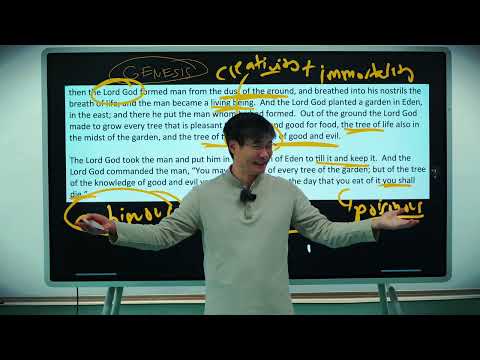
This lecture examines the Bible's Book of Genesis and early Israelite history as a literary and political project. The speaker argues that ancient Israel was a multicultural coalition of mercenaries, Egyptian priests, hill farmers, and nomads who united against the Philistines after the Bronze Age collapse, and that King David commissioned the Bible as propaganda to solve three problems: legitimacy, unity, and differentiation. The lecture walks through Genesis narratives (Adam and Eve, Cain and Abel, Abraham and Sodom, Jacob and Rachel) and the story of David and Bathsheba, arguing that the genius of the Yahwist author — whom the speaker claims was a woman — lies in creating ambiguous, ironic stories that provoke debate and self-reflection. The central claim is that this literary tradition of interpretive engagement explains why Jewish people have been disproportionately creative throughout history.

Video thumbnail
youtube.com/watch?v=PlMNq44tBG0 ↗ Analyzed 2026-03-14 by claude-opus-4-6

Viewer Advisory

  • The claim that the J source author was a woman, presented as fact, is a controversial minority position most biblical scholars reject.
  • The 'real story' behind David's actions is interpretive reconstruction, not established historical fact.
  • The comparison between biblical and Greek theology oversimplifies both traditions.
  • The monocausal explanation for Jewish creativity ignores extensive scholarship offering alternative or complementary explanations.
  • Claims about Jewish 'domination' of media and academia, while intended positively, echo antisemitic tropes and should be evaluated critically.
  • The lecture applies deconstructive analysis to ancient Israelite national mythology ('fake nation,' 'fake history') but the channel never applies this same critical lens to Chinese national mythology — viewers should consider whether this framework is being selectively deployed.
  • The celebration of debate, questioning authority, and epistemological pluralism as foundations of creativity implicitly critiques educational and political systems that suppress these values, including China's — a subtext the lecture does not acknowledge.
Central Thesis

The Bible was originally created as political propaganda to legitimize King David's rule, but its literary genius — characterized by ambiguity, irony, and economy of language — fostered a culture of debate and self-reflection that explains Jewish creative excellence throughout history.

  • Ancient Israel was not a single ethnic group but a multicultural coalition of Greek mercenaries, exiled Egyptian priests, hill farmers, and nomadic pastoralists who united against the Philistines after the Bronze Age collapse.
  • King David faced three political problems — legitimacy (he usurped Saul's throne), unity (Israel was a diverse coalition), and differentiation (they needed a distinct identity) — and the Bible was created to address all three.
  • The Yahwist author ('J source') who wrote Genesis was a woman, evidenced by the elevated treatment of female characters like Eve and the sophisticated understanding of women's perspectives in the narratives.
  • Yahweh is presented as a revolutionary god compared to other ancient deities: capable of self-reflection, forgiveness, and debate with humans — unlike the vengeful Greek gods.
  • The story of Adam and Eve is really about creativity: the Tree of Knowledge of Good and Evil represents the capacity to learn from mistakes, and banishment from Eden was necessary because mortality drives creativity.
  • The David and Bathsheba story is a deliberate 'gaslighting' that reframes David's political murder of Uriah (a popular rival soldier) as a mere crime of passion, thereby making the gossip less dangerous to David's rule.
  • Jewish creativity stems from growing up with stories that demand interpretation and debate rather than religious texts that present absolute truths or sayings.
Qualitative Scorecard 2.6 / 5.0 average across 7 axes
Historical Accuracy ▸ Expand
The broad outlines are defensible: the Bronze Age collapse did occur; the Philistines were likely Sea Peoples settled in the Levant; ancient Israel was likely a coalition of diverse groups; and the Bible was compiled over centuries with political motivations. However, several claims are stated with far more certainty than the evidence supports. The claim that David 'killed' Saul is stated as fact ('David betrayed Saul') when the biblical text presents Saul dying in battle or by suicide, and there is no archaeological evidence for either version. The claim that the J source was a woman writing as David's court historian represents a specific and minority scholarly position (Harold Bloom's) presented as established fact. The characterization of the Levant as an Egyptian colony oversimplifies a complex relationship of varying degrees of Egyptian control. The assertion that 'Sigmund Freud' (mispronounced as 'Simon Freud') was among the three most influential individuals of the past 200 years is subjective, and the omission of any non-Jewish figures from this list is revealing of the lecture's framing.
3
Argumentative Rigor ▸ Expand
The central argument — that the Bible's literary qualities explain Jewish creativity — commits a fundamental logical error: it conflates the existence of a sophisticated literary tradition with a causal explanation for group-level creative achievement, while ignoring numerous alternative explanations (Talmudic study culture, diaspora conditions, urban concentration, selection effects, literacy rates). The 'behind the text' readings of David's story are presented as the definitive 'real story' without acknowledging that these are interpretive reconstructions, not established historical facts. The claim that 'only a woman would write stories like this' is an assertion without methodological support. The argument also contains circular reasoning: the Bible is evidence of Jewish creativity, and Jewish creativity is explained by the Bible.
2
Framing & Selectivity ▸ Expand
The lecture is selective in service of its thesis but is somewhat more balanced than the channel's geopolitical content. The positive framing of Jewish intellectual achievement is genuine and substantive. However, the selectivity manifests in: presenting one scholarly theory (J as a woman) as fact while ignoring alternatives; characterizing all Greek gods as purely vengeful to make Yahweh seem more revolutionary (Greek mythology also features gods who show mercy and engage with mortals); and ignoring Mesopotamian literary traditions that share many motifs with Genesis. The lecture also selectively reads the biblical text — finding evidence of female authorship in passages that support the thesis while not addressing passages that might undermine it.
3
Perspective Diversity ▸ Expand
The lecture presents a single interpretive framework throughout. There is no engagement with competing scholarly perspectives on the Bible's composition, no alternative explanations for Jewish creativity, no consideration of how the biblical texts might be read differently by different traditions (Jewish, Christian, secular, feminist), and no student-driven questioning that genuinely challenges the speaker's framework. The Q&A segment shows students asking clarifying questions, not presenting alternative views. The lecture also presents a monolithic view of 'Jewish creativity' without acknowledging internal diversity within Jewish intellectual traditions.
2
Normative Loading ▸ Expand
The lecture is more analytically balanced than the channel's geopolitical content, but still carries significant normative freight. The framing of Jewish people as 'the most creative people in the world' is an evaluative claim presented as fact. The characterization of the Bible as 'beautiful,' 'revolutionary,' and 'genius' embeds aesthetic and cultural judgments. The claim that 'school is stupid because school we tell you there's a wall don't touch it' is a normative digression. However, the close readings of biblical text are genuinely analytical and the discussion of propaganda, spin, and gaslighting shows a willingness to apply critical categories to the texts being celebrated.
3
Determinism vs. Contingency ▸ Expand
The lecture presents a highly deterministic narrative: the Bible was created to serve specific political needs (legitimacy, unity, differentiation), and its literary qualities inevitably produced Jewish creative excellence. No room is given for contingency — the possibility that Israel might have developed different literary traditions, that other factors might explain Jewish achievement, or that the relationship between text and culture might be more complex than direct causation. The Bronze Age collapse is presented as straightforwardly producing the conditions for Israel's formation, without acknowledging the significant scholarly debate about this period.
2
Civilizational Framing ▸ Expand
The lecture frames Jewish civilization in overwhelmingly positive terms as uniquely creative, intellectual, and morally sophisticated. The comparison with Greek civilization serves primarily to elevate Jewish distinctiveness — Greek gods are vengeful, while Yahweh is forgiving. No other civilizations receive substantive treatment. The claim that Jews, Greeks, and Persians are 'the pillars of Western civilization' excludes significant contributions from other traditions. The lecture does not engage in the anti-Western framing typical of the channel's geopolitical content, but the essentialist characterization of Jewish creativity ('from the moment they're born') borders on romantic nationalism.
3
Overall Average
2.6
Civilizational Treatment
CHINA

China is not mentioned in the lecture. Given the apparent Chinese student audience, the omission of any comparison with Chinese literary traditions — which also feature ambiguity, political propaganda, and deep philosophical reflection — is notable. The implicit framing positions Western/Abrahamic literary traditions as uniquely creative without acknowledging comparable Eastern achievements.

THE WEST

Western civilization is characterized as resting on three pillars — Jewish, Greek, and Persian peoples — a framing that privileges these traditions while excluding Roman, Germanic, and other contributions. The lecture treats Western literary origins positively, in contrast to the channel's typical geopolitical framing of 'the West.'

Named Sources

primary_document
The Bible (Genesis, 1 Samuel, 2 Samuel)
Extensive quotation and close reading of Genesis (creation narrative, Cain and Abel, Abraham and Sodom, Jacob and Rachel) and the David narrative (Abner's assassination, David and Bathsheba) as the primary texts under analysis.
✓ Accurate
scholar
Documentary Hypothesis / J Source (Yahwist)
The speaker draws on the Documentary Hypothesis tradition, identifying the 'Yahwist' or 'J' as the original author of Genesis, a court historian of David's era. Claims this author was a woman. This echoes Harold Bloom's 'Book of J' thesis, though Bloom is never cited by name.
? Unverified
primary_document
The Iliad / Greek mythology
Referenced as a contrast to the Bible — Greek gods are characterized as vengeful and wrathful, while Yahweh is presented as a god of forgiveness and debate, to demonstrate the revolutionary nature of biblical theology.
✓ Accurate

Vague Appeals to Authority

  • 'We think that the person who wrote this was actually a woman' — presented as scholarly consensus without naming any scholar or citing evidence. This echoes Harold Bloom's controversial 1990 thesis in 'The Book of J,' which most biblical scholars reject.
  • 'Remember the Bronze Age...' and 'What really happened is...' — historical reconstructions of Israelite origins presented as established fact without citing specific archaeological or scholarly sources.
  • 'If you look at the media, if you look at Hollywood, if you look at academia, the Jews dominate' — presented as self-evident fact without data or nuance.
  • 'Today, the most creative people in the world are Jews' — sweeping generalization presented as established fact at the lecture's opening.

Notable Omissions

  • No engagement with the Documentary Hypothesis beyond the J source — no mention of E (Elohist), P (Priestly), or D (Deuteronomist) sources, which are essential to understanding the Bible's composition.
  • Harold Bloom's 'The Book of J' (1990) is the obvious source for the claim that J was a woman, but Bloom is never cited, nor is the significant scholarly criticism of this theory mentioned.
  • No reference to archaeological scholarship on early Israel (Israel Finkelstein and Neil Asher Silberman's 'The Bible Unearthed,' William Dever, etc.) that complicates the narrative presented.
  • No mention of the many biblical scholars who dispute that J was a court historian of David's era — dating of the J source remains highly contested.
  • No engagement with alternative explanations for Jewish intellectual achievement (literacy culture, Talmudic tradition, diaspora conditions, urbanization patterns, selection effects).
  • Chinese civilization's own literary traditions — such as the Analects, the I Ching, or the rich poetic tradition — are never discussed for comparison, despite the lecture being delivered to what appears to be Chinese students.
  • No mention of other ancient Near Eastern creation narratives (Enuma Elish, Atrahasis) that share motifs with Genesis and would complicate the claim of Genesis's uniqueness.
Essentialist cultural argument 00:00:15
Opening claim: 'Today, the most creative people in the world are Jews... Karl Marx, Sigmund Freud, Albert Einstein. They're all Jews. So why are Jews so creative? And the answer is the Bible.'
Establishes a sweeping essentialist claim at the outset, creating a mystery that the lecture promises to solve. By selecting three universally recognized Jewish thinkers, the premise seems self-evident, discouraging critical examination of the underlying assumptions.
Authoritative reconstruction presented as fact 00:43:22
The speaker states 'What really happened is that Saul is king. David is the mercenary and he's a very good and popular mercenary... he kills Saul and becomes king himself' — presenting a speculative historical reconstruction as the definitive truth behind the biblical narrative.
By framing interpretive reconstruction as 'what really happened,' the speaker positions himself as possessing knowledge superior to both the biblical text and mainstream scholarship, establishing authority while foreclosing alternative interpretations.
Socratic leading with predetermined conclusions 00:13:07
The amusement park analogy: 'I say to you, you can ride any ride... but there's a ride called the dragon roller coaster. Do not ride that or you will die. What do you do?' Student: 'Ride that.' Speaker: 'You ride that stupid thing.'
Uses a relatable modern analogy to guide students to a predetermined conclusion about God's psychology in Genesis, making the speaker's specific interpretation feel like common sense rather than one reading among many.
Anachronistic close reading 00:54:20
The speaker identifies 'gaslighting' in the David and Bathsheba narrative: 'This is what we call gaslighting. You see how clever this is where the Bible set up so that you forget that David's crime is killing Uriah.'
Applying a modern psychological concept to an ancient text makes the analysis feel contemporary and incisive, while potentially imposing frameworks alien to the text's original context and purpose.
Argument from literary aesthetics 00:39:04
'Only a woman would write stories like this' — used to support the claim that the J source author was female, based on the elevated treatment of female characters and the romantic love story of Jacob and Rachel.
Appeals to aesthetic intuition rather than evidence, while simultaneously flattering the audience's sense of literary sophistication. The claim is unfalsifiable and relies on gender essentialism.
Strategic comparison with inferior examples 00:20:14
Repeated contrasts between Yahweh and Greek gods: 'If we were in the Iliad, then surely Adam and Eve would have died because the gods in the Iliad, the Greek gods, most gods are vengeful. They're wrathful. But not this God.'
By consistently comparing Yahweh favorably to a simplified version of Greek religion, the lecture makes the biblical God seem uniquely sophisticated, while ignoring instances of divine mercy in Greek mythology and Yahweh's own wrathful episodes later in the Bible.
Conspiracy-adjacent historical reasoning 00:46:24
On Abner's assassination: 'The only conclusion is that Job acted with the permission of David. So David knew about this... David probably ordered Job to kill Abner.'
Presents speculative political reasoning as the 'only conclusion,' mirroring the channel's geopolitical method of inferring hidden motives from surface events. While plausible, it forecloses other interpretations of the biblical narrative.
Flattery of the text under analysis 00:34:38
'What follows next is the greatest love story in the Bible. You can also argue it's the greatest love story ever in human history.' — referring to Jacob and Rachel.
Superlative claims about the text create a reverential frame that makes critical analysis seem churlish, while the hedge 'you can also argue' provides plausible deniability for the hyperbole.
Pedagogical digression as authority signal 00:09:40
'That's why school is stupid because school we tell you there's a wall don't touch it because you will hurt yourself and you don't touch it you don't hurt yourself but you never learn for yourself.'
By criticizing conventional education, the speaker signals that his classroom offers something superior — genuine learning through experience and debate — positioning himself as an unconventional, more authentic educator.
Repetitive thesis reinforcement 00:33:28
The phrase 'And this is why the Jews are so creative' or close variants appears at least five times throughout the lecture, after each narrative section.
Constant repetition of the central thesis creates a sense of accumulating evidence, even when each narrative section demonstrates literary quality rather than causally explaining group-level creativity.
⏵ 00:00:15
Today, the most creative people in the world are Jews. In the past 200 years, there have been three extremely influential individuals. Karl Marx, Sigmund Freud, Albert Einstein. They're all Jews. So why are Jews so creative? And the answer is the Bible.
The lecture's opening thesis, which makes a sweeping essentialist claim about Jewish creativity and promises a monocausal explanation. The selection of three individuals to represent 200 years of human achievement reveals the lecture's method of arguing from selective exemplars.
⏵ 00:10:00
The secret to creativity is trying for yourself and learning for yourself what is good and evil.
Reveals the speaker's educational philosophy, which he derives from the Genesis narrative. This is both a reading of the text and a meta-statement about his pedagogical approach — learning through independent experience rather than received wisdom.
The speaker celebrates free inquiry and learning from mistakes as the foundation of creativity, yet this value is sharply constrained in the Chinese educational system where these students are studying. China's emphasis on standardized testing and ideological conformity represents the opposite of the 'eat the fruit yourself' philosophy being celebrated here.
⏵ 00:09:40
That's why school is stupid because school we tell you there's a wall don't touch it because you will hurt yourself... but you never learn for yourself.
A revealing pedagogical aside that positions the speaker as anti-establishment while teaching in what appears to be a school setting. The irony of an authority figure criticizing authority structures is unacknowledged.
⏵ 00:44:01
The person who wrote Genesis is a person we call the Yahwist... for her the God is Yahweh. The Yahwist or J. This person is a court historian... Only a woman would write stories like this.
Presents Harold Bloom's controversial and minority scholarly position as established fact without attribution. The claim that 'only a woman would write stories like this' relies on gender essentialism to support a literary theory, ironically undermining the lecture's celebration of open debate by presenting a contested theory as settled truth.
⏵ 00:54:20
This is what we call gaslighting. You see how clever this is where the Bible set up so that you forget that David's crime is killing Uriah. You think that the real crime is David stealing Bathsheba. No, that's not the real crime. The real crime is murder.
One of the lecture's most analytically incisive moments, applying modern media criticism to ancient text. Reveals the speaker's core method: reading political manipulation behind sacred narratives. The same technique of identifying hidden motives behind official stories drives the channel's geopolitical analyses.
The speaker celebrates the ability to see through biblical propaganda — official narratives designed to legitimize power and suppress inconvenient truths. This is precisely the kind of critical reading that is suppressed in China regarding the CCP's own founding mythology, the official narrative of Tiananmen Square, or the Cultural Revolution. The skill of reading 'behind the text' is celebrated when applied to ancient Israel but would be dangerous if applied to modern Chinese state narratives.
⏵ 00:33:28
Jews are encouraged to debate each other to figure out what is truly right. There is no absolute truth. It's always a process of asking questions, open debate, and self-reflection.
Encapsulates the lecture's central claim about Jewish intellectual culture. The celebration of debate and rejection of absolute truth is notable coming from a channel that often presents its own geopolitical analyses with considerable certainty.
The speaker praises a culture where 'there is no absolute truth' and debate is foundational, yet this lecture is delivered in a Chinese educational context where the ruling party explicitly rejects such epistemological pluralism. The CCP promotes 'Xi Jinping Thought' as the definitive framework and restricts open debate on political matters. The very qualities that the speaker credits for Jewish creativity — questioning authority, debating received wisdom, rejecting absolute truth — are systematically discouraged in contemporary China.
⏵ 00:58:04
Israel is a fake nation. It's a collection of different tribes, different peoples, and they need to make it so it's one people. So they create a fake history.
A provocative formulation that applies constructivist nation-building theory to ancient Israel. The term 'fake' is deliberately provocative in an academic context where scholars would say 'constructed' or 'imagined community.'
The same analysis of constructed national identity and 'fake history' could be applied to the Chinese nation-state, which unified diverse ethnic groups, languages, and cultures under a single Han-centric narrative. The concept of a unified 5,000-year Chinese civilization is similarly a constructed national mythology that served political purposes of legitimacy and unity — yet the channel never applies this deconstructive lens to Chinese national identity.
⏵ 01:05:05
When the Bible was first constructed, it was constructed as propaganda. But the Yahwist uses the opportunity to create beautiful stories that become living entities, living memories onto themselves and they ignite the imagination of the Jewish people.
The lecture's concluding synthesis, arguing that propaganda can transcend its origins to become genuine art. This is a sophisticated and generous reading that acknowledges the political origins of sacred text while celebrating its enduring literary power.
⏵ 00:41:49
If you look at the media, if you look at Hollywood, if you look at academia, the Jews dominate. Because from the moment they're born, they're born with these stories that force them to think deeply about who they are.
This claim about Jewish dominance of media and academia echoes tropes that have historically been deployed antisemitically, though the speaker uses them positively. The biological framing ('from the moment they're born') conflates cultural practices with innate characteristics.
⏵ 00:34:38
You can also argue it's the greatest love story ever in human history... She uses opportunity to create beautiful stories... It has both economy and irony.
The speaker's literary analysis of the Jacob-Rachel narrative demonstrates genuine close reading skill and appreciation for narrative craft. These moments of textual engagement are the lecture's strongest contribution.
Verdict

Strengths

The lecture's greatest strength is its genuine engagement with biblical text as literature. The close readings of Genesis narratives — particularly the analysis of ambiguity in God's prohibition, Eve as the story's hero, the comedy of Rachel and Leah's competition, and the 'gaslighting' in the David-Bathsheba narrative — demonstrate real literary-analytical skill. The framework of reading the Bible as political propaganda that transcends its origins is intellectually productive and pedagogically effective. The speaker's enthusiasm for the material is evident and likely infectious for students encountering these texts for the first time. The argument that Jewish creativity stems from a culture of interpretive engagement with ambiguous texts, while oversimplified, contains a genuine insight about how literary traditions shape intellectual cultures.

Weaknesses

The lecture suffers from several significant problems. First, the monocausal explanation for Jewish creativity (the Bible) ignores a rich scholarly literature on this question. Second, the claim that the J source author was a woman is presented as fact when it is a minority scholarly position (Harold Bloom's) that most biblical scholars reject, and Bloom is never credited. Third, the comparison with Greek religion is unfairly simplified — Greek mythology also contains moments of divine mercy and human-divine negotiation, while Yahweh is far more wrathful in other biblical passages than the lecture acknowledges. Fourth, sweeping claims about Jewish people ('the most creative people in the world,' they 'dominate' media and academia) border on essentialism and echo stereotypes that have historically been weaponized. Fifth, the reconstruction of 'what really happened' behind the biblical narratives is presented with far more certainty than the evidence supports. Sixth, the absence of any comparison with Chinese literary traditions is a missed pedagogical opportunity given the student audience.

Cross-References

BUILDS ON

  • Previous Secret History lectures on the Bronze Age collapse and the formation of early civilizations (referenced as 'remember the Bronze Age').
  • Earlier lectures on Greek civilization and the Iliad (referenced: 'we've done the Greeks'), likely covering the themes of divine wrath and heroic culture that serve as contrast points.
  • The lecture series' overarching framework about how civilizations use writing for legitimacy, unity, and differentiation — presented as a recurring analytical framework.

CONTRADICTS

  • The channel's Geo-Strategy series, which often presents Israel's modern strategic behavior as cynical and manipulative (e.g., Geo-Strategy #8 claims Israel's optimal outcome is mutual US-Iran destruction), sits in tension with this lecture's celebratory treatment of Jewish intellectual culture and literary achievement.
This lecture represents a significant departure from the channel's geopolitical content in tone and method. While the Geo-Strategy and Civilization series are characterized by confident geopolitical predictions and civilizational grand narratives, this Secret History lecture engages in literary close reading with genuine analytical care. However, the underlying method is consistent: the speaker reads 'behind' official narratives to identify hidden political motivations, whether in biblical text or modern geopolitics. The celebration of debate, questioning authority, and rejecting absolute truth in this lecture is notably at odds with the channel's geopolitical content, which typically presents the speaker's own analyses with considerable certainty and minimal acknowledgment of alternative viewpoints. The lecture also reveals that the Secret History series covers a broader cultural-intellectual curriculum (Greeks, Jews, Persians) aimed at what appears to be a Chinese student audience, providing Western civilizational literacy.