Predictive History Audit / Systematic Content Analysis
Secret History
Episode 19 · Posted 2025-11-18

Dawn of the Jews

This lecture argues that Jewish identity was 'invented' by the Persian Empire as a divide-and-rule strategy for controlling the strategically vital Levant. The speaker traces the history from Mesopotamian city-state warfare through the Akkadian, Babylonian, and Assyrian empires to the Persian Achaemenid Empire under Cyrus the Great, arguing that Cyrus sent Israelite exiles back to Jerusalem not out of mercy or religious tolerance but as a deliberate imperial policy to create a loyal, factional minority that would keep the region divided. Through close reading of the biblical books of Ezra and Nehemiah, the speaker contends that the key markers of Jewish identity -- monotheism, endogamy, Sabbath observance, and the Bible as collective memory -- were Persian-era innovations designed to make Jews maximally useful as imperial agents. The lecture draws a direct parallel between the Persian Edict of Cyrus and the British Balfour Declaration of 1917, arguing that Israel has always been a construct of imperial imagination, and concludes with three predictions: Israel will destroy Al-Aqsa Mosque to build the Third Temple, Israel will become a theocracy, and the 'Pax Judeica' will expand as Israel displaces the American Empire in the Middle East.

Video thumbnail
youtube.com/watch?v=3t0MeVBD24I ↗ Analyzed 2026-03-14 by claude-opus-4-6

Viewer Advisory

  • The 'Jews were invented by the Persians' thesis is a radical interpretive claim, not established historical fact -- it ignores extensive evidence of pre-exilic Israelite religious development and the Cyrus Cylinder's evidence that restoring displaced peoples was general Persian policy.
  • The speaker's framework of reading the Bible as a geopolitical roadmap for modern Israel conflates religious texts with policy documents in a way that no serious analyst would endorse.
  • The characterization of Jewish people as 'imperial agents' throughout history echoes antisemitic dual-loyalty tropes, even if unintentionally.
  • The predictions (Third Temple, ethnic cleansing, Pax Judeica) are presented with false certainty about outcomes that are, at most, one possibility among many.
  • The comparison between ancient Persian and modern British/American imperial strategies operates through pattern-matching rather than causal analysis, collapsing 2,500 years of context.
  • The lecture omits the extensive scholarly literature on Second Temple Judaism, the archaeology of ancient Israel, and the internal diversity of both historical and modern Jewish communities.
  • The speaker's early disclaimer ('take everything I say with a grain of salt') should be taken seriously -- this is speculative interpretation, not established historical analysis.
Central Thesis

Jewish identity was constructed by the Persian Empire as an instrument of divide-and-rule imperial strategy in the Levant, a pattern that was later replicated by the British Empire, and this imperial origin explains both the resilience and the geopolitical trajectory of modern Israel.

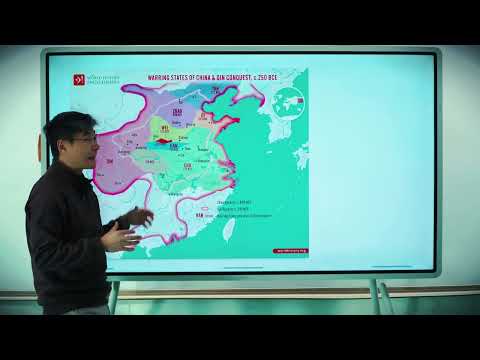
  • Competition within states (elite overproduction) matters more than competition between states, and warfare often functions to maintain elite equilibrium rather than achieve genuine conquest.
  • The Qin dynasty unified China because, as an outsider, it committed to total warfare rather than the ritualized warfare practiced by established states -- a pattern repeated by Sargon of Akkad in Mesopotamia.
  • The Levant is the most strategically important location in the ancient world because it provides access to Egypt, Mesopotamia, and Anatolia simultaneously.
  • The Babylonian exile destroyed the Israelite identity; the 'Jews' who returned under Persian patronage were a fundamentally different people practicing a new, Zoroastrian-influenced monotheistic religion.
  • Cyrus the Great's Edict allowing Jews to return to Jerusalem was a divide-and-rule strategy: creating a loyal minority dependent on Persian protection and in perpetual conflict with local populations.
  • The books of Ezra and Nehemiah reveal that Jewish identity markers (monotheism, endogamy, no interest-charging among Jews, Sabbath observance) were established to serve Persian imperial purposes.
  • The Balfour Declaration of 1917 directly parallels the letter of Artaxerxes to Ezra -- both are empires using Jews as instruments of regional control.
  • Modern Israel was created by the British Empire for the same divide-and-rule purposes that the Persians used, and Israel now seeks to break free from American imperial control to establish 'Pax Judeica.'
  • Israel will inevitably destroy Al-Aqsa Mosque to build the Third Temple, become a theocracy, and clear the West Bank and Gaza of Palestinians.
Qualitative Scorecard 1.6 / 5.0 average across 7 axes
Historical Accuracy ▸ Expand
The lecture contains some accurate historical facts -- the Babylonian destruction of the First Temple (~587 BCE), Cyrus's conquest of Babylon (539 BCE), the Edict of Cyrus, the roles of Ezra and Nehemiah, and the general structure of Persian provincial administration -- but embeds them in a deeply tendentious framework. Major inaccuracies include: (1) The Qin dynasty is repeatedly called the 'Qing dynasty,' confusing two different Chinese dynasties separated by nearly 2000 years; (2) Sun Tzu's 'Art of War' is dismissed as 'one of the stupidest books ever written,' a judgment no serious military historian would endorse; (3) The claim that 'Jews were invented by the Persians' dramatically oversimplifies complex processes of identity formation over centuries; (4) The assertion that Israelite religion was 'polytheistic' before the exile oversimplifies -- monolatry and henotheism were already developing; (5) The Cyrus Cylinder shows that restoring displaced peoples was a general Persian policy, not a specific divide-and-rule strategy aimed at Jews; (6) The comparison of Artaxerxes' letter to the Balfour Declaration elides 2,400 years of fundamentally different geopolitical context.
2
Argumentative Rigor ▸ Expand
The central argument -- that Jewish identity was created as a Persian imperial tool -- commits a fundamental logical error: it confuses correlation with causation. That the Persian Empire benefited from Jewish settlement in the Levant does not mean that Jewish identity was deliberately engineered for that purpose. The argument also relies heavily on the fallacy of the single cause: the complex formation of Second Temple Judaism is reduced to one factor (Persian imperial strategy). The leap from ancient Persian imperial policy to modern Israeli geopolitics via the Balfour Declaration is made through superficial pattern-matching rather than causal analysis. The claim that 'the only way to understand' the conflict between returning exiles and local Israelites is as imperial strategy ignores numerous other explanations (religious, economic, social). The prediction framework -- reading the Bible to predict Israeli behavior -- conflates a 2,500-year-old text with a modern nation-state's policy apparatus in a way that no serious political scientist would accept.
2
Framing & Selectivity ▸ Expand
The lecture is extraordinarily selective in its evidence and framing. Evidence supporting the 'Jews as imperial construct' thesis is emphasized while countervailing evidence is systematically excluded: the Cyrus Cylinder (showing restoration of multiple peoples, not just Jews) is not mentioned; the gradual development of monotheism in pre-exilic Israel is ignored; the complex internal dynamics of the Zionist movement are reduced to 'British imperial policy'; the rich scholarly debate about Second Temple Judaism is completely absent. The reading of Ezra and Nehemiah extracts only passages supporting the thesis while ignoring the texts' own theological framework. The parallel between Artaxerxes' letter and the Balfour Declaration is presented as revelatory when it requires ignoring the vast differences in historical context. Israeli political diversity (secular vs. religious, left vs. right, Ashkenazi vs. Mizrahi) is flattened into a single theocratic trajectory.
1
Perspective Diversity ▸ Expand
The lecture presents a single interpretive lens -- Jewish identity as imperial construct -- and allows no alternative perspectives. No Jewish scholars are cited on the development of Judaism. No Persian Empire historians are engaged. No Israeli political scientists are consulted on Israel's trajectory. No Palestinian voices are included. The students' questions receive only answers that reinforce the thesis. The Zoroastrian influence on Judaism is stated as fact without engaging the substantial scholarly debate on this topic. The speaker's framework admits no possibility that Jewish identity might have authentic religious, cultural, or communal origins independent of imperial manipulation.
1
Normative Loading ▸ Expand
While the speaker occasionally adds disclaimers ('this is intellectual speculation,' 'take everything I say with a grain of salt'), the lecture is heavily normatively loaded. Sun Tzu's 'Art of War' is called 'one of the stupidest books ever written.' Ritualized Chinese warfare is called 'stupid.' The speaker states flatly that Israel 'will clear the West Bank and Gaza of Palestinians' as though this were a matter-of-fact observation rather than a description of ethnic cleansing. The characterization of Jews as 'imperial agents' carries heavy normative baggage. The phrase 'the Jews were invented by the Persians' treats an entire people's identity as artificial. The claim that 'they don't really care' about Islamic holy sites reduces complex geopolitics to dismissive characterization.
2
Determinism vs. Contingency ▸ Expand
The lecture is rigidly deterministic. The speaker presents a single causal chain from Persian imperial strategy to modern Israeli policy with no acknowledgment of contingency: 'If you read the Bible, it's clear what's going to happen.' The three predictions (Third Temple, theocracy, Palestinian expulsion) are presented as inevitable outcomes of reading the Bible, ignoring the enormous role of contingent factors (international pressure, domestic politics, military constraints, economic conditions, diplomatic developments). The claim that 'the world is just a game of thrones' reduces all human political behavior to a single elite-competition model. The historical framework treats 2,500 years of Jewish history as a simple repetition of one imperial pattern. No room is left for agency, reform, democratic processes, or unexpected developments.
1
Civilizational Framing ▸ Expand
The lecture employs deeply essentialist civilizational categories. Jews/Israelis are characterized as fundamentally shaped by a 2,500-year-old imperial template, with modern Israel inevitably replaying biblical patterns. Jewish identity is reduced to an imperial construct with no authentic cultural content. The Islamic world is mentioned only as a future victim of Israeli expansion ('they don't really care'). The American Empire is presented as a modern Persia -- using Israel as a tool but destined to be overthrown by its own creation. The framing treats civilizations as monolithic actors with unchanging essential characteristics determined by their founding texts.
2
Overall Average
1.6
Civilizational Treatment
CHINA

China is mentioned briefly in two contexts: (1) Chinese people are described as 'extremely materialistic' who 'love money' but are 'not as creative as Jewish people' -- a reductive cultural comparison; (2) The Chinese Warring States period is used as an analogy for ritualized warfare vs. total warfare, with the Qin dynasty (incorrectly called 'Qing') praised for breaking the rules. Sun Tzu's Art of War is dismissed as 'stupid.'

UNITED STATES

The United States is characterized as the modern equivalent of the Persian Empire -- using Israel as a divide-and-rule tool in the Middle East. America is presented as maintaining dominance through managed conflict. The speaker predicts Israel will 'win' its conflict with America and establish 'Pax Judeica.'

THE WEST

The British Empire is characterized as having created modern Israel through the Balfour Declaration for the same divide-and-rule purposes that the Persians used -- a cynical imperial calculation disguised as humanitarian support for Jewish self-determination.

Named Sources

primary_document
The Bible (Books of Ezra and Nehemiah)
Extended passages are read aloud and interpreted as evidence that Jewish identity was constructed by Persian imperial policy. The Edict of Cyrus, Artaxerxes' letter to Ezra, Ezra's prayer, and Nehemiah's reforms are presented as revealing the 'true' political purposes behind religious narrative.
✗ Inaccurate
primary_document
Herodotus (Histories)
Cited as describing Jews as known for Sabbath observance and endogamy (refusing to marry foreign men). Used to support the claim that these were defining characteristics of post-exilic Jewish identity.
? Unverified
primary_document
Balfour Declaration (1917)
Read aloud and compared directly to Artaxerxes' letter to Ezra, arguing both represent the same imperial pattern of using Jews as instruments of divide-and-rule in the Levant.
? Unverified
book
Theodore Herzl / 'Der Judenstaat'
Briefly mentioned as the supposed origin of Zionism, which the speaker dismisses as a cover for British imperial policy rather than a genuine grassroots movement.
✗ Inaccurate
book
Sun Tzu / The Art of War
Dismissed as 'one of the stupidest books ever written' because it teaches cheating within ritualized warfare rather than total warfare principles. Used to illustrate the speaker's argument about elite-maintained equilibrium in Chinese Warring States.
✗ Inaccurate
other
Game of Thrones (George R.R. Martin)
Referenced as an illustration of elite shifting loyalties and the 'world is just a game of thrones' principle.
? Unverified

Vague Appeals to Authority

  • 'This is a pattern in history where...' -- the speaker repeatedly asserts historical patterns without citing specific historians or historiographic traditions.
  • 'We know because this is what the Romans did. This is what the Persians did. This is what the Aztecs did.' -- sweeping claims about universal conquest patterns without specific evidence or dates.
  • 'This is true throughout history where Jewish people will rise very high in all empires' -- presented as self-evident without evidence or acknowledgment of significant variation.
  • 'Ezra is considered actually the creator of the Bible that we have today' -- presents the Documentary Hypothesis conclusion as settled fact without attribution.
  • 'If you look at the Middle East, Israel is the greatest power in the Middle East' -- assertion without comparative analysis of military, economic, or diplomatic capabilities.

Notable Omissions

  • No engagement with mainstream biblical scholarship on the development of Israelite monotheism (e.g., Mark Smith's 'The Early History of God', Thomas Romer's work on Yahwism, or the vast literature on the Deuteronomistic History).
  • No discussion of the archaeological evidence for pre-exilic Israelite religion and its gradual evolution toward monotheism, which complicates the 'Persian invention' thesis.
  • No engagement with historians of the Achaemenid Empire (e.g., Pierre Briant, Amelie Kuhrt, or Josef Wiesehofer) who offer more nuanced accounts of Persian provincial administration.
  • No mention of the Cyrus Cylinder and its scholarly interpretation, which would complicate the 'divide and rule' thesis since Cyrus restored multiple displaced peoples, not just Jews.
  • No discussion of the significant scholarly debate about the historicity of the return from exile and the composition dates of Ezra-Nehemiah.
  • No engagement with Shlomo Sand's 'The Invention of the Jewish People' -- a work that shares some of the speaker's revisionist premises but with far more scholarly rigor.
  • No consideration of the internal diversity of Second Temple Judaism (Sadducees, Pharisees, Essenes, etc.) which complicates the monolithic 'imperial agent' characterization.
  • The Zionist movement's complex internal debates (Labor Zionism, Revisionist Zionism, Cultural Zionism, Religious Zionism) are entirely omitted in favor of the 'British imperial tool' narrative.
  • No mention of Arab or Palestinian perspectives on the conflict beyond being passive objects of Israeli actions.
Historical teleology 00:42:09
The lecture presents a continuous line from Persian imperial strategy through the Balfour Declaration to modern Israel, treating 2,500 years of history as the unfolding of a single pattern: empires creating and using Jewish identity for divide-and-rule.
Makes modern geopolitics seem like the inevitable product of ancient patterns, eliminating contingency and making the speaker's predictions appear self-evident rather than speculative.
Provocative dismissal 00:11:09
Sun Tzu's Art of War is called 'one of the stupidest books ever written' and ritualized Chinese warfare is called 'stupid.'
Establishes the speaker as iconoclastic and willing to challenge received wisdom, building credibility with students who value intellectual boldness, while discouraging critical examination of whether the dismissal is warranted.
False exclusivity of explanation 00:39:09
'And so the only way to understand this is the conflict is part of the imperial strategy.' -- regarding the tension between returning Jewish exiles and local populations.
Forecloses alternative explanations (religious sincerity, economic competition, cultural divergence) by presenting the imperial thesis as the sole valid interpretation, rather than one possibility among many.
Pattern-matching across millennia 00:43:14
The Balfour Declaration is read aloud immediately after Artaxerxes' letter to Ezra, with the speaker saying 'this is almost like the Artaxerxes declaration, right?' to establish structural identity between events 2,400 years apart.
Creates a false equivalence that strips away historical context, making the listener see an 'eternal pattern' rather than two distinct events in vastly different circumstances.
Casual assertion of extraordinary claims 00:31:31
'The Jews were invented by the Persians to control the Levant' is stated matter-of-factly, as though this were an established historical finding rather than a highly controversial interpretive thesis.
By treating a radical claim as unremarkable, the speaker normalizes it and avoids the burden of proof that such an extraordinary claim would normally require.
Disclaimers as inoculation 00:06:03
The speaker says 'this is a class on intellectual speculation... take everything I say with a grain of salt' early in the lecture, then proceeds to make definitive assertions throughout.
The early disclaimer inoculates against criticism ('I said it was speculation') while the assertive tone of the actual lecture encourages students to accept the claims as authoritative analysis.
Socratic direction 00:28:13
The speaker repeatedly asks leading questions like 'Why would Cyrus do that?' and 'Does that make sense?' then provides the predetermined answer, creating the illusion of collaborative discovery.
Students feel they are reasoning through the material independently, when they are being guided to the speaker's conclusion through controlled questioning.
Confident prediction from sacred text 01:11:34
'If you read the Bible, it's clear what's going to happen. Israel is going to clear the West Bank and Gaza of Palestinians.'
Conflates a 2,500-year-old religious text with a modern policy roadmap, presenting ethnic cleansing as a foreordained outcome of biblical prophecy rather than a contingent political choice, which simultaneously naturalizes and depoliticizes the prediction.
Strategic category distinction 01:10:31
The speaker carefully distinguishes Israelites, Jews, and Israelis -- 'Don't say the Jews... It's the Israelis that are doing this, not the Jews' -- while simultaneously arguing that 'the Jews were invented by the Persians.'
Creates an appearance of analytical precision and sensitivity that masks the lecture's broader essentialism. The distinction protects against charges of antisemitism while the overall framework treats Jewish identity as an artificial imperial construct.
Insider knowledge framing 00:00:10
'I'm going to show you how the American Empire will fall. And I will show you that what will replace the American Empire is Israel, what we call Pax Judeica.'
Positions the speaker as possessing privileged knowledge about the future trajectory of world history, establishing authority and creating anticipation that keeps students invested across the remaining lectures.
⏵ 00:00:10
I'm going to show you how the American Empire will fall. And I will show you that what will replace the American Empire is Israel, what we call Pax Judeica.
Sets the entire lecture series' thesis in the opening seconds. The confidence with which a Chinese educator predicts Israeli global hegemony replacing American power reveals the lecture's speculative ambition and deterministic worldview.
⏵ 00:31:31
The Jews were invented by the Persians to control the Levant.
The lecture's most provocative claim, stated as historical fact. Reduces the entire formation of Jewish identity to a single imperial decision, denying agency to the Jewish people themselves in creating their own religious and cultural tradition.
The speaker criticizes imperial powers for manufacturing identities to serve strategic purposes, yet China's own history includes numerous examples of the state constructing and manipulating ethnic categories -- from the creation of the 56 officially recognized 'minzu' (ethnic groups) under the PRC to the ongoing cultural assimilation policies toward Uyghurs and Tibetans. The claim that Jewish identity was 'invented' by empire could equally be applied to many identities within China.
⏵ 00:11:09
This is one of the stupidest books ever written. Okay, I guarantee you if you follow this book, you're going to lose the war badly.
Dismissing Sun Tzu's Art of War -- one of the most influential texts in military history and Chinese cultural heritage -- as 'one of the stupidest books ever written' is extraordinary, especially from a Chinese educator. Reveals the speaker's commitment to provocation over nuance.
⏵ 00:50:26
The nation of Israel is also an invention of the British Empire.
Extends the 'imperial invention' thesis from ancient Persia to modern Britain, treating Jewish self-determination as always and entirely the product of foreign manipulation. This denies the authentic motivations of millions of Jews who supported Zionism for their own reasons.
The speaker treats Israel as an 'invention' of the British Empire, but this logic could equally apply to many modern nation-states, including the People's Republic of China itself, whose borders, governance structure, and national identity were significantly shaped by Soviet influence and Marxist-Leninist ideology imported from the West.
⏵ 00:40:01
It seems as though these Jews in Babylon, they're actually imperial agents who are trying to sow discontent within the region.
Characterizing an entire people as 'imperial agents' echoes some of history's most dangerous antisemitic tropes -- the accusation that Jews serve as agents of foreign powers rather than acting in their own interest. The speaker may not intend this echo, but the framing is troubling.
⏵ 01:11:34
If you read the Bible, it's clear what's going to happen. Israel is going to clear the West Bank and Gaza of Palestinians.
Treats ethnic cleansing as the inevitable outcome of biblical interpretation, naturalizing an extreme political outcome as foreordained. This framing removes moral agency from Israeli decision-makers and treats Palestinian displacement as an unstoppable historical force.
⏵ 00:05:28
Chinese people are extremely materialistic. Like Chinese love money, but we're not as creative as Jewish people.
A rare moment of self-critical cultural comparison that simultaneously essentializes both Chinese and Jewish people. The speaker uses essentialist cultural characterizations casually, treating entire civilizations as having fixed personality traits.
⏵ 00:08:51
The world is just a game of thrones.
Reduces all human political behavior to elite power competition, providing the theoretical foundation for the lecture's cynical interpretation of all historical events as elite manipulation. Using a popular TV show as the metaphor for human civilization reveals the lecture's accessibility-over-rigor approach.
⏵ 00:02:11
I'm already connected to the divine.
A self-characterization that reveals the speaker's self-positioning: not merely an academic analyst but someone with spiritual insight that transcends material reality. This claim to spiritual authority underwrites the lecture's confident assertions about civilizational destiny.
⏵ 00:06:08
Take everything I say with a grain of salt. Doubt whatever I say. This class is really meant to be a platform or jumping board for you to undertake your own intellectual journey.
The most important disclaimer in the lecture, which functions as a rhetorical shield. The speaker encourages doubt but then proceeds with unwavering assertiveness, never modeling the doubt he recommends. The disclaimer is undermined by every subsequent claim stated as fact.
prediction Israel will destroy Al-Aqsa Mosque and build the Third Temple (Temple of Solomon).
01:04:42 · Falsifiable
unfalsifiable
Reclassified: speculative/conspiratorial claim without empirical testability.
prediction Israel will become increasingly theocratic, with the Bible replacing secular law.
01:06:13 · Falsifiable
partially confirmed
Israel's coalition under Netanyahu includes ultra-Orthodox and far-right religious parties with increasing influence on policy, but Israel retains a secular legal system. The trend is toward greater religious influence but full theocracy has not materialized.
prediction More Jews will return to Israel as 'Pax Judeica' expands.
01:06:22 · Falsifiable
unfalsifiable
Reclassified: speculative/conspiratorial claim without empirical testability.
prediction Israel will clear the West Bank and Gaza of Palestinians to establish a theocratic state.
01:11:37 · Falsifiable
partially confirmed
Israel's military campaign in Gaza (2023-2025) has displaced the vast majority of Gaza's population and Israeli ministers have openly discussed permanent resettlement. West Bank settlement expansion continues. However, full ethnic cleansing remains internationally opposed and incomplete.
prediction There will be a major conflict between America and Israel, resulting in an American-Israeli 'divorce' with Israel winning.
01:09:26 · Falsifiable
untested
US-Israel relations remain close despite tensions over Gaza. No 'divorce' has occurred.
prediction The American Empire will fall and be replaced by Israel ('Pax Judeica').
00:00:10 · Falsifiable
unfalsifiable
Reclassified: speculative/conspiratorial claim without empirical testability.
Verdict

Strengths

The lecture has genuine pedagogical merits: it encourages students to read primary sources (Ezra, Nehemiah, Balfour Declaration) and to think about the relationship between imperial power and identity formation -- a legitimate and important topic in academic historiography. The discussion of Persian administrative innovations (roads, postal systems, satraps, divide-and-rule) is broadly accurate. The distinction between Israelites, Jews, and Israelis is pedagogically useful. The speaker's willingness to question received narratives and encourage critical thinking is valuable in principle. The observation that empires shape the identities of their subjects is a well-established insight in postcolonial studies.

Weaknesses

The lecture's central thesis -- that Jewish identity was 'invented' by the Persians as an imperial tool -- dramatically oversimplifies a complex historical process and ignores the substantial archaeological and textual evidence for pre-exilic developments in Israelite religion. The Cyrus Cylinder shows that restoring displaced peoples was a general Persian policy, not a specific anti-Levantine strategy, which fundamentally undermines the divide-and-rule thesis. The comparison between the Edict of Cyrus and the Balfour Declaration strips 2,400 years of context to create a false pattern. The predictions (Third Temple, ethnic cleansing of Palestinians, Pax Judeica) are stated with confidence but rest on the assumption that a 2,500-year-old text determines modern state behavior -- an analytical framework no serious political scientist or international relations scholar would accept. The characterization of Jews as 'imperial agents' uncomfortably echoes antisemitic dual-loyalty tropes. The dismissal of Sun Tzu's Art of War as 'the stupidest book ever written' reflects intellectual carelessness. The rigid determinism leaves no room for human agency, democratic processes, or contingency.

Cross-References

BUILDS ON

  • Secret History #18 (referenced as 'last week' -- covered cultures emerging from Bronze Age collapse: Greeks, Persians, Israelites)
  • Previous Secret History lectures on King David and the Bible's origins as legitimization narrative
  • Previous lecture on Zoroastrianism as the first great world religion
  • Geo-Strategy #8 'The Iran Trap' (shares the framework of Israel as a strategic actor seeking to escape American imperial control)
  • Earlier lecture series on the Bronze Age collapse

CONTRADICTS

  • Geo-Strategy #8 argued that Israel's optimal outcome is mutual US-Iran destruction, while this lecture argues Israel seeks to replace the American Empire entirely with 'Pax Judeica' -- a more ambitious claim that goes beyond regional dominance to global hegemony.
This lecture represents a significant escalation in the speaker's thesis about Israel. Where Geo-Strategy #8 positioned Israel as a cynical regional actor manipulating the US into war, this lecture reframes the entire history of Jewish identity as an imperial construct, then projects a future 'Pax Judeica' replacing American global hegemony. The pattern across the corpus is one of escalating claims: from Israel as a US ally (early lectures) to Israel as a manipulator of the US (Geo-Strategy #8) to Israel as the inevitable successor to the American Empire (this lecture). The speaker's analytical framework -- reading sacred texts as geopolitical roadmaps -- is consistent across the series but is applied here with less restraint than in earlier lectures.