Predictive History Audit / Systematic Content Analysis
Secret History
Episode 21 · Posted 2025-11-25

Roman Anti-Civilization

This lecture argues that Rome was the 'great anti-civilization' — an empire fundamentally built on hatred, violence, and militarism rather than the love, reflection, and empathy that characterized Greek civilization. The speaker traces Rome's rise from the borderlands of Etruscan civilization through the Punic Wars, the civil wars, Caesar's rise, and the establishment of the Empire under Augustus. A central and provocative claim is that most Roman history — including the Battle of Cannae and possibly Hannibal Barca himself — was fabricated by Greek historian Polybius to justify Rome's destruction of Carthage, and later rewritten by Livy under Augustus's direction. The lecture contrasts Greek cultural achievements (tragedy, symposia, the Iliad's message of love and forgiveness) with Roman culture (gladiatorial combat, orgies, the Aeneid's message of hatred), and draws explicit parallels between Rome and modern America, comparing Caesar's myth-building to Trump's media career and Roman decadence to American party culture.

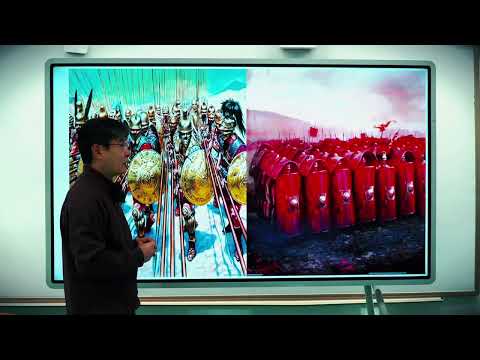
Video thumbnail
youtube.com/watch?v=Y-gXVzwbFMU ↗ Analyzed 2026-03-14 by claude-opus-4-6

Viewer Advisory

  • The claim that the Battle of Cannae never happened and Hannibal didn't exist is not supported by any mainstream classical historian and contradicts extensive evidence from multiple independent ancient sources.
  • The assertion that 'all Roman history is complete nonsense' is an extraordinary claim made without extraordinary evidence.
  • The idealization of Greek civilization ignores well-documented Greek slavery, imperialism, and violence.
  • The characterization of the Aeneid as pure anti-Greek propaganda ignores a rich scholarly tradition reading it as deeply critical of Roman imperialism.
  • The speaker's 'predictive history' framework — using pattern-matching, game theory, and religion to determine whether events happened — is not an accepted historical methodology and functions primarily to confirm predetermined conclusions.
  • The Rome-America parallels are superficial analogies that flatten the complexity of both civilizations.
  • The claim about German and Japanese war guilt being imperial imposition rather than genuine moral reckoning minimizes the Holocaust and Japanese wartime atrocities.
  • The civilizational binary (Greeks = love/good, Romans = hate/evil) is a moral framework masquerading as historical analysis.
Central Thesis

Rome was not a civilization but an 'anti-civilization' — an empire built on hatred, violence, and trauma that systematically destroyed the love-based Greek civilization it conquered, and whose patterns of militarism, propaganda, and cultural degradation are replicated in the modern American empire.

  • Rome emerged from a disadvantaged geographic position that forced it to develop the most militaristic culture among Italian peoples, making war the foundation of its entire society.
  • Rome's open citizenship system (unlike Greek blood-based citizenship) allowed it to continually replenish soldiers, enabling it to lose battles but win wars.
  • The Battle of Cannae never happened — there is no archaeological evidence, the double envelopment strategy was unprecedented in ancient warfare, and Hannibal's subsequent behavior (not seizing power) contradicts the pattern of great military conquerors.
  • Polybius, a Greek hostage of Rome, invented much of Roman military history — including the Second Punic War narrative — to justify Rome's destruction of Carthage.
  • All Roman history is 'complete nonsense' — fabricated propaganda rather than factual record.
  • The Roman war machine created a self-perpetuating cycle of conquest, slavery, debt, corruption, and inequality that could not be stopped even after Rome became the dominant Mediterranean power.
  • Caesar's Gallic Wars were primarily about capturing slaves for personal wealth, building a private army, and creating a political myth — not about pacification, and many of his reported victories were fabricated.
  • Augustus Caesar commissioned Virgil to write the Aeneid specifically to create a Roman cultural identity based on hatred of the Greeks, replacing the Iliad's message of love and forgiveness.
  • The Roman cultural model — gladiatorial violence, orgies, decadent feasting — stands in direct opposition to Greek civilization's emphasis on empathy, philosophical debate, and artistic reflection.
  • Modern America replicates the Roman pattern: football replaces gladiatorial combat, drug-fueled parties replace Roman orgies, Trump's WWE/Apprentice career mirrors Caesar's myth-building, and AI/ChatGPT is a 'scam' that empires use for psychological control.
Qualitative Scorecard 1.3 / 5.0 average across 7 axes
Historical Accuracy ▸ Expand
The lecture contains multiple significant historical errors and highly contested claims presented as fact. The central claim that the Battle of Cannae 'did not happen' contradicts overwhelming scholarly consensus based on multiple independent ancient sources (Polybius, Livy, Appian, Plutarch) and is not supported by serious classical historians. The claim that 'we can't find the damn place' is misleading — while the exact battlefield location is debated between two candidate sites near Cannae, this is normal for ancient battlefield archaeology. The assertion that double envelopment was impossible in ancient warfare ignores documented instances and the tactical logic involved. The claim that Hannibal Barca 'did not exist as a person' is extraordinary historical denialism without scholarly support. The characterization of the Battle of Alesia as probably fabricated contradicts extensive archaeological evidence — Napoleon III excavated the site in the 1860s, and modern archaeology has confirmed Caesar's siege works. The claim that Polybius was a 'hostage who became the official historian of the Roman Empire' conflates Republic and Empire. Some broader claims about Roman social dynamics (the war machine cycle, land consolidation, grain dole) have genuine scholarly support, and the readings from Livy and Virgil are accurately presented, preventing a score of 1.
2
Argumentative Rigor ▸ Expand
The argument is fundamentally circular and relies on assertion rather than evidence. The speaker's 'predictive history' framework — asking whether events fit a pattern, make sense via game theory, and can be explained by religion — is used to dismiss established history when it doesn't fit the thesis. The argument that Cannae didn't happen because (1) double envelopment was unprecedented, (2) the battlefield hasn't been found, and (3) Hannibal's behavior afterward doesn't make sense by 'game theory' conflates absence of evidence with evidence of absence, applies modern rational-actor assumptions to ancient contexts, and ignores alternative explanations. The leap from 'Polybius was a Greek hostage' to 'therefore he fabricated all of Roman military history' is a non sequitur. The blanket dismissal — 'all Roman history is complete nonsense' — is not a scholarly position but a rhetorical posture that makes the argument unfalsifiable: any evidence for Roman history can be dismissed as fabrication. The comparison of the Aeneid to the Iliad as 'hate vs. love' is a reductive reading that ignores the Aeneid's well-documented ambivalences.
1
Framing & Selectivity ▸ Expand
The lecture is extraordinarily selective, presenting Rome through an exclusively negative lens while idealizing Greek civilization. Greek slavery, the destruction of Melos, Athenian imperialism, pederasty, and the exclusion of women from public life are entirely omitted. Roman law, engineering, aqueducts, road systems, religious tolerance, philosophical contributions (Stoicism, Cicero, Seneca, Marcus Aurelius), and the Pax Romana are ignored. The Aeneid — one of the most studied texts in Western literature, with a rich scholarly tradition reading it as critical of imperialism — is dismissed as 'a complete piece of crap' and 'propaganda' without engaging with any literary scholarship. The comparison of Roman feasting to American partying, and Roman gladiatorial combat to American football, cherry-picks the most negative aspects of both cultures while ignoring their more complex dimensions. Evidence that doesn't support the 'anti-civilization' thesis is simply declared fabricated.
1
Perspective Diversity ▸ Expand
The lecture presents a single, uncontested perspective throughout. There is no engagement with alternative views on any major claim: no classicists who defend the historicity of Cannae, no literary scholars who read the Aeneid as ambivalent, no historians who see Roman civilization as having positive contributions, no acknowledgment that the 'all Roman history is nonsense' position is not held by any mainstream ancient historian. The classroom format reinforces this — students ask questions but receive definitive answers that brook no dissent. The speaker's framework ('predictive history') is presented as superior to traditional historical methodology without engaging with historiographic debates. The framing is consistently Manichean: Greeks = good (love, empathy, civilization), Romans = bad (hate, violence, anti-civilization).
1
Normative Loading ▸ Expand
The lecture is saturated with evaluative and emotional language. Rome is called 'the evil empire,' 'the great anti-civilization,' 'demonic,' 'crazy,' 'disgusting,' and 'barbaric.' The Aeneid is 'a complete piece of crap.' American football is 'pretty barbaric.' ChatGPT is 'a scam.' Roman history is 'complete nonsense.' The Romans 'just want to kill other people.' These are not analytical assessments but moral judgments that replace historical analysis. The speaker explicitly positions himself as revealing hidden truths that mainstream historians refuse to acknowledge, framing the lecture as a moral crusade against false history rather than a scholarly investigation.
1
Determinism vs. Contingency ▸ Expand
The lecture presents Roman history as almost entirely determined by geography and social structure. Rome's militarism is presented as an inevitable consequence of its geographic position ('forced to be the most militaristic'). The war machine's self-perpetuating cycle of conquest, slavery, and inequality is presented as unstoppable. The rise of dictators is presented as the inevitable consequence of inequality. There is some acknowledgment of contingency in the discussion of specific events (the Gracchi reforms could have worked, Caesar's wealth was partly fortunate), but the overarching narrative is rigidly deterministic: empires inevitably become 'lazy, arrogant, and stupid,' and their fall is inevitable because of hubris. The one structural acknowledgment of contingency — 'if an empire recognized that it could fall one day, it would never ever fall' — actually reinforces the deterministic framework by asserting that empires are structurally incapable of self-awareness.
2
Civilizational Framing ▸ Expand
The lecture employs the most reductive civilizational framing possible. Rome is characterized as pure evil — 'the great anti-civilization' — with essentially no redeeming qualities. Greek civilization is idealized as based entirely on love, empathy, and reflection. This binary is historically untenable: Greece practiced slavery, engaged in imperial conquest, committed genocides (Melos), excluded women from public life, and produced militaristic cultures (Sparta). Rome produced Stoic philosophy, republican governance, legal codes that influenced all of Western law, magnificent engineering, and literature that includes genuine moral complexity. The extension to modern America — football = gladiators, parties = orgies, Trump = Caesar — is superficial analogy presented as deep structural analysis.
1
Overall Average
1.3
Civilizational Treatment
UNITED STATES

America is explicitly compared to Rome as a declining empire throughout the lecture. American football is compared to gladiatorial combat. American party culture is compared to Roman orgies and decadent feasting. Trump is compared to Caesar as a media-savvy myth-builder. America 'doesn't have the energy' to build real AI systems. The American Empire is described as operating like the Roman Empire — conquering peoples and implanting ideology into their souls. This is consistently negative framing without any acknowledgment of American cultural, scientific, or democratic achievements.

THE WEST

The West is implicitly characterized through the Rome-to-modern-West continuity. The British Empire is mentioned as following the same pattern as Rome. Germany and Japan are described as nations whose souls were conquered by the victors of WWII, who now believe they are 'the worst people in the world' because 'the winners write the history.' This framing implies that German guilt over the Holocaust and Japanese pacifism are not genuine moral reckonings but imposed narratives — a historically problematic claim.

Named Sources

scholar
Polybius / Histories
Identified as the Greek hostage who became Rome's 'official historian' and allegedly fabricated the history of the Punic Wars, including the Battle of Cannae, to justify Rome's destruction of Carthage. The speaker claims Polybius 'invented the battle of Cannae' and 'basically made the entire history of Rome.'
✗ Inaccurate
primary_document
Livy / Ab Urbe Condita (History of Rome)
Excerpts are read aloud in class covering the founding myths of Rome: Romulus and Remus, the Rape of the Sabine Women, the story of Lucretia, the execution of Brutus's sons, and the story of Mucius Scaevola. The speaker identifies Livy as rewriting Polybius's history 'from a Roman lens' under Augustus Caesar's direction.
? Unverified
primary_document
Virgil / The Aeneid
Excerpts read covering the death of Priam at the hands of Pyrrhus/Neoptolemus. Characterized as 'a complete piece of crap' and 'propaganda' commissioned by Augustus to replace the Iliad's message of love with hatred of the Greeks, creating Roman cultural identity.
✗ Inaccurate
primary_document
Homer / The Iliad
Referenced as the foundational text of Greek civilization based on love, forgiveness, and compassion — specifically the reconciliation scene between Achilles and Priam. Used as the moral counterpoint to the Aeneid's hatred.
✓ Accurate
other
ChatGPT
Cited as a source for listing battles that used double envelopment strategy, supporting the claim that Cannae was unprecedented. Also dismissed as 'a scam' in a later segment about AI and empire.
? Unverified

Vague Appeals to Authority

  • 'We actually don't know that much about the history of Rome' — presented without qualification or engagement with the extensive archaeological and textual evidence that does exist.
  • 'We can't find the damn place' regarding Cannae — while the exact battlefield location is debated, the speaker presents this as conclusive evidence of fabrication without noting that battlefield archaeology for ancient sites is inherently difficult.
  • 'We have reason to think that this didn't happen' regarding the Battle of Alesia — no specific historians or evidence cited for doubting one of the best-archaeologically-attested Roman battles.
  • 'Every historian that you talk to tells you the Battle of Cannae must be historical fact' — presented as evidence of groupthink rather than scholarly consensus based on multiple independent sources.
  • 'Some historians suggest' regarding Marathon as double envelopment — no specific historians named.

Notable Omissions

  • No engagement with the extensive archaeological evidence for Roman history, including inscriptions, coins, architectural remains, and battlefield archaeology (notably, Alesia's fortifications have been extensively excavated and confirmed).
  • No mention of non-Polybian and non-Livian sources for the Punic Wars, including Appian, Cassius Dio, and fragments of Fabius Pictor (a Roman senator who wrote during the Second Punic War itself).
  • No engagement with modern classical scholarship on the historicity of Cannae — scholars like Adrian Goldsworthy, Gregory Daly, and Robert O'Connell have written detailed analyses of the battle.
  • No discussion of Roman law, engineering, architecture, literature beyond the Aeneid, or philosophy (Stoicism, Epicureanism, Lucretius) — all of which complicate the 'anti-civilization' thesis.
  • No mention of Roman contributions to governance, republican institutions, or legal traditions that heavily influenced Western democratic institutions.
  • No engagement with the scholarly debate about Virgil's intentions — many classicists read the Aeneid as deeply ambivalent about Roman imperialism, not straightforward propaganda.
  • No discussion of Chinese imperial history for comparison — despite the series' emphasis on civilizational comparison, no mention of comparable Chinese practices (legalism, the burning of books and burying of scholars under Qin Shi Huang, the brutal suppression of the Taiping Rebellion).
  • No acknowledgment that Greek civilization also practiced slavery extensively, waged genocidal wars (Melos), and had its own forms of violence and domination.
Historical denialism presented as iconoclasm 00:17:28
The speaker claims the Battle of Cannae 'did not happen,' Hannibal Barca 'did not exist as a person,' and 'all Roman history is complete nonsense' — dismissing the entire established historical record of one of the most documented ancient civilizations.
Positions the speaker as a bold truth-teller who sees through establishment lies, while making his claims unfalsifiable — any counter-evidence can be dismissed as part of the fabricated history. This appeals to students' desire to access hidden knowledge unavailable to conventional thinkers.
Moralistic binary framing 01:09:02
Greeks are consistently characterized as representing love, empathy, reflection, and civilization, while Romans represent hatred, violence, cruelty, and anti-civilization. 'The Greeks want to understand and feel empathy for other people. The Romans just want to kill other people.'
Creates a moral framework so stark that nuance becomes impossible. Students are positioned to see history as a battle between good (Greek/love-based) and evil (Roman/hate-based) civilizations, foreclosing complex analysis of either.
Anachronistic analogy 00:32:58
Caesar's military campaigns in Gaul and his political myth-building are directly compared to Trump's career in WWE and The Apprentice. 'This is what all these great politicians understand. If you really want to have a great political career, you have to create a myth of yourself.'
Makes ancient history feel immediately relevant and contemporary, but at the cost of erasing the vast differences between ancient Roman politics and modern American media culture. The analogy flatters students' existing knowledge while oversimplifying both periods.
Argument from incredulity 00:15:48
The Battle of Cannae is dismissed because 'this has never happened before in human history' (double envelopment), 'we can't find the damn place,' and Hannibal's behavior afterward 'makes absolutely no sense whatsoever.'
Appeals to common sense rather than evidence. The fact that an event was unprecedented is presented as proof it didn't happen, rather than as a reason it was historically significant. This inverts the logic of historical analysis.
Repetitive assertion as proof 00:21:38
The speaker repeatedly states 'none of this is true,' 'this is all made up,' 'just throw it in the garbage,' 'don't believe anything you read' about Roman history, without providing alternative evidence — only his 'predictive history' framework.
Through sheer repetition, the blanket dismissal of Roman history becomes normalized. Students hear the claim so often that it begins to feel like established classroom consensus rather than a radical and unsupported position.
Selective reading of literary texts 01:02:36
The Iliad is presented as purely about 'love, forgiveness, compassion' while the Aeneid is presented as purely about 'hatred.' The complex moral ambiguities of both texts — the Iliad's glorification of warrior violence, the Aeneid's deep sympathy for the conquered — are ignored.
Creates a false binary that supports the Greeks = love, Romans = hate thesis. Students unfamiliar with the texts accept the speaker's characterization as authoritative, not knowing that Virgil scholars have long debated whether the Aeneid critiques or celebrates Roman imperialism.
Conspiracy-adjacent reasoning 00:20:46
The claim that Polybius fabricated the entire Punic Wars narrative to justify Rome's destruction of Carthage, and that Augustus Caesar then had Livy rewrite history 'from a Roman lens,' constructs a conspiracy of historical fabrication spanning centuries.
Transforms mainstream historiography into a cover-up, positioning the speaker as someone who has penetrated the deception. This parallels conspiracy thinking patterns where official narratives are by definition false.
Emotional anchoring through primary texts 00:44:28
Extended readings from Livy (Rape of the Sabine Women, Lucretia, Brutus's sons) and Virgil (death of Priam) are performed dramatically in class, with the speaker providing emotionally charged commentary: 'the Romans are pretty disgusting,' 'Romans are crazy,' 'they are demonic.'
The vivid, disturbing content of the primary texts creates genuine emotional responses in students, which the speaker then channels toward his thesis. The texts become evidence for Roman evil rather than complex literary-historical documents.
Pseudo-methodological framework 00:17:01
The speaker presents 'predictive history' as a rigorous analytical framework with three tests: (1) does it fit a historical pattern, (2) does it make sense via game theory, (3) does religion explain it. He then uses this framework to dismiss the Battle of Cannae.
Gives the appearance of systematic methodology while actually providing a tool for confirming predetermined conclusions. The framework is flexible enough to dismiss any evidence that contradicts the thesis.
Casual dismissal of expertise 01:17:38
'ChatGPT is a scam, guys. It's not really doing anything.' Also: 'Every historian that you talk to tells you the Battle of Cannae must be historical fact... even though we don't have any evidence for it.' Both expert consensus and modern technology are dismissed with equal casualness.
Undermines students' trust in both academic expertise and technological reality, leaving the speaker as the sole reliable authority. Combined with the claim that 'all Roman history is nonsense,' this creates an epistemological vacuum that only the speaker's framework can fill.
⏵ 00:00:30
What I will argue to you today is that Rome is the great anti-civilization. Or you can call it just the evil empire.
Sets the lecture's thesis from the opening — Rome is not merely flawed but fundamentally evil. This framing forecloses any balanced assessment of Roman civilization from the start.
The characterization of an entire civilization as 'the evil empire' mirrors the kind of dehumanizing rhetoric the speaker criticizes Rome for using against its enemies. China's own imperial history — the Qin dynasty's legalism, book burnings, and forced labor on the Great Wall — could equally be characterized as an 'anti-civilization,' but the speaker never applies this framework to Chinese history.
⏵ 00:21:38
All Roman history is complete nonsense. If you read Roman history, just don't believe anything you read.
This is perhaps the lecture's most radical claim — a blanket dismissal of one of the most extensively documented ancient civilizations. It reveals the speaker's willingness to make sweeping claims unsupported by mainstream scholarship.
The instruction to 'not believe anything you read' in established history could equally apply to official Chinese historiography, which has been shaped by successive dynasties and modern state interests. The CCP's control over historical narratives — including censorship of the Cultural Revolution, Tiananmen Square, and the Great Leap Forward — represents exactly the kind of state-directed history fabrication the speaker accuses Rome of.
⏵ 00:19:08
The battle of Cannae did not happen. There's no way it could have happened. And second thing is you can also say that Hannibal Barka did not exist as a person.
Extraordinary historical denialism presented with absolute certainty. This claim contradicts the consensus of virtually all ancient historians and is unsupported by any serious scholarly source.
⏵ 00:55:46
Trauma is a drug. The Roman way is use trauma as a drug to empower you against your enemies.
Reveals the speaker's psychological-mythological interpretive framework. Rather than analyzing Roman institutions, economics, or politics, he reduces Roman civilization to a psychological pathology — trauma addiction. This is more literary criticism than historical analysis.
⏵ 01:07:57
The entire purpose of the Aeneid is to create hatred of the Greeks in order to create a Roman identity.
A reductive reading that ignores the rich scholarly tradition seeing the Aeneid as deeply ambivalent about Roman imperialism. Virgil's sympathy for the defeated (Dido, Turnus, Priam) has been noted by classicists from antiquity to the present.
The accusation that the Aeneid was state-commissioned propaganda to create national identity through hatred of an 'other' could describe China's contemporary 'century of humiliation' narrative, which cultivates grievance against Western and Japanese imperialism to forge national unity. Chinese state media and education systematically promote historical narratives designed to create hatred toward foreign powers, yet the speaker never examines this parallel.
⏵ 01:09:10
In America today we have a very similar Roman culture as well. This is American football of course and it is pretty violent. It is pretty barbaric.
Exemplifies the lecture's method of drawing sweeping civilizational parallels between Rome and America. American football, a regulated sport with safety rules, is equated with gladiatorial combat where enslaved people were killed for entertainment.
⏵ 01:17:38
ChatGPT is a scam, guys. It's not really doing anything. But you can actually take this technology and create like a matrix to enslave people psychologically, mentally.
Reveals the speaker's conspiratorial thinking about modern technology. The simultaneous claims that AI 'isn't doing anything' but can 'enslave people psychologically' are contradictory. This positions Silicon Valley as the modern equivalent of Roman imperial propagandists.
China has built the world's most extensive AI-powered surveillance state, including facial recognition, social credit scoring, and internet censorship — the actual 'matrix to enslave people psychologically' that the speaker warns about. Yet this concrete, documented example of AI-enabled social control goes entirely unmentioned.
⏵ 01:23:22
The winners write the history and the losers have to accept this history.
Used to explain why Germany and Japan accept guilt narratives imposed by WWII victors. This implies that German acknowledgment of the Holocaust and Japanese pacifism are not genuine moral reckonings but imperial impositions — a historically dangerous claim.
This 'winners write history' framework could be applied to China's own treatment of conquered peoples — Tibetans, Uyghurs, and other minorities whose histories and cultures have been suppressed or rewritten by the Chinese state. The speaker applies this analysis to the US and British empires but never to Chinese imperial or modern state power.
⏵ 01:23:07
So if you go to Germany and you talk to Germans, the Germans will tell you, 'Oh, we are the worst people in the world. We're the most evil people in the world. We did the Holocaust.'
Frames German Holocaust remembrance as an example of imperial soul-conquest rather than genuine moral reckoning. This is a deeply problematic framing that implicitly minimizes the Holocaust by recasting German guilt as an externally imposed narrative rather than an appropriate response to historical atrocity.
⏵ 01:08:06
The Greeks were the greatest civilization we ever had. Why? Because they were a civilization based on reflection, on debate, on openness.
Reveals the speaker's idealized view of Greek civilization, which ignores Greek slavery, imperialism, misogyny, and genocidal warfare. This uncritical idealization is necessary to maintain the Greeks = good, Romans = bad binary.
The characterization of Greece as history's greatest civilization 'based on reflection, debate, and openness' implicitly invites comparison with modern China, where political debate is severely restricted, academic freedom is curtailed, internet access is censored, and dissent is punished. The speaker celebrates Greek openness while teaching from within a Chinese educational context where many forms of open debate are structurally impossible.
claim ChatGPT is a scam and AI technology will be used to create a 'matrix' to psychologically enslave people (transhumanism).
01:17:38 · Not falsifiable
unfalsifiable
The claim that ChatGPT is 'a scam' and 'not really doing anything' is vague enough to be unfalsifiable. The broader prediction about AI-driven psychological control ('transhumanism') is too nebulous to test.
prediction America, as a declining empire, does not have the energy to build a real AI system.
01:17:28 · Falsifiable
disconfirmed
As of March 2026, the US remains the global leader in AI development, with companies like OpenAI, Anthropic, Google DeepMind, and Meta producing increasingly capable systems. The US has invested hundreds of billions in AI infrastructure.
Verdict

Strengths

The lecture succeeds as a provocative pedagogical exercise that challenges students to question received narratives and think critically about how history is constructed. The extended readings from Livy and Virgil are genuinely illuminating and expose students to important primary sources. The analysis of the Roman war machine's self-perpetuating cycle of conquest, slavery, and inequality draws on legitimate scholarly frameworks (paralleling Peter Turchin's work on elite overproduction and structural-demographic theory). The comparison of ancient political myth-making to modern media manipulation, while overdrawn, raises genuinely important questions about how political figures construct public personas. The discussion of Roman citizenship as more inclusive than Greek citizenship is historically accurate and nuanced.

Weaknesses

The lecture's central claim — that most Roman history was fabricated — is extraordinary historical denialism unsupported by mainstream classical scholarship. The assertion that the Battle of Cannae never happened and Hannibal didn't exist contradicts overwhelming evidence from multiple independent ancient sources and modern archaeology. The blanket dismissal of an entire civilization's historical record ('all Roman history is complete nonsense') is not a scholarly position but a rhetorical posture. The idealization of Greek civilization ignores Greek slavery, imperialism, misogyny, and violence. The characterization of the Aeneid as pure propaganda ignores decades of literary scholarship reading it as deeply ambivalent about Roman power. The Rome-America analogies are superficial (football ≠ gladiatorial combat). The claim that ChatGPT is 'a scam' is uninformed. The treatment of German Holocaust remembrance as imperial soul-conquest rather than genuine moral reckoning is historically irresponsible.

Cross-References

BUILDS ON

  • Earlier Secret History lectures on Persia, the Jews, and the Greeks (referenced as 'before we've done Persia, the Jews and the Greeks').
  • Previous lectures on the Bronze Age collapse (referenced as 'three main civilizations after Bronze Age collapse').
  • Earlier lecture on the Iliad and Greek civilization (referenced as 'remember we read the Iliad').
  • Previous discussion of Proto-Indo-European mythology and the 'steppe people' (referenced as 'remember when we discussed the steps people, they had a mythology').
  • Earlier lecture on Chinese military strategy — 'behind the river strategy' (referenced as 'remember before we discussed the idea that in China').
  • Geo-Strategy lectures on Trump and American politics (Caesar-Trump comparison echoes analysis from Geo-Strategy #8).

CONTRADICTS

  • The blanket dismissal of Roman history as 'complete nonsense' implicitly contradicts any previous lectures in the series that treated Roman historical events as factual.
This lecture continues the series' pattern of idealizing certain civilizations (Greece, Persia) while demonizing others (Rome, and by extension America/the West). The 'Secret History' series title itself implies hidden truths that mainstream scholarship conceals, establishing an epistemological framework where the speaker's interpretations are inherently more trustworthy than established historiography. The Rome-America parallel is a recurring theme across the broader lecture corpus, reinforcing the thesis of American imperial decline. The speaker's dismissal of AI as 'a scam' while teaching a YouTube-based course to students who likely use AI tools regularly creates an interesting tension. The lecture's treatment of German and Japanese war guilt as imperial imposition rather than genuine moral reckoning aligns with a broader pattern of minimizing Western moral agency while maximizing Western culpability.