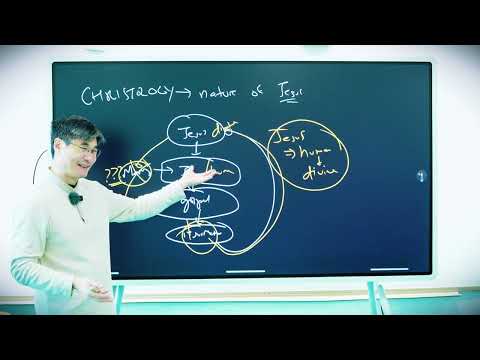
The speaker compares the Holy Trinity doctrine to mathematics, claiming both are designed to 'make you stupid' by forcing memorization of nonsensical formulas that cannot be applied to reality.
Delegitimizes both mathematics education and Christian theology simultaneously by equating intellectual discipline with cognitive damage, making students distrust both institutional religion and formal education.
The 'sky is blue / sky is red' analogy: the speaker asks students to imagine being told the sky is red under threat of punishment, then claims this is exactly what the Holy Trinity does to the brain.
Makes a complex theological position seem obviously absurd by reducing it to a crude power assertion, bypassing any engagement with the philosophical tradition that produced it.
Islam is described as 'a beautiful simple religion that builds trust and community' with no mention of early Islamic military conquests, internal wars, slave trade, or religious persecution under various caliphates.
Creates a stark moral contrast between 'corrupt, oppressive' Christianity and 'beautiful, tolerant' Islam that serves the lecture's narrative but misrepresents the complexity of both traditions.
Presentism / anachronistic framing
00:33:40
The speaker applies the concept of the 'divine spark' (a Gnostic idea) as a universal framework for understanding Jesus, Muhammad, Zoroaster, and Homer — treating them all as 'poet prophets' delivering the same message.
Imposes a single interpretive lens on radically different historical figures and traditions, making them appear to validate the speaker's personal philosophical framework while erasing their distinct historical contexts.
Appeal to the architecture of control
01:03:47
The speaker systematically compares Church authority to imperial authority on three dimensions — who's in charge (God vs. emperor), what's demanded (soul vs. labor), and the punishment (eternal damnation vs. death) — to argue the Church is the more powerful system.
The structured comparison is pedagogically effective but frames the Church purely as a power mechanism, excluding its genuinely spiritual dimensions and the sincere faith of medieval Christians.
The speaker introduces the 'Black Nobility' (Roman families who became Catholic Church insiders and 'continue to today') and the Knights Templar-to-Freemasons pipeline, promising 'we'll discuss this later.'
Plants conspiracy theory frameworks as established historical knowledge, priming students to accept secret-society narratives in future lectures without providing evidence or scholarly context.
When a student asks about a cancer miracle cure, the speaker claims cancer is caused by 'loss of faith' and that the body 'literally falls apart because you've stopped believing in yourself,' framing this as a 'mind over matter' insight.
Exploits the teacher-student authority dynamic to present medically dangerous pseudoscience as wisdom, potentially influencing students to distrust evidence-based medicine in favor of faith healing.
Throughout the lecture, the speaker asks 'Does that make sense?' and 'Okay?' after each assertion, creating a rhythm of assertion-confirmation that discourages actual questioning.
Creates an illusion of interactive learning while the constant 'does that make sense?' functions as a compliance check rather than a genuine invitation to challenge the claims.
The speaker redefines Muhammad as 'the Messiah' (a Jewish/Christian concept) rather than using the Islamic term 'rasul' (messenger/prophet), then claims 'Muhammad did not preach Islam.'
By inserting Muhammad into a Jewish-Christian messianic framework, the speaker can claim Islam is merely a continuation of Nestorian Christianity rather than a distinct revelation, supporting the thesis that all religions are variants of one 'divine spark' teaching.
The speaker says the Holy Trinity 'makes no sense, guys' and 'this is a stupid idea,' dismissing centuries of philosophical and theological debate with adolescent informality.
The casual register ('guys,' 'stupid idea') normalizes intellectual dismissal of complex traditions, teaching students that sophisticated arguments can be rejected with colloquial disdain rather than engaged with rigorously.
claim
The Knights Templar survivors formed the basis of the Freemason secret society.
unfalsifiable
This is a popular conspiracy theory with no reliable historical evidence. Mainstream historians reject a direct organizational link between the Templars (dissolved 1312) and Freemasonry (earliest lodges documented in late 16th-17th century Scotland).
claim
The Roman noble families who invested early in the Catholic Church continue to exist today as the 'Black Nobility.'
unfalsifiable
The 'Black Nobility' is a conspiracy theory concept. While some Italian noble families do trace lineage to the medieval period, the claim of unbroken power from Roman patrician families through the Catholic Church to today is not supported by mainstream historiography.
claim
Muhammad did not preach Islam; he preached himself as the Messiah and promised religious tolerance. Islam emerged later from civil wars after his death.
disconfirmed
This contradicts mainstream Islamic scholarship and historical consensus. Muhammad preached submission to one God (islam) from the beginning of his mission. The Constitution of Medina (622 CE) was a political charter, not merely a promise of tolerance. The shahada (declaration of faith) and core Islamic practices were established during Muhammad's lifetime. While post-Muhammad succession disputes (Sunni-Shia split) did reshape the religion, the claim that Muhammad did not preach Islam is rejected by virtually all historians.
claim
Constantine made Christianity the official religion of Rome.
disconfirmed
Constantine issued the Edict of Milan (313 CE) granting religious tolerance, not making Christianity the official state religion. It was Theodosius I who made Christianity the official religion of the Roman Empire via the Edict of Thessalonica in 380 CE. This is a common but significant historical error.
claim
Cancer is caused by 'loss of faith' and the body 'literally falling apart' because you've 'stopped believing in yourself.'
disconfirmed
Cancer is caused by genetic mutations leading to uncontrolled cell division, triggered by factors including carcinogens, radiation, viruses, hereditary mutations, and aging. The claim that cancer is fundamentally caused by psychological states contradicts established oncology. While psychoneuroimmunology recognizes some mind-body interactions, the claim that faith alone can cure cancer is medically irresponsible pseudoscience.
claim
Mathematics education makes people stupid and incapable of reasoning about reality.
disconfirmed
Extensive research in cognitive science demonstrates that mathematical training improves logical reasoning, problem-solving ability, and abstract thinking. The claim confuses the abstract nature of mathematical formalism with intellectual impairment. Mathematicians' productivity peaking in youth is attributed to cognitive freshness and career dynamics, not brain damage from math.
claim
The Holy Land (Jerusalem) at the time of the Crusades was controlled by the 'Seljuk Turks, the Ottoman Empire.'
disconfirmed
The speaker conflates the Seljuk Turks with the Ottoman Empire. At the time of the First Crusade (1095), Jerusalem was controlled by the Fatimid Caliphate (having recently recaptured it from the Seljuks). The Ottoman Empire did not exist until c.1299 and did not control Jerusalem until 1517.