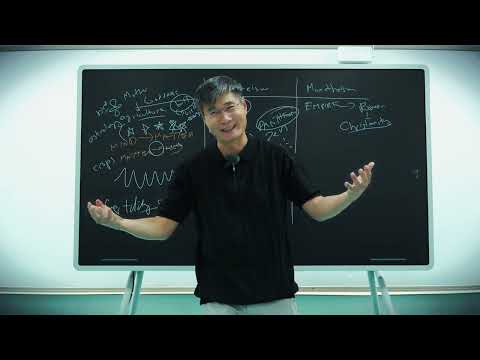
The speaker presents only two possibilities for God's prohibition on the fruit: either God is testing humanity (and would reward disobedience) or God is a false god enslaving humanity. The possibility that the prohibition represents a genuine moral boundary, or that the text operates as allegory, is not considered.
Forces the audience to choose between two options that both lead to the speaker's conclusion — that orthodox Christianity is wrong — while excluding the mainstream theological interpretations that have engaged with this question for centuries.
The mother goddess civilization is described as having 'no property, no hierarchy,' where 'everything belongs to everyone' and people were 'much more creative than we are today,' with abilities 'beyond our imagination.'
Creates an idealized lost paradise that makes the transition to monotheism feel like a fall from grace, priming the audience to view Christianity as destructive rather than constructive.
Rhetorical anaphora ('What kind of god would...')
00:39:54
The speaker uses five consecutive 'What kind of god would...' questions — kick someone out of paradise for eating fruit, kill people for no reason, demand loyalty, enforce his will, play favorites — each answered with 'A monster.'
The rhythmic repetition creates an emotionally overwhelming case against the God of the Bible without allowing the audience time to consider alternative readings. The cumulative effect makes the 'false god' conclusion feel self-evident.
The entire lecture is structured as a revelation of 'what secret societies really believe' versus 'what you're taught officially by the church' and 'what you're taught in university,' positioning the speaker as someone who can see through both religious and academic orthodoxy.
Flatters the audience by making them feel they are being initiated into exclusive knowledge, creating a sense of intellectual distinction that makes them more receptive to claims they might otherwise question.
The speaker reads Genesis 3:22 ('See the man has become like one of us') to argue God was afraid of humans becoming gods, while ignoring the broader narrative context where mortality, suffering, and exile are the consequences of eating the fruit — exactly as God warned.
Makes the Bible appear to contradict itself and support the speaker's Gnostic reading by isolating a single verse from its narrative and theological context.
The speaker mentions 'I took Milton in college. I was an English major at Yale and I took a semester of Paradise Lost' to establish his credentials, then positions himself as seeing deeper than his Yale professors who supposedly taught that 'Satan is lying.'
Establishes academic credentials while simultaneously positioning himself as having transcended academic orthodoxy, giving him the authority of insider knowledge combined with outsider insight.
Pop culture analogy for complex theology
00:35:39
The Nephilim are explained through an extended Avengers analogy: 'Let's just say there's this group of superhumans called the Avengers... Spider-Man, Iron Man, Captain America, Thor... they start to have lots and lots of sex. They have lots and lots of children. And these children now are like demagogues.'
Makes an obscure theological concept immediately accessible to young students, but also trivializes it and makes the audience more likely to accept the premise uncritically because it's been mapped onto a familiar, entertaining framework.
Misrepresentation of mainstream science
00:12:02
The speaker claims that the question of how the brain creates consciousness is 'forbidden to ask in neuroscience' and that neuroscientists' 'response will always be don't ask this question.'
Creates a false impression that modern science is suppressing fundamental questions, which supports the broader narrative that institutional authority (science, church, university) hides truth from ordinary people.
Enthymemic reasoning (unstated premise treated as obvious)
01:02:48
The speaker states 'Satan was telling the truth' as a self-evident conclusion after reading Genesis, treating it as so obvious that it needs no further argument. The unstated premise — that 'you will not die' must mean immediate physical death rather than spiritual death or mortality — goes entirely unexamined.
By treating a contested interpretation as self-evident, the speaker forecloses the audience's ability to consider alternative readings and creates the impression that anyone who disagrees simply hasn't read the text carefully.
The speaker argues that King David probably wrote the Bible because the Davidic covenant elevates him above other figures: 'If you have to guess who wrote the Bible, probably this guy... because he's saying that of these five, I am the best.'
Reduces the Bible to political propaganda by a self-interested author, delegitimizing it as a religious text without engaging with any actual evidence about biblical authorship.
claim
The Nephilim are real beings who still exist today and control the world, with 'the richest people in the world' actually being Nephilim.
unfalsifiable
claim
Christianity was the first monotheistic religion in the world.
disconfirmed
Zoroastrianism (c. 1500-500 BCE), Atenism (c. 1350 BCE), and Judaism (as a practice distinct from Christianity) all predate Christianity. The speaker acknowledges the debate but dismisses it, promising to demonstrate his claim later without doing so in this lecture.
claim
The mother goddess civilization had no property, no hierarchy, no marriage, and communal sex as a religious act.
disconfirmed
This characterization draws on discredited 19th-century anthropological theories (e.g., Bachofen's 'Das Mutterrecht'). Archaeological evidence from Çatalhöyük and other Neolithic sites does not support a universal matriarchal, egalitarian, propertyless stage of civilization. While goddess figurines exist, their interpretation as evidence of matriarchy is contested by mainstream archaeology.
claim
Ancient peoples were 'much more creative than we are today' and could accomplish things 'beyond our imagination' like building the pyramids, which modern people attribute to aliens because 'their mind is beyond our imagination.'
disconfirmed
Pyramid construction methods are well-understood by modern Egyptologists and engineers. Mainstream archaeology does not attribute pyramids to aliens — that is a fringe claim associated with pseudoarchaeology (e.g., Erich von Däniken). The speaker conflates fringe theories with mainstream scientific understanding.
claim
The question of how the brain creates consciousness is 'forbidden to ask in neuroscience' and neuroscientists always respond 'don't ask this question.'
disconfirmed
The hard problem of consciousness is one of the most actively researched and debated topics in neuroscience and philosophy of mind. Major neuroscientists (Giulio Tononi, Christof Koch, Antonio Damasio) have built entire careers studying this question. It is not suppressed or forbidden.
claim
John Milton was a member of secret societies.
unfalsifiable
Reclassified: speculative/conspiratorial claim without empirical testability.
claim
Paradise Lost is 'the foundational text of many secret societies' who 'worship this text.'
unfalsifiable
Reclassified: speculative/conspiratorial claim without empirical testability.
claim
King David probably wrote the Bible because the Davidic covenant favors him above all other figures.
disconfirmed
Biblical scholarship (the Documentary Hypothesis) identifies multiple authors across centuries. The Deuteronomistic History was compiled during the Babylonian Exile (6th century BCE), centuries after David's reign. No serious biblical scholar attributes the Bible to David.
BUILDS ON
- Secret History #4 (referenced as 'last class we discussed how they come into power' — the previous lecture covered how secret societies gain power)
- Earlier Secret History lectures on the mother goddess civilization and polytheistic world (referenced through 'remember' and 'as I explained')
- The speaker references material he plans to cover 'throughout the semester' and 'next class,' suggesting this is part of a sequential curriculum
This lecture is distinctly different from the Geo-Strategy series — it focuses on religious history, esoteric theology, and literary analysis rather than geopolitics. However, it shares the series' pattern of presenting a single interpretive framework as hidden truth suppressed by establishment institutions (here: the church, universities, science). The speaker's authority claim follows the same structure across series: insider credentials (Yale education, strategic analysis training) combined with outsider insight (seeing what institutional authorities miss). The 'Secret History' series appears to be building toward a unified theory connecting secret societies, esoteric knowledge, and modern power structures.