Predictive History Audit / Systematic Content Analysis
Secret History
Episode 8 · Posted 2025-10-11

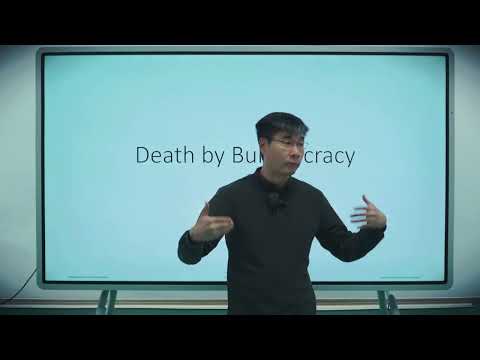
Death by Bureaucracy

This lecture argues that the root cause of campus culture wars, institutional dysfunction, and democratic decline is not parenting, consumerism, or ideology, but the unchecked growth of administrative bureaucracies across all Western institutions. Using the 2015 Yale Halloween costume controversy, the Yale Law School 'trap house' email incident, and the USC professor Greg Patton firing as case studies, the speaker contends that administrators manufacture problems to justify their existence. He supports this with data on administrative bloat in universities (UC San Diego, Swedish higher education, Illinois, Gallaudet), the US military, healthcare, and federal government, then frames the argument through Kafka's The Trial, Hannah Arendt's Origins of Totalitarianism, and James C. Scott's Seeing Like a State. The lecture concludes that all universities are 'a scam' and advises students to pursue self-education rather than higher education.

Video thumbnail
youtube.com/watch?v=hk_yhi3-prw ↗ Analyzed 2026-03-14 by claude-opus-4-6

Viewer Advisory

  • The core observation about administrative bloat is real but massively overgeneralized — administrative growth has legitimate causes alongside rent-seeking.
  • The extension of Arendt's totalitarianism framework to all bureaucracies is the speaker's own invention and is explicitly acknowledged as not something Arendt argued.
  • The 'all universities are a scam' conclusion ignores extensive evidence on the economic returns to higher education.
  • The conspiratorial elements (fake alien invasions, deliberate civil wars, AI mind control) should be treated as red flags about the speaker's analytical framework.
  • The lecture applies its critical framework exclusively to Western institutions while leaving Chinese bureaucracy, government corruption, and educational dysfunction completely unexamined — a significant bias given the speaker is addressing Chinese students.
  • The gold-denominated stock argument, while containing a grain of truth about monetary policy, does not prove that 'all wealth is a lie created by bureaucrats.'.
  • The speaker's pedagogical advice — that students should skip university entirely — contradicts his own career path and is delivered without acknowledgment of the economic risks of foregoing higher education credentials.
Central Thesis

Modern institutions — universities, governments, militaries, and healthcare systems — have been captured by parasitic administrative bureaucracies that produce no real work, extract wealth from productive workers, manufacture problems to justify their existence, and are driving Western civilization toward collapse.

  • The Yale Halloween controversy and similar campus incidents are best explained not by parenting, consumerism, or ideology, but by the self-interest of a bloated administrative class that needs to create problems to justify its existence.
  • University administrative staff have grown dramatically while teaching faculty have stagnated or declined, with administrators now earning salaries far exceeding those of professors.
  • The US military has become bureaucratically bloated, with the officer-to-soldier ratio declining from 1:14 in the Civil War to 1:4 today, and four-star generals increasing from 7 (with 12 million soldiers in WWII) to 40 (with 1.2 million soldiers today).
  • Healthcare costs in America are unaffordable not because of quality but because of massive administrative bloat, with insurance companies systematically denying claims as a profit strategy.
  • Kafka's The Trial, Arendt's Origins of Totalitarianism, and Scott's Seeing Like a State all illuminate how bureaucracies become self-serving, detached from reality, and ultimately destructive to the societies they govern.
  • All bureaucracies tend toward totalitarianism because they share three characteristics with totalitarian regimes: removal from reality, logic of expansion, and defiance of reality.
  • The over-bureaucratization of society has led to quiet quitting, democratic decline, and the illusion of prosperity (stock market gains that disappear when priced in gold).
  • Universities are 'all a scam' regardless of prestige or major, and students should pursue self-education instead.
Qualitative Scorecard 2.3 / 5.0 average across 7 axes
Historical Accuracy ▸ Expand
The specific incidents cited (Yale Halloween 2015, Yale Law School trap house, USC Greg Patton) are real events described broadly correctly. The data on administrative bloat in universities is consistent with well-documented trends (e.g., Benjamin Ginsberg's 'The Fall of the Faculty'). The WWII-era statistics on generals (7 four-star generals for 12 million soldiers vs. ~40 for 1.2 million today) are approximately correct. However, the speaker makes some misleading claims: Greg Patton was not permanently 'fired' — he was temporarily removed from that one class and reinstated; the name 'Silleon/Sillein' is actually 'Silliman College'; Erica 'Kakus/Kustakis' is Erica Christakis; the claim that the Stratford University case exemplifies a widespread pattern conflates one fraud case with systemic corruption. The presentation of bureaucratic growth data, while directionally correct, lacks the nuance of proper attribution and context.
3
Argumentative Rigor ▸ Expand
The lecture commits several logical fallacies. The central argument — that bureaucratic bloat explains campus culture wars, economic stagnation, military inefficiency, healthcare costs, democratic decline, and essentially all institutional dysfunction — is a monocausal explanation for extraordinarily complex phenomena. The leap from 'administrators have grown in number' to 'they are parasites who deliberately manufacture problems' is not supported by evidence, only by assertion and anecdote (the personal park story). The extension of Arendt's totalitarianism framework to all bureaucracies is explicitly acknowledged as not something Arendt herself argues, yet is presented as self-evident. The claim that university is 'all a scam' regardless of institution or major ignores extensive evidence on the economic returns to education. The gold-denominated stock argument, while containing a kernel of truth about monetary policy, is presented as proof that 'we are living in a lie created by bureaucrats' — an enormous interpretive leap.
2
Framing & Selectivity ▸ Expand
The lecture is highly selective in its evidence. Administrative bloat is real, but the speaker presents only data that supports his thesis while ignoring countervailing evidence: legitimate reasons for administrative growth (regulatory compliance, expanded student services, research administration), successful reform examples, and the continued economic value of education. The anecdotes are chosen for maximum emotional impact — the USC professor case, the Stratford University fraud — but are presented as typical rather than exceptional. The healthcare discussion frames all administrators as parasites without acknowledging the genuine complexity of healthcare administration (billing, compliance, quality assurance). The Q&A section is notable: when a student asks 'are there any good sides?' the answer redirects to the thesis rather than genuinely engaging with counterarguments.
2
Perspective Diversity ▸ Expand
The lecture presents a single analytical lens throughout: bureaucrats are parasites, institutions exist to serve administrators, and the system is irredeemable. No alternative perspectives are seriously entertained. The three 'standard explanations' for campus culture (parenting, consumerism, ideology) are introduced only to be dismissed in favor of the speaker's preferred explanation. No voice speaks for administrators, policymakers, or institutional leaders. The student questions are engaged with, but the answers consistently reinforce the thesis without acknowledging legitimate complexity. The speaker explicitly dismisses all counterarguments: 'It's all a scam. Doesn't matter what university you go to... doesn't matter what your major is... it's all a scam.'
2
Normative Loading ▸ Expand
The lecture is heavily loaded with normative language presented as descriptive analysis. Administrators are called 'parasites' who 'steal,' do 'absolutely no work,' and 'screw over' patients. Universities are a 'complete ripoff' and 'all a scam.' The wealthy 'always win in the court system.' Society is 'living in a lie' and 'a fairy land created by bureaucrats to fool us.' Bureaucrats' mentality is compared to those who would 'rather send you to war and kill you off than lose their jobs.' The fake alien invasion comment, while perhaps intended as humor, reveals the conspiratorial undertone of the analysis. The emotional language consistently replaces measured analysis.
2
Determinism vs. Contingency ▸ Expand
The lecture presents bureaucratic capture as an inevitable, irreversible process. Once an institution achieves success, bureaucratic rot inevitably follows. 'There's nothing we can do about it' is stated explicitly. The only solution offered is societal collapse and regeneration — an extremely deterministic framework. No contingency is acknowledged: no reform can work, no institution can resist, no major or university type escapes. The Arendt framework is extended to argue that all bureaucracies inherently tend toward totalitarianism. The speaker acknowledges no historical examples of successful institutional reform, bureaucratic pruning, or organizational renewal.
2
Civilizational Framing ▸ Expand
The lecture focuses primarily on American and Western institutional decay, with some acknowledgment that 'it's not just America' and the problem extends globally. China is briefly mentioned in connection with quiet quitting ('tangping' and 'bailan') and manufacturing job offshoring, but is not subjected to the same critical analysis of bureaucratic bloat. The speaker teaches at what appears to be a Chinese school ('Moonshot') and addresses Chinese students, but does not apply his framework to Chinese institutions, government, or education system.
3
Overall Average
2.3
Civilizational Treatment
CHINA

China is mentioned only tangentially: as the destination for offshored manufacturing jobs, and as having its own version of quiet quitting (tangping/bailan). The Chinese educational word 'nàge' is used in the USC incident. No analysis of Chinese bureaucratic bloat, government corruption, or educational system dysfunction is offered — a notable omission given the speaker is teaching Chinese students and China has one of the world's largest government bureaucracies.

UNITED STATES

The United States is the primary subject of criticism. Its universities, military, healthcare system, government, and financial system are all characterized as captured by parasitic bureaucrats. American institutions are portrayed as irredeemably corrupt, with administrators described as thieves and the entire higher education system dismissed as 'a scam.' The American military is characterized as bloated with generals enjoying luxury while veterans go hungry.

THE WEST

The West broadly is implicated in bureaucratic decay — 'it's true for every major organization in America and in the western world and arguably all around the world.' Swedish university data is presented to show the problem extends beyond America. However, the critical analysis is overwhelmingly focused on American and Western institutions, with no comparable scrutiny applied to non-Western bureaucracies.

Named Sources

book
Franz Kafka, The Trial
Used to illustrate how bureaucracies arrest innocent people and wage pointless prosecutions to justify their existence. The quote about institutions becoming 'deeply corrupt when everything is devoid of meaning' is presented as a diagnosis of modern bureaucracy.
✓ Accurate
book
Hannah Arendt, The Origins of Totalitarianism
Her three characteristics of totalitarian regimes (removed from reality, logic of expansion/movement, defiance of reality) are presented and then extended — by the speaker, not by Arendt — to argue that all bureaucracies tend toward totalitarianism.
? Unverified
book
James C. Scott, Seeing Like a State
Used to argue that governments create more problems than they solve through four mechanisms: administrative ordering of nature/society, high-modernist ideology, authoritarianism suppressing civil society, and weak civil society unable to resist. The German forestry and Tanzanian forced collectivization examples are drawn from this book.
✓ Accurate
other
Raymond DuBois (Pentagon official)
Cited on the perks of four-star generals, specifically that each has a personal G5 aircraft costing $50-60 million.
? Unverified
media
CNN report on Greg Patton / USC incident
Used as evidence of bureaucratic overreach: a professor was fired for using the Chinese filler word 'nàge' (那个) which phonetically resembles an English racial slur.
? Unverified
paper
Swedish higher education study
Referenced as showing bureaucratic bloat in Swedish universities — teachers teaching more students while administrators manage fewer, with manager numbers and pay increasing while teacher and secretary numbers and pay decline.
? Unverified
data
UC San Diego enrollment and staffing data
Charts showing slight increase in student enrollment but massive increase in senior management, deans, administrators, and managers — presented as evidence of rent-seeking behavior.
? Unverified
data
UnitedHealthcare claims denial data
Cited as showing ~32% claim denial rate, presented as evidence that healthcare administrators systematically exploit patients for profit.
? Unverified

Vague Appeals to Authority

  • 'Experts estimate that democracy, the capacity for people to participate in politics, has declined rapidly these past 10 years' — no specific experts, indices, or studies named.
  • 'More and more universities are going bankrupt' — presented as a trend without specific data beyond the Stratford University example.
  • 'In America, the rich always wins in the court system' — presented as a universal truth without qualification or sourcing.
  • 'Only 10% of people in United States control most of the stocks, over 90% of the stocks' — approximate figure stated without source (actual Federal Reserve data shows top 10% own ~93% of stocks, so roughly accurate but unsourced).

Notable Omissions

  • No engagement with the substantial literature defending the value of higher education (e.g., research on wage premiums, Claudia Goldin's work on education and inequality, Bryan Caplan's The Case Against Education which makes a more nuanced version of the speaker's argument).
  • No discussion of why administrative positions have grown — legitimate factors include compliance requirements (Title IX, ADA, accreditation), student services demand, research administration, and technology management.
  • No comparison with non-Western bureaucracies. China's government bureaucracy, for instance, is massive and growing, with well-documented corruption and administrative bloat, but is never mentioned despite the speaker teaching Chinese students.
  • No engagement with Max Weber's foundational sociology of bureaucracy, which argues bureaucracy is essential to modern governance despite its pathologies.
  • No discussion of successful bureaucratic reform efforts or counter-examples (e.g., Purdue University under Mitch Daniels freezing tuition, or countries that have successfully reduced administrative bloat).
  • No acknowledgment that some administrative growth correlates with expanding access to higher education for underrepresented groups.
  • The Erica Christakis case outcome is not mentioned — both she and her husband voluntarily left their positions, which could be interpreted as either bureaucratic victory or principled resignation.
Anecdotal evidence as proof 00:39:01
The speaker tells a personal story about police in Toronto insisting on taking his son to the hospital while ignoring a nearby fight, as proof that bureaucrats 'always think of ways to justify their existence but not do real work.'
Transforms a single personal anecdote into a universal principle about bureaucratic behavior. The story is emotionally compelling but proves nothing about systemic institutional dynamics.
Monocausal reduction 00:11:14
Three explanations for campus culture wars (parenting, consumerism, ideology) are introduced and dismissed in favor of bureaucratic bloat as the single 'much more compelling' explanation.
Creates the appearance of considering multiple viewpoints while actually funneling the audience toward a predetermined conclusion. The dismissed explanations are not actually refuted, just set aside.
Data cascade 00:20:55
A rapid succession of charts and statistics from UC San Diego, Swedish universities, Illinois, Gallaudet, US military, federal government, and healthcare are presented one after another with minimal context.
The volume of data creates an overwhelming impression of evidence, even though each data point is presented without context, sourcing, or counter-interpretation. The audience is meant to be convinced by quantity rather than quality of evidence.
Escalating hyperbole 00:11:29
From 'universities have become bureaucracies' to 'all organizations' to 'all governments tend toward totalitarianism' to 'university is all a scam' to 'society has to collapse' — each claim more extreme than the last.
Gradually shifts the Overton window so that by the lecture's end, the most extreme conclusions feel like natural extensions of earlier, more moderate claims that the audience already accepted.
Appeal to personal authority 00:08:55
The speaker repeatedly invokes his Yale education and personal experience — 'when I was growing up,' 'when I went to Yale a long time ago' — to establish credibility for his critique of elite institutions.
Positions the speaker as an insider critic with special knowledge, making his sweeping condemnation of universities more credible than it would be from an outsider.
Kafkatrap framing 00:57:14
When a student asks whether the situation can be reversed, the speaker says 'they have all the power' and 'there's nothing we can do about it,' then when asked about hope, redirects to 'society has to collapse first.'
Creates a closed logical system where any attempt to work within institutions proves you're being exploited, and any reform attempt is doomed because 'they have all the power.' Only total system collapse is presented as a path forward.
False equivalence via literary analogy 00:43:31
Arendt's framework for analyzing Nazi Germany and Stalinist Soviet Union — totalitarian regimes that killed tens of millions — is extended to describe university administration and modern government bureaucracy.
By applying the same analytical framework to both genocidal regimes and university deans, the lecture implicitly equates bureaucratic bloat with totalitarian evil, dramatically inflating the severity of the problem.
Conspiratorial escalation 01:00:08
When asked how bureaucrats maintain power, the speaker lists: 'they can create civil wars... they can use AI to control you... they can fake an alien invasion... they can send you to war.'
Shifts the lecture from data-driven institutional critique into conspiratorial territory, suggesting that elites deliberately engineer social conflict, technological control, and even fabricated alien invasions to maintain power.
Rhetorical absolutism 01:02:39
'It's all a scam. Doesn't matter what university you go to, liberal arts, Ivy League, state, it's all a scam. Doesn't matter what your major is... it's all a scam.'
Eliminates all nuance by making the most extreme version of the claim. This rhetorical move forecloses any student's attempt to find exceptions or qualifications, presenting a binary worldview where all higher education is valueless.
Socratic misdirection 00:45:01
The speaker asks a student 'who are you?' then cuts off the student's self-introduction to declare 'the correct answer is you're a teenage boy' — illustrating how states classify people.
Creates a dramatic pedagogical moment that makes the abstract concept of state legibility viscerally personal, while simultaneously modeling the very authoritarian dynamic the speaker criticizes — telling a student what the 'correct' answer to an identity question is.
⏵ 00:11:44
Universities have become bureaucracies that exist in order to promote the interests of the administrators who want to sit in their office, get a really big salary and feel good about themselves.
Encapsulates the lecture's central thesis in a single sentence. Reduces all institutional complexity to administrator self-interest.
This critique of self-serving institutional bureaucracy could apply equally to China's massive government apparatus, the CCP's administrative system, or Chinese state-run universities — none of which the speaker addresses despite teaching Chinese students at a Chinese school.
⏵ 00:16:13
Bureaucrats go make problems for everyone in order to create solutions for everyone.
A pithy formulation of the lecture's core mechanism — bureaucrats as problem-manufacturers rather than problem-solvers.
⏵ 00:28:38
In America, the rich always wins in the court system. So whoever is able to hire the best lawyers always wins out.
Reveals the speaker's sweeping characterization of American institutions as irredeemably corrupt. Stated as absolute fact without qualification.
China's legal system is widely documented as even more captured by state and elite interests, with the CCP explicitly asserting control over the judiciary and no independent rule of law. The speaker's critique of American justice would apply far more acutely to the system under which his students live.
⏵ 00:31:51
In World War II America had about 12 million soldiers. They had seven generals who are four-star. Today America has about 1.2 million soldiers. They have 40 four-star generals.
One of the lecture's strongest empirical claims — a genuinely striking statistical comparison that effectively illustrates military bureaucratic bloat.
⏵ 00:53:36
We are living in a lie. All this wealth generation, it's all a lie. It's not real. We're living in a fairy land created by bureaucrats to fool us.
Crosses from institutional critique into conspiratorial framing — the entire economic system is dismissed as a deliberate deception by bureaucrats. This is a significant escalation from 'administrators are overpaid' to 'reality itself is fake.'
China's GDP figures are widely suspected of being inflated by bureaucrats — Rhodium Group estimates real GDP growth at ~2.5-3% versus official ~5%. The problem of bureaucrats constructing misleading economic narratives applies at least as strongly to China's state-managed statistics.
⏵ 00:43:29
What she does not say in the book is that these three can apply to all bureaucracies. All governments, meaning that over time all governments, all bureaucracies will tend towards totalitarianism.
The speaker explicitly acknowledges extending Arendt's framework beyond her own argument, then presents this extension as self-evident. This is the lecture's most theoretically ambitious — and most unsupported — claim.
The claim that all bureaucracies tend toward totalitarianism would apply most obviously to China's one-party state, which already exhibits the characteristics described (removed from reality, logic of expansion, defiance of reality in e.g. COVID statistics, Xinjiang policies). The speaker never applies this framework to the political system of his audience's home country.
⏵ 01:02:39
It's all a scam. Doesn't matter what university you go to, liberal arts, Ivy League, state, it's all a scam. Doesn't matter what your major is, economics, psychology, humanities, computer science, it's all a scam.
The lecture's most extreme conclusion — delivered to students who are presumably preparing for university applications. The repetition of 'it's all a scam' five times in 30 seconds reveals the speaker's pedagogical approach: conviction through assertion rather than evidence.
⏵ 01:00:16
They can create civil wars where the left and the right fight each other and they're left alone. Or they can use AI to control you. Or they can fake an alien invasion.
Marks the lecture's most conspiratorial moment, suggesting that elites deliberately engineer social conflict, use AI for population control, and might fabricate extraterrestrial threats to maintain power.
⏵ 00:37:53
Its purpose is to arrest innocent people and wage pointless prosecutions against them. How are we to avoid those in office becoming deeply corrupt when everything is devoid of meaning?
Kafka quote deployed to frame bureaucratic dysfunction as existential corruption. The speaker uses literary authority to elevate institutional critique to philosophical diagnosis.
The description of a system that 'arrests innocent people and wages pointless prosecutions' more precisely describes China's treatment of Uyghurs, Hong Kong democracy activists, and human rights lawyers than it does American or Western university administration.
⏵ 00:57:45
These are parasites and there's nothing we can do about it.
Reveals the lecture's ultimately fatalistic worldview — institutional capture is not merely a problem to be solved but a terminal condition. This fatalism, delivered to teenagers, is pedagogically irresponsible.
prediction Many universities will go bankrupt over the next 5-10 years in America due to administrative bloat and managerial theft.
00:28:54 · Falsifiable
untested
Some university closures have occurred but the predicted wave of bankruptcies has not yet materialized at the scale implied. Timeframe extends to 2030-2035.
prediction Society has to collapse before it can regenerate or rejuvenate, because the bureaucratic elite will use every trick (civil wars, AI control, fake alien invasions, pointless wars) to maintain their power.
01:00:00 · Not falsifiable
unfalsifiable
claim All universities — regardless of type, prestige, or major — are a scam that exist to enrich administrators.
01:02:39 · Not falsifiable
unfalsifiable
This is a normative judgment, not a falsifiable empirical claim. While administrative bloat is well-documented, the blanket claim that all higher education is valueless is not empirically testable.
claim Democracy and people's capacity to participate in and influence politics has declined rapidly over the past 10 years.
00:55:29 · Falsifiable
partially confirmed
Multiple democracy indices (V-Dem, Freedom House, EIU) show democratic backsliding globally, though the causes are more complex than bureaucratic capture alone.
claim The stock market's apparent growth is illusory — when priced in gold, stocks have declined, meaning perceived wealth is a lie created by bureaucrats to fool citizens.
00:53:31 · Falsifiable
partially confirmed
The S&P 500 priced in gold has indeed underperformed nominal terms at various periods, but the claim that this proves wealth is 'all a lie created by bureaucrats' is a massive interpretive leap. Gold-denominated stock performance is a legitimate metric but does not prove the conspiratorial framing.
Verdict

Strengths

The lecture addresses a genuine and well-documented phenomenon: administrative bloat in American higher education and government. The statistical comparisons — such as WWII-era military having 7 four-star generals for 12 million soldiers versus today's 40 for 1.2 million — are striking and broadly accurate. The use of serious intellectual sources (Kafka, Arendt, James C. Scott) elevates the discussion beyond mere polemic, and Scott's Seeing Like a State is genuinely relevant and well-summarized. The Yale incidents are real and do raise legitimate questions about the role of administrators in campus culture. The speaker's willingness to engage with student questions shows genuine pedagogical commitment.

Weaknesses

The lecture suffers from severe monocausal reasoning, attributing virtually all institutional dysfunction to a single factor (bureaucratic self-interest) while ignoring legitimate drivers of administrative growth (regulatory compliance, expanded access, research complexity). The escalation from documented administrative bloat to 'all universities are a scam' to 'bureaucrats fake alien invasions' represents a dramatic decline in analytical rigor. Hannah Arendt's framework for analyzing Nazi Germany and Stalinist Russia is recklessly extended to university administration without any justification. The lecture's fatalism ('there's nothing we can do about it,' 'society has to collapse') is both unsupported and irresponsible when delivered to teenagers making educational decisions. The conspiratorial elements (fake alien invasions, AI control, deliberate civil wars) undermine the lecture's credibility. Most critically, the speaker never applies his analytical framework to non-Western bureaucracies, particularly China's — a glaring omission given his audience.

Cross-References

BUILDS ON

  • The lecture references earlier Secret History lectures ('as I told you in this class') and appears to build on a broader curriculum about institutional dysfunction, presumably including earlier episodes on related topics.
  • The speaker mentions having discussed the Yale incident and related themes in previous sessions, suggesting this is a continuation of a series-long argument about Western institutional decline.
  • References to 'Moonshot' school suggest the lecture is delivered in a Chinese educational context, connecting to the speaker's broader project of educating Chinese students about Western decline.

CONTRADICTS

  • The blanket claim that all universities are 'a scam' and all education is worthless contradicts the speaker's own position — he is employed as a teacher and derives his authority from his Yale education, creating a performative contradiction.
This lecture fits the Predictive History channel's recurring pattern of diagnosing Western/American institutional decay while leaving Chinese institutions unexamined. The focus on bureaucratic bloat in American universities, military, healthcare, and government, delivered to Chinese students, functions as a comprehensive indictment of Western civilization without any comparative framework. The speaker's willingness to make absolute claims ('all a scam,' 'nothing we can do') and venture into conspiratorial territory ('fake alien invasion') represents an escalation from data-driven analysis to ideological conviction. The lecture also continues a pattern of the speaker using his personal biography (Yale alumnus) as both credential and cautionary tale.